Procurement Market Intelligence Report
Agricultural Tractors
Sourcing Guide & Market Intelligence
Smarter cost management starts with comprehensive market intelligence
 United States
 Global
Quick Navigation
Agricultural Tractors Global Overview
Definition
Summary
Agricultural tractors are high-torque, heavy-duty vehicles commonly used on farms. Agricultural tractors are used in various activities, including plowing, tilling, planting, disking, and harrowing. Tractors are also used to pull different types of equipment, such as forage equipment and hay tools. Agricultural tractors are typically used within the confines of a farm or other agricultural establishment but can also be driven on public roads. Agricultural tractors are produced by industrial equipment manufacturers of various sizes and sold to buyers through a network of authorized dealers. Common buyers include individuals and businesses operating in the agricultural sector. Key buyers include farmers, agricultural businesses, large agribusiness corporations, and agricultural machinery rental companies
This Report Includes:
- Utility Tractors
- Farm Tractors
Not in this Report:
- Tow Tractors
- Non-Agricultural Heavy Vehicles
Global Agricultural Tractors Procurement Trends
Discover the top international trends affecting procurement in the global Agricultural Tractors market.
Warning Trends
Tariffs to negatively impact the commercial vehicles and components sector
- In June, the Trump Administration implemented 25.0% tariffs on all automobile and automobile parts imported into the United States, except for those imported from the United Kingdom, which face a reduced 10.0% tariff rate. Additionally, the administration raised tariffs on the import of aluminum, copper, and steel to 50.0%, all vital inputs for automotive manufacturing, and raised the tariffs on heavy trucks made outside the United States to 25.0%.
- In 2024, the value of automotive imports totaled $388.9 billion, which accounted for over a quarter of the total US automotive market revenue that year. Thus, these tariffs are likely to significantly increase the cost of motor vehicles, parts, and maintenance services, as both foreign manufacturers and domestic manufacturers with foreign sub-suppliers face higher import costs.
- According to the US International Trade Commission, Mexico and Canada account for 47.4% of motor vehicle imports to the United States, and 54.1% of motor vehicles bodies and parts. According to Anderson Economic Group (AEG), a Michigan-based economic consultancy, the broad-based 25.0% tariff could raise new car prices by $1,000 to $4,000, and up to $10,000 if manufacturers are unable to mitigate the tariff’s impact.
- Germany is a major exporter of crane trucks, vehicles, vehicle seating and interior trim, and other components in the sector. The higher automotive and metals tariffs will mean that many German companies, even those operating in the United States, will face higher costs to import subcomponents to their facilities in the United States.
- According to Telemetry Insights, many auto parts suppliers will be unable to absorb the tariffs or adjust to mitigate the tariff impact (e.g., relocating their facilities or splitting efforts across three countries). The introduction of 50.0% metals tariffs could drive up production costs further.
Fed lowers rates for the first time in 2025
- On September 17, the Federal Reserve’s Federal Open Market Committee (FOMC) voted to lower interest rates to a target range of 4.0% to 4.25%, down 0.25% from the rate it had been holding since November of last year.
- Despite indications at the start of the year that steady reductions to the relatively high 4.25% to 4.5% rate were on the horizon, the Fed held off on rate cuts for much of the year due to concerns that the combination of higher tariffs and a reduction in borrowing costs could cause rebounding inflation.
- The September cut to Fed interest rates signals a shift in this strategy, indicating that the Fed now considers weakening employment figures a greater threat than inflation. As a result, FOMC officials have also signaled that two additional rate cuts are likely before the end of the year in an effort to fight unemployment and stimulate the economy.
- Declining Fed funds rates will provide relief to borrowers by lowering the market interest rates for consumer and business loans. This reduction in the cost of borrowing will reduce the cost of many banking and financial services, and may spur increases in demand across the economy.
United States announces new tariffs on all imported steel
- In February 2025, the United States announced 25.0% tariffs on all imported steel with no exemptions or exceptions. The tariffs took effect on March 12, 2025. On June 4th, these tariffs were increased further to 50%. These tariffs were not impacted by a recent court decision that temporarily suspended duties on certain goods as they were implemented under Section 232 of the Trade Expansion Act.
- Previously, countries such as Canada, Mexico, and Brazil, the top exporters of steel to the United States, had exemptions from tariffs. These have now been removed and all imported steel, regardless of origin, will be subject to the 50.0% tariff. However, on May 8th, the US announced an agreement with the United Kingdom to remove all levies on steel exported from the UK.
- Due to these tariff increases, the Yale Budget Lab forecasts a 32.9% increase in US metals prices, translating to an estimated 12.7% increase in average tractor prices.
Global Agricultural Tractors Market - Suppliers by Region
| Country/Region | Number of Suppliers |
|---|---|
| #1 China | 9,510 |
| #2 Europe | 9,125 |
| #3 United States | 3,440 |
Explore supplier concentration across the globe
We've uncovered the 11 top regions for global procurement, based on feedback from our most strategic clients. Access vendor counts for each unique region when you subscribe.
2
Geography Drilldown - US
Average Cost of Agricultural Tractors
United States
2026 Market Pricing$9,000.00 to $XXX,XXX.XX
per tractorAverage Price
Prices in the Agricultural Tractors market range from $9,000.00 to $XXX,XXX.XX, depending on Horsepower, Size, Technology, Age and Hours of Previous Use. For example, lower prices are associated with Low horsepower tractors (50-100 HP) ($30,000 to $350,000 per tractor), whereas higher prices are associated with High horsepower tractors (250-400 HP) ($200,000 to $650,000 per tractor).
Need the scoop on international price trends?
Between our Europe and Canada collections, we provide price data for 350 markets so you can instantly compare prices across borders. Or, use our custom research services for intel on prices in any region across the globe.
Agricultural Tractors Category Price Trends
Pricing trends are indicated by the compound annual growth rate (CAGR) during a set period of time. For the Agricultural Tractors market, prices in the US have grown 2.6% from 2022 to 2025. Subscribers can access price trend forecasts, price driver projections and forward-looking cost structure data. Learn more
United States (2022-2025)


Wondering where prices are heading?
Price trend forecasts are available to subscribers, along with price driver projections and forward-looking cost structure data.
Cost Analysis - Total Cost of Ownership for Agricultural Tractors
Total cost of ownership is Low in the Agricultural Tractors market. The average cost of ownership differs depending on the contract but generally includes costs negotiated before the contract begins, costs billed during the contract period and unforeseen costs. For example, unforeseen costs in the form of Downtime may raise the total cost of ownership unexpectedly.
Billed During
Repairs
Fuel
Depreciation
Unforeseen
Downtime
Buyer Power in Procurement Negotiations
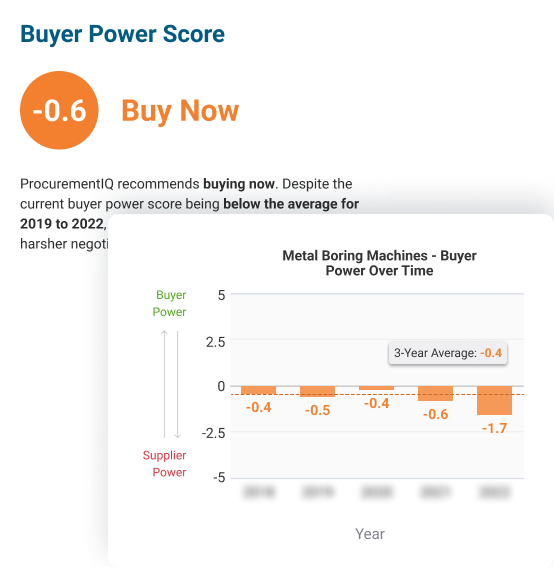
In 2026, buyer power amounts to -3.4 in the United States. Buyer power is most positively impacted by Recent Developments. It is most negatively impacted by Product Specialization. Subscribers can access details on eight other factors that impact buyer power. Learn more
United States
Buyer power forecasts: your glimpse into the future
Develop strategies for the upcoming year and identify unforeseen opportunities for buying now
- Actionable "Buy Now" and "Buy Later" insights
- Near-real-time updates to current and forecast Buyer Power Scores
- Methodology and weightings for Buyer Power Score Components
Supply Chain Risk
The average level of supply chain risk is assessed as High, which has a negative impact on buyer power. The level of supply chain risk is affected by industry volatility, barriers to entry, competition, import penetration, regulation and industry financial risk. Buyers in this market can mitigate procurement and supply chain management risks by monitoring risk levels for individual first and second tier suppliers:
1st
Tier Suppliers
- Engine & Turbine Manufacturers
- Ferrous Metal Foundry Products
- Tire Wholesalers
- Circuit Board & Electronic Component Manufacturers
2nd
Tier Suppliers
- Metalworking Machinery Manufacturers
- Iron & Steel Manufacturers
- Tire Manufacturers
- Semiconductor & Circuit Manufacturers
Biggest Agricultural Tractors Suppliers in the US by Revenue
The largest Agricultural Tractors vendors by revenue in the US are Tong Yang Moolsan Co. Ltd., Argo Tractors SpA and SDF SpA. Subscribers can sort and filter by market share concentration, profit level and other factors. Learn more
| Supplier | Operational Size | Headquarters | Number of Employees | Market Share (%) | Market Share Performance (3yr trend) | Total Revenue ($ million) | Profit Level (%) | Risk Level |
|---|---|---|---|---|---|---|---|---|
| Cnh Global N V | Global | BASILDON, ESSEX | >10,000 | 15-20 | ||||
| Deere & Co | National | MOLINE, IL | >10,000 | 25+ | ||||
| Agco Corp | Global | DULUTH, GA | >10,000 | 5-10 | ||||
| Mahindra & Mahindra Ltd. | Global | Mumbai, IN | >10,001 | < 5 | ||||
| Caterpillar Inc. | Global | IRVING, IL | >10,000 | < 5 | ||||
| Daedong Industrial Co. Ltd. | International | Daegu, KR | 501-1,000 | < 5 | ||||
| J.C. Bamford Excavators Ltd. | Global | Rocester, UK | >10,000 | < 5 | ||||
| Argo Tractors SpA | Global | Fabbrico RE, IT | 1,001-10,000 | < 5 | ||||
| SDF SpA | US | < 5 | ||||||
Looking for a list of suppliers by country?
Subscribers can access vendor information on Canadian and European suppliers, too. We also offer custom research services to help with vendor sourcing anywhere in the world.
Profit Analysis
The average profit margin across vendors in the Agricultural Tractors market is 4.0% and steady. Profit levels shift depending on suppliers' spend on wages, purchases and overhead. The highest cost component for vendors is Purchases. The cost trend for this component is falling, when considering movement between 2025 and 2026. To understand cost forecasts for 2027 and uncover the implications on profit, start your subscription. Learn more
Vendor & Supply Chain Analysis
The agricultural tractors market is highly concentrated, as evidenced by the commanding presence of Deer & Company, CNH Industrial, AGCO and Mahindra, which together account for close to three-quarters of market sales. High market share concentration gives tractor manufacturers significant pricing power; however, buyers often interact with dealers and wholesalers that may be more flexible with pricing to compete with other dealerships.
Due to the market's reliance on materials such as steel and semiconductors that tend to fluctuate in price and availability, supply chain risk is high. This risk level is heightened by tariff increases and uncertainty surrounding future tariff policy shifts.
Due to low average profit and unstable input prices, average vendor risk is moderate in this market.
The United States is a net exporter of tractors, meaning buyers benefit from high access to domestically produced tractors, which can reduce supply chain risk.
Supplier Information
Cnh Global N V
Cnh Global N V is a public company operating globally in the manufacturing sector. The company's offerings include harvesting machines, front-end loaders, motor graders, bulldozers, excavators. Founded in 1842, the company is currently headquartered in Basildon, United Kingdom with an estimated employee count... Subscribe to learn more
Deere & Co
Deere & Co is a public company operating nationally in the manufacturing and wholesale trade sectors. The company's offerings include soil preparation machinery, planting & seeding machinery, harvesting machines, agricultural dispersing & spraying equipment, forestry & logging equipment. Founded in 1837, Subscribe to learn more
Agco Corp
AGCO Corp./DE/ is a global manufacturer and distributor of agricultural equipment and related replacement parts. It offers tractors, combines, self-propelled sprayers, hay tools, forage equipment, seeding and tillage, implements, grain storage, and protein production systems under the Challenger®, Fendt®,... Subscribe to learn more
Argo Tractors SpA
Argo Tractors SpA is a private company operating globally in the manufacturing sector. The company's offerings include agricultural tractors. Founded in 1996, the company is currently headquartered in Fabbrico RE, Aarhus, Italy with an estimated 5500 employees. Subscribe to learn more
Caterpillar Inc.
Caterpillar Inc. is a public company operating globally in the manufacturing, manufacturing, manufacturing, wholesale trade, real estate and rental and leasing and other services (except public administration) sectors. The company's offerings include antifreeze, drilling & exploration equipment, drilling Subscribe to learn more
Daedong Industrial Co. Ltd.
Daedong Industrial Co. Ltd. is a private company operating internationally in the manufacturing sector. The company's offerings include agricultural tractors. Founded in 1993, the company is currently headquartered in Daegu, Gyeonggi, South Korea with an estimated 750 employees. Subscribe to learn more
J.C. Bamford Excavators Ltd.
J.C. Bamford Excavators Ltd. is a private company operating globally in the manufacturing sector. The company's offerings include paving equipment and agricultural tractors. Founded in 1945, the company is currently headquartered in Rocester, Staffordshire, United Kingdom with an estimated 10000 employees.... Subscribe to learn more
Mahindra & Mahindra Ltd.
Mahindra & Mahindra Ltd. is a public company operating globally in the manufacturing sector. The company's offerings include soil preparation machinery, agricultural dispersing & spraying equipment and agricultural tractors. Founded in 1945, the company is currently headquartered in Mumbai, Maharashtra, India... Subscribe to learn more
SDF SpA
SDF SpA is a private company operating in the manufacturing sector. The company's offerings include agricultural tractors. Founded in 2013, the company is currently headquartered in United States of America. Subscribe to learn more
Accelerate the vendor selection process
Get a clear picture of the competition in a market and discover which vendors are best-suited for your sourcing needs. Our supplier profiles include hard-to-find financial ranges for private companies, cover public company data and feature an interactive competitor matrix.
Procurement Management KPIs for the Agricultural Tractors Market
Managing vendor performance throughout the contract period is easier when tracking specific key performance indicators (KPIs). For example, buyers should monitor Average Time Between Failures and Delivery In Full On Time Rate. Buyers may experience better performance throughout their contracts if they establish service level agreements (SLAs) based on Delivery and other factors.
| KPI | Level of Importance (1-5) | Measurements | Key Considerations |
|---|---|---|---|
| Average Time Between Failures |
|
Average time between failres Average failure rate |
Tractor reliability is essential for minimizing maintenance costs and downtime. On average a new tractor should surpass an average time between failures of 1,000 hours. |
| Delivery In Full On Time Rate |
|
On-time delivery rate Lead time |
On-time delivery is important both for the initial delivery of the tractor and any subsequent replacement part deliveries. Vendors with poor on-time delivery rates will slow down the buyer's operations. Vendors that do not meet deliveries in full on time typically indicate issues in the company's supply chain and overall management. |

Questions to Ask During Procurement Negotiations
How can I gain leverage during negotiations?
Inventory Control
Where are your tractors manufactured? Does this provide any price or quality advantages?
How do you track inventory? How often do you place orders for new tractors and parts?
Supply Chain Risk
How have changes in the price of steel affected your cost structure and overall business operations in the past three years?
Where do you source the majority of your raw materials? How long have you been using your current suppliers?
Warranty
What are the terms and conditions of your warranty? Are there multiple warranty options?
How often are warranty claims filed? Does fulfilling a warranty require extensive paperwork or processing time?
The ultimate prep for procurement negotations
View all 24 negotiation questions for this category when you subscribe.
Agricultural Tractors RFP Guidelines
What should my RFP include?
Organizational Overview
Buyers should provide a brief description of their organization, including the size, daily operations, and years in business.
Buyers should include the name, position, phone number, and any other applicable contact information for the individual that prospective vendors should direct queries.
Statement Of Need
Buyers should indicate the condition and size of the agricultural tractor they require.
Buyers should specify the number of agricultural tractors they require.
Project Budget
Buyers should specify their total budget for agricultural tractor purchases, as well as their per-unit budget.
Buyers should indicate whether they will require financing options with their purchase.
The RFP process made easy
Find out how you can access RFP templates for 800+ procurement categories to start writing better, more consistent RFPs.
We display average pricing information, trends and market data.
Our Reports include:
- Opportunity assessment
- Market dynamics
- Recent developments
- Positive and warning trends
- Buyer power levers
- Price environment and market pricing
- Geographic wage rates
- Global market updates
- Total cost of ownership
- Cost structure benchmarks and analysis
- Supply chain and vendors
- Global supplier breakdown
- Market share concentration
- Regulation and business requirements
- Vendor management and KPIs
- Sourcing strategy guidance