Procurement Market Intelligence Report
Body Cameras
Sourcing Guide & Market Intelligence
Smarter cost management starts with comprehensive market intelligence
 United States
 Global
Quick Navigation
Body Cameras Global Overview
Definition
Summary
Body cameras are body-mounted video-recording devices that provide hands-free video recordings of a person’s actions and surroundings. Top buyers include law enforcement agencies, commercial security providers, first responders, military organizations, transportation providers, and, to a lesser extent, film companies. Suppliers include manufacturers specializing in the production of body cameras or offering body cameras, as well as other tactical or electronic recording gear. Additionally, body cameras can be procured from wholesalers and retailers.
This Report Includes:
- Mini Body Cameras
- Night Vision Body Cameras
Not in this Report:
- Dashboard Mounted Recording Cameras
- Digital Video Storage Services
Global Body Cameras Procurement Trends
Discover the top international trends affecting procurement in the global Body Cameras market.
Warning Trends
Public sector demand slumps as the government enters shutdown
- On October 1, the US federal government entered a shutdown after negotiations for a new appropriations bill failed.
- During a government shutdown, essential federal government operations, such as law enforcement, air-traffic control, and social security, persist, while nonessential operations are paused and workers involved in these operations are furloughed. Thus, the current shutdown is expected to result in 750,000 federal workers being furloughed, representing a $400 million reduction in daily expenditure by the federal government.
- This significant reduction in federal spending and operations will affect the entire US economy, weakening aggregate demand and slowing economic growth. For example, the 35-day government shutdown in Q1, 2019, reduced aggregate demand in both the public and private sectors, resulting in a 0.2% reduction in GDP growth that quarter.
- The effects of the shutdown are likely to be most acute in markets where the public sector is a major buyer segment, weakening demand and increasing average vendor risk by destabilizing important revenue streams.
- As negotiations for a new appropriations bill to reopen the government remain ongoing, ProcurementIQ will continue to monitor the situation and update this story with the latest information.
Tariffs to escalate prices for electronics and computing equipment
- The Trump administration’s reciprocating tariffs, which will increase the tariff on all products imported from nearly all US trade partners, are set to take effect on August 7 and are likely to drive price increases across a wide range of sectors.
- The United States is highly reliant on imported electronics, communication equipment, and computing devices, having imported more than $472 billion worth of electronics in 2024, or about half of the total domestic supply. Starting August 7, imports from key computer and electronics producers such as China (54,0%), Japan (15.0%), South Korea (15.0%), Thailand (19.0%), Vietnam (20.0%), and Taiwan (20.0%) will be subject to new tariff rates. Trade deals for many countries are still being negotiated, and these rates are subject to change.
- For this reason, the US electronics industry is highly exposed to price increases and supply chain disruptions when the tariffs take effect. For example, the cost of iPhones, which are predominantly manufactured in China, could rise by as much as 43.0% in response to tariffs, according to projections by Rosenblatt Securities.
- Overall, the Yale Budget Lab anticipates tariffs will increase the average cost of computers and electronics by 18.7% in the short term.
- The tariffs exempt semiconductors, limiting the cost increases for domestic electronics manufacturers, but the lack of domestic electronics assembly capacity means that this exemption will have a limited effect.
Global Body Cameras Market - Suppliers by Region
| Country/Region | Number of Suppliers |
|---|---|
| #1 Oceania & Southeast Asia | 1,350 |
| #2 China | 990 |
| #3 Europe | 890 |
Explore supplier concentration across the globe
We've uncovered the 11 top regions for global procurement, based on feedback from our most strategic clients. Access vendor counts for each unique region when you subscribe.
2
Geography Drilldown - US
Average Cost of Body Cameras
United States
2026 Market Pricing$50.00 to $X,XXX.XX
per body cameraAverage Price
Prices in the Body Cameras market range from $50.00 to $X,XXX.XX, depending on Resolution, Storage Capacity and Battery Run-Time. For example, lower prices are associated with Lower resolution (e.g., 480 pixels) ($50.00 to $180 per body camera), whereas higher prices are associated with Higher resolution (e.g., 1080 pixels) ($130 to $1,200 per body camera).
Need the scoop on international price trends?
Between our Europe and Canada collections, we provide price data for 350 markets so you can instantly compare prices across borders. Or, use our custom research services for intel on prices in any region across the globe.
Body Cameras Category Price Trends
Pricing trends are indicated by the compound annual growth rate (CAGR) during a set period of time. For the Body Cameras market, prices in the US have grown 0.4% from 2022 to 2025. Subscribers can access price trend forecasts, price driver projections and forward-looking cost structure data. Learn more
United States (2022-2025)


Wondering where prices are heading?
Price trend forecasts are available to subscribers, along with price driver projections and forward-looking cost structure data.
Cost Analysis - Total Cost of Ownership for Body Cameras
Total cost of ownership is High in the Body Cameras market. The average cost of ownership differs depending on the contract but generally includes costs negotiated before the contract begins, costs billed during the contract period and unforeseen costs.
Billed During
Storage
Training
Additional Fees
Buyer Power in Procurement Negotiations
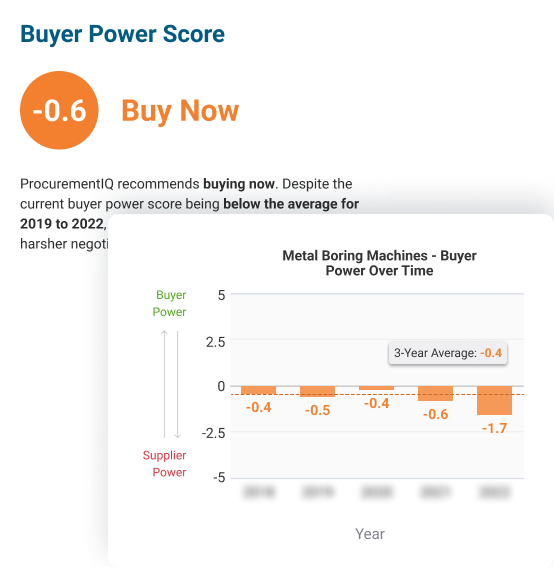
In 2026, buyer power amounts to -0.4 in the United States. Buyer power is most positively impacted by Recent Developments. It is most negatively impacted by Recent Price Volatility. Subscribers can access details on eight other factors that impact buyer power. Learn more
United States
Buyer power forecasts: your glimpse into the future
Develop strategies for the upcoming year and identify unforeseen opportunities for buying now
- Actionable "Buy Now" and "Buy Later" insights
- Near-real-time updates to current and forecast Buyer Power Scores
- Methodology and weightings for Buyer Power Score Components
Supply Chain Risk
The average level of supply chain risk is assessed as Medium, which has a negative impact on buyer power. The level of supply chain risk is affected by industry volatility, barriers to entry, competition, import penetration, regulation and industry financial risk. Buyers in this market can mitigate procurement and supply chain management risks by monitoring risk levels for individual first and second tier suppliers:
1st
Tier Suppliers
- Circuit Board & Electronic Component Manufacturers
- Laminated Plastics Manufacturers
- Wire & Cable Manufacturers
2nd
Tier Suppliers
- Semiconductor & Circuit Manufacturers
- Plastic & Resin Manufacturers
- Copper Rolling, Drawing & Extruding Firms
Biggest Body Cameras Suppliers in the US by Revenue
The largest Body Cameras vendors by revenue in the US are Galls, Llc, Pinnacle Response Limited and Wolfcom Enterprises Inc. Subscribers can sort and filter by market share concentration, profit level and other factors. Learn more
| Supplier | Operational Size | Headquarters | Number of Employees | Market Share (%) | Market Share Performance (3yr trend) | Total Revenue ($ million) | Profit Level (%) | Risk Level |
|---|---|---|---|---|---|---|---|---|
| Axon Enterprise Inc. | Global | SCOTTSDALE, AZ | 1,001-10,000 | 25+ | ||||
| Panasonic Corp | Global | Kadoma, JP | >10,001 | 5-10 | ||||
| Canon Inc. | Global | Tokyo, JP | >10,001 | < 5 | ||||
| L3Harris Technologies Inc. | International | MELBOURNE | >10,000 | < 5 | ||||
| Transcend Information Inc. | Global | New Taipei City, TW | 1,001-10,000 | < 5 | ||||
| Motorola Solutions, inc. | Global | CHICAGO | >10,000 | < 5 | ||||
| Pro-Vision Inc. | National | Byron Center, MI | 51-100 | < 5 | ||||
| Reveal Media Limited | Global | Hampton Wick, UK | 51-100 | < 5 | ||||
| Safety Vision, Llc | International | Houston, TX | 51-100 | < 5 | ||||
Looking for a list of suppliers by country?
Subscribers can access vendor information on Canadian and European suppliers, too. We also offer custom research services to help with vendor sourcing anywhere in the world.
Profit Analysis
The average profit margin across vendors in the Body Cameras market is 5.8% and rising. Profit levels shift depending on suppliers' spend on wages, purchases and overhead. The highest cost component for vendors is Purchases. The cost trend for this component is falling, when considering movement between 2025 and 2026. To understand cost forecasts for 2027 and uncover the implications on profit, start your subscription. Learn more
Vendor & Supply Chain Analysis
The average vendor in this market operates at low risk due to consistent revenue streams from government entities.
Market share concentration is very high, with Axon controlling most of the market and wielding significant pricing power.
This market faces a moderate supply chain risk due to its reliance on tariff-subject plastics and electronics components, as recent US tariffs on Chinese imports have raised costs for key materials like semiconductors, wiring, and plastic parts used in body cameras, resulting in price increases and delays in delivery, particularly as manufacturers struggle to navigate both tariff hikes and ongoing global supply shortages.
The United States is a net exporter of forensic and criminological cameras, meaning it exports more than it imports. This limits foreign competition within the market but indicates that buyers have greater domestic options, which may result in quicker delivery times and lower costs.
Supplier Information
Axon Enterprise Inc.
Axon Enterprise Inc. is a public company operating globally in the manufacturing sector. The company's offerings include body cameras and electroshock weapons. Founded in 1993, the company is currently headquartered in Scottsdale, Arizona, United States of America with an estimated 2821 employees. Subscribe to learn more
Panasonic Corp
Panasonic Corp is a public company operating globally in the manufacturing and information sectors. The company's offerings include warehouse management systems, commercial refrigerators & freezers, industrial freezers, alkaline batteries, lithium-ion batteries. Founded in 1918, the company is currently headquartered... Subscribe to learn more
Canon Inc.
Canon Inc. is a public company operating globally in the manufacturing, manufacturing, information and real estate & rental & leasing sectors. The company's offerings include printing & writing paper, print servers, computer printers, video management software, printer toner. Founded in 1937, the company Subscribe to learn more
Digital Ally Inc.
Digital Ally Inc. is a public company operating nationally in the manufacturing sector. The company's offerings include body cameras. Founded in 2004, the company is currently headquartered in LENEXA, Kansas, United States of America with an estimated 201 employees. Subscribe to learn more
Galls, Llc
Galls, Llc is a private company operating nationally in the manufacturing sector. The company's offerings include body cameras, security metal detectors and bulletproof vests. Founded in 1967, the company is currently headquartered in San Francisco, California, United States of America with an estimated 750... Subscribe to learn more
L3Harris Technologies Inc.
L3Harris Technologies, Inc. /DE/ is an end-to-end technology solutions provider for the defense industry. It organizes its business into four reportable segments: the Space & Airborne Systems segment, which designs, develops, integrates, produces, and sustains weapon systems for the national and international... Subscribe to learn more
Motorola Solutions, inc.
Motorola Solutions, Inc. is a global technology company focusing on safety and security. It designs and advances on-premises, cloud-based, and hybrid software solutions and services, such as cybersecurity subscription services and managed and support services, across land mobile radio communications, video... Subscribe to learn more
Pinnacle Response Limited
Pinnacle Response Limited is a private company operating globally in the manufacturing sector. The company's offerings include body cameras. Founded in 2007, the company is currently headquartered in Belfast, Northern Ireland, United Kingdom with an estimated 49 employees. Subscribe to learn more
Pro-Vision Inc.
Pro-Vision Inc. is a private company operating nationally in the manufacturing sector. The company's offerings include body cameras and commercial fleet cameras. Founded in 2003, the company is currently headquartered in Byron Center, Michigan, United States of America with an estimated 90 employees. Subscribe to learn more
Accelerate the vendor selection process
Get a clear picture of the competition in a market and discover which vendors are best-suited for your sourcing needs. Our supplier profiles include hard-to-find financial ranges for private companies, cover public company data and feature an interactive competitor matrix.
Procurement Management KPIs for the Body Cameras Market
Managing vendor performance throughout the contract period is easier when tracking specific key performance indicators (KPIs). For example, buyers should monitor Average Resolution Time and Defect Density. Buyers may experience better performance throughout their contracts if they establish service level agreements (SLAs) based on Features and other factors.
| KPI | Level of Importance (1-5) | Measurements | Key Considerations |
|---|---|---|---|
| Average Resolution Time |
|
Total resolution time Number of resolved tickets |
Buyers who are new to the market will inevitably face troubleshooting issues during body camera training. Therefore, a low average resolution time is paramount to efficient customer support. |
| Defect Density |
|
Number of units Number of defective units |
The defect density represents the share of defective products a company produces. Buyers should avoid vendors with relatively high defect density since defective products could threaten the integrity of the legal process. |

Questions to Ask During Procurement Negotiations
How can I gain leverage during negotiations?
Product Lines
If I were to purchase body camera cloud-storage services from you alongside body cameras, what advantages would this provide in price and functionality?
What types of discounts may be available by bundling the purchase of body cameras with other related goods and services?
Regulation
Do your body cameras and related video storage services comply with all applicable local, state, and federal laws?
Do you anticipate any future legal developments that could prevent the successful implementation of the body camera program we proposed in our RFP?
Customer Service
How many clients does each account manager manage? How do account managers allocate their time between clients?
On average, how much experience do your customer service and support personnel have in helping similar organizations successfully implement body camera programs?
The ultimate prep for procurement negotations
View all 25 negotiation questions for this category when you subscribe.
Body Cameras RFP Guidelines
What should my RFP include?
Organizational Overview
Buyers should provide an overview of their operations and describe their typical use of body cameras, including models, frequency of use, and video quality.
Buyers should describe situations where their users would be required to wear body cameras.
Statement Of Need
Buyers should specify the camera model(s), video resolution, data storage, and any required additional features.
Buyers should specify the number of each model of body camera being ordered.
Project Budget
Buyers should specify a total budget with the price broken down by camera.
Buyers should include total ownership costs such as delivery, installation, maintenance, and applicable discounts (i.e., cash or product bundling).
The RFP process made easy
Find out how you can access RFP templates for 800+ procurement categories to start writing better, more consistent RFPs.
We display average pricing information, trends and market data.
Our Reports include:
- Opportunity assessment
- Market dynamics
- Recent developments
- Positive and warning trends
- Buyer power levers
- Price environment and market pricing
- Geographic wage rates
- Global market updates
- Total cost of ownership
- Cost structure benchmarks and analysis
- Supply chain and vendors
- Global supplier breakdown
- Market share concentration
- Regulation and business requirements
- Vendor management and KPIs
- Sourcing strategy guidance