Procurement Market Intelligence Report
Material-Handling Equipment Maintenance Services
Sourcing Guide & Market Intelligence
Smarter cost management starts with comprehensive market intelligence
 United States
 Canada
 Europe
 Global
Quick Navigation
Material-Handling Equipment Maintenance Services Global Overview
Definition
Summary
This report is intended to assist buyers of material-handling equipment maintenance services. Material-handling equipment manufacturers and machinery maintenance firms provide various types of preventative and corrective maintenance on forklifts, aerial lifts, or other material-handling equipment. Buyers of material-handling equipment maintenance services include contractors, federal government agencies, brick-and-mortar retailers, and online retailers.
This Report Includes:
- Forklift Maintenance & Repair
- Aerial Lift Maintenance & Repair
- Other Material-Handling Equipment Maintenance & Repair
Not in this Report:
- Replacement Parts & Equipment Procurement
- Equipment Transportation Services
Classification:
Global Material-Handling Equipment Maintenance Services Procurement Trends
Discover the top international trends affecting procurement in the global Material-Handling Equipment Maintenance Services market.
Warning Trends
Public sector demand slumps as the government enters shutdown
- On October 1, the US federal government entered a shutdown after negotiations for a new appropriations bill failed.
- During a government shutdown, essential federal government operations, such as law enforcement, air-traffic control, and social security, persist, while nonessential operations are paused and workers involved in these operations are furloughed. Thus, the current shutdown is expected to result in 750,000 federal workers being furloughed, representing a $400 million reduction in daily expenditure by the federal government.
- This significant reduction in federal spending and operations will affect the entire US economy, weakening aggregate demand and slowing economic growth. For example, the 35-day government shutdown in Q1, 2019, reduced aggregate demand in both the public and private sectors, resulting in a 0.2% reduction in GDP growth that quarter.
- The effects of the shutdown are likely to be most acute in markets where the public sector is a major buyer segment, weakening demand and increasing average vendor risk by destabilizing important revenue streams.
- As negotiations for a new appropriations bill to reopen the government remain ongoing, ProcurementIQ will continue to monitor the situation and update this story with the latest information.
Tariffs to negatively impact the building and construction machinery sector
- The Trump Administration’s reciprocal tariffs, which apply general tariff rate increases to most countries the United States trades with, are set to take effect on August 7, after the administration finalized the national rates on August 1. As a result, leading sources of imported construction machinery face significantly higher tariff rates, including Japan (15.0%), Mexico (25.0%), South Korea (15.0%), the European Union (15.0%), the United Kingdom (10.0%), China (54.0%), and Canada (35.0%).
- The increase in tariffs on building and construction machinery imported from tariff-impacted countries will add to the price of imports, which are typically passed on to buyers in the form of higher prices. According to The Budget Lab at Yale, the additional tariffs on imports will increase overall prices for machinery and equipment by 13.3%.
- Additionally, the administration has already implemented 50.0% tariffs on all aluminum and steel imported into the United States, with the sole exception of imports from the United Kingdom. These tariffs will increase input costs even for construction machinery suppliers with domestic manufacturing operations.
- According to an April 2025 survey from Construction Equipment Magazine, around half of the respondents reported that the higher tariffs will increase operating costs by up to 15.0%, and more than half said they plan to pass those increases along to buyers.
- As many building and construction machinery brands source parts and components such as steel, engines, and electronics from foreign countries, higher tariff rates will put upward pressure on prices and lead to greater rental rates as manufacturers and dealers pass on costs. In addition, suppliers that source parts from tariff-affected regions may see supply chain disruptions as they seek alternative suppliers to mitigate tariff impacts.
Increased tariffs on copper imports take effect
- On August 1, the Trump administration implemented 50.0% tariffs on imported copper. Chile and Canada will be most impacted by these tariffs, as they account for a combined 87.0% of all copper imports in the United States.
- However, these tariffs are less sweeping than initially expected, only applying to semi-finished copper products, while excluding high-purity refined copper and copper input materials, such as ore and concentrate. As leading importers, such as Chile and Canada, have both high copper mining and refining capacities, they will likely avoid most of these tariffs by either exporting the copper in its unrefined form or refining the copper before exporting it to the United States
- These copper tariff exemptions limit the impact on the electronics and electrical equipment sectors because these applications require refined copper due to its optimal conductive properties.
- Thus, the prices of metal alloys that include copper, consumer products made from copper, tools, plumbing, corrosion-resistant alloys, and construction materials made from copper are forecast to rise by an average of 39.2%, according to the Yale Budget Lab.
Global Material-Handling Equipment Maintenance Services Market - Suppliers by Region
| Country/Region | Number of Suppliers |
|---|---|
| #1 Oceania & Southeast Asia | 105,765 |
| #2 Europe | 77,180 |
| #3 India | 65,895 |
Explore supplier concentration across the globe
We've uncovered the 11 top regions for global procurement, based on feedback from our most strategic clients. Access vendor counts for each unique region when you subscribe.
2
Geography Drilldown - US, Canada & Europe
Average Cost of Material-Handling Equipment Maintenance Services
United States
2026 Market Pricing$26.33 to $X,XXX.XX
per unit, per year
Average Price
Prices in the Material-Handling Equipment Maintenance Services market range from $26.33 to $X,XXX.XX, depending on Type of Maintenance, Type of Equipment, Level of Usage and Age of Equipment. For example, lower prices are associated with Preventative maintenance, whereas higher prices are associated with Corrective maintenance.
Need the scoop on international price trends?
Between our Europe and Canada collections, we provide price data for 350 markets so you can instantly compare prices across borders. Or, use our custom research services for intel on prices in any region across the globe.
Material-Handling Equipment Maintenance Services Category Price Trends
Pricing trends are indicated by the compound annual growth rate (CAGR) during a set period of time. For the Material-Handling Equipment Maintenance Services market, prices in the US have grown 3.7% from 2022 to 2025. and +2.3% in Europe.
United States (2022-2025)

Europe (2022-2025)
Compound Annual Growth Rate
Wondering where prices are heading?
Price trend forecasts are available to subscribers, along with price driver projections and forward-looking cost structure data.
Cost Analysis - Total Cost of Ownership for Material-Handling Equipment Maintenance Services
Total cost of ownership is Medium in the Material-Handling Equipment Maintenance Services market. The average cost of ownership differs depending on the contract but generally includes costs negotiated before the contract begins, costs billed during the contract period and unforeseen costs. For example, unforeseen costs in the form of Delays may raise the total cost of ownership unexpectedly.
Billed During
Repairs
Depreciation
Maintenance
Unforeseen
Delays
Emergencies
Buyer Power in Procurement Negotiations
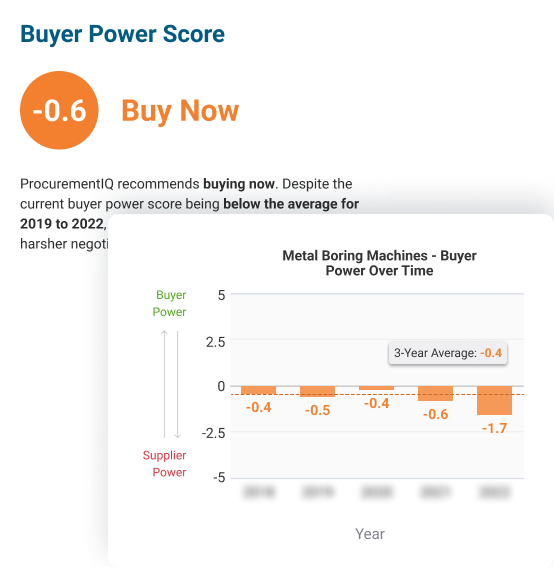
In 2026, buyer power amounts to -2.6 in the United States. Buyer power is most positively impacted by Recent Developments. It is most negatively impacted by Market Share Concentration. Subscribers can access details on eight other factors that impact buyer power. Learn more
United States

Buyer power forecasts: your glimpse into the future
Develop strategies for the upcoming year and identify unforeseen opportunities for buying now
- Actionable "Buy Now" and "Buy Later" insights
- Near-real-time updates to current and forecast Buyer Power Scores
- Methodology and weightings for Buyer Power Score Components
Supply Chain Risk
The average level of supply chain risk is assessed as Medium, which has a negative impact on buyer power. The level of supply chain risk is affected by industry volatility, barriers to entry, competition, import penetration, regulation and industry financial risk. Buyers in this market can mitigate procurement and supply chain management risks by monitoring risk levels for individual first and second tier suppliers:
1st
Tier Suppliers
- Industrial Machinery & Equipment Parts Wholesaling
- Tool & Hardware Wholesalers
- Lubricants & Other Petroleum Product Manufacturers
2nd
Tier Suppliers
- Industrial Machinery & Equipment Parts Manufacturers
- Tool & Hardware Manufacturers
- Petroleum Refiners
Biggest Material-Handling Equipment Maintenance Services Suppliers in the US by Revenue
The largest Material-Handling Equipment Maintenance Services vendors by revenue in the US are M.H. Equipment Co., Larry T. Weiss Co. Inc. and Oshkosh Corporation. Subscribers can sort and filter by market share concentration, profit level and other factors. Learn more
| Supplier | Operational Size | Headquarters | Number of Employees | Market Share (%) | Market Share Performance (3yr trend) | Total Revenue ($ million) | Profit Level (%) | Risk Level |
|---|---|---|---|---|---|---|---|---|
| Toyota Industries Corporation | Global | Kariya, JP | >10,001 | < 5 | ||||
| Mitsubishi Logisnext Co. Ltd. | Global | Nagaokakyo, JP | >10,001 | < 5 | ||||
| Oshkosh Corporation | Global | OSHKOSH, WI | >10,000 | < 5 | ||||
| Terex Corp | Global | NORWALK, CT | 1,001-10,000 | < 5 | ||||
| Crown Equipment Corporation | Global | New Bremen, OH | >10,000 | < 5 | ||||
| M.H. Equipment Co. | National | Peoria, IL | 501-1,000 | < 5 | ||||
| Quinn Company Inc. | Regional | City of Industry, CA | 1,001-10,000 | < 5 | ||||
| Eastern Lift Truck Co., Inc. | Regional | Maple Shade, NJ | 251-500 | < 5 | ||||
| Larry T. Weiss Co. Inc. | National | Elkridge, MD | 25-50 | < 5 | ||||
Looking for a list of suppliers by country?
Subscribers can access vendor information on Canadian and European suppliers, too. We also offer custom research services to help with vendor sourcing anywhere in the world.
Profit Analysis
The average profit margin across vendors in the Material-Handling Equipment Maintenance Services market is 5.6% and steady. Profit levels shift depending on suppliers' spend on wages, purchases and overhead. The highest cost component for vendors is Overhead. The cost trend for this component is falling, when considering movement between 2025 and 2026. To understand cost forecasts for 2027 and uncover the implications on profit, start your subscription. Learn more
Vendor & Supply Chain Analysis
The degree of risk among retailers increased as economic activity stalled during the pandemic and mandated business closures; however, it has decreased as economic activity has recovered and grown by comparison, thereby bringing it to a moderate level.
Market share concentration is low, which aids buyer power by promoting price-based competition among suppliers. While market share concentration has been increasing over the previous years due to the consolidation of larger suppliers, low barriers to entry have resulted in new, smaller suppliers entering the market, keeping the overall concentration level low.
Regarding supply chain risks, vendors have leveraged lower-priced foreign tools to keep purchase costs steady. There is a moderate risk of repair tool supply disruptions that would negatively impact market providers or buyers for most repairs.
The United States is a net importer of machinery and mechanical parts, indicating high competition in the market from foreign vendors. While buyers benefit from the increased competition and wider selection of vendors, the increased reliance on overseas vendors heightens the risk of supply chain disruptions.
Supplier Information
Crown Equipment Corporation
Crown Equipment Corporation is a private company operating globally in the manufacturing and other services (except public administration) sectors. The company's offerings include forklifts, tow tractors and material-handling equipment maintenance services. Founded in 1945, the company is currently headquartered... Subscribe to learn more
Eastern Lift Truck Co., Inc.
Eastern Lift Truck Co., Inc. is a private company operating regionally in the other services (except public administration) sector. The company's offerings include material-handling equipment maintenance services. Founded in 1971, the company is currently headquartered in Maple Shade, New Jersey, United States... Subscribe to learn more
Larry T. Weiss Co. Inc.
Larry T. Weiss Co. Inc. is a private company operating nationally in the other services (except public administration) sector. The company's offerings include material-handling equipment maintenance services. Founded in 1971, the company is currently headquartered in Elkridge, Maryland, United States of America... Subscribe to learn more
M.H. Equipment Co.
M.H. Equipment Co. is a private company operating nationally in the other services (except public administration) sector. The company's offerings include material-handling equipment maintenance services. Founded in 1952, the company is currently headquartered in Peoria, Illinois, United States of America Subscribe to learn more
Mitsubishi Logisnext Co. Ltd.
Mitsubishi Logisnext Co. Ltd. is a public company operating globally in the real estate & rental & leasing and other services (except public administration) sectors. The company's offerings include industrial truck rental and material-handling equipment maintenance services. Founded in 1937, the company is... Subscribe to learn more
Oshkosh Corporation
Oshkosh Corporation is a global industrial technology company that designs, develops, and manufactures vehicles and equipment for the postal, firefighting, refuse and recycling collection, construction, aviation, and defense industries. It organizes its business into three reportable segments: the Access Subscribe to learn more
Quinn Company Inc.
Quinn Company Inc. is a private company operating regionally in the real estate & rental & leasing and other services (except public administration) sectors. The company's offerings include forklift rental and material-handling equipment maintenance services. Founded in 1919, the company is currently headquartered... Subscribe to learn more
Terex Corp
Terex Corp is a public company operating globally in the manufacturing and other services (except public administration) sectors. The company's offerings include bulldozers, paving equipment, aerial lifts, platform lifts, building demolition machinery & equipment. Founded in 1933, the company is currently... Subscribe to learn more
Toyota Industries Corporation
Toyota Industries Corporation is a public company operating globally in the manufacturing and other services (except public administration) sectors. The company's offerings include front-end loaders, aerial lifts, pallet trucks, industrial trucks, forklifts. Founded in 1926, the company is currently headquartered... Subscribe to learn more
Accelerate the vendor selection process
Get a clear picture of the competition in a market and discover which vendors are best-suited for your sourcing needs. Our supplier profiles include hard-to-find financial ranges for private companies, cover public company data and feature an interactive competitor matrix.
Procurement Management KPIs for the Material-Handling Equipment Maintenance Services Market
Managing vendor performance throughout the contract period is easier when tracking specific key performance indicators (KPIs). For example, buyers should monitor Average Response Time and Employee Training Rate. Buyers may experience better performance throughout their contracts if they establish service level agreements (SLAs) based on Preventative Maintenance Frequency and other factors.
| KPI | Level of Importance (1-5) | Measurements | Key Considerations |
|---|---|---|---|
| Average Response Time |
|
Total number of tickets or inquiries sent to the supplier Total time to response for these inquiries or tickets |
The average response time measures how long it takes for a supplier to respond to requests, questions, or inquiries that the buyer may have regarding service. Average response time can indicate how quickly maintenance or issues will be able to be solved, as a poor average response time can lead to extended periods of downtime while awaiting information on next steps, scheduling, or troubleshooting from suppliers. |
| Employee Training Rate |
|
Total number of employees that have underwent training Total number of employees that have successfully completed training |
The employee training rate measures the percentage of the supplier's workforce that has been properly trained on techniques critical to service in the market. The employee training rate can be used as an indicator to assess the quality of the work being done, as highly skilled and trained employees may be better equipped to perform maintenance in the market. A highly trained workforce may lead to fewer reopened tickets or requests for repeated maintenance. |

Questions to Ask During Procurement Negotiations
How can I gain leverage during negotiations?
Customer Support
What is your client renewal or repeat business rate? Why do companies renew their contract with your business?
What are the terms of your service-level agreements?
Experience and Expertise
How long have you provided services such as this to your longest tenured client? Who are your five largest clients?
Do you have case studies or client testimonials detailing the services performed? Can we speak to or visit a current client about their experiences?
Service Performance
How do you balance quick turnaround times with maintaining maximum possible accuracy?
What quality awards have you won?
The ultimate prep for procurement negotations
View all 26 negotiation questions for this category when you subscribe.
Material-Handling Equipment Maintenance Services RFP Guidelines
What should my RFP include?
Organizational Overview
Buyers should describe the size of their organization and provide some information about their operations.
Buyers should specify their business type. For example, they should state whether they are a warehouse, manufacturing facility or government building.
Statement Of Need
Buyers should include as much information as possible about the scope of the required services. Relevant information includes the number of units being serviced, the exact type of equipment, the type of maintenance required and the frequency of maintenance checks.
Buyers should include relevant information about the times that installation or maintenance can occur. If buyers want work to be done after business hours, this should also be included.
Project Budget
Buyers should include as much information about the total scope of the project as possible.
Buyers should include information about the payment schedule (e.g., if it is incremental or done at the completion of the project).
The RFP process made easy
Find out how you can access RFP templates for 800+ procurement categories to start writing better, more consistent RFPs.
We display average pricing information, trends and market data.
Our Reports include:
- Opportunity assessment
- Market dynamics
- Recent developments
- Positive and warning trends
- Buyer power levers
- Price environment and market pricing
- Geographic wage rates
- Global market updates
- Total cost of ownership
- Cost structure benchmarks and analysis
- Supply chain and vendors
- Global supplier breakdown
- Market share concentration
- Regulation and business requirements
- Vendor management and KPIs
- Sourcing strategy guidance