Procurement Market Intelligence Report
Molded Fiber Packaging
Sourcing Guide & Market Intelligence
Smarter cost management starts with comprehensive market intelligence
 United States
 Global
Quick Navigation
Molded Fiber Packaging Global Overview
Definition
Summary
Molded fiber is made from wood fibers and is used to make goods such as box inserts (support packaging), cup carrying trays and egg carton packages. The primary distributors for molded fiber packaging products are manufacturers and wholesalers. Typical buyers include electronics companies, industrial goods manufacturers, food producers and restaurants.
This Report Includes:
- Box Inserts
- Cup Carrying Trays
- Egg Carton Packages
Not in this Report:
- Corrugated Boxes
- Paperboard & Packaging Papers
- Non-Wood Plant Fiber Packaging
Global Molded Fiber Packaging Procurement Trends
Discover the top international trends affecting procurement in the global Molded Fiber Packaging market.
Warning Trends
Reciprocal tariffs drive up packaging product prices
- The Trump administration’s reciprocal tariffs, which apply general tariff rate increases to all products imported from most nations, are set to take effect on August 7 after the national tariff rates were finalized on August 1. Additionally, 50.0% tariffs on all steel and aluminum imports, except those from the United Kingdom, went into effect in June.
- These tariffs will have a significant effect across the packaging industry as the United States imports a combined total of more than $127 billion worth of plastic, steel, and lumber annually, the three most common materials in packaging products.
- Leading packaging product importers include Canada, Mexico, and China, which face tariff rates of 35.0%, 25.0%, and 20.0%, respectively, with the Chinese import tariff rate set to rise to 54.0% in August. However, United States-Mexico-Canada Trade Agreement (USMCA)-originating goods, meaning those produced entirely in Canada or Mexico, are exempt from these tariffs.
- China accounts for 48.6% of imported plastic products in the United States, making current and upcoming tariffs on Chinese goods particularly impactful for the price of plastic packaging materials, which the Yale Budget Lab projects will rise in price by 11.0%.
- Likewise, Canada and Mexico provide a combined 51.6% of lumber imports, driving a 6.8% increase in the price of wooden products. Steel and aluminum tariffs are projected to fuel a 39.2% increase in the cost of metal packaging products on average.
Global Molded Fiber Packaging Market - Suppliers by Region
| Country/Region | Number of Suppliers |
|---|---|
| #1 Europe | 120 |
| #2 Oceania & Southeast Asia | 105 |
| #3 India | 70 |
Explore supplier concentration across the globe
We've uncovered the 11 top regions for global procurement, based on feedback from our most strategic clients. Access vendor counts for each unique region when you subscribe.
2
Geography Drilldown - US
Average Cost of Molded Fiber Packaging
United States
2026 Market Pricing$75.98 to $X,XXX.XX
per 1,000 packagesAverage Price
Prices in the Molded Fiber Packaging market range from $75.98 to $X,XXX.XX, depending on Size, Thickness, Customization, Coating and Quantity. For example, lower prices are associated with 0.5 quarts ($60.00 to $70.00 per 1,000 packages) and 1 quart ($100 to $110 per 1,000 packages), whereas higher prices are associated with 2 quarts ($190 to $200 per 1,000 packages) and 2.5 quarts ($220 to $230 per 1,000 packages).
Need the scoop on international price trends?
Between our Europe and Canada collections, we provide price data for 350 markets so you can instantly compare prices across borders. Or, use our custom research services for intel on prices in any region across the globe.
Molded Fiber Packaging Category Price Trends
Pricing trends are indicated by the compound annual growth rate (CAGR) during a set period of time. For the Molded Fiber Packaging market, prices in the US have grown 1.8% from 2022 to 2025. Subscribers can access price trend forecasts, price driver projections and forward-looking cost structure data. Learn more
United States (2022-2025)


Wondering where prices are heading?
Price trend forecasts are available to subscribers, along with price driver projections and forward-looking cost structure data.
Cost Analysis - Total Cost of Ownership for Molded Fiber Packaging
Total cost of ownership is Low in the Molded Fiber Packaging market. The average cost of ownership differs depending on the contract but generally includes costs negotiated before the contract begins, costs billed during the contract period and unforeseen costs.
Negotiated Before
Transportation
Billed During
Storage
Additional Fees
Buyer Power in Procurement Negotiations
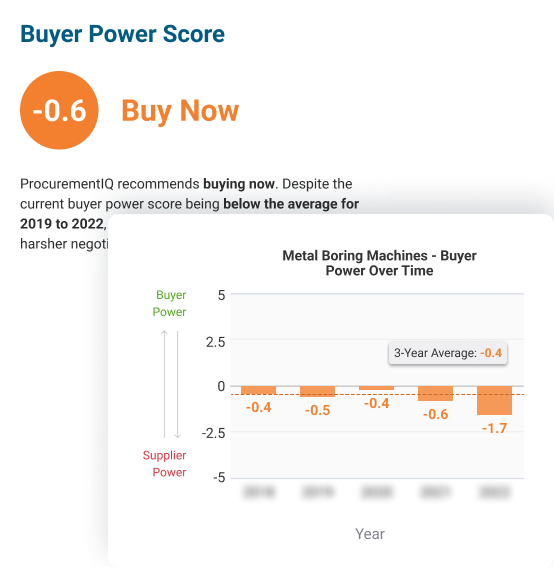
In 2026, buyer power amounts to -0.8 in the United States. Buyer power is most positively impacted by Recent Developments. It is most negatively impacted by Switching Costs. Subscribers can access details on eight other factors that impact buyer power. Learn more
United States
Buyer power forecasts: your glimpse into the future
Develop strategies for the upcoming year and identify unforeseen opportunities for buying now
- Actionable "Buy Now" and "Buy Later" insights
- Near-real-time updates to current and forecast Buyer Power Scores
- Methodology and weightings for Buyer Power Score Components
Supply Chain Risk
The average level of supply chain risk is assessed as Medium, which has a negative impact on buyer power. The level of supply chain risk is affected by industry volatility, barriers to entry, competition, import penetration, regulation and industry financial risk. Buyers in this market can mitigate procurement and supply chain management risks by monitoring risk levels for individual first and second tier suppliers:
1st
Tier Suppliers
- Recyclable Material Wholesalers
- Ink Manufacturers
- Paper Mills
2nd
Tier Suppliers
- Recycling Facilities
- Dye & Pigment Manufacturers
- Wood Pulp Mills
Biggest Molded Fiber Packaging Suppliers in the US by Revenue
The largest Molded Fiber Packaging vendors by revenue in the US are BCPE Empire Holdings Inc., Sabert Corporation and Bunzl Plc. Subscribers can sort and filter by market share concentration, profit level and other factors. Learn more
| Supplier | Operational Size | Headquarters | Number of Employees | Market Share (%) | Market Share Performance (3yr trend) | Total Revenue ($ million) | Profit Level (%) | Risk Level |
|---|---|---|---|---|---|---|---|---|
| Pactiv Evergreen Inc. | Global | LAKE FOREST | >10,000 | 15-20 | ||||
| Huhtamaki Group | Global | Espoo, FI | >10,001 | 20-25 | ||||
| International Paper Company | Global | MEMPHIS | >10,000 | < 5 | ||||
| Bunzl Plc | Global | London, UK | >10,001 | < 5 | ||||
| The Jim Pattison Group | International | Vancouver, CA | >10,000 | < 5 | ||||
| Tekni-Plex Inc. | Global | Wayne, PA | < 5 | |||||
| Brodrene Hartmann A/S | Global | Gentofte, DK | 1,001-10,000 | < 5 | ||||
| BCPE Empire Holdings Inc. | US | < 5 | ||||||
| Sabert Corporation | National | Sayreville, NJ | 1,001-10,000 | < 5 | ||||
Looking for a list of suppliers by country?
Subscribers can access vendor information on Canadian and European suppliers, too. We also offer custom research services to help with vendor sourcing anywhere in the world.
Profit Analysis
The average profit margin across vendors in the Molded Fiber Packaging market is 4.2% and steady. Profit levels shift depending on suppliers' spend on wages, purchases and overhead. The highest cost component for vendors is Purchases. The cost trend for this component is rising, when considering movement between 2025 and 2026. To understand cost forecasts for 2027 and uncover the implications on profit, start your subscription. Learn more
Vendor & Supply Chain Analysis
Vendors typically carry a low level of financial risk. Growing demand for molded fiber packaging has boosted many operators financially.
There is a medium level of market share concentration in the molded fiber packaging market. There are about 46 molded fiber packaging vendors in the United States, and the top four vendors account for between 40.0% and 50.0% of total market revenue.
There is a medium level of supply chain risk associated with molded fiber packaging. This is attributed to suppliers' reliance on paper materials and recent declines in wood pulp production, which have been adversely affected by the upstream logging industry.
The United States is a net importer of molded fiber packaging, importing more than it exports. Buyers importing molded fiber packaging should weigh higher shipping costs and longer delivery times against any cost savings from sourcing internationally.
Supplier Information
Pactiv Evergreen Inc.
Pactiv Evergreen Inc. is a packaging company serving fresh food service, food merchandising, and beverage markets. It manufactures and distributes food containers, drinkware, tableware, service ware, products for on-the-go and ready-to-eat food, clear rigid-display containers, trays for meat and poultry, Subscribe to learn more
Huhtamaki Group
Huhtamaki Group is a public company operating globally in the manufacturing sector. The company's offerings include paper cups, flexible packaging and molded fiber packaging. Founded in 1941, the company is currently headquartered in Espoo, Finland with an estimated employee count of over 10,000. Subscribe to learn more
BCPE Empire Holdings Inc.
BCPE Empire Holdings Inc. is a private company operating internationally in the manufacturing sector. The company's offerings include paper bags and molded fiber packaging. Founded in 1935, the company is currently headquartered in Jersey City, New Jersey, United States of America with an estimated employee... Subscribe to learn more
Brodrene Hartmann A/S
Brodrene Hartmann A/S is a public company operating globally in the manufacturing sector. The company's offerings include molded fiber packaging. Founded in 1917, the company is currently headquartered in Gentofte, Denmark with an estimated 5500 employees. Subscribe to learn more
Bunzl Plc
Bunzl Plc is a public company operating globally in the construction, manufacturing and manufacturing sectors. The company's offerings include paper bags, plastic bags, slip sheets, molded fiber packaging, safety apparel. Founded in 1854, the company is currently headquartered in London, United Kingdom with... Subscribe to learn more
CKF Inc.
CKF Inc. is a International operator providing Molded Fiber Packaging from their headquarters in Etobicoke, US. This operator has a staff size of about 501-1,000 employees. According to ProcurementIQ estimates, CKF Inc. holds < 5% of market share... Subscribe to learn more
Henry Molded Products Inc.
Henry Molded Products Inc. is a private company operating globally in the manufacturing sector. The company's offerings include molded fiber packaging. Founded in 1962, the company is currently headquartered in Lebanon, Pennsylvania, United States of America with an estimated 175 employees. Subscribe to learn more
International Paper Company
International Paper Co. /NEW/ is a global producer of renewable fiber-based packaging and pulp products. It organizes its business into two segments: Industrial Packaging, which manufactures linerboard, medium, whitetop, recycled medium, and saturating kraft; and Global Cellulose Fibers, which includes a Subscribe to learn more
Michelsen Packaging Company
Michelsen Packaging Company is a private company operating regionally in the manufacturing sector. The company's offerings include molded fiber packaging. Founded in 1937, the company is currently headquartered in Yakima, Washington, United States of America with an estimated 175 employees. Subscribe to learn more
Accelerate the vendor selection process
Get a clear picture of the competition in a market and discover which vendors are best-suited for your sourcing needs. Our supplier profiles include hard-to-find financial ranges for private companies, cover public company data and feature an interactive competitor matrix.
Procurement Management KPIs for the Molded Fiber Packaging Market
Managing vendor performance throughout the contract period is easier when tracking specific key performance indicators (KPIs). For example, buyers should monitor Average Response Time and Defect Density. Buyers may experience better performance throughout their contracts if they establish service level agreements (SLAs) based on Delivery and other factors.
| KPI | Level of Importance (1-5) | Measurements | Key Considerations |
|---|---|---|---|
| Average Response Time |
|
Cumulative response time Number of client queries |
The average response time tracks how quickly suppliers respond to queries from the customer. Suppliers that respond promptly to client queries will be able to resolve issues quickly, minimizing the impact on the buyer’s operations. |
| Defect Density |
|
Number of products delivered Number of defective products |
The defect density matters because defective products cannot be used for packaging. Suppliers should be required to replace defective products at no cost to the buyer. |

Questions to Ask During Procurement Negotiations
How can I gain leverage during negotiations?
Quality Control
What type of training do your employees receive? How often is this refreshed?
What procedures do you have in place to check for quality? Is it machine or labor based?
Supplier Size
What is the maximum output your largest location can produce?
What is the largest order you typically process? How often can an order of that size be ordered?
Customer Service
What are the different ways you can be contacted?
What is the best method to reach a client service representative?
The ultimate prep for procurement negotations
View all 24 negotiation questions for this category when you subscribe.
Molded Fiber Packaging RFP Guidelines
What should my RFP include?
Organizational Overview
Buyers should provide an overview of their operations and describe their general use of product packaging and whether they are using molded fiber packaging or other materials such as polystyrene.
Buyers detail each of the products they use molded fiber packaging with.
Statement Of Need
Buyers should provide specifications including size, shape, thickness, price as well as ability to absorb water.
Buyers should specify the duration of the contract.
Project Budget
Buyers should specify their total budget for their molded fiber packaging order.
Buyers should break down to budget to include price per thousand packages as well as include and shipping costs.
The RFP process made easy
Find out how you can access RFP templates for 800+ procurement categories to start writing better, more consistent RFPs.
We display average pricing information, trends and market data.
Our Reports include:
- Opportunity assessment
- Market dynamics
- Recent developments
- Positive and warning trends
- Buyer power levers
- Price environment and market pricing
- Geographic wage rates
- Global market updates
- Total cost of ownership
- Cost structure benchmarks and analysis
- Supply chain and vendors
- Global supplier breakdown
- Market share concentration
- Regulation and business requirements
- Vendor management and KPIs
- Sourcing strategy guidance