Procurement Market Intelligence Report
Network Planning & Design Services
Sourcing Guide & Market Intelligence
Smarter cost management starts with comprehensive market intelligence
 United States
 Canada
 Europe
 Global
Quick Navigation
Network Planning & Design Services Global Overview
Definition
Summary
Network planning and design service providers help clients identify and optimize the network hardware and software applications in their new and existing telecommunications networks. Key buyers range widely and can include manufacturers, financial institutions, federal, state and local governments, healthcare providers, and retail vendors.
This Report Includes:
- Gathering Network Requirements
- Network Architecture Selection
- Detailed Network Analysis and Design
- License Coordination
- Product and Technology Recommendations
Not in this Report:
- On-premises Network Hosting
- Post-implementation Network Management Services
Classification:
Global Network Planning & Design Services Procurement Trends
Discover the top international trends affecting procurement in the global Network Planning & Design Services market.
Neutral
GSA memo asks agencies to review consulting contracts
- The General Services Administration (GSA) recently issued a memorandum asking government agencies to review their consulting contracts with the ten highest-paid firms. The ten firms are Accenture PLC (Accenture Federal Services), Booz Allen Hamilton Inc., CGI Group Inc. (CGI Federal), Deloitte Touche Tohmatsu (Deloitte Consulting), General Dynamics Corporation (General Dynamics IT), Guidehouse Inc., Huntington Ingalls Industries Inc. (HII Mission Technologies), International Business Machines Corporation (IBM), Leidos Holdings, Inc., and Science Applications International Corporation, Inc. (SAIC).
- The memo states that agencies are strongly encouraged to cut non-essential consulting contracts, providing a list of those intended to be terminated by March 7, 2025. By April 19, 2025, agencies must submit their reviews of non-GSA consulting service contracts.
- According to the GSA, the ten consulting firms identified are set to receive $65.0 billion in fees in 2025. The Department of Defense (DoD) has stated its intention to terminate or descope contracts non-essential to the DoD’s purposes; some of the largest market players with high-value DoD contracts include Booz Allen Hamilton, Deloitte, and Accenture.
- According to the Government Accountability Office, in the fiscal year 2023, government agencies spent $478.0 billion on services, with the DoD accounting for $230.0 billion and non-defense agencies accounting for the rest. The DoD spent $21.3 billion on support, professional, and engineering and technical services, while non-defense agencies spent $21.4 billion on professional services, which includes consulting, training, and support services.
- The Department of Veterans Affairs (VA) initially cancelled 875 contracts (amounting to around $2.0 billion) but has currently paused efforts. However, contract terminations across most agencies are expected to continue.
Global Network Planning & Design Services Market - Suppliers by Region
| Country/Region | Number of Suppliers |
|---|---|
| #1 Europe | 72,355 |
| #2 China | 72,355 |
| #3 United States | 40,000 |
Explore supplier concentration across the globe
We've uncovered the 11 top regions for global procurement, based on feedback from our most strategic clients. Access vendor counts for each unique region when you subscribe.
2
Geography Drilldown - US, Canada & Europe
Average Cost of Network Planning & Design Services
United States
2026 Market Pricing$100.00 to $XXX.XX
per hour
Average Price
Prices in the Network Planning & Design Services market range from $100.00 to $XXX.XX, depending on Experience of Staff, Complexity of Network Requirements, Network Structure and Location. For example, lower prices are associated with Entry-level call center staff ($100 to $200 per hour), whereas higher prices are associated with Seasoned and certified IT professionals ($150 to $310 per hour).
Need the scoop on international price trends?
Between our Europe and Canada collections, we provide price data for 350 markets so you can instantly compare prices across borders. Or, use our custom research services for intel on prices in any region across the globe.
Network Planning & Design Services Category Price Trends
Pricing trends are indicated by the compound annual growth rate (CAGR) during a set period of time. For the Network Planning & Design Services market, prices in the US have grown 2.0% from 2022 to 2025. and +1.2% in Europe.
United States (2022-2025)

Europe (2022-2025)
Compound Annual Growth Rate
Wondering where prices are heading?
Price trend forecasts are available to subscribers, along with price driver projections and forward-looking cost structure data.
Cost Analysis - Total Cost of Ownership for Network Planning & Design Services
Total cost of ownership is Medium in the Network Planning & Design Services market. The average cost of ownership differs depending on the contract but generally includes costs negotiated before the contract begins, costs billed during the contract period and unforeseen costs. For example, unforeseen costs in the form of Delays may raise the total cost of ownership unexpectedly.
Negotiated Before
Implementation
Pre-evaluation
Billed During
License fees
Hardware
Unforeseen
Delays
Buyer Power in Procurement Negotiations
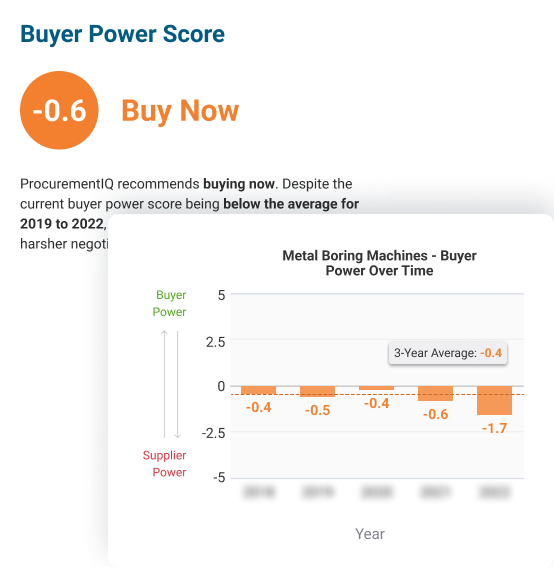
In 2026, buyer power amounts to 0.0 in the United States. Buyer power is most positively impacted by Product Specialization. It is most negatively impacted by Market Share Concentration. Subscribers can access details on eight other factors that impact buyer power. Learn more
United States

Buyer power forecasts: your glimpse into the future
Develop strategies for the upcoming year and identify unforeseen opportunities for buying now
- Actionable "Buy Now" and "Buy Later" insights
- Near-real-time updates to current and forecast Buyer Power Scores
- Methodology and weightings for Buyer Power Score Components
Supply Chain Risk
The average level of supply chain risk is assessed as Low, which has a positive impact on buyer power. The level of supply chain risk is affected by industry volatility, barriers to entry, competition, import penetration, regulation and industry financial risk. Buyers in this market can mitigate procurement and supply chain management risks by monitoring risk levels for individual first and second tier suppliers:
1st
Tier Suppliers
- Computer Manufacturers
- Software Publishers
- Internet Service Providers
- Networking Equipment Wholesalers
- Semiconductor & Circuit Manufacturers
2nd
Tier Suppliers
- Semiconductor & Circuit Manufacturers
- Intellectual Property Licensors
- Fiber Optic Cable Manufacturers
Biggest Network Planning & Design Services Suppliers in the US by Revenue
The largest Network Planning & Design Services vendors by revenue in the US are Adtran, Inc., Booz Allen Hamilton Inc. and Hewlett Packard Enterprise Co. Subscribers can sort and filter by market share concentration, profit level and other factors. Learn more
| Supplier | Operational Size | Headquarters | Number of Employees | Market Share (%) | Market Share Performance (3yr trend) | Total Revenue ($ million) | Profit Level (%) | Risk Level |
|---|---|---|---|---|---|---|---|---|
| NEC Corporation | Global | Tokyo, JP | >10,001 | < 5 | ||||
| Accenture Plc | International | DUBLIN | >10,000 | < 5 | ||||
| International Business Machines Corporation | Global | ARMONK | >10,000 | < 5 | ||||
| Intel Corporation | Global | SANTA CLARA | >10,000 | < 5 | ||||
| Cisco Systems, Inc. | Global | SAN JOSE, CA | >10,000 | < 5 | ||||
| Hewlett Packard Enterprise Co | Global | SPRING | >10,000 | < 5 | ||||
| Booz Allen Hamilton Inc. | Global | MCLEAN, VA | >10,000 | < 5 | ||||
| CACI International Inc | Global | RESTON, VA | >10,000 | < 5 | ||||
| Juniper Networks B.V. | Global | SUNNYVALE | >10,000 | < 5 | ||||
Looking for a list of suppliers by country?
Subscribers can access vendor information on Canadian and European suppliers, too. We also offer custom research services to help with vendor sourcing anywhere in the world.
Profit Analysis
The average profit margin across vendors in the Network Planning & Design Services market is 7.7% and steady. Profit levels shift depending on suppliers' spend on wages, purchases and overhead. The highest cost component for vendors is Overhead. The cost trend for this component is rising, when considering movement between 2025 and 2026. To understand cost forecasts for 2027 and uncover the implications on profit, start your subscription. Learn more
Vendor & Supply Chain Analysis
Financial risk for the average vendor is low and holding steady. Moreover, moderate profit margins keep suppliers somewhat open to negotiations.
The supply chain risk associated with this market is low as there are very few key inputs that vendors rely on to provide their services.
The low level of market share concentration indicates a fragmented market in which no supplier or group of suppliers has significant influence over market prices. Therefore, vendors will continue competing for market share through competitive service rates and quality offerings, which will slow price growth.
The United States is a net importer of network equipment, which indicates a high level of competition in the market from foreign vendors. However, the increased reliance on overseas vendors heightens the risk of supply chain disruptions.
Supplier Information
Accenture Plc
Accenture Plc is a public company operating internationally in the mining, information, professional, scientific and technical services and administration, business support and waste management services sectors. The company's offerings include mobile enterprise application platforms, claims management software,... Subscribe to learn more
Adtran, Inc.
Adtran, Inc. is a public company operating globally in the professional, scientific & technical services sector. The company's offerings include network planning & design services. Founded in 1985, the company is currently headquartered in Huntsville, Alabama, United States of America. Subscribe to learn more
Booz Allen Hamilton Inc.
Booz Allen Hamilton Inc. is a public company operating globally in the professional, scientific and technical services sector. The company's offerings include management consulting services, it consulting services, healthcare consulting services, data privacy consulting services, it systems integration services.... Subscribe to learn more
CACI International Inc
CACI International Inc. /DE/ is a provider of expertise and technology to national security in the intelligence, defense, and federal civilian sectors globally. It delivers talent with specific technical and functional knowledge in software development, data and business analysis, operations support, naval... Subscribe to learn more
Cisco Systems, Inc.
Cisco Systems, Inc. is a public company operating globally in the manufacturing, information and professional, scientific and technical services sectors. The company's offerings include rail signaling systems, office phones, print servers, computer servers, database management systems. Founded in 1984, the... Subscribe to learn more
Hewlett Packard Enterprise Co
Hewlett Packard Enterprise Co. is a global technology company developing intelligent solutions for business and public sector enterprises. It organizes its business into six reportable business segments: the Compute segment, which consists of general purpose servers for multi-workload computing and workload-optimized... Subscribe to learn more
Intel Corporation
Intel Corporation is a global integrated device manufacturer that designs, develops, manufactures, markets, and services central processing units (CPUs) and related solutions. It offers CPUs and chipsets, a system on a chip (SoC), or a multichip package based on Intel® architecture that processes data and... Subscribe to learn more
International Business Machines Corporation
International Business Machines Corporation (IBM) is a global integrated computer technology, hardware, software, and services provider. It organizes its business into four segments: Software segment, which provides software solutions for a hybrid cloud platform, data and artificial intelligence, automation,... Subscribe to learn more
Juniper Networks B.V.
Juniper Networks, Inc. is a networking technology company delivering solutions for cloud and telecommunication service providers and enterprises. It offers routing solutions for wide-area networking; cloud management, networking, and security solutions for campus and branch environments; fabric management,... Subscribe to learn more
Accelerate the vendor selection process
Get a clear picture of the competition in a market and discover which vendors are best-suited for your sourcing needs. Our supplier profiles include hard-to-find financial ranges for private companies, cover public company data and feature an interactive competitor matrix.
Procurement Management KPIs for the Network Planning & Design Services Market
Managing vendor performance throughout the contract period is easier when tracking specific key performance indicators (KPIs). For example, buyers should monitor Average Resolution Time and Employee Training Rate. Buyers may experience better performance throughout their contracts if they establish service level agreements (SLAs) based on Customer Service and other factors.
| KPI | Level of Importance (1-5) | Measurements | Key Considerations |
|---|---|---|---|
| Average Resolution Time |
|
Length of time from query to solution Ability to quickly resolve issues. |
The average resolution time represents the average amount of time it takes to resolve a support ticket. The average resolution time can be used to determine a company’s support responsiveness. Backlogs and delays may indicate a supplier that cannot effectively fill the contract. |
| Employee Training Rate |
|
Number of employees passing certifications or tests Number of employees passing certifications or tests |
Vendors that are proactively training employees will be better able to adapt to future issues. The employee training rate represents the share of employees a company is able to successfully train. The employee training rate can be used to determine a company’s ability to familiarize and adapt its employee base to shifting market conditions. |

Questions to Ask During Procurement Negotiations
How can I gain leverage during negotiations?
Quality Control
What, if any, SLAs do you offer? How negotiable are the terms of any SLAs you offer?
What response time can you guarantee in the event of a network malfunction?
Service Performance
What changes do you expect to see in the hardware or software incorporated into your networks in the near future? How will these changes affect our network's performance?
How will adding users to the network affect its performance?
Experience and Expertise
What is your previous experience working within my business sector?
How does my IT infrastructure compare to those with which you most commonly work?
The ultimate prep for procurement negotations
View all 28 negotiation questions for this category when you subscribe.
Network Planning & Design Services RFP Guidelines
What should my RFP include?
Organizational Overview
Buyers should describe the size of their organization and their location, and provide some information about their operations.
Buyers should describe their existing network, IT infrastructure and any programs they currently have in place.
Statement Of Need
Buyers should specify the desired speed, security and scalability of the network and the type of technology required.
Buyers should list the intended users of the network, including which departments will be using it and any requirements they may have.
Project Budget
Buyers should specify their budget for the required hardware, software and services.
Buyers should include information about the payment schedule (i.e., incremental or done at the completion of the project).
The RFP process made easy
Find out how you can access RFP templates for 800+ procurement categories to start writing better, more consistent RFPs.
We display average pricing information, trends and market data.
Our Reports include:
- Opportunity assessment
- Market dynamics
- Recent developments
- Positive and warning trends
- Buyer power levers
- Price environment and market pricing
- Geographic wage rates
- Global market updates
- Total cost of ownership
- Cost structure benchmarks and analysis
- Supply chain and vendors
- Global supplier breakdown
- Market share concentration
- Regulation and business requirements
- Vendor management and KPIs
- Sourcing strategy guidance