Procurement Market Intelligence Report
Sheet Metal
Sourcing Guide & Market Intelligence
Smarter cost management starts with comprehensive market intelligence
 United States
 Europe
 Global
Quick Navigation
Sheet Metal Global Overview
Definition
Summary
Sheet metal is produced during an industrial process that forms the raw metal into thin, flat pieces. Sheet metal is used in a variety of applications, including automobile and aerospace manufacturing and construction, and is thus frequently demanded by operators in these sectors. Key buyers include residential and nonresidential building developers, and automobile and aerospace manufacturers.
This Report Includes:
- Aluminum Sheet Metal
- Brass Sheet Metal
- Copper Sheet Metal
- Steel Sheet Metal
- Tin Sheet Metal
Not in this Report:
- Sheet Plastic
- Sheet Polymers
Global Sheet Metal Procurement Trends
Discover the top international trends affecting procurement in the global Sheet Metal market.
Warning Trends
Tariffs to negatively impact building and construction components and supplies sector
- The Trump Administration’s reciprocal tariffs, which impose higher tariffs on all products imported from most foreign nations, are set to take effect on August 7, after the rates were finalized on August 1. As a result, most construction material import sources face higher tariffs, including Mexico (25.0%), Canada (35.0%), Turkiye (15.0%), and China (54.0%).
- According to Realtor.com, about 70.0% of the softwood lumber and drywall gypsum (used for drywall) used in residential construction is imported from Canada and Mexico, respectively. According to the New York Times, drywall prices could rise by 22.0%. Other products like wood utility poles, medium-density fiberboard, particleboard, plywood, wood veneers, and wood pulp will also see higher prices as a result.
- The Yale Budget Lab estimates that construction inputs like cement could see a 3.5% increase in price with higher tariffs on imports. Turkiye, Canada, and Mexico, which account for over 65.0% of US imports, face tariff rates of 10.0%, 25.0%, and 25.0%, respectively.
- Specific steel and aluminum tariffs of 50.0% on all US imports are also negatively affecting buyers of building and construction components and supplies like sheet metal, automatic sliding doors, garage doors, ladders, posts and bollards, and more. In 2024, 23.0% of all steel used in the United States was imported from foreign countries such as Canada and Mexico.
- US manufacturers reliant on imported plastic resins from countries like China will not be impacted by tariffs as key resins, like polyethylene, polypropylene, and PET, will be exempt from the reciprocal tariffs. Other construction components and supplies that are compliant with the United States-Canada-Mexico Agreement will be exempt from tariffs.
United States announces new tariffs on all imported steel
- In February 2025, the United States announced 25.0% tariffs on all imported steel with no exemptions or exceptions. The tariffs took effect on March 12, 2025. On June 4th, these tariffs were increased further to 50%. These tariffs were not impacted by a recent court decision that temporarily suspended duties on certain goods as they were implemented under Section 232 of the Trade Expansion Act.
- Previously, countries such as Canada, Mexico, and Brazil, the top exporters of steel to the United States, had exemptions from tariffs. These have now been removed and all imported steel, regardless of origin, will be subject to the 50.0% tariff. However, on May 8th, the US announced an agreement with the United Kingdom to remove all levies on steel exported from the UK.
- When tariffs on steel imports were introduced in March 2018, they contributed to an increase in the price of steel and steel products. According to the Bureau of Labor Statistics, the price of steel-milled products increased by 10.2% in the year after the tariffs were implemented. This market heavily relies on steel as an input and may be impacted by this policy.
United States announces new tariffs on all imported aluminum
- In February 2025, the United States announced 25.0% tariffs on all imported aluminum with no exemptions or exceptions. The tariffs took effect on March 12, 2025. On June 4th, these tariffs were increased further to 50%. These tariffs were not impacted by a recent court decision that temporarily suspended duties on certain goods as they were implemented under Section 232 of the Trade Expansion Act.
- Previously, countries such as Canada and Mexico, two of the top exporters of aluminum to the United States, had exemptions from tariffs and the rate was only 10.0%. These have now been removed and all imported aluminum, regardless of origin, will be subject to the 50.0% tariff.
- When tariffs on imported aluminum were implemented in March 2018, aluminum prices rose modestly. According to the Bureau of Labor Statistics (BLS), prices rose 1.2% in the year after the tariffs were introduced. Because this market relies on aluminum as an input, it may be impacted by this policy.
Global Sheet Metal Market - Suppliers by Region
| Country/Region | Number of Suppliers |
|---|---|
| #1 Oceania & Southeast Asia | 28,475 |
| #2 India | 22,950 |
| #3 Europe | 21,970 |
Explore supplier concentration across the globe
We've uncovered the 11 top regions for global procurement, based on feedback from our most strategic clients. Access vendor counts for each unique region when you subscribe.
2
Geography Drilldown - US & Europe
Average Cost of Sheet Metal
United States
2026 Market Pricing$1.20 to $X.XX
per 12 in x 24 in sheet
Average Price
Prices in the Sheet Metal market range from $1.20 to $X.XX, depending on Metal Type, Metal Gauge, Processing Type and Buyer Location. For example, lower prices are associated with Aluminum sheet metal ($10.00 to $50.00 per sheet) and Galvanized steel sheet metal ($10.00 to $60.00 per sheet), whereas higher prices are associated with Steel sheet metal ($60.00 to $150 per sheet) and Stainless steel sheet metal ($150 to $220 per sheet).
Need the scoop on international price trends?
Between our Europe and Canada collections, we provide price data for 350 markets so you can instantly compare prices across borders. Or, use our custom research services for intel on prices in any region across the globe.
Sheet Metal Category Price Trends
Pricing trends are indicated by the compound annual growth rate (CAGR) during a set period of time. For the Sheet Metal market, prices in the US have grown 1.7% from 2022 to 2025. Meanwhile, the recent three-year CAGR for Europe is +1.7%.
United States (2022-2025)

Europe (2022-2025)
Compound Annual Growth Rate
Wondering where prices are heading?
Price trend forecasts are available to subscribers, along with price driver projections and forward-looking cost structure data.
Cost Analysis - Total Cost of Ownership for Sheet Metal
Total cost of ownership is Low in the Sheet Metal market. The average cost of ownership differs depending on the contract but generally includes costs negotiated before the contract begins, costs billed during the contract period and unforeseen costs. For example, unforeseen costs in the form of Delays may raise the total cost of ownership unexpectedly.
Negotiated Before
Customization
Billed During
Storage
Unforeseen
Delays
Buyer Power in Procurement Negotiations
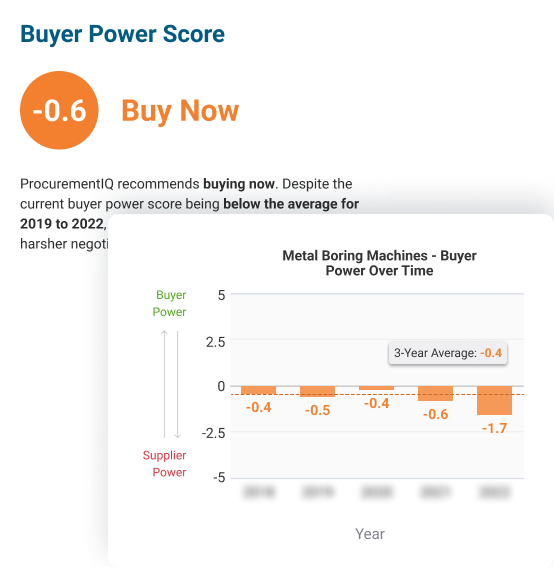
In 2026, buyer power amounts to -2.6 in the United States. Buyer power is most positively impacted by Recent Price Volatility. It is most negatively impacted by Switching Costs. Subscribers can access details on eight other factors that impact buyer power. Learn more
United States

Buyer power forecasts: your glimpse into the future
Develop strategies for the upcoming year and identify unforeseen opportunities for buying now
- Actionable "Buy Now" and "Buy Later" insights
- Near-real-time updates to current and forecast Buyer Power Scores
- Methodology and weightings for Buyer Power Score Components
Supply Chain Risk
The average level of supply chain risk is assessed as High, which has a negative impact on buyer power. The level of supply chain risk is affected by industry volatility, barriers to entry, competition, import penetration, regulation and industry financial risk. Buyers in this market can mitigate procurement and supply chain management risks by monitoring risk levels for individual first and second tier suppliers:
1st
Tier Suppliers
- Iron & Steel Manufacturers
- Aluminum Manufacturers
- Inorganic Chemical Manufacturers
2nd
Tier Suppliers
- Iron Ore Miners
- Coal Miners
- Electric Power Transmission Firms
- Mineral & Phosphate Miners
Biggest Sheet Metal Suppliers in the US by Revenue
The largest Sheet Metal vendors by revenue in the US are ThyssenKrupp Elevator AG, Ak Steel Holding Corp and Ecco Group. Subscribers can sort and filter by market share concentration, profit level and other factors. Learn more
| Supplier | Operational Size | Headquarters | Number of Employees | Market Share (%) | Market Share Performance (3yr trend) | Total Revenue ($ million) | Profit Level (%) | Risk Level |
|---|---|---|---|---|---|---|---|---|
| Arcelormittal | Global | Luxembourg, LU | >10,001 | 10-15 | ||||
| Nucor Corporation | Global | CHARLOTTE, NC | >10,000 | 10-15 | ||||
| Ryerson Holding Corporation | Global | CHICAGO, IL | 1,001-10,000 | 10-15 | ||||
| Steel Dynamics, Inc. | National | FORT WAYNE, IN | >10,000 | 5-10 | ||||
| Ak Steel Holding Corp | 5-10 | |||||||
| O'neal Industries, Inc. | Global | Birmingham, AL | 1,001-10,000 | 5-10 | ||||
| ThyssenKrupp Elevator AG | US | 5-10 | ||||||
| Cleveland-Cliffs Inc. | International | CLEVELAND, OH | >10,000 | < 5 | ||||
| United States Steel Corp | Global | PITTSBURGH, PA | >10,000 | < 5 | ||||
Looking for a list of suppliers by country?
Subscribers can access vendor information on Canadian and European suppliers, too. We also offer custom research services to help with vendor sourcing anywhere in the world.
Profit Analysis
The average profit margin across vendors in the Sheet Metal market is 8.3% and rising. Profit levels shift depending on suppliers' spend on wages, purchases and overhead. The highest cost component for vendors is Purchases. The cost trend for this component is rising, when considering movement between 2025 and 2026. To understand cost forecasts for 2027 and uncover the implications on profit, start your subscription. Learn more
Vendor & Supply Chain Analysis
The market's level of supply chain risk is high, increasing buyers' likelihood of facing significant price swings stemming from upstream supply chain disruptions.
Average vendor risk in the sheet metal market is moderate, primarily due to inherent supply chain risk and frequent fluctuations in vendor profitability.
Market share concentration in this market is moderate, as the top four sheet metal suppliers generate more than 30.0% of market revenue, boosting suppliers' pricing power and thus, leverage during negotiations with buyers.
As a net importer in the sheet metal market, US buyers' procurement strategies may be influenced by factors such as cost considerations and international competition and will need to carefully evaluate pricing options and potentially seek out more cost-effective solutions. Being a net importer can restrict buyer power and reduce their ability to dictate terms and conditions in procurement transactions, and will have less control over pricing, quality, and availability of the goods or services they need.
Supplier Information
Arcelormittal
Arcelormittal is a public company operating globally in the manufacturing sector. The company's offerings include oil & gas casing & tubing, railroad track, sheet metal and nonelectric iron & steel wire. Founded in 2007, the company is currently headquartered in Luxembourg, Luxembourg with an estimated 125416... Subscribe to learn more
Nucor Corporation
Nucor Corporation is a manufacturer of steel and steel products serving the US market. It organizes its business into three segments: the Steel Mills segment, which produces sheet steel, plate steel, structural steel, and bar steel; the Steel Products segment, which offers steel joists and joist girders, Subscribe to learn more
Ryerson Holding Corporation
Ryerson Holding Corporation is a public company operating globally in the manufacturing sector. The company's offerings include sheet metal. Founded in 1842, the company is currently headquartered in CHICAGO, Illinois, United States of America with an estimated 4200 employees. Subscribe to learn more
Ak Steel Holding Corp
Ak Steel Holding Corp is a private company operating nationally in the manufacturing sector. The company's offerings include sheet metal. Founded in 1900, the company is currently headquartered in West Chester, Ohio, United States of America. Subscribe to learn more
O'neal Industries, Inc.
O'neal Industries, Inc. is a private company operating globally in the manufacturing sector. The company's offerings include sheet metal, electroshock weapons, metal forming services and welding, brazing & soldering services. Founded in 1921, the company is currently headquartered in Birmingham, Alabama, Subscribe to learn more
Steel Dynamics, Inc.
Steel Dynamics, Inc. is a public company operating nationally in the manufacturing sector. The company's offerings include railroad track and sheet metal. Founded in 1993, the company is currently headquartered in FORT WAYNE, Indiana, United States of America with an estimated 12060 employees. Subscribe to learn more
ThyssenKrupp Elevator AG
ThyssenKrupp Elevator AG is a public company operating in the construction and manufacturing sectors. The company's offerings include elevators, escalators and elevator & escalator maintenance services. Founded in 2014, the company is currently headquartered in United States of America. Subscribe to learn more
Alcoa Corp
Alcoa Corp is a public company operating globally in the manufacturing and manufacturing sectors. The company's offerings include truck wheels, sheet metal, rivets, trash bags and metal forming services. Founded in 1888, the company is currently headquartered in PITTSBURGH, Pennsylvania, United States of Subscribe to learn more
Cleveland-Cliffs Inc.
Cleveland-Cliffs Inc. is a steel producer and supplier in North America. It mines and manufactures iron ore pellets, its primary raw material input for steelmaking and downstream finishing, stamping, tooling, and tubing. It offers flat-rolled steel, advanced high-strength steel, hot-dipped galvanized, aluminized,... Subscribe to learn more
Accelerate the vendor selection process
Get a clear picture of the competition in a market and discover which vendors are best-suited for your sourcing needs. Our supplier profiles include hard-to-find financial ranges for private companies, cover public company data and feature an interactive competitor matrix.
Procurement Management KPIs for the Sheet Metal Market
Managing vendor performance throughout the contract period is easier when tracking specific key performance indicators (KPIs). For example, buyers should monitor Return On Investment (ROI) and Revenue by Product or Service. Buyers may experience better performance throughout their contracts if they establish service level agreements (SLAs) based on Accuracy and other factors.
| KPI | Level of Importance (1-5) | Measurements | Key Considerations |
|---|---|---|---|
| Return On Investment (ROI) |
|
Cost of investment Benefit of investment Revenue generated by investment |
Return on investment can be used to determine the efficiency of a supplier's investments. In the event that a supplier has recently invested in process improvements, such as lean manufacturing initiatives, the buyer can evaluate the ROI to determine the supplier's likelihood of passing cost increases on to buyers. |
| Revenue by Product or Service |
|
Total revenue Product-specific revenue Service-specific revenue |
Buyers can use the revenue per product or service to determine which product or service segments generate the highest returns for the supplier. Suppliers that generate a higher portion of revenue from the products and services the buyer is interested in are more likely to invest in improving such products and services, which could improve the supplier's value to the buyer over time. |

Questions to Ask During Procurement Negotiations
How can I gain leverage during negotiations?
Supply Chain Risk
What percentage of your revenue is currently dedicated to raw input materials? How has that differed in recent years?
In the past three years, what percentage of your revenue has been dedicated to labor? Do labor costs fluctuate seasonally?
Quality Control
What kinds of quality control checks does your company use?
In terms of quality, what separates your sheet metal from that of your competitors?
Experience and Expertise
How long have you been active in this field?
What are some similar clients you have serviced, along with dates and service periods?
The ultimate prep for procurement negotations
View all 26 negotiation questions for this category when you subscribe.
Sheet Metal RFP Guidelines
What should my RFP include?
Organizational Overview
Buyers should give an overview of their manufacturing or construction operations to help vendors understand the type and volume of sheet metal they require.
Buyers should provide a detailed description of their operational structure, including to whom vendors will report.
Statement Of Need
Buyers should describe the desired metal, weight, gauge, tolerance range and other specific performance metrics.
In addition to listing applicable federal, state and local regulations, buyers should also list requirements specific to their industry and energy efficiency (e.g. LEED certification).
Project Budget
Buyers should explicitly state the amount for the award.
Buyers should describe the desired type of supply contract (e.g., payment terms, contract length).
The RFP process made easy
Find out how you can access RFP templates for 800+ procurement categories to start writing better, more consistent RFPs.
We display average pricing information, trends and market data.
Our Reports include:
- Opportunity assessment
- Market dynamics
- Recent developments
- Positive and warning trends
- Buyer power levers
- Price environment and market pricing
- Geographic wage rates
- Global market updates
- Total cost of ownership
- Cost structure benchmarks and analysis
- Supply chain and vendors
- Global supplier breakdown
- Market share concentration
- Regulation and business requirements
- Vendor management and KPIs
- Sourcing strategy guidance