

Artificial Intelligence (AI) has exploded in effectiveness and popularity over the last few years, with businesses from every sector implenting the new technology to drive operational efficiency, reduce costs, and streamline business processes. Generative AI has been responsible for much of the traditionally mainstream AI use cases, particularly for procurement departments. AI for procurement utilizes Machine Learning (ML) and Natural Language Processing (NLP) capabilities to promote efficient sourcing processes. The advanced capabilities can reduce data inaccuracies, human error, and the manual burden of simpler processes.
Before we dive into how generative AI has been driving growth in the procurement space, let’s look at the technology's effect on other industries.
How is AI used in programming?
In the programming field, generative AI has begun to expand its reach and capabilities, particularly in 2024. GitHub and OpenAI created Copilot as part of a joint partnership to assist programmers with code completion. Copilot offers code suggestions and autocompletion capabilities that are ‘learned’ from open-source code. Although its technology still lags behind skilled programmers, businesses that have implemented Copilot have reported greater productivity and efficiency from their developers.
How is AI used in marketing?
Generative AI has also become a powerful tool in the marketing industry. Claude AI, a ChatGPT competitor developed by Anthropic, has skyrocketed in popularity after the introduction of its Sonnet 3.5 AI suite. In contrast to ChatGPT 4o, Claude utilizes real-time data to inform its responses to users. In doing so, users are able to stay on top of important new trends that may potentially drive growth from marketing departments. The figure below demonstrates how Claude 3.5 Sonnet performs against its largest competitor, GPT-4o.
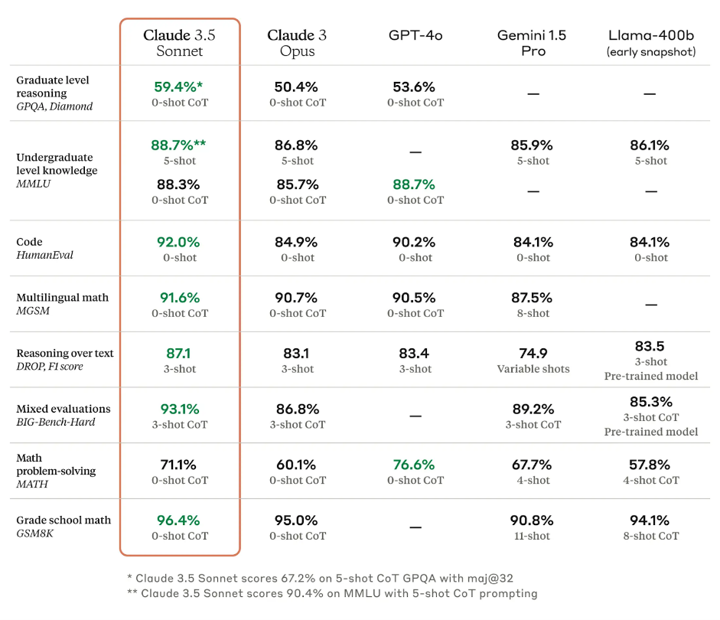
Source: Datacamp
How is AI used in finance?
In the finance sector, generative AI has been implemented in both customer use cases and internal processes, depending on the firm. For example, Mastercard partnered with Create Labs in January 2024 to develop an AI chatbot assistant for its small business clients. This development reduced the financial burden of hiring or outsourcing customer service representatives. On the other hand, Morgan Stanley launched its new AI tool, dubbed the Morgan Stanley Debrief, in July 2024. The tool records client meetings, generates notes, and creates action items for the firm’s financial advisors. These capabilities can help drive greater efficiency and work capacity for financial advisors by reducing the number of manual processes in their workflows.
How is AI used in procurement?
Supply chain management has been a key sector that AI technology is streamlining. Historically, firms have been required to manually collect, record, and manipulate supplier data to assess and predict performance through internal modeling. With AI in supply chain, however, supplier performance monitoring has shifted from a reactive pathway to a predictive process. Generative AI can sift through large quantities of historical data while using advanced algorithms to forecast supplier performance. In doing so, the risk of service disruptions and price shocks from upstream supply incidents is minimized, which procurement departments greatly benefit from.
Additionally, the growth of real-time data monitoring has been a key development in the AI for procurement space.
As I’m sure many of our readers know, the Red Sea Crisis, beginning in October 2023 and ending in March 2024, wreaked havoc on the global supply chain. Houthi militants carried out attacks on dozens of merchant and military vessels traversing the Red Sea, which is one of the world’s most essential waterways for international trade. Consequently, global logistics firms had to reroute hundreds of container ships around Africa, which led to widespread delays and upward price shocks for businesses and consumers. For companies using AI, however, the consequences of this massive geopolitical event were minimized. Here’s how:
AI using real-time monitoring and predictive analytics helped sourcing departments navigate the rapidly changing global shipping market. AI-powered databases like Resilience360 by DHL can track and visualize global shipping pathways, enabling quicker reactions to supply chain crises. In Resilience360, you can view risk factors by location, severity, and projected resolution time.

Source: ITLN
Prior to AI integration, similar visualization software required manual data entry and risk triage by providers, which added time and limited the value attained by users. Due to ongoing port congestion in the United States, driven in part by labor strikes at major ports like those in Louisiana, the value of AI-driven shipping visualization tools is expected to increase in demand in the next few years. For procurement departments looking to reduce costs, lower the likelihood of shipping delays, and drive efficiency, shipping visualization tools should be on your radar.
What are the drawbacks of generative AI?
Like any technology, generative AI has a unique set of drawbacks and limitations. It is important to mention a few key areas in which generative AI is limited and how procurement departments can turn these limitations into strengths.
The most obvious downside of utilizing generative AI is the lack of transparency. How exactly do advanced technology suites like ChatGPT or Claude create their responses? Should we blindly trust generative AI's internal methodology, which is often not publicly available? Although using generative AI can lead to many benefits for procurement departments, its implementation only magnifies the importance of human oversight to minimize errors and biases. Biases can rapidly propagate within AI responses as this software derives its answers from historical data that can be skewed. Thus, regular auditing and monitoring of AI to minimize the appearance of latent biases will be vital in integrating generative AI with procurement strategies. Users will be able to guarantee that AI-driven decisions are ultimately grounded in human expertise.
Procurement is also inherently a very ‘human’ process. Take supplier negotiations, for example, which are often complex and require strong interpersonal skills and finesse from both sourcing professionals and suppliers. Generative AI can assist significantly in data analysis for metrics like pricing trends and supplier performance, but it cannot replace humans during negotiations. This process requires human intuition, emotional intelligence, and real-time adaptability while being face-to-face, which generative AI cannot replicate. Pricing and contract terms can also be heavily influenced by nuances in supplier relationships, an intangible metric that generative AI will struggle to account for.
How should procurement account for suppliers using generative AI?
There are several strategies you should be wary of when contracting suppliers who use generative AI in their operations.
1. AI-Use Transparency
When contracting with suppliers, buyers should clearly outline the acceptable level of generative AI use. Suppliers should clearly state what types of AI will be implemented (e.g., generative AI for text, image generation tools like Midjourney, etc.) and their specific use cases. Additionally, the scope of AI work should be defined, which allows buyers to view whether the content is AI-generated or crafted by human professionals.
2. Quality Assurance
Due to aforementioned transparency concerns surrounding AI-generated content, buyers should always be wary of potential errors and biases occurring from suppliers using generative AI. Buyers should articulate minimum quality standards for AI-generated content, which should be accompanied by the supplier's proper validation and testing protocols. Buyers can also develop contingency plans for events where AI-generated content is unsatisfactory. These can include no-cost revisions or switching workflows to human-generated content where necessary.
3. Cost-Savings Opportunities
Implementing generative AI within supplier operations is an obvious avenue toward cost-savings on the supplier end. Buyers may have additional room to lobby for discount opportunities due to the reduction in operating costs for their suppliers. Opting for value-based pricing, which derives prices from actual value creation rather than hours worked, is a method by which buyers can locate savings. Additionally, exploring discount structures based on the level of implemented AI by suppliers can lead to further cost reductions for buyers.
For procurement departments, generative AI can improve efficiency and drive cost savings in many ways. As long as the necessary standards, workflows, and processes are in place, AI should be a key tool embraced by sourcing professionals in the coming years.
Follow ProcurementIQ on LinkedIn to get notified of the latest procurement news and market developments from our experts to yours.


