
Cross-functional collaboration is a challenging but worthy goal across organizations and departments of all types. If you work in procurement, you’re probably used to collaborating with finance staff and your main stakeholders. When you’re working on procurement strategies, you undoubtedly consider the goals of your business, at least as they relate to procurement. But what about the goals around supply chain transformation?
To best align departmental goals with the wider business, it’s important for procurement and supply chain functions to break down the boundaries and drive toward business goals together.
Supply chain vs procurement
When people hear procurement, chances are they interpret the role to be supply chain and purchasing focused. However, those in the role know there’s much more to it. Often, procurement and supply chain management are discussed as if they are the same task; some may even use the terms interchangeably. The truth is that, though related, they are comprised of different functions.
The first step in understanding supply chain vs procurement is to look at how they differ. But in order to prepare your business for future growth, it’s also important to consider how these two functions fit together and how they can further converge to create a more efficient and resilient supply network.
What is procurement?
Simply stated, procurement is the process of sourcing goods and services with the objective of meeting business needs. Procurement asks what is needed, at sometimes the most basic level, for the business to function and oversees both direct and indirect costs. Direct costs are what’s needed to manufacture or deliver the product or service your business provides. These costs directly affect the company’s business goals and bottom line. Indirect costs, on the other hand, do not necessarily impact the bottom line but are related to items that are necessary for the business to operate (e.g., office supplies, business cards, accounting services, etc.).
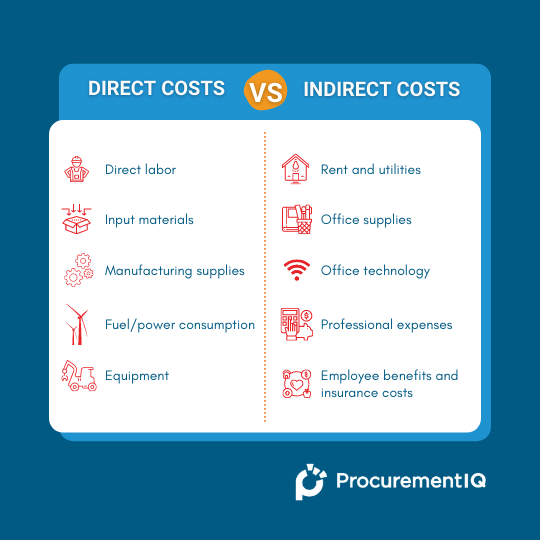
Basic elements of the procurement process include vendor selection, purchasing, receiving, and payment. Responsibilities that come with the role of procurement management also include cost containment, optimizing the buying process, and streamlining purchasing (e.g., eliminating waste and increasing efficiency by reducing the number of vendors a company works with).
What is supply chain management?
A supply chain can be defined as the entire network of a company and the lifecycle of its processes, including those between vendors. From the sourcing of raw materials, to product development, to the delivery of the product to the end user—all of these can be viewed as links within a supply chain. In summary, the supply chain of a company varies depending on the product or service sold and includes the jobs and services that help move the product from point A to B to C.
As such, supply chain management involves overseeing every stage of this process, from production to distribution to invoicing. It also includes quality control, strategic sourcing, contract negotiation, cost reduction, B2B collaboration, and risk mitigation, with the main goal of making sure the entire process runs as smoothly as possible from beginning to end.
So, what is procurement in supply chain? How does the process of procurement relate to supply chain management?
Procurement’s role in supply chain resilience
Taking these definitions into account, it may be helpful, for simplicity’s sake, to view procurement as more input focused and supply chain management as more output focused. With each function having a different focus, one supports the other. More specifically, procurement is needed to support the greater system of supply chain management, and both supply chain managers and procurement professionals rely upon one another for the business to not just operate but succeed.
Recent disruptions such as COVID-19, supply shortages, global trade barriers, evolving consumer expectations, and inflation have all made the processes of supply chain management and procurement increasingly complex. As a result, businesses have undergone increased pressure to improve collaboration across functions and departments to create a more resilient supply network known as “supply chain convergence.”
Gartner, a technology research and consulting company, explained the concept of supply chain convergence in a 2018 study, which focused on how “supply chain leaders can transform their operations by breaking down functional silos and designing business operations that span, optimize, and synchronize across traditional functional domains.”
ProcurementIQ agrees that the convergence of procurement and supply chain management will be the next evolutionary stage on this journey toward more resilient supply chains. By implementing this type of cross-functional collaboration, companies can build the resilience to withstand disruptions, improve risk management, and accelerate innovation. However, to this end, it will require a fundamental shift in how organizations view their internal processes.
First steps and goals of supply chain convergence
The first step toward convergence will require a mutual understanding of each department’s scope of work to determine how they can assist one another by sharking skills and information. Once that mutual understanding is achieved, there are many tools that can be implemented to further develop a cohesive system, including shared KPIs, the co-development of procedures and policies, and the use of technology and data sharing. Ultimately, the goal should be to create cross-functional teams that work in alignment with one another and their shared goals. From there, companies can seek to enable multi-enterprise collaboration with external suppliers, stakeholders, and partners across the entire supply network.
This simple breakdown can help your business begin the long journey of reassessing procurement’s place in the greater scope of supply chain management and how the two can come together to construct a clear, more purposeful direction as well as sustainable results. Rather than cutting corners to achieve short-term value, it will ultimately take company-wide initiatives and a unified culture. In other words, get ready to play the long game.
Need more supply chain transparency? ProcurementIQ offers supply chain insights at the category level — or, dive deeper with a custom research project.
Project Sample: US Manufacturer Seeks Supply Chain Transparency


