

E-procurement definition
What is e-procurement and how can it benefit your business? E-procurement, or electronic procurement, includes using computer networks to purchase goods and services on behalf of an organization. E-procurement improves the procurement process by replacing traditional paper-based processes with modern digital technologies, especially making use of the Internet. However, unlike e-commerce, e-procurement is done by procurement professionals on behalf of a business or government organization.
The benefits of e-procurement solutions
Why does e-procurement matter? Many organizations benefit from the use of e-procurement services. In short, these benefits include:
- Cost savings
- Increased speed to market
- Greater control over spending
Cost savings: An e-procurement system allows your organization to automate repetitive, low-value tasks that were previously done manually, freeing up your staff to work on more important, higher-value projects. E-procurement also enables a more competitive sourcing process, which can translate into lower prices. Your savings grow even more when taking advantage of monitoring tools that help capitalize on opportunities for cost avoidance. For example, these tools may show you areas where your company may be spending too much and areas where you can consolidate your spending under a single supplier to win volume or bundling discounts.
Increased speed to market: The ability to automate routine tasks also makes e-procurement faster than paper-based processes, shortening the amount of time from purchase order creation to order fulfillment. Additionally, e-procurement tools can help you evaluate and select suppliers by narrowing your list of potential suppliers down to those that best fit your organization’s needs. Finally, errors are less likely with e-procurement since software tools can catch errors automatically, shortening the procurement cycle.
Greater control over spending: E-procurement programs often include reporting tools that give you a better view of spending across your organization. These reporting tools can detect and flag fraudulent orders, helping you minimize losses. They can also show you when and where non-compliant (maverick) spending is occurring that is outside the scope of existing contracts. Cutting down on off-contract spending may help you save money as contract terms often provide more favorable prices.
The e-procurement process
What does the e-procurement process look like? The e-procurement process generally consists of five steps:
1. E-informing
2. E-sourcing
3. E-tendering
4. E-auctioning
5. E-ordering
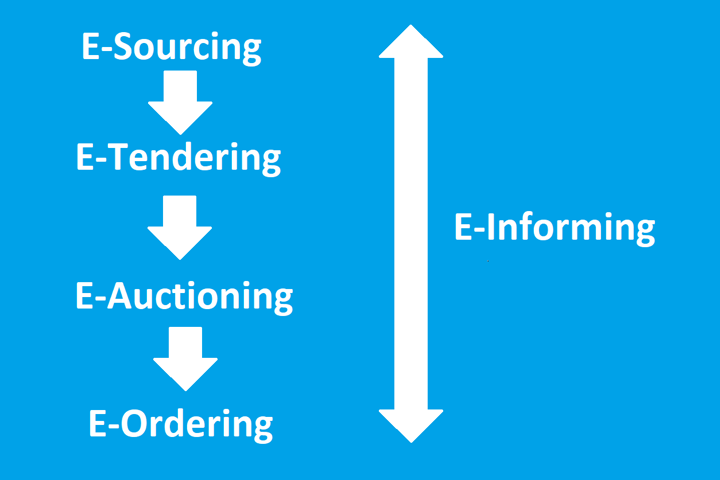
E-informing: E-informing, which is the use of digital technologies to gather and send information between the buyer and prospective suppliers, occurs during all stages of the e-procurement process. E-informing may occur via e-mail, chat, e-procurement software, ERP software or other means. E-procurement systems greatly speed up the process; whereas information was once exchanged via the postal system, today’s digital technology offers nearly instantaneous feedback.
E-sourcing: E-sourcing involves gathering any requirements for the procured good or service and qualifying suppliers based on how well they fit the organization’s needs. The first step in this process includes communicating with end users within your organization to define these requirements. This step is done quickly and easily through electronic means, such as e-mail or software programs. Then, using e-procurement software or other e-sourcing tools, you can narrow down suppliers based on location, how many employees they have, what other goods and services they offer and whether or not they meet other selection criteria.
E-tendering: The next step in the e-procurement process is e-tendering. E-tendering may take the form of a request for information (RFI), a request for proposals (RFP) or a request for quotations (RFQ). Again, the use of digital technologies also helps to expedite the e-procurement process. Internet-based e-procurement solutions can allow you to quickly create and send RFIs, RFPs and RFQs. Furthermore, buyers can now exchange tenders with suppliers electronically through e-procurement software, bypassing the postal system.
E-auctioning: Once you have a list of proposals from qualified suppliers, the next step is to secure the best possible contract terms. This can be done through e-auctioning, which is also known as e-reverse auctioning. Unlike a traditional auction where many buyers compete to buy from a single supplier, a reverse auction involves multiple suppliers competing for the chance to sell to a single buyer. Many e-procurement solutions have e-auctioning or e-reverse auctioning capabilities.
E-ordering: E-ordering is the final stage in the e-procurement process. At this stage, a supplier or group of suppliers has won the contract and has agreed to sell goods or services at a prearranged price. Now, all you have to do is place the order for the first batch of goods or services that you need. As with the other stages of the e-procurement process, e-ordering can also be done within an e-procurement system. The e-procurement process ends once the purchased goods or services are received.
Key takeaways
- E-procurement systems offer three benefits for buyers: cost savings, increased speed to market and greater control over spending.
- The e-procurement process includes e-informing, e-sourcing, e-tendering, e-auctioning and e-ordering.
- Technology has improved the procurement process by reducing human error and increasing efficiency.
For more on the intersection of technology and procurement, take a look at ProcurementIQ’s analysis here: Technologies Shaping the Future of Procurement


