Procurement Market Intelligence Report
Oil & Gas Pipeline Construction
Sourcing Guide & Market Intelligence
Smarter cost management starts with comprehensive market intelligence
 United States
 Canada
 Europe
 Global
Quick Navigation
Oil & Gas Pipeline Construction Global Overview
Definition
Summary
Providers of these services build piping to transport oil and gas from one location to another. Suppliers in this market provide construction services for onshore pipelines (both above and below ground) and offshore pipelines. These services are purchased by buyers operating in the upstream and midstream oil and gas markets, as well as utility providers and government agencies. Services are typically provided by oil and gas field service providers and pipeline construction specialists.
This Report Includes:
- Onshore Aboveground Pipeline Construction
- Onshore Underground Pipeline Construction
- Offshore Pipeline Construction
Not in this Report:
- Pipeline Inspection Services
- Pipeline Maintenance Services
- Refinery Construction Services
Global Oil & Gas Pipeline Construction Procurement Trends
Discover the top international trends affecting procurement in the global Oil & Gas Pipeline Construction market.
Warning Trends
Fed lowers rates for the first time in 2025
- On September 17, the Federal Reserve’s Federal Open Market Committee (FOMC) voted to lower interest rates to a target range of 4.0% to 4.25%, down 0.25% from the rate it had been holding since November of last year.
- Despite indications at the start of the year that steady reductions to the relatively high 4.25% to 4.5% rate were on the horizon, the Fed held off on rate cuts for much of the year due to concerns that the combination of higher tariffs and a reduction in borrowing costs could cause rebounding inflation.
- The September cut to Fed interest rates signals a shift in this strategy, indicating that the Fed now considers weakening employment figures a greater threat than inflation. As a result, FOMC officials have also signaled that two additional rate cuts are likely before the end of the year in an effort to fight unemployment and stimulate the economy.
- Declining Fed funds rates will provide relief to borrowers by lowering the market interest rates for consumer and business loans. This reduction in the cost of borrowing will reduce the cost of many banking and financial services, and may spur increases in demand across the economy.
Tariffs to negatively impact the building and construction machinery sector
- The Trump Administration’s reciprocal tariffs, which apply general tariff rate increases to most countries the United States trades with, are set to take effect on August 7, after the administration finalized the national rates on August 1. As a result, leading sources of imported construction machinery face significantly higher tariff rates, including Japan (15.0%), Mexico (25.0%), South Korea (15.0%), the European Union (15.0%), the United Kingdom (10.0%), China (54.0%), and Canada (35.0%).
- The increase in tariffs on building and construction machinery imported from tariff-impacted countries will add to the price of imports, which are typically passed on to buyers in the form of higher prices. According to The Budget Lab at Yale, the additional tariffs on imports will increase overall prices for machinery and equipment by 13.3%.
- Additionally, the administration has already implemented 50.0% tariffs on all aluminum and steel imported into the United States, with the sole exception of imports from the United Kingdom. These tariffs will increase input costs even for construction machinery suppliers with domestic manufacturing operations.
- According to an April 2025 survey from Construction Equipment Magazine, around half of the respondents reported that the higher tariffs will increase operating costs by up to 15.0%, and more than half said they plan to pass those increases along to buyers.
- As many building and construction machinery brands source parts and components such as steel, engines, and electronics from foreign countries, higher tariff rates will put upward pressure on prices and lead to greater rental rates as manufacturers and dealers pass on costs. In addition, suppliers that source parts from tariff-affected regions may see supply chain disruptions as they seek alternative suppliers to mitigate tariff impacts.
Neutral
Crude oil prices dip, but natural gas and fuel prices remain volatile in 2025
- Oil prices have been falling with the introduction of higher tariffs and the predicted decline in global demand. The OPEC+ group of countries also announced they would be unwinding production cuts and increasing their collective output target for May by 411,000 barrels per day.
- Trade wars, ongoing conflict between Hamas and Israel, and general unrest in the Middle East are causing uncertainty surrounding oil prices, which has led to volatility in prices. In the third week of May 2025, crude oil prices hit $63.67 per barrel, but volatility remains as geopolitical concerns remain.
- Natural gas prices rallied early in 2025 with colder-than-usual temperatures in the United States and high demand, topping out at $4.68/MMBtu in March. Prices have since fallen with the onset of trade wars and weakening demand projections to $3.64/MMBtu in the third week of May 2025.
- The national average of gasoline prices has been rising slightly due to refinery maintenance/outages and blending issues, hitting a national average of $3.15 per gallon in the third week of May 2025. However, gasoline futures have been volatile, falling due to fears of oversupply and deepening concerns about weakening demand with tariffs, but rising after trade deals.
Global Oil & Gas Pipeline Construction Market - Suppliers by Region
| Country/Region | Number of Suppliers |
|---|---|
| #1 Europe | 4,535 |
| #2 China | 4,535 |
| #3 Africa & Middle East | 2,465 |
Explore supplier concentration across the globe
We've uncovered the 11 top regions for global procurement, based on feedback from our most strategic clients. Access vendor counts for each unique region when you subscribe.
2
Geography Drilldown - US, Canada & Europe
Average Cost of Oil & Gas Pipeline Construction
United States
2026 Market Pricing$100,000.00 to $XXX,XXX.XX
per inch-mile
Average Price
Prices in the Oil & Gas Pipeline Construction market range from $100,000.00 to $XXX,XXX.XX, depending on Outside Diameter & Wall Thickness, Onshore or Offshore, Location and Complexity of Project. For example, lower prices are associated with Small diameter and thin pipelines, whereas higher prices are associated with Large diameter and thick pipelines.
Need the scoop on international price trends?
Between our Europe and Canada collections, we provide price data for 350 markets so you can instantly compare prices across borders. Or, use our custom research services for intel on prices in any region across the globe.
Oil & Gas Pipeline Construction Category Price Trends
Pricing trends are indicated by the compound annual growth rate (CAGR) during a set period of time. For the Oil & Gas Pipeline Construction market, prices in the US have grown 31.4% from 2022 to 2025. and --5.7% in Europe.
United States (2022-2025)

Europe (2022-2025)

Compound Annual Growth Rate
Wondering where prices are heading?
Price trend forecasts are available to subscribers, along with price driver projections and forward-looking cost structure data.
Cost Analysis - Total Cost of Ownership for Oil & Gas Pipeline Construction
Total cost of ownership is Low in the Oil & Gas Pipeline Construction market. The average cost of ownership differs depending on the contract but generally includes costs negotiated before the contract begins, costs billed during the contract period and unforeseen costs. For example, unforeseen costs in the form of Delays may raise the total cost of ownership unexpectedly.
Negotiated Before
Implementation
Financing
Billed During
Inspections
Maintenance
Unforeseen
Delays
Emergencies
Buyer Power in Procurement Negotiations
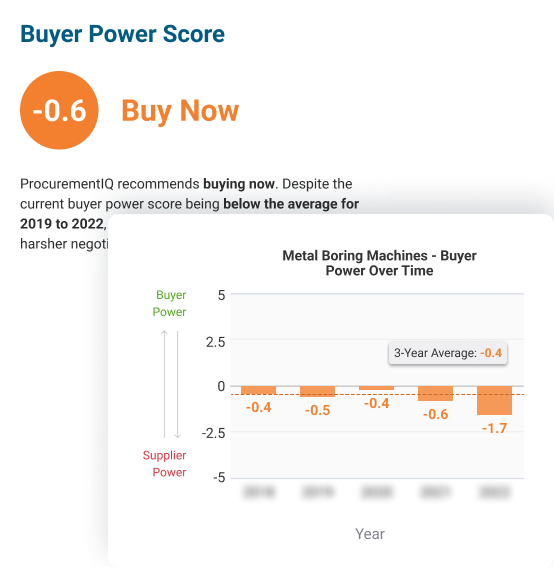
In 2026, buyer power amounts to -3.6 in the United States. Buyer power is most positively impacted by Recent Developments. It is most negatively impacted by Market Share Concentration. Subscribers can access details on eight other factors that impact buyer power. Learn more
United States

Buyer power forecasts: your glimpse into the future
Develop strategies for the upcoming year and identify unforeseen opportunities for buying now
- Actionable "Buy Now" and "Buy Later" insights
- Near-real-time updates to current and forecast Buyer Power Scores
- Methodology and weightings for Buyer Power Score Components
Supply Chain Risk
The average level of supply chain risk is assessed as High, which has a negative impact on buyer power. The level of supply chain risk is affected by industry volatility, barriers to entry, competition, import penetration, regulation and industry financial risk. Buyers in this market can mitigate procurement and supply chain management risks by monitoring risk levels for individual first and second tier suppliers:
1st
Tier Suppliers
- Ready-Mix Concrete Manufacturers
- Valve Manufacturing
- Heavy Equipment Rental Firms
- Metal Pipe Manufacturers
2nd
Tier Suppliers
- Iron & Steel Manufacturing Firms
Biggest Oil & Gas Pipeline Construction Suppliers in the US by Revenue
The largest Oil & Gas Pipeline Construction vendors by revenue in the US are Worley Limited, Williams Companies, Inc. and Mastec, Inc. Subscribers can sort and filter by market share concentration, profit level and other factors. Learn more
| Supplier | Operational Size | Headquarters | Number of Employees | Market Share (%) | Market Share Performance (3yr trend) | Total Revenue ($ million) | Profit Level (%) | Risk Level |
|---|---|---|---|---|---|---|---|---|
| Emcor Group, Inc. | International | NORWALK, CT | >10,000 | 5-10 | ||||
| Mastec, Inc. | National | CORAL GABLES, FL | >10,000 | 5-10 | ||||
| Williams Companies, Inc. | National | TULSA, OK | 1,001-10,000 | 5-10 | ||||
| Mcdermott International Inc. | Global | Houston | >10,000 | 5-10 | ||||
| Primoris Services Corporation | International | DALLAS, TX | >10,000 | 5-10 | ||||
| Michels Corporation | National | Brownsville, WI | 1,001-10,000 | 5-10 | ||||
| Bechtel Corporation | Global | Reston, VA | >10,000 | 5-10 | ||||
| Aecom | Global | DALLAS, TX | >10,000 | < 5 | ||||
| KBR Inc. | Global | HOUSTON | >10,000 | < 5 | ||||
Looking for a list of suppliers by country?
Subscribers can access vendor information on Canadian and European suppliers, too. We also offer custom research services to help with vendor sourcing anywhere in the world.
Profit Analysis
The average profit margin across vendors in the Oil & Gas Pipeline Construction market is 8.0% and steady. Profit levels shift depending on suppliers' spend on wages, purchases and overhead. The highest cost component for vendors is Overhead. The cost trend for this component is falling, when considering movement between 2025 and 2026. To understand cost forecasts for 2027 and uncover the implications on profit, start your subscription. Learn more
Vendor & Supply Chain Analysis
Low vendor risk indicates that buyers face a low risk of service disruptions due to instability in vendors that may stem from external forces or financial distress.
Low market share concentration indicates that the market is not controlled by a small portion of vendors, fostering higher competition.
Supply chain risk in the market is elevated due to the stong shifts in the price of key materials, such as steel pipes and cement, and due to ongoing supply chain constraints leading to shortages and delays in materials.
The United States is a net importer of line pipes used for pipelines. With a large percentage of imported line pipe coming from Mexico and Canada, the risk of severe supply chain disruptions due to the reliance on foreign goods is lowered slightly. However, the introduction of tariffs on steel products has led to significant volatility and cost increases for pipeline construction contractors.
Supplier Information
Bechtel Corporation
Bechtel Corporation is a private company operating globally in the construction, professional, scientific & technical services and administration, business support and waste management services sectors. The company's offerings include field-erected tanks, general contractor services, industrial building &... Subscribe to learn more
Emcor Group, Inc.
Emcor Group, Inc. is a public company operating internationally in the construction, manufacturing, professional, scientific and technical services, administration, business support and waste management services and other services (except public administration) sectors. The company's offerings include building... Subscribe to learn more
Mastec, Inc.
MasTec, Inc. is an infrastructure construction company that engineers, builds, installs, maintains, and upgrades communications, energy, utility, and other infrastructure. It services include wireless, wireline/fiber, and customer fulfillment activities; power delivery infrastructure, including transmission,... Subscribe to learn more
Mcdermott International Inc.
McDermott International, Inc. is a global provider of engineering, procurement, construction and installation, and technology solutions to the energy industry. It delivers front-end design, engineering, procurement, fabrication, construction, installation, hook-up, start-up, and commissioning services to Subscribe to learn more
Michels Corporation
Michels Corporation is a private company operating nationally in the mining and construction sectors. The company's offerings include directional drilling services, oil & gas pipeline construction, transmission tower construction and oil & gas pipe coating services. Founded in 1959, the company is currently... Subscribe to learn more
Primoris Services Corporation
Primoris Services Corporation is a provider of infrastructure services to the utility and energy markets in the US and Canada. It organizes its business into two segments: the Utilities segment, which specializes in the installation and maintenance of new and existing natural gas and electric utility distribution... Subscribe to learn more
Williams Companies, Inc.
Williams Companies, Inc. is a public company operating nationally in the construction sector. The company's offerings include midstream oil & gas services and oil & gas pipeline construction. Founded in 1908, the company is currently headquartered in TULSA, Oklahoma, United States of America with an estimated... Subscribe to learn more
Aecom
Aecom is a public company operating globally in the construction, professional, scientific and technical services, administration, business support and waste management services and healthcare and social assistance sectors. The company's offerings include general contractor services, industrial building &... Subscribe to learn more
KBR Inc.
KBR, Inc. is an engineering company delivering solutions to governments and businesses. It offers research and development, advanced prototyping, acquisition support, systems engineering, systems assurance and technology, C5ISR, cyber analytics, space domain awareness, test and evaluation, systems integration... Subscribe to learn more
Accelerate the vendor selection process
Get a clear picture of the competition in a market and discover which vendors are best-suited for your sourcing needs. Our supplier profiles include hard-to-find financial ranges for private companies, cover public company data and feature an interactive competitor matrix.
Procurement Management KPIs for the Oil & Gas Pipeline Construction Market
Managing vendor performance throughout the contract period is easier when tracking specific key performance indicators (KPIs). For example, buyers should monitor Average Response Time and Employee Absence Rate. Buyers may experience better performance throughout their contracts if they establish service level agreements (SLAs) based on Communication and other factors.
| KPI | Level of Importance (1-5) | Measurements | Key Considerations |
|---|---|---|---|
| Average Response Time |
|
Time to respond to regular outreach Time to respond to conflicts |
Buyers should measure the time it takes for the point of contact on the project to respond to questions, concerns or any buyer outreach. Quicker response times typically lead to faster conflict resolution. Buyers should take into consideration the urgency of their message to the point of contact. Vendors may prioritize responses differently depending on the importance of a response. |
| Employee Absence Rate |
|
Number of days employees were absent Correlation of absent employees and project schedule variance |
The project deadline should account for an average absence rate, as sick time and vacation time should be factored in. However, excessive time off should be addressed if it is impacted deadlines. Buyers should measure the rate at which the vendor’s employees do not show up to the work site. Continuous absentees may result in missed deadlines and project delays. |

Questions to Ask During Procurement Negotiations
How can I gain leverage during negotiations?
Subcontractor Groups
Which subcontractors have you done work like this with in the past?
How does your company select subcontractors?
Timeliness
How do you ensure that your employees are all working consistently?
What methods of time management does your company employ?
Business Continuity
Can you go over your firm's cost structure?
What purchases or costs do you struggle with? Why?
The ultimate prep for procurement negotations
View all 24 negotiation questions for this category when you subscribe.
Oil & Gas Pipeline Construction RFP Guidelines
What should my RFP include?
Organizational Overview
Buyers should give an overview of their organization, including the type(s) of material(s) being transported using the pipeline.
Buyers should specify the type (i.e. underground, subsea, above ground) of pipeline that needs to be constructed.
Statement Of Need
Buyers should specify the number of miles of pipeline to be built and the type of surrounding topography.
Buyers should communicate known construction projects nearby that may impede progress on the project, such as road closures.
Project Budget
Buyers should specify the total budget, and how to proceed if the budget is exhausted before the services are completed.
Buyers should specify the desired payment terms.
The RFP process made easy
Find out how you can access RFP templates for 800+ procurement categories to start writing better, more consistent RFPs.
We display average pricing information, trends and market data.
Our Reports include:
- Opportunity assessment
- Market dynamics
- Recent developments
- Positive and warning trends
- Buyer power levers
- Price environment and market pricing
- Geographic wage rates
- Global market updates
- Total cost of ownership
- Cost structure benchmarks and analysis
- Supply chain and vendors
- Global supplier breakdown
- Market share concentration
- Regulation and business requirements
- Vendor management and KPIs
- Sourcing strategy guidance