Procurement Market Intelligence Report
Pesticides
Sourcing Guide & Market Intelligence
Smarter cost management starts with comprehensive market intelligence
 United States
 Global
Quick Navigation
Pesticides Global Overview
Definition
Summary
Pesticides are chemical or biological substances used to prevent, control, or kill plant, fungal, and animal pests. They are used in agricultural, commercial, and industrial settings to protect against insects, weeds, rodents, birds, and a variety of other pest types. Pesticides are usually categorized according to the type of pest they help control and can be applied in the form of sprays, repellents, dips, or powders. Pesticides are bought by farmers, gardeners, and lawn care professionals.
This Report Includes:
- Insecticides
- Rodenticides
- Herbicides
- Fungicides
Not in this Report:
- Genetically Modified Organisms (GMOs) with Pesticide Properties
- Disinfectants
Global Pesticides Procurement Trends
Discover the top international trends affecting procurement in the global Pesticides market.
Warning Trends
Tariffs to negatively impact chemicals industry
- The Trump Administration’s reciprocal tariffs, which apply general tariff rate increases to most leading US trade partners in August, and raised tariffs on specific chemicals like branded and patented pharmaceutical products to 100.0% in October. These changes will significantly increase the tariff rate on leading chemical exporting countries, including the European Union (15.0%), Canada (35.0%), China (54.0%), Singapore (10.0%), and India (25.0%).
- Certain chemicals, including polyethylene, polypropylene, polyethylene terephthalate, phenols, ethylene, and titanium dioxide, are exempt from tariffs. However, according to Chemical Processing Magazine, tariffs, in general, are expected to add 2.0% to 5.0% to overall expenses for US chemical producers due to higher steel and equipment costs, as well as rising supply chain risk.
- China is a major supplier of chemicals to the United States, estimated to account for around 11.0% of total imports, according to the US Chamber of Commerce. Most of these imports are intermediate products used as inputs in domestic chemical production, meaning the tariffs will still impact chemical suppliers with US manufacturing operations.
- According to the Society of Chemical Manufacturers and Affiliates (SOCMA), the higher US tariff rate on imports of chemicals will disrupt supply chains and raise operating costs for domestic chemical manufacturers. Increased input costs are typically passed on to buyers in the form of higher prices.
- The United States is the most important export market for Germany’s chemical industry, and major suppliers like BASF are expected to be negatively impacted by the 15.0% tariff on the European Union member countries. However, chemicals covered under the United States-Mexico-Canada (USMCA) agreement, meaning those produced wholly in Mexico or Canada, will be exempt from tariffs on Canadian and Mexican imports, providing some relief for the highly integrated North American chemicals trade.
Global Pesticides Market - Suppliers by Region
| Country/Region | Number of Suppliers |
|---|---|
| #1 China | 16,585 |
| #2 Europe | 9,890 |
| #3 India | 8,145 |
Explore supplier concentration across the globe
We've uncovered the 11 top regions for global procurement, based on feedback from our most strategic clients. Access vendor counts for each unique region when you subscribe.
2
Geography Drilldown - US
Average Cost of Pesticides
United States
2026 Market Pricing$18.00 to $XX.XX
per literAverage Price
Prices in the Pesticides market range from $18.00 to $XX.XX, depending on Pesticide Composition, Pesticide Concentration and Order Quantity. For example, lower prices are associated with Synthetic ($15 to $45 per liter), whereas higher prices are associated with Environmentally friendly ($25 to $45 per liter), Natural ($30 to $45per liter) and Liquid ($30 to $45 per liter).
Need the scoop on international price trends?
Between our Europe and Canada collections, we provide price data for 350 markets so you can instantly compare prices across borders. Or, use our custom research services for intel on prices in any region across the globe.
Pesticides Category Price Trends
Pricing trends are indicated by the compound annual growth rate (CAGR) during a set period of time. For the Pesticides market, prices in the US have declined -0.6% from 2022 to 2025. Subscribers can access price trend forecasts, price driver projections and forward-looking cost structure data. Learn more
United States (2022-2025)


Wondering where prices are heading?
Price trend forecasts are available to subscribers, along with price driver projections and forward-looking cost structure data.
Cost Analysis - Total Cost of Ownership for Pesticides
Total cost of ownership is High in the Pesticides market. The average cost of ownership differs depending on the contract but generally includes costs negotiated before the contract begins, costs billed during the contract period and unforeseen costs. For example, unforeseen costs in the form of Spoilage may raise the total cost of ownership unexpectedly.
Negotiated Before
Customization
Billed During
Handling
Unforeseen
Spoilage
Emergencies
Buyer Power in Procurement Negotiations
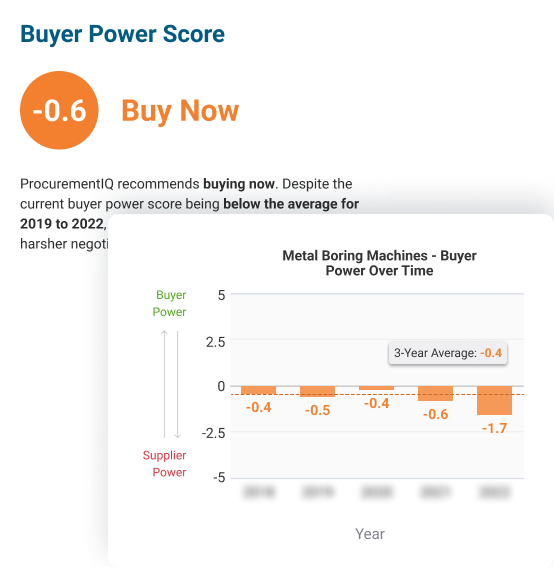
In 2026, buyer power amounts to -2.1 in the United States. Buyer power is most positively impacted by Recent Developments. It is most negatively impacted by Recent Price Trend. Subscribers can access details on eight other factors that impact buyer power. Learn more
United States
Buyer power forecasts: your glimpse into the future
Develop strategies for the upcoming year and identify unforeseen opportunities for buying now
- Actionable "Buy Now" and "Buy Later" insights
- Near-real-time updates to current and forecast Buyer Power Scores
- Methodology and weightings for Buyer Power Score Components
Supply Chain Risk
The average level of supply chain risk is assessed as High, which has a negative impact on buyer power. The level of supply chain risk is affected by industry volatility, barriers to entry, competition, import penetration, regulation and industry financial risk. Buyers in this market can mitigate procurement and supply chain management risks by monitoring risk levels for individual first and second tier suppliers:
1st
Tier Suppliers
- Organic Chemical Manufacturers
- Inorganic Chemical Manufacturers
- Fertilizer Manufacturers
- Oxygen & Hydrogen Gas Manufacturers
2nd
Tier Suppliers
- Petrochemical Manufacturers
- Mineral & Phosphate Miners
Biggest Pesticides Suppliers in the US by Revenue
The largest Pesticides vendors by revenue in the US are Univar Inc., Brenntag AG and Corteva, Inc. Subscribers can sort and filter by market share concentration, profit level and other factors. Learn more
| Supplier | Operational Size | Headquarters | Number of Employees | Market Share (%) | Market Share Performance (3yr trend) | Total Revenue ($ million) | Profit Level (%) | Risk Level |
|---|---|---|---|---|---|---|---|---|
| Bayer Corp | Global | Leverkusen, DE | >10,001 | 25+ | ||||
| Corteva, Inc. | INDIANAPOLIS, IN | >10,000 | 25+ | |||||
| China National Chemical Corporation | Global | CN | >10,000 | 25+ | ||||
| Basf Se | Global | Ludwigshafen, DE | >10,001 | 5-10 | ||||
| Sumitomo Chemical Company Ltd. | Global | Tokyo, JP | >10,001 | < 5 | ||||
| UPL Corporation Ltd. | Global | Mumbai, IN | >10,001 | < 5 | ||||
| Brenntag AG | Global | Essen, DE | >10,001 | < 5 | ||||
| Univar Inc. | Global | DOWNERS GROVE, IL | 1,001-10,000 | < 5 | ||||
| FMC Corporation | Global | PHILADELPHIA, PA | 1,001-10,000 | < 5 | ||||
Looking for a list of suppliers by country?
Subscribers can access vendor information on Canadian and European suppliers, too. We also offer custom research services to help with vendor sourcing anywhere in the world.
Profit Analysis
The average profit margin across vendors in the Pesticides market is 4.5% and steady. Profit levels shift depending on suppliers' spend on wages, purchases and overhead. The highest cost component for vendors is Purchases. The cost trend for this component is falling, when considering movement between 2025 and 2026. To understand cost forecasts for 2027 and uncover the implications on profit, start your subscription. Learn more
Vendor & Supply Chain Analysis
The three top vendors each hold a market share concentration above 25.0%, which enables them to keep prices high.
Vendor risk is moderate due to fluctuations in demand from farmers and the significant investments vendors must make to develop and handle pesticides. As a result, vendors may charge higher prices due to the risk of going out of business.
Supply chain risk is high due to tariffs placed on Chinese imports for input materials and ongoing supply shortages of chemicals. Because vendors maintain a large client pool of farmers and gardeners who rely on pesticides, buyers absorb the supply chain risk in the form of higher prices.
The United States is a net importer of pesticides, meaning it imports more pesticides than it exports. US Buyers can effectively leverage the option of sourcing from an international supplier against a domestic supplier
Supplier Information
Bayer Corp
Bayer Corp is a public company operating globally in the manufacturing sector. The company's offerings include pesticides. Founded in 1863, the company is currently headquartered in Leverkusen, Germany with an estimated employee count of over 10,000. Subscribe to learn more
China National Chemical Corporation
China National Chemical Corporation is a private company operating globally in the manufacturing and manufacturing sectors. The company's offerings include pesticides and extrusion machines. Founded in 1984, the company is currently headquartered in Beijing, China, China with an estimated 10000 employees.... Subscribe to learn more
Corteva, Inc.
Corteva, Inc. is a public company operating in the manufacturing sector. The company's offerings include pesticides. Founded in 2019, the company is currently headquartered in INDIANAPOLIS, Indiana, United States of America with an estimated 21000 employees. Subscribe to learn more
Basf Se
Basf Se is a public company operating globally in the manufacturing, manufacturing and professional, scientific & technical services sectors. The company's offerings include pesticides, refining catalysts, plasticizers, preservatives, waterproofing coatings. Founded in 1865, the company is currently headquartered... Subscribe to learn more
Brenntag AG
Brenntag AG is a public company operating globally in the manufacturing sector. The company's offerings include pesticides, diesel exhaust fluid (def), water treatment chemicals and industrial absorbents. Founded in 1874, the company is currently headquartered in Essen, Germany with an estimated employee Subscribe to learn more
FMC Corporation
FMC Corporation is a global agricultural sciences company that discovers and develops new insecticide, herbicide, and fungicide active ingredients, product formulations, and technologies. Its product portfolio features two key diamide-class molecules: Rynaxypyr® (chlorantraniliprole) and Cyazypyr® (cyantraniliprole)... Subscribe to learn more
Nufarm Ltd
Nufarm Ltd is a public company operating globally in the manufacturing sector. The company's offerings include pesticides. Founded in 2013, the company is currently headquartered in Melbourne, Australia with an estimated 5500 employees. Subscribe to learn more
Sumitomo Chemical Company Ltd.
Sumitomo Chemical Company Ltd. is a public company operating globally in the manufacturing sector. The company's offerings include pesticides. Founded in 2013, the company is currently headquartered in Tokyo, Japan with an estimated employee count of over 10,000. Subscribe to learn more
Univar Inc.
Univar Inc. is a public company operating globally in the manufacturing sector. The company's offerings include pesticides, detergent, drilling fluids, water treatment chemicals, industrial absorbents. Founded in 1924, the company is currently headquartered in DOWNERS GROVE, Illinois, United States of America... Subscribe to learn more
Accelerate the vendor selection process
Get a clear picture of the competition in a market and discover which vendors are best-suited for your sourcing needs. Our supplier profiles include hard-to-find financial ranges for private companies, cover public company data and feature an interactive competitor matrix.
Procurement Management KPIs for the Pesticides Market
Managing vendor performance throughout the contract period is easier when tracking specific key performance indicators (KPIs). For example, buyers should monitor Mean Time to Failure (MTTF) and On-Time Delivery (OTD). Buyers may experience better performance throughout their contracts if they establish service level agreements (SLAs) based on Compliance and other factors.
| KPI | Level of Importance (1-5) | Measurements | Key Considerations |
|---|---|---|---|
| Mean Time to Failure (MTTF) |
|
Time for pesticides to spoil Number of spoiled pesticides |
Having an understanding of how quickly pesticides will spoil can help buyers select the proper pesticide they need in the proper volume. Buyers should prioritize a pesticide that takes two years to spoil. |
| On-Time Delivery (OTD) |
|
Planned delivery date Actual delivery date |
If pesticides are not delivered on time, then buyers must delay their pesticide application project. This value is more important for specialized pesticides, since most pesticides can be bought off the shelf, as is. |

Questions to Ask During Procurement Negotiations
How can I gain leverage during negotiations?
Product Lines
Do you specialize in one or a few categories of pesticide?
Pests adapt to treatments over time, allowing them to reappear every year. How do you address this issue?
Supply Chain Risk
What key markets do you focus on? How close are you to these markets to provide timely service?
Have you had to deal with issues regarding quality control of upstream inputs? If so, how did you address these issues?
Environment
How are you adjusting your production to account for newer forms of pest control, such as genetically modified seeds?
Are you addressing the needs of buyers that prefer ecofriendly or more humane treatments in their pest control needs? If so, how?
The ultimate prep for procurement negotations
View all 26 negotiation questions for this category when you subscribe.
Pesticides RFP Guidelines
What should my RFP include?
Organizational Overview
Buyers should describe what type of area they need pesticides applied to (e.g., a golf course, public park, or agricultural field).
Buyers should give the acreage or dimensions of the area being serviced.
Statement Of Need
Buyers should detail the types of pests they are trying to exterminate.
Buyers must inform suppliers of any laws or regulations they are required to follow.
Project Budget
Buyers should give a total dollar amount for the contract.
Buyers should request the cost per bag or container, and relay to suppliers their per-unit cost expectations.
The RFP process made easy
Find out how you can access RFP templates for 800+ procurement categories to start writing better, more consistent RFPs.
We display average pricing information, trends and market data.
Our Reports include:
- Opportunity assessment
- Market dynamics
- Recent developments
- Positive and warning trends
- Buyer power levers
- Price environment and market pricing
- Geographic wage rates
- Global market updates
- Total cost of ownership
- Cost structure benchmarks and analysis
- Supply chain and vendors
- Global supplier breakdown
- Market share concentration
- Regulation and business requirements
- Vendor management and KPIs
- Sourcing strategy guidance