Procurement Market Intelligence Report
Financial Data Services
Sourcing Guide & Market Intelligence
Smarter cost management starts with comprehensive market intelligence
 United States
 Canada
 Europe
 Global
Quick Navigation
Financial Data Services Global Overview
Definition
Summary
Service providers compile financial data from public sources, such as stock exchange feeds, stock brokers and regulatory filings, into a central database that buyers can access in exchange for a monthly or annual fee. Typical buyers include banks, investors and corporations. Services are purchased from multiline vendors or specialists that focus on financial data services.
This Report Includes:
- Stock Feeds
- Company Financial Data
- Company Filings
Not in this Report:
- Investment Management Services
- Accounting
- Investment Consulting
Global Financial Data Services Procurement Trends
Discover the top international trends affecting procurement in the global Financial Data Services market.
Warning Trends
Fed lowers rates for the first time in 2025
- On September 17, the Federal Reserve’s Federal Open Market Committee (FOMC) voted to lower interest rates to a target range of 4.0% to 4.25%, down 0.25% from the rate it had been holding since November of last year.
- Despite indications at the start of the year that steady reductions to the relatively high 4.25% to 4.5% rate were on the horizon, the Fed held off on rate cuts for much of the year due to concerns that the combination of higher tariffs and a reduction in borrowing costs could cause rebounding inflation.
- The September cut to Fed interest rates signals a shift in this strategy, indicating that the Fed now considers weakening employment figures a greater threat than inflation. As a result, FOMC officials have also signaled that two additional rate cuts are likely before the end of the year in an effort to fight unemployment and stimulate the economy.
- Declining Fed funds rates will provide relief to borrowers by lowering the market interest rates for consumer and business loans. This reduction in the cost of borrowing will reduce the cost of many banking and financial services, and may spur increases in demand across the economy.
The European Union’s Artificial Intelligence (AI) Act enters into force
- In August 2024, the European Union (EU) began enforcing its new regulation on artificial intelligence. Although EU legislation, the act will have a major effect on global technological companies operating in the AI space, similar to the General Data Protection regulation.
- The legislation aims to apply a risk-based framework to AI regulation, meaning different AI applications will be treated differently. The law applies a general ban for “unacceptable” uses, such as social scoring and predictive policing.
- For general-purpose AI models, companies will be required to comply with EU copyright law and intellectual property provisions, carry out regular testing, issue transparency disclosures, and implement adequate cybersecurity protections. For “high-risk” AI applications, such as autonomous vehicles, medical devices, financial services, and biometric identification systems, companies must meet stricter requirements in terms of risk-mitigation systems, documentation, human oversight, and cybersecurity.
- Companies that breach the AI Act may face fines ranging from 7.5 million euros or 1.5% of global annual revenues to 35.0 million euros or 7.0% of global annual revenues, whichever amount is higher.
- While the blanket ban on unacceptable systems entered into force in February 2025, most of the obligations do not take effect for a full year. In August 2025, requirements for general-purpose AI will come into effect, and in August 2026, obligations for high-risk AI systems will be enforced.
Global Financial Data Services Market - Suppliers by Region
| Country/Region | Number of Suppliers |
|---|---|
| #1 China | 495 |
| #2 Europe | 465 |
| #3 Oceania & Southeast Asia | 400 |
Explore supplier concentration across the globe
We've uncovered the 11 top regions for global procurement, based on feedback from our most strategic clients. Access vendor counts for each unique region when you subscribe.
2
Geography Drilldown - US, Canada & Europe
Average Cost of Financial Data Services
United States
2026 Market Pricing$3,600.00 to $XX,XXX.XX
per terminal per year
Average Price
Prices in the Financial Data Services market range from $3,600.00 to $XX,XXX.XX, depending on Data configuration, Number of seats, Regional location and Data delivery. For example, lower prices are associated with Basic stock and fund data, whereas higher prices are associated with Full suite of data and live terminal.
Need the scoop on international price trends?
Between our Europe and Canada collections, we provide price data for 350 markets so you can instantly compare prices across borders. Or, use our custom research services for intel on prices in any region across the globe.
Financial Data Services Category Price Trends
Pricing trends are indicated by the compound annual growth rate (CAGR) during a set period of time. For the Financial Data Services market, prices in the US have grown 2.5% from 2022 to 2025. and +0.9% in Europe.
United States (2022-2025)

Europe (2022-2025)
Compound Annual Growth Rate
Wondering where prices are heading?
Price trend forecasts are available to subscribers, along with price driver projections and forward-looking cost structure data.
Cost Analysis - Total Cost of Ownership for Financial Data Services
Total cost of ownership is Low in the Financial Data Services market. The average cost of ownership differs depending on the contract but generally includes costs negotiated before the contract begins, costs billed during the contract period and unforeseen costs. For example, unforeseen costs in the form of Downtime may raise the total cost of ownership unexpectedly.
Negotiated Before
Installation
Billed During
Training
Unforeseen
Downtime
Buyer Power in Procurement Negotiations
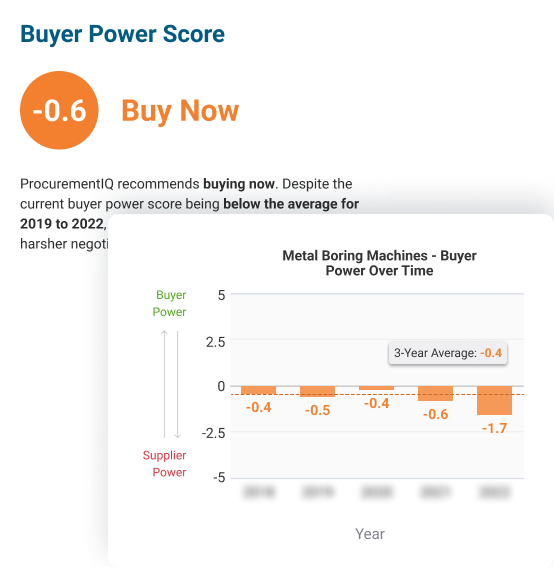
In 2026, buyer power amounts to -1.2 in the United States. Buyer power is most positively impacted by Recent Developments. It is most negatively impacted by Recent Price Volatility. Subscribers can access details on eight other factors that impact buyer power. Learn more
United States

Buyer power forecasts: your glimpse into the future
Develop strategies for the upcoming year and identify unforeseen opportunities for buying now
- Actionable "Buy Now" and "Buy Later" insights
- Near-real-time updates to current and forecast Buyer Power Scores
- Methodology and weightings for Buyer Power Score Components
Supply Chain Risk
The average level of supply chain risk is assessed as Low, which has a positive impact on buyer power. The level of supply chain risk is affected by industry volatility, barriers to entry, competition, import penetration, regulation and industry financial risk. Buyers in this market can mitigate procurement and supply chain management risks by monitoring risk levels for individual first and second tier suppliers:
1st
Tier Suppliers
- Wired Telecommunication Carriers
- Data Process & Hosting Service Providers
- Commercial Real Estate
2nd
Tier Suppliers
- Transmission Line Construction Companies
- Software Publishers
- Computer Manufacturers
- Real Estate Sales & Brokerage Companies
Biggest Financial Data Services Suppliers in the US by Revenue
The largest Financial Data Services vendors by revenue in the US are Fidelity Investment, Standard & Poor's and Intercontinentalexchange Inc. Subscribers can sort and filter by market share concentration, profit level and other factors. Learn more
| Supplier | Operational Size | Headquarters | Number of Employees | Market Share (%) | Market Share Performance (3yr trend) | Total Revenue ($ million) | Profit Level (%) | Risk Level |
|---|---|---|---|---|---|---|---|---|
| Bloomberg Inc. | Global | New York, NY | >10,000 | 25+ | ||||
| Thomson Reuters Corporation | Global | TORONTO | >10,000 | 25+ | ||||
| Intercontinentalexchange Inc. | ATLANTA | >10,000 | 5-10 | |||||
| Factset Research Systems Inc. | Global | NORWALK, CT | >10,000 | 5-10 | ||||
| Dow Inc. | Global | MIDLAND, MI | >10,000 | < 5 | ||||
| Moody’s Corporation | Global | NEW YORK | >10,000 | < 5 | ||||
| Ss&C Technologies Inc. | Global | WINDSOR, CT | >10,000 | < 5 | ||||
| Morningstar, inc. | Global | CHICAGO | >10,000 | < 5 | ||||
| Fidelity Investment | US | < 5 | ||||||
Looking for a list of suppliers by country?
Subscribers can access vendor information on Canadian and European suppliers, too. We also offer custom research services to help with vendor sourcing anywhere in the world.
Profit Analysis
The average profit margin across vendors in the Financial Data Services market is 19.9% and steady. Profit levels shift depending on suppliers' spend on wages, purchases and overhead. The highest cost component for vendors is Overhead. The cost trend for this component is falling, when considering movement between 2025 and 2026. To understand cost forecasts for 2027 and uncover the implications on profit, start your subscription. Learn more
Vendor & Supply Chain Analysis
Vendors in the market have a low average risk due to the lack of competition in the market and from competitors, indicating that buyers are unlikely to encounter service disruptions due to issues such as financial instability among vendors.
Vendors in the market have a low supply chain risk as they don't rely on constant procurement of physical inputs.
Market share concentration is high, with vendors such as Bloomberg Inc. and Thomson Reuters Corporation each having over 25.0% of the total market share.
The United States is a net importer of computers, meaning it imports more computers than it exports. While lower manufacturing costs abroad drive down prices for imported computers, relying on imports can lead to potential shortages or price increases if there are supply chain disruptions due to geopolitical tensions, trade disputes, or global crises
Supplier Information
Bloomberg Inc.
Bloomberg Inc. is a private company operating globally in the information sector. The company's offerings include financial data services. Founded in 1981, the company is currently headquartered in New York, New York, United States of America with an estimated 10000 employees. Subscribe to learn more
Thomson Reuters Corporation
Thomson Reuters Corporation is a public company operating globally in the information and professional, scientific and technical services sectors. The company's offerings include financial analysis software, tax preparation software, online compliance training, legal management software, aca compliance software.... Subscribe to learn more
Factset Research Systems Inc.
Factset Research Systems Inc. is a public company operating globally in the information sector. The company's offerings include financial data services. Founded in 1978, the company is currently headquartered in NORWALK, Connecticut, United States of America with an estimated 11203 employees. Subscribe to learn more
Intercontinentalexchange Inc.
Intercontinental Exchange, Inc. is a global technology and data provider to financial institutions, corporations, and government entities. It organizes its business into three segments: the Exchanges segment, which operates regulated marketplace technology for listing, trading, and clearing of derivatives... Subscribe to learn more
Dow Inc.
Dow Inc. is a public company operating globally in the manufacturing, information and professional, scientific and technical services sectors. The company's offerings include detergent, plasticizers, preservatives, waterproofing coatings, methanol. Founded in 1897, the company is currently headquartered in... Subscribe to learn more
Fidelity Investment
FMR LLC is a private company operating globally in the information and finance & insurance sectors. The company's offerings include lockbox services and financial data services. Founded in 1946, the company is currently headquartered in Boston, Massachusetts, United States of America with an estimated employee... Subscribe to learn more
Moody’s Corporation
Moody's Corporation is a global integrated risk assessment company that provides data, analytical solutions, and insights. It organizes its business into two segments: Moody's Analytics segment, which provides research and insights, data and information, and decision solutions, and Moody's Investor's Advice,... Subscribe to learn more
Morningstar, inc.
Morningstar, Inc. is a global provider of independent investment research services. It organizes its business into five reportable segments: the Morningstar Data and Analytics segment, which offers comprehensive data, research, insights, and investment analysis; the PitchBook segment, which provides a collection... Subscribe to learn more
Ss&C Technologies Inc.
Ss&C Technologies Inc. is a public company operating globally in the information sector. The company's offerings include virtual data room software and financial data services. Founded in 2015, the company is currently headquartered in WINDSOR, Connecticut, United States of America with an estimated 27600... Subscribe to learn more
Accelerate the vendor selection process
Get a clear picture of the competition in a market and discover which vendors are best-suited for your sourcing needs. Our supplier profiles include hard-to-find financial ranges for private companies, cover public company data and feature an interactive competitor matrix.
Procurement Management KPIs for the Financial Data Services Market
Managing vendor performance throughout the contract period is easier when tracking specific key performance indicators (KPIs). For example, buyers should monitor Average Resolution Time and Critical Bugs. Buyers may experience better performance throughout their contracts if they establish service level agreements (SLAs) based on System Availability and other factors.
| KPI | Level of Importance (1-5) | Measurements | Key Considerations |
|---|---|---|---|
| Average Resolution Time |
|
Time to resolution for minor conflicts Time to resolution for major conflicts |
Complaints or service issues should be resolved in a prompt manner. Buyers should assess resolution time using different weightings for different levels of conflict severity. |
| Critical Bugs |
|
Number of bugs per version Bugs identified and fixed Number of bugs leading to service disruptions per year |
Software and web-based services will likely have bugs to some degree, but critical bugs that affect the use of the product or service will negatively impact buyers. Buyers should assess the vendor's update schedule to identify how frequently they are address bugs found. |

Questions to Ask During Procurement Negotiations
How can I gain leverage during negotiations?
Experience and Expertise
How long have you provided services to your longest tenured client? Who are your five largest clients?
On average, how many years of experience does your analysis team have in this field? How does this measure up to the industry average?
Quality Control
Does a separate department check and verify data and analysis before it is disseminated to clients? If not, how do you ensure the integrity of your outgoing data?
How many employees do you have in production roles and how many in quality control roles?
Reputation
Who are your top five clients and how long have they been your clients?
What is your average retention rate?
The ultimate prep for procurement negotations
View all 25 negotiation questions for this category when you subscribe.
Financial Data Services RFP Guidelines
What should my RFP include?
Organizational Overview
Buyers should provide an overview of their organization that details their main operations. The buyer should also include a brief history of the organization.
Buyers should indicate which downstream markets they serve.
Statement Of Need
Buyers should provide a more detailed explanation of the services being requested.
Buyers should state why they are requesting financial data services and what they hope to gain.
Project Budget
Buyers should specify their budget for the financial data services.
Buyers should provide alternative budgets, if available.
The RFP process made easy
Find out how you can access RFP templates for 800+ procurement categories to start writing better, more consistent RFPs.
We display average pricing information, trends and market data.
Our Reports include:
- Opportunity assessment
- Market dynamics
- Recent developments
- Positive and warning trends
- Buyer power levers
- Price environment and market pricing
- Geographic wage rates
- Global market updates
- Total cost of ownership
- Cost structure benchmarks and analysis
- Supply chain and vendors
- Global supplier breakdown
- Market share concentration
- Regulation and business requirements
- Vendor management and KPIs
- Sourcing strategy guidance