Procurement Market Intelligence Report
Crawler Cranes
Sourcing Guide & Market Intelligence
Smarter cost management starts with comprehensive market intelligence
 United States
 Global
Quick Navigation
Crawler Cranes Global Overview
Definition
Summary
Crawlers cranes include a machine deck mounted on tracks (called crawlers) with a boom and hoist attached. Crawler cranes carry heavy loads of up to several thousand tons around a work site. The tracks enable the crane to easily move around a site while the deck and attachments rotate up to 360 degrees. Buyers can purchase cranes directly from manufacturers or from wholesalers and dealers. Common buyers of crawler cranes include operators in the construction and mining markets.
This Report Includes:
- New & Used Crawler Cranes
- Telescopic Crawler Cranes
- Lattice Boom Crawler Cranes
Not in this Report:
Take the ProcurementIQ products and data tour
Explore live samples of price trend forecasts, price driver projections, forward-looking cost structure data and more.
Global Crawler Cranes Procurement Trends
Discover the top international trends affecting procurement in the global Crawler Cranes market.
Warning Trends
Tariffs to negatively impact the industrial manufacturing and processing machinery sector
- The Trump Administration’s reciprocal tariffs, which apply general tariff rate increases to most leading US trade partners, are set to take effect on August 7, after the administration finalized the rates on August 1. As a result, leading sources of industrial equipment imports face significantly increased tariffs, including Canada (35.0%), China (54.0%), the European Union (15.0%), Japan (15.0%), Mexico (25.0%), and South Korea (15.0%).
- Additionally, the administration increased tariffs on aluminum and steel, common input materials for industrial machinery, to 50.0%, which is likely to increase input costs for suppliers operating inside the United States.
- China, Mexico, and Japan are three of the top sources of US machinery imports, accounting for about 50.0% of US imports in total. In addition to the increased costs from tariffs on these countries, the Japanese and Mexican machinery sectors could face increased financial risk as a large share of their revenue comes from US clients.
- According to the Association of Equipment Manufacturers, the increase in tariff rates on steel and aluminum in 2018 led to a 78.0% increase in domestic equipment production costs, a trend that may be repeated following the latest increases in steel and aluminum tariffs.
- Suppliers that source machinery or parts from tariff-affected countries may see supply chain disruptions or extended lead times as they seek alternative suppliers to mitigate tariff impacts. In addition, buyers seeking to rent industrial machinery will likely see higher rental rates as dealers pass on higher costs and possibly limited available units if supply chain issues occur.
United States announces new tariffs on all imported steel
- In February 2025, the United States announced 25.0% tariffs on all imported steel with no exemptions or exceptions. The tariffs took effect on March 12, 2025. On June 4th, these tariffs were increased further to 50%. These tariffs were not impacted by a recent court decision that temporarily suspended duties on certain goods as they were implemented under Section 232 of the Trade Expansion Act.
- Previously, countries such as Canada, Mexico, and Brazil, the top exporters of steel to the United States, had exemptions from tariffs. These have now been removed and all imported steel, regardless of origin, will be subject to the 50.0% tariff. However, on May 8th, the US announced an agreement with the United Kingdom to remove all levies on steel exported from the UK.
- When tariffs on steel imports were introduced in March 2018, they contributed to an increase in the price of steel and steel products. According to the Bureau of Labor Statistics, the price of steel-milled products increased by 10.2% in the year after the tariffs were implemented. This market heavily relies on steel as an input and may be impacted by this policy.
Global Crawler Cranes Market - Suppliers by Region
| Country/Region | Number of Suppliers |
|---|---|
| #1 China | 1,935 |
| #2 Europe | 765 |
| #3 United States | 700 |
Explore supplier concentration across the globe
We've uncovered the 11 top regions for global procurement, based on feedback from our most strategic clients. Access vendor counts for each unique region when you subscribe.
Geography Drilldown - US
Average Cost of Crawler Cranes
United States
2026 Market Pricing$16,000.00 to $XX,XXX,XXX.XX
per unitAverage Price
Prices in the Crawler Cranes market range from $16,000.00 to $XX,XXX,XXX.XX, depending on Lift Capacity, Boom Reach and Condition. For example, lower prices are associated with 100 to 200 tons ($16,000 to $700,000 per unit), whereas higher prices are associated with 200 to 500 tons ($700,000 to $1,500,000 per unit) and 500 to 1000 tons ($2,000,000 to $5,000,000 per unit).
Need the scoop on international price trends?
Between our Europe and Canada collections, we provide price data for 350 markets so you can instantly compare prices across borders. Or, use our custom research services for intel on prices in any region across the globe.
Crawler Cranes Category Price Trends
Pricing trends are indicated by the compound annual growth rate (CAGR) during a set period of time. For the Crawler Cranes market, prices in the US have grown 3.5% from 2022 to 2025. Subscribers can access price trend forecasts, price driver projections and forward-looking cost structure data. Learn more
United States (2022-2025)


Wondering where prices are heading?
Price trend forecasts are available to subscribers, along with price driver projections and forward-looking cost structure data.
Cost Analysis - Total Cost of Ownership for Crawler Cranes
Total cost of ownership is Medium in the Crawler Cranes market. The average cost of ownership differs depending on the contract but generally includes costs negotiated before the contract begins, costs billed during the contract period and unforeseen costs. For example, unforeseen costs in the form of Downtime may raise the total cost of ownership unexpectedly.
Negotiated Before
Transportation
Financing
Billed During
Training
Maintenance
Warranties
Unforeseen
Downtime
Emergencies
Buyer Power in Procurement Negotiations
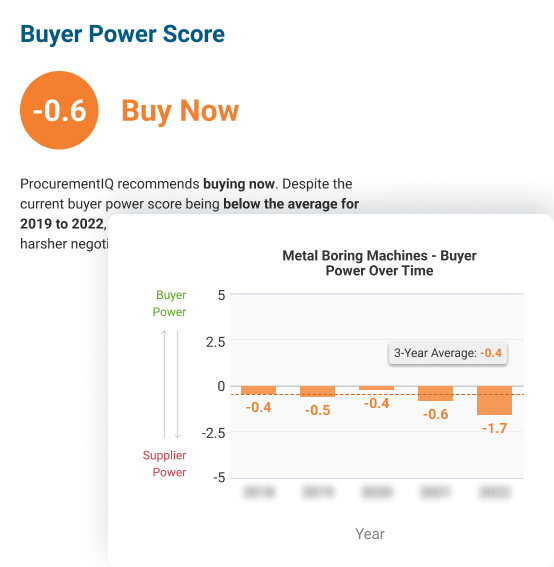
In 2026, buyer power amounts to -2.9 in the United States. Buyer power is most positively impacted by Recent Developments. It is most negatively impacted by Availability of Substitutes. Subscribers can access details on eight other factors that impact buyer power. Learn more
United States
Buyer power forecasts: your glimpse into the future
Develop strategies for the upcoming year and identify unforeseen opportunities for buying now
- Actionable "Buy Now" and "Buy Later" insights
- Near-real-time updates to current and forecast Buyer Power Scores
- Methodology and weightings for Buyer Power Score Components
Supply Chain Risk
The average level of supply chain risk is assessed as High, which has a negative impact on buyer power. The level of supply chain risk is affected by industry volatility, barriers to entry, competition, import penetration, regulation and industry financial risk. Buyers in this market can mitigate procurement and supply chain management risks by monitoring risk levels for individual first and second tier suppliers:
1st
Tier Suppliers
- Steel Rolling & Drawing Manufacturers
- Engine & Turbine Manufacturers
- Metal Stamping & Forging Manufacturers
2nd
Tier Suppliers
- Iron & Steel Manufacturers
- Iron Ore Miners
- Screw, Nut & Bolt Manufacturers
- Nonferrous Metal Rolling & Alloying Manufacturers
- Gasoline & Petroleum Wholesalers
Biggest Crawler Cranes Suppliers in the US by Revenue
The largest Crawler Cranes vendors by revenue in the US are Mammoet, Sennebogen Maschinenfabrik GmbH and Altec Inc. Subscribers can sort and filter by market share concentration, profit level and other factors. Learn more
| Supplier | Operational Size | Headquarters | Number of Employees | Market Share (%) | Market Share Performance (3yr trend) | Total Revenue ($ million) | Profit Level (%) | Risk Level |
|---|---|---|---|---|---|---|---|---|
| Liebherr Group | Global | Bulle, CH | >10,001 | 10-15 | ||||
| Tadano Ltd. | Global | Takamatsu, JP | 1,001-10,000 | 5-10 | ||||
| Zoomlion Heavy Industry Science & Technology Co., Ltd. | Global | Changsha, CN | >10,001 | 5-10 | ||||
| Konecranes Plc | Global | Hyvinkaa, FI | >10,001 | 5-10 | ||||
| The Manitowoc Company, Inc. | Global | MILWAUKEE, WI | 1,001-10,000 | 5-10 | ||||
| Kobe Steel Ltd. | Global | Kobe, JP | >10,001 | < 5 | ||||
| Sumitomo Heavy Industries Ltd. | Global | Tokyo, JP | >10,001 | < 5 | ||||
| Sany Heavy Industry Co., Ltd. | Global | Beijing , CN | >10,001 | < 5 | ||||
| Altec Inc. | Global | Birmingham, AL | 1,001-10,000 | < 5 | ||||
Looking for a list of suppliers by country?
Subscribers can access vendor information on Canadian and European suppliers, too. We also offer custom research services to help with vendor sourcing anywhere in the world.
Profit Analysis
The average profit margin across vendors in the Crawler Cranes market is 5.5% and rising. Profit levels shift depending on suppliers' spend on wages, purchases and overhead. The highest cost component for vendors is Purchases. The cost trend for this component is falling, when considering movement between 2025 and 2026. To understand cost forecasts for 2027 and uncover the implications on profit, start your subscription. Learn more
Vendor & Supply Chain Analysis
Supply chain risk is high in the market for crawler cranes, with steel rolling and drawing posing the largest threat. In the event of negative supply chain events affecting the main components or raw materials of crawler cranes, suppliers’ purchase costs will increase, putting upward pressure on the price buyers ultimately pay.
Average vendor risk in this market is moderate, as small suppliers are susceptible to supply chain risk and shifting demand trends. Large suppliers typically present less financial risk than smaller vendors because they benefit from having more diverse product portfolios and can cope better with changing trends.
The top four suppliers of crawler cranes account for between 30.0% and 45.0% of market revenue, which indicates a moderate level of market share concentration. While manufacturers compete strongly with one another, competition among wholesalers and dealers is weaker as manufacturers typically limit the number of wholesalers and dealers allowed to sell their equipment within a particular locale, which can mean fewer prospects for buyers from which to source bids.
The US is a net importer of crawler cranes, which may lead to longer lead times for delivery, higher transportation costs, and potential tariffs. However, buyers benefit from the wide availability of imported cranes, which aids buyer power by affording plenty of supplier options and enabling buyers to leverage lower-priced equipment from countries to drive up competition among vendors and obtain fair prices.
Supplier Information
Liebherr Group
Liebherr-International AG is a private company operating globally in the manufacturing sector. The company's offerings include front-end loaders, bulldozers, excavators, building demolition machinery & equipment, tower cranes. Founded in 1949, the company is currently headquartered in Bulle, Switzerland with... Subscribe to learn more
Konecranes Plc
Konecranes Plc is a public company operating globally in the manufacturing sector. The company's offerings include forklifts, tower cranes, workshop cranes, crawler cranes and gantry cranes. Founded in 1999, the company is currently headquartered in Hyvinkaa, Finland with an estimated employee count of over... Subscribe to learn more
Tadano Ltd.
Tadano Ltd. is a public company operating globally in the manufacturing sector. The company's offerings include aerial lifts, workshop cranes, crawler cranes and crane trucks. Founded in 1948, the company is currently headquartered in Takamatsu, Japan with an estimated 5500 employees. Subscribe to learn more
The Manitowoc Company, Inc.
The Manitowoc Company, Inc. is a holding company that provides engineered lifting solutions for the energy production and distribution, as well as utility, petrochemical, industrial, infrastructure, and commercial and residential construction applications. It designs, manufactures, markets, distributes, and... Subscribe to learn more
Zoomlion Heavy Industry Science & Technology Co., Ltd.
Zoomlion Heavy Industry Science & Technology Co., Ltd. is a public company operating globally in the manufacturing sector. The company's offerings include tower cranes and crawler cranes. Founded in 1999, the company is currently headquartered in Changsha, China with an estimated employee count of over 10,000.... Subscribe to learn more
Altec Inc.
Altec Inc. is a private company operating globally in the manufacturing sector. The company's offerings include crawler cranes, crane trucks and hydraulic tools. Founded in 1929, the company is currently headquartered in Birmingham, Alabama, United States of America with an estimated 5500 employees. Subscribe to learn more
CraneWorks Inc.
CraneWorks Inc. is a private company operating nationally in the manufacturing and other services (except public administration) sectors. The company's offerings include crawler cranes and heavy equipment installation & maintenance services. Founded in 2002, the company is currently headquartered in Birmingham,... Subscribe to learn more
Kobe Steel Ltd.
Kobe Steel Ltd. is a public company operating globally in the manufacturing sector. The company's offerings include crawler cranes and metal casting services. Founded in 1900, the company is currently headquartered in Kobe, Japan with an estimated employee count of over 10,000. Subscribe to learn more
Mammoet
Mammoet is a private company operating globally in the manufacturing sector. The company's offerings include crawler cranes and crane trucks. Founded in 1807, the company is currently headquartered in Scheidam, Netherlands with an estimated 5500 employees. Subscribe to learn more
Accelerate the vendor selection process
Get a clear picture of the competition in a market and discover which vendors are best-suited for your sourcing needs. Our supplier profiles include hard-to-find financial ranges for private companies, cover public company data and feature an interactive competitor matrix.
Procurement Management KPIs for the Crawler Cranes Market
Managing vendor performance throughout the contract period is easier when tracking specific key performance indicators (KPIs). For example, buyers should monitor Defect Density and Mean Time to Failure (MTTF). Buyers may experience better performance throughout their contracts if they establish service level agreements (SLAs) based on Warranty and other factors.
| KPI | Level of Importance (1-5) | Measurements | Key Considerations |
|---|---|---|---|
| Defect Density |
|
Number of defective units Number of units |
The defect density represents the share of defective crawler cranes that a company produces. Due to the significant danger involved with defective crawler cranes, specifically potential deaths, buyers should ensure suppliers have low defect rates to avoid significant operational issues. |
| Mean Time to Failure (MTTF) |
|
Total working hours until failure Total number of crane failures |
The mean time to failure represents the average time it takes for an operational asset to become inoperative. This measurement helps in predicting the expected service needs and can assist in proactive maintenance scheduling to attempt to prevent breakdowns. |

Questions to Ask During Procurement Negotiations
How can I gain leverage during negotiations?
Competition
What is your reputation like among competitors and customers, and how have you developed it?
What sets your crawler cranes apart from those of your competitors?
Quality Control
What types of technical issues have you experienced with this particular model of crawler crane?
How long will this crane last with proper care? How does the life span of this crane compare to that of other models?
Service & Maintenance
Do you offer maintenance and repair services? If not, can the services be included at an additional cost?
Are there any instances or circumstances that would significantly reduce the useful life?
The ultimate prep for procurement negotations
View all 24 negotiation questions for this category when you subscribe.
Crawler Cranes RFP Guidelines
What should my RFP include?
Organizational Overview
Buyers should describe their organization, including the industry, years in business, number of employees, and location.
The name and contact information for the individual that prospective suppliers should direct proposal questions or concerns toward should be provided.
Statement Of Need
Buyers should specify where the crawler crane will be placed for service. The location that a crane must be delivered should be included by buyers as well.
Buyers should indicate the type of operations for which a crane shall be suitable.
Project Budget
Buyers should state their total budget for crawler crane purchases.
Buyers should indicate if they will require financing for their purchase.
The RFP process made easy
Find out how you can access RFP templates for 800+ procurement categories to start writing better, more consistent RFPs.
We display average pricing information, trends and market data.
Our Reports include:
- Opportunity assessment
- Market dynamics
- Recent developments
- Positive and warning trends
- Buyer power levers
- Price environment and market pricing
- Geographic wage rates
- Global market updates
- Total cost of ownership
- Cost structure benchmarks and analysis
- Supply chain and vendors
- Global supplier breakdown
- Market share concentration
- Regulation and business requirements
- Vendor management and KPIs
- Sourcing strategy guidance