Procurement Market Intelligence Report
Machine Shop Services
Sourcing Guide & Market Intelligence
Smarter cost management starts with comprehensive market intelligence
 United States
 Canada
 Global
Quick Navigation
Machine Shop Services Global Overview
Definition
Summary
Service providers cut raw materials like metal, plastic, and composite materials into buyer-specified shapes and sizes. Suppliers are typically small local companies. The primary buyers of these services are aircraft manufacturers, tank and armored vehicle manufacturers, general-purpose machinery manufacturers, and engine and turbine manufacturers.
This Report Includes:
- Mechanical & Electrochemical Machining
- Milling Services
- Metal Stamping
- Sheet Metal Bending & Punching
- Turning, Drilling, Boring, & Tapping Services
Not in this Report:
- Metal Welding
- Forming Services
- Forging Services
Take the ProcurementIQ products and data tour
Explore live samples of price trend forecasts, price driver projections, forward-looking cost structure data and more.
Global Machine Shop Services Procurement Trends
Discover the top international trends affecting procurement in the global Machine Shop Services market.
Warning Trends
Public sector demand slumps as the government enters shutdown
- On October 1, the US federal government entered a shutdown after negotiations for a new appropriations bill failed.
- During a government shutdown, essential federal government operations, such as law enforcement, air-traffic control, and social security, persist, while nonessential operations are paused and workers involved in these operations are furloughed. Thus, the current shutdown is expected to result in 750,000 federal workers being furloughed, representing a $400 million reduction in daily expenditure by the federal government.
- This significant reduction in federal spending and operations will affect the entire US economy, weakening aggregate demand and slowing economic growth. For example, the 35-day government shutdown in Q1, 2019, reduced aggregate demand in both the public and private sectors, resulting in a 0.2% reduction in GDP growth that quarter.
- The effects of the shutdown are likely to be most acute in markets where the public sector is a major buyer segment, weakening demand and increasing average vendor risk by destabilizing important revenue streams.
- As negotiations for a new appropriations bill to reopen the government remain ongoing, ProcurementIQ will continue to monitor the situation and update this story with the latest information.
Tariffs to negatively impact the industrial manufacturing and processing machinery sector
- The Trump Administration’s reciprocal tariffs, which apply general tariff rate increases to most leading US trade partners, are set to take effect on August 7, after the administration finalized the rates on August 1. As a result, leading sources of industrial equipment imports face significantly increased tariffs, including Canada (35.0%), China (54.0%), the European Union (15.0%), Japan (15.0%), Mexico (25.0%), and South Korea (15.0%).
- Additionally, the administration increased tariffs on aluminum and steel, common input materials for industrial machinery, to 50.0%, which is likely to increase input costs for suppliers operating inside the United States.
- China, Mexico, and Japan are three of the top sources of US machinery imports, accounting for about 50.0% of US imports in total. In addition to the increased costs from tariffs on these countries, the Japanese and Mexican machinery sectors could face increased financial risk as a large share of their revenue comes from US clients.
- According to the Association of Equipment Manufacturers, the increase in tariff rates on steel and aluminum in 2018 led to a 78.0% increase in domestic equipment production costs, a trend that may be repeated following the latest increases in steel and aluminum tariffs.
- Suppliers that source machinery or parts from tariff-affected countries may see supply chain disruptions or extended lead times as they seek alternative suppliers to mitigate tariff impacts. In addition, buyers seeking to rent industrial machinery will likely see higher rental rates as dealers pass on higher costs and possibly limited available units if supply chain issues occur.
United States announces new tariffs on all imported steel
- In February 2025, the United States announced 25.0% tariffs on all imported steel with no exemptions or exceptions. The tariffs took effect on March 12, 2025. On June 4th, these tariffs were increased further to 50%. These tariffs were not impacted by a recent court decision that temporarily suspended duties on certain goods as they were implemented under Section 232 of the Trade Expansion Act.
- Previously, countries such as Canada, Mexico, and Brazil, the top exporters of steel to the United States, had exemptions from tariffs. These have now been removed and all imported steel, regardless of origin, will be subject to the 50.0% tariff. However, on May 8th, the US announced an agreement with the United Kingdom to remove all levies on steel exported from the UK.
- When tariffs on steel imports were introduced in March 2018, they contributed to an increase in the price of steel and steel products. According to the Bureau of Labor Statistics, the price of steel-milled products increased by 10.2% in the year after the tariffs were implemented. This market heavily relies on steel as an input and may be impacted by this policy.
Global Machine Shop Services Market - Suppliers by Region
| Country/Region | Number of Suppliers |
|---|---|
| #1 Oceania & Southeast Asia | 73,420 |
| #2 Europe | 53,575 |
| #3 India | 45,745 |
Explore supplier concentration across the globe
We've uncovered the 11 top regions for global procurement, based on feedback from our most strategic clients. Access vendor counts for each unique region when you subscribe.
Geography Drilldown - US & Canada
Average Cost of Machine Shop Services
United States
2026 Market Pricing$80.00 to $XXX.XX
per metal sheet
Average Price
Prices in the Machine Shop Services market range from $80.00 to $XXX.XX, depending on Type of Material, Volume, Machinability, Level of Precision and Supplier's Experience & Qualifications. For example, lower prices are associated with Aluminum ($100.00 to $150.00 per metal sheet) and Steel ($120.00 to $150.00 per metal sheet), whereas higher prices are associated with Titanium ($250.00 to $500.00 per metal sheet) and Specialty plastics ($200.00 to $500.00 per metal sheet).
Need the scoop on international price trends?
Between our Europe and Canada collections, we provide price data for 350 markets so you can instantly compare prices across borders. Or, use our custom research services for intel on prices in any region across the globe.
Machine Shop Services Category Price Trends
Pricing trends are indicated by the compound annual growth rate (CAGR) during a set period of time. For the Machine Shop Services market, prices in the US have grown 3.7% from 2022 to 2025. Meanwhile, the recent three-year CAGR for Canada is +1.6%.
United States (2022-2025)

Wondering where prices are heading?
Price trend forecasts are available to subscribers, along with price driver projections and forward-looking cost structure data.
Cost Analysis - Total Cost of Ownership for Machine Shop Services
Total cost of ownership is Low in the Machine Shop Services market. The average cost of ownership differs depending on the contract but generally includes costs negotiated before the contract begins, costs billed during the contract period and unforeseen costs. For example, unforeseen costs in the form of Scope Changes may raise the total cost of ownership unexpectedly.
Negotiated Before
Set Up Fees
Transportation
Billed During
Consumables
Testing
Unforeseen
Scope Changes
Buyer Power in Procurement Negotiations
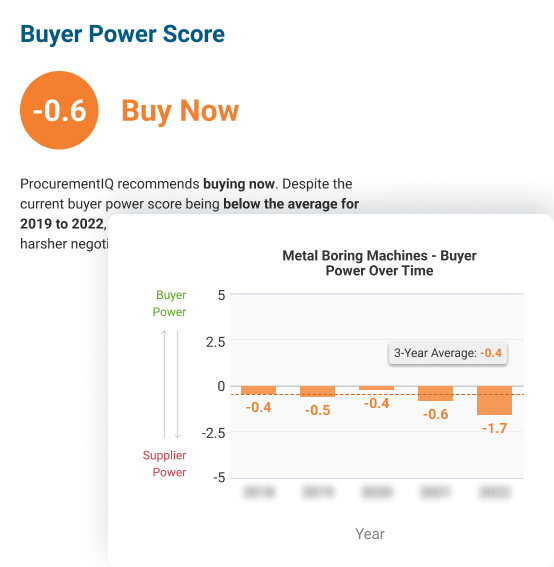
In 2026, buyer power amounts to -2.9 in the United States. Buyer power is most positively impacted by Recent Developments. It is most negatively impacted by Market Share Concentration. Subscribers can access details on eight other factors that impact buyer power. Learn more
United States

Buyer power forecasts: your glimpse into the future
Develop strategies for the upcoming year and identify unforeseen opportunities for buying now
- Actionable "Buy Now" and "Buy Later" insights
- Near-real-time updates to current and forecast Buyer Power Scores
- Methodology and weightings for Buyer Power Score Components
Supply Chain Risk
The average level of supply chain risk is assessed as High, which has a negative impact on buyer power. The level of supply chain risk is affected by industry volatility, barriers to entry, competition, import penetration, regulation and industry financial risk. Buyers in this market can mitigate procurement and supply chain management risks by monitoring risk levels for individual first and second tier suppliers:
1st
Tier Suppliers
- Metal Pipe & Tube Manufacturing
- Steel Rolling & Drawing
- Plastic Pipe & Parts Manufacturing
- Metalworking Machinery Manufacturing
2nd
Tier Suppliers
- Nonferrous Metal Foundry Products Manufacturing
- Iron & Steel Manufacturing
- Plastic & Resin Manufacturing
- Electrical Equipment Manufacturing
Biggest Machine Shop Services Suppliers in the US by Revenue
The largest Machine Shop Services vendors by revenue in the US are Advanced Machining LLC, CNC Industries Inc. and Major Tool & Machine Inc. Subscribers can sort and filter by market share concentration, profit level and other factors. Learn more
| Supplier | Operational Size | Headquarters | Number of Employees | Market Share (%) | Market Share Performance (3yr trend) | Total Revenue ($ million) | Profit Level (%) | Risk Level |
|---|---|---|---|---|---|---|---|---|
| Rockwell Automation Inc. | Global | MILWAUKEE, WI | >10,000 | < 5 | ||||
| Advanced Machining LLC | Regional | Salisbury, NC | 25-50 | < 5 | ||||
| CNC Industries Inc. | Global | Fort Wayne, IN | 25-50 | < 5 | ||||
| Major Tool & Machine Inc. | Regional | Indianapolis, IN | 251-500 | < 5 | ||||
| MIC Group | US | 501-1,000 | < 5 | |||||
| Norman Noble Inc. | International | Highland Heights, OH | 501-1,000 | < 5 | ||||
| Pacific Contours | US | < 5 | ||||||
| United Scientific Inc. | Regional | St. Paul, MN | 25-50 | < 5 | ||||
| TechPrecision Corporation | Global | WESTMINSTER, MA | 101-250 | < 5 | ||||
Looking for a list of suppliers by country?
Subscribers can access vendor information on Canadian and European suppliers, too. We also offer custom research services to help with vendor sourcing anywhere in the world.
Profit Analysis
The average profit margin across vendors in the Machine Shop Services market is 3.5% and steady. Profit levels shift depending on suppliers' spend on wages, purchases and overhead. The highest cost component for vendors is Overhead. The cost trend for this component is stagnating, when considering movement between 2025 and 2026. To understand cost forecasts for 2027 and uncover the implications on profit, start your subscription. Learn more
Vendor & Supply Chain Analysis
Vendors in this market rely on metalworking machinery and inputs such as steel and plastic. The prices of raw material inputs like steel and plastic have been shifting widely on a year-to-year basis due to their commoditized nature, which has resulted in a high supply chain risk for this market.
Large-scale, multiline suppliers are unlikely to experience bankruptcy or other service discontinuities in the coming years due to their economies of scale, whereas smaller specialist vendors may have difficulty staying afloat during periods of poor demand because they have a narrower client base.
Market share concentration is very low with over 16,000 vendors providing machine shop services and the top four vendors generating less than 5%.
The United States is a net importer of machinery and mechanical parts, which indicates a high level of competition in the market from foreign vendors. While buyers benefit from the increased competition and wider selection of vendors, the increased reliance on overseas vendors heightens the risk of supply chain disruptions.
Supplier Information
Advanced Machining LLC
Advanced Machining LLC is a private company operating regionally in the manufacturing sector. The company's offerings include machine shop services and machining services. Founded in 1985, the company is currently headquartered in Salisbury, North Carolina, United States of America with an estimated 38 employees.... Subscribe to learn more
CNC Industries Inc.
CNC Industries Inc. is a private company operating globally in the manufacturing sector. The company's offerings include machine shop services and machining services. Founded in 1995, the company is currently headquartered in Fort Wayne, Indiana, United States of America with an estimated 50 employees. Subscribe to learn more
Global Precision Products, Llc
Global Precision Products, Llc is a private company operating regionally in the manufacturing sector. The company's offerings include machine shop services and machining services. Founded in 1997, the company is currently headquartered in Rush, New York, United States of America with an estimated 200 employees.... Subscribe to learn more
Major Tool & Machine Inc.
Major Tool & Machine Inc. is a private company operating regionally in the manufacturing sector. The company's offerings include machine shop services and machining services. Founded in 1946, the company is currently headquartered in Indianapolis, Indiana, United States of America with an estimated 375 employees.... Subscribe to learn more
Mcalpin Industries Inc.
Mcalpin Industries Inc. is a private company operating regionally in the manufacturing sector. The company's offerings include machine shop services and machining services. Founded in 1964, the company is currently headquartered in Rochester, New York, United States of America with an estimated 200 employees.... Subscribe to learn more
MIC Group
MIC Group is a private company operating nationally in the manufacturing sector. The company's offerings include machine shop services. Founded in 2026, the company is currently headquartered in Brenham, Texas, United States of America with an estimated 555 employees. Subscribe to learn more
National Technologies Inc.
National Technologies Inc. is a private company operating nationally in the construction and manufacturing sectors. The company's offerings include machine shop services, riser management services and machining services. Founded in 2009, the company is currently headquartered in Oak Creek, Wisconsin, United... Subscribe to learn more
Norman Noble Inc.
Norman Noble Inc. is a private company operating internationally in the manufacturing sector. The company's offerings include machine shop services and machining services. Founded in 1946, the company is currently headquartered in Highland Heights, Ohio, United States of America with an estimated 512 employees.... Subscribe to learn more
Pacific Contours
Pacific Contours is a private company operating regionally in the manufacturing sector. The company's offerings include machine shop services. Founded in 1997, the company is currently headquartered in Anaheim, California, United States of America with an estimated 175 employees. Subscribe to learn more
Accelerate the vendor selection process
Get a clear picture of the competition in a market and discover which vendors are best-suited for your sourcing needs. Our supplier profiles include hard-to-find financial ranges for private companies, cover public company data and feature an interactive competitor matrix.
Procurement Management KPIs for the Machine Shop Services Market
Managing vendor performance throughout the contract period is easier when tracking specific key performance indicators (KPIs). For example, buyers should monitor Defect Density and Employee Turnover Rate. Buyers may experience better performance throughout their contracts if they establish service level agreements (SLAs) based on Pricing and other factors.
| KPI | Level of Importance (1-5) | Measurements | Key Considerations |
|---|---|---|---|
| Defect Density |
|
Number of defects per lot |
This KPI measures the amount of total product manufactured minus the scrapped product. By assessing this KPI from the beginning of the production process, suppliers are able to better control their production costs. |
| Employee Turnover Rate |
|
Share of employees who leave in a period compared to total employees at the organization during the same period Average tenure |
High turnover may indicate that work conditions for employees are poor. Quality and efficiency problems often stem from high turnover due to training new, inexperienced employees, which may extend service lead time for buyers. |

Questions to Ask During Procurement Negotiations
How can I gain leverage during negotiations?
Experience and Expertise
How long have you provided machine shop services to your most-tenured client?
What types of raw material cutting services do you specialize in?
Customer Service
Do you have experience working with product data management, product releases and alerts systems like mine?
What kind of troubleshooting services do you offer?
Competition
What are the benefits of working with you compared with other suppliers?
What kind of warranties can you provide for the integrity of the work?
The ultimate prep for procurement negotations
View all 27 negotiation questions for this category when you subscribe.
Machine Shop Services RFP Guidelines
What should my RFP include?
Organizational Overview
Buyers should provide an overview of their company and their operations.
Buyers should specify the cities, counties and state(s) where they require machine shop services.
Statement Of Need
Buyers should specify the type(s) of machining services required.
Buyers should specify the project scale and expected duration.
Project Budget
Buyers should specify preferred payment terms.
Buyers should specify their total budget.
The RFP process made easy
Find out how you can access RFP templates for 800+ procurement categories to start writing better, more consistent RFPs.
We display average pricing information, trends and market data.
Our Reports include:
- Opportunity assessment
- Market dynamics
- Recent developments
- Positive and warning trends
- Buyer power levers
- Price environment and market pricing
- Geographic wage rates
- Global market updates
- Total cost of ownership
- Cost structure benchmarks and analysis
- Supply chain and vendors
- Global supplier breakdown
- Market share concentration
- Regulation and business requirements
- Vendor management and KPIs
- Sourcing strategy guidance