Procurement Market Intelligence Report
Vendor Management Software
Sourcing Guide & Market Intelligence
Smarter cost management starts with comprehensive market intelligence
 United States
 Europe
 Global
Quick Navigation
Vendor Management Software Global Overview
Definition
Summary
Vendor management software (VMS) is also known as a vendor management system. This software assists buyers in overseeing their temporary workers, including freelancers and those sourced through a staffing agency. The software assists buyers with the recruitment and the onboarding and offboarding of these hires, as well as providing budgeting, scheduling, tracking, and analytical tools. The key buyers are retailers and manufacturers.
This Report Includes:
- Recruitment
- Onboarding
- Offboarding
- Budgeting
- Scheduling
Not in this Report:
- Freeware versions of the software
- Temporary staffing services
Global Vendor Management Software Procurement Trends
Discover the top international trends affecting procurement in the global Vendor Management Software market.
Warning Trends
United States announces additional tariffs on China
- In February 2025, the United States announced 10.0% tariffs on imports from China. The tariffs took effect on February 4, 2025.
- The tariff plan applies to all merchandise imported for consumption and applies in addition to other duties and fees that are in place, with limited exceptions.
- In response, China announced a 15.0% tariff on products such as coal and natural gas, as well as a 10.0% tariff on crude oil, agricultural machinery, pickup trucks, and large cars. The tariff executive orders indicate retaliatory tariffs could lead to further escalation in rates.
- Providers in this market rely on inputs often sourced from China. As such, ProcurementIQ will continue to monitor developments in this space and update analysis accordingly.
Neutral
Labor markets tighten slightly following interest rate cuts
- In recent months, the unemployment rate has remained stable at 4.1%, a still relatively low mark, though higher than it was in prior years. This trend indicates sustained competitiveness in the overall labor market, though certain industries have experienced waning labor demand.
- The latest jobs report indicates that major industries, such as construction, retail, leisure & hospitality, and transportation & warehousing, no longer face hiring shortfalls.
- However, worker shortages persist in the manufacturing and healthcare sectors, as 29.9% and 50.0% of job openings in each sector remained unfilled in August, respectively.
- In blue-collar fields, 33.9%, 70.1%, and 49.9% of job openings for information, finance, and professional service roles remained unfilled in September, though unfilled positions in these occupations can also be partially attributed to the longer average hiring times in these industries.
Positive Trends
The DOJ proposes Google breakup in latest tech antitrust action
- In August, Google was found guilty of operating as a monopoly and engaging in anti-competitive practices through the operation of its search engine business.
- In response to this ruling the Department of Justice (DOJ) has stated it will seek a breakup of Google’s business segments, among other similarly harsh penalties. While the actual penalty Google receives must be approved by the judge, the DOJ’s proposed penalties signal a zero-tolerance policy toward tech monopolies.
- During the last few years, the Federal government has significantly increased its enforcement actions against major technology companies in an effort to contest the high level of market share concentration in this sector.
- These actions include high-profile anti-trust lawsuits against Amazon, Apple, and Meta, in addition to the case against Google. Consequently, the results of these lawsuits could significantly affect the structure of a wide range of tech markets.
Global Vendor Management Software Market - Suppliers by Region
| Country/Region | Number of Suppliers |
|---|---|
| #1 Europe | 50 |
| #2 United States | 35 |
| #3 China | 25 |
Explore supplier concentration across the globe
We've uncovered the 11 top regions for global procurement, based on feedback from our most strategic clients. Access vendor counts for each unique region when you subscribe.
2
Geography Drilldown - US & Europe
Average Cost of Vendor Management Software
United States
2026 Market Pricing$0.30 to $X.XX
of spend under management
Average Price
Prices in the Vendor Management Software market range from $0.30 to $X.XX, depending on Spend managed, Features, Vendor neutrality and Support. For example, lower prices are associated with More managed spend (0.3% to 2.79% of spend under management), whereas higher prices are associated with Less managed spend (2.79% to 4.0% of spend under management).
Need the scoop on international price trends?
Between our Europe and Canada collections, we provide price data for 350 markets so you can instantly compare prices across borders. Or, use our custom research services for intel on prices in any region across the globe.
Vendor Management Software Category Price Trends
Pricing trends are indicated by the compound annual growth rate (CAGR) during a set period of time. For the Vendor Management Software market, prices in the US have grown 0.3% from 2022 to 2025. Meanwhile, the recent three-year CAGR for Europe is +0.1%.
United States (2022-2025)

Europe (2022-2025)
Compound Annual Growth Rate
Wondering where prices are heading?
Price trend forecasts are available to subscribers, along with price driver projections and forward-looking cost structure data.
Cost Analysis - Total Cost of Ownership for Vendor Management Software
Total cost of ownership is Medium in the Vendor Management Software market. The average cost of ownership differs depending on the contract but generally includes costs negotiated before the contract begins, costs billed during the contract period and unforeseen costs. For example, unforeseen costs in the form of Cancellations may raise the total cost of ownership unexpectedly.
Negotiated Before
Customization
Billed During
Upgrades
Unforeseen
Cancellations
Buyer Power in Procurement Negotiations
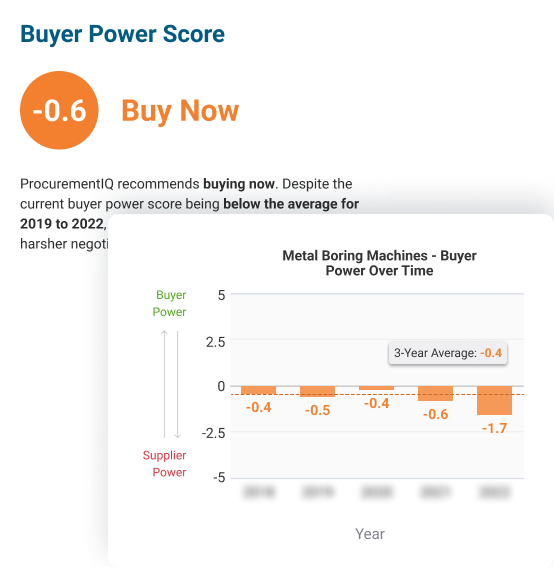
In 2026, buyer power amounts to 0.2 in the United States. Buyer power is most positively impacted by Availability of Substitutes. It is most negatively impacted by Recent Price Volatility. Subscribers can access details on eight other factors that impact buyer power. Learn more
United States

Buyer power forecasts: your glimpse into the future
Develop strategies for the upcoming year and identify unforeseen opportunities for buying now
- Actionable "Buy Now" and "Buy Later" insights
- Near-real-time updates to current and forecast Buyer Power Scores
- Methodology and weightings for Buyer Power Score Components
Supply Chain Risk
The average level of supply chain risk is assessed as Low, which has a positive impact on buyer power. The level of supply chain risk is affected by industry volatility, barriers to entry, competition, import penetration, regulation and industry financial risk. Buyers in this market can mitigate procurement and supply chain management risks by monitoring risk levels for individual first and second tier suppliers:
1st
Tier Suppliers
- Computer Manufacturers
- Intellectual Property Licensing Operators
- Data Processing & Hosting Service Providers
2nd
Tier Suppliers
- Semiconductor & Circuit Manufacturers
- Software Publishers
- IT Consulting Firms
Biggest Vendor Management Software Suppliers in the US by Revenue
The largest Vendor Management Software vendors by revenue in the US are PIXID, Shortlist Project Inc. and Smart ERP Solutions Inc. Subscribers can sort and filter by market share concentration, profit level and other factors. Learn more
| Supplier | Operational Size | Headquarters | Number of Employees | Market Share (%) | Market Share Performance (3yr trend) | Total Revenue ($ million) | Profit Level (%) | Risk Level |
|---|---|---|---|---|---|---|---|---|
| Beeline.com Inc. | Global | Jacksonville, FL | 501-1,000 | 10-15 | ||||
| Sap Se | Global | WALLDORF | >10,000 | 25+ | ||||
| Learning Technologies Group PLC | Global | London, UK | 501-1,000 | 5-10 | ||||
| APC Workforce Solutions LLC | Global | Orlando, FL | 501-1,000 | 5-10 | ||||
| Manpowergroup Inc. | Global | MILWAUKEE | >10,000 | < 5 | ||||
| Coupa Software Inc. | Global | SAN MATEO, CA | 1,001-10,000 | < 5 | ||||
| PRO Unlimited Inc. | Global | Folsom, CA | 1,001-10,000 | < 5 | ||||
| Tipalti, Inc. | Global | Foster City, CA | 1,001-10,000 | < 5 | ||||
| PIXID | Global | Courbevoie, FR | 101-250 | < 5 | ||||
Looking for a list of suppliers by country?
Subscribers can access vendor information on Canadian and European suppliers, too. We also offer custom research services to help with vendor sourcing anywhere in the world.
Profit Analysis
The average profit margin across vendors in the Vendor Management Software market is % and steady. Profit levels shift depending on suppliers' spend on wages, purchases and overhead. The highest cost component for vendors is . The cost trend for this component is not available, when considering movement between 2025 and 2026. To understand cost forecasts for 2027 and uncover the implications on profit, start your subscription. Learn more
Vendor & Supply Chain Analysis
The supply chain risk in the market is low. Software development is a labor-intensive process, so wages are the most significant cost to suppliers.
High market share concentration harms buyers by reducing competitive forces in the market.
Suppliers are afforded stable streams of demand, which mitigates overall vendor risk by making their financial health more predictable.
The United States is a net importer of computers, meaning it buys more computers than it exports. US buyers looking to import computers should evaluate the quality standards and production capabilities of international manufacturers. This assessment should include factors like expected delivery times, quality and safety certifications, and whether the manufactured products meet US standards and compatibility requirements.
Supplier Information
Beeline.com Inc.
Beeline.com Inc. is a private company operating globally in the information sector. The company's offerings include procurement software and vendor management software. Founded in 1999, the company is currently headquartered in Jacksonville, Florida, United States of America with an estimated 600 employees.... Subscribe to learn more
Sap Se
Sap Se is a public company operating globally in the information, professional, scientific & technical services and educational services sectors. The company's offerings include warehouse management systems, travel management software, recruitment software, order tracking software, contract management software.... Subscribe to learn more
APC Workforce Solutions LLC
APC Workforce Solutions LLC is a private company operating globally in the information sector. The company's offerings include vendor management software. Founded in 1999, the company is currently headquartered in Orlando, Florida, United States of America with an estimated 1000 employees. Subscribe to learn more
Learning Technologies Group PLC
Learning Technologies Group PLC is a public company operating globally in the information sector. The company's offerings include recruitment software, vendor management software and temporary workforce management software. Founded in 2010, the company is currently headquartered in London, United Kingdom Subscribe to learn more
Coupa Software Inc.
Coupa Software Inc. is a private company operating globally in the information and professional, scientific and technical services sectors. The company's offerings include procurement software, vendor management software, expense management software and cash management systems. Founded in 2006, the company... Subscribe to learn more
Manpowergroup Inc.
ManpowerGroup Inc. is a global workforce solutions and services provider focusing on recruiting and workforce-intensive initiatives. Its solutions and services include recruitment and assessment, training and development, career management, workforce consulting, and outsourcing. It offers a family of brands,... Subscribe to learn more
PIXID
PIXID is a private company operating globally in the information sector. The company's offerings include vendor management software. Founded in 2004, the company is currently headquartered in Courbevoie, France with an estimated 175 employees. Subscribe to learn more
PRO Unlimited Inc.
Magnit Corporation is a private company operating globally in the information and professional, scientific & technical services sectors. The company's offerings include vendor management software and contingent workforce management services. Founded in 1991, the company is currently headquartered in Folsom,... Subscribe to learn more
Shortlist Project Inc.
Shortlist Project Inc. is a private company operating internationally in the information sector. The company's offerings include vendor management software. Founded in 2015, the company is currently headquartered in San Francisco, California, United States of America with an estimated 37 employees. Subscribe to learn more
Accelerate the vendor selection process
Get a clear picture of the competition in a market and discover which vendors are best-suited for your sourcing needs. Our supplier profiles include hard-to-find financial ranges for private companies, cover public company data and feature an interactive competitor matrix.
Procurement Management KPIs for the Vendor Management Software Market
Managing vendor performance throughout the contract period is easier when tracking specific key performance indicators (KPIs). For example, buyers should monitor Average Resolution Time and Critical Bugs. Buyers may experience better performance throughout their contracts if they establish service level agreements (SLAs) based on Pricing and other factors.
| KPI | Level of Importance (1-5) | Measurements | Key Considerations |
|---|---|---|---|
| Average Resolution Time |
|
Length of time from query to solution Positive reviews of resolution |
Vendors should be measured on their ability to quickly resolve issues. Vendors should be able to provide past testimonials from other customers who have received on-time resolutions. |
| Critical Bugs |
|
Number of flagged system bugs Severity of bugs |
If there are critical bugs, this can result in inefficient work or downtime. Buyers should ensure that the supplier does not have a history of bugs. |

Questions to Ask During Procurement Negotiations
How can I gain leverage during negotiations?
Technology
What improvements are you currently planning? Do you have a calendar of plans for future enhancements?
What new features and functionalities have you added in the past year? What improvements do your customers request most frequently?
Security
How often is client data and content backed up on your servers? What are your continuity processes for business interruption?
What encryption standards do you use for data storage and transmission? Has your clients' private data ever been compromised? What is your data protection strategy?
Vendor Lock-In
What proprietary software or technology do you use? How will that affect the ability to maintain and troubleshoot in-house?
To what extent can data be extracted from your software in a raw format?
The ultimate prep for procurement negotations
View all 25 negotiation questions for this category when you subscribe.
Vendor Management Software RFP Guidelines
What should my RFP include?
Organizational Overview
Buyers should include details of their organization, such as the number of employees and business locations.
Buyers should specify their reasons for purchasing VMS and include the benefits they expect to receive.
Statement Of Need
Buyers should provide a list of desired vendor management features that the software should include (e.g., the ability to assess vendor risk, the ability to track vendor incidents, conduct vendor surveys, review contracts, ensure compliance with third party requirements, generate comprehensive reports).
Buyers should provide a list of desired administrative features that the software should include (e.g., the ability to auto back-up, import and export, generate automatic notifications, audit history logs).
Project Budget
Buyers should reference the Benchmark Price and Total Cost of Ownership sections of this report for assistance in creating a budget.
Buyers should request that vendors specify the cost of implementation.
The RFP process made easy
Find out how you can access RFP templates for 800+ procurement categories to start writing better, more consistent RFPs.
We display average pricing information, trends and market data.
Our Reports include:
- Opportunity assessment
- Market dynamics
- Recent developments
- Positive and warning trends
- Buyer power levers
- Price environment and market pricing
- Geographic wage rates
- Global market updates
- Total cost of ownership
- Cost structure benchmarks and analysis
- Supply chain and vendors
- Global supplier breakdown
- Market share concentration
- Regulation and business requirements
- Vendor management and KPIs
- Sourcing strategy guidance