Procurement Market Intelligence Report
ERP Software
Sourcing Guide & Market Intelligence
Smarter cost management starts with comprehensive market intelligence
 United States
 Europe
 Global
Quick Navigation
ERP Software Global Overview
Definition
Summary
This report is intended to assist buyers of enterprise resource planning (ERP) software. This report covers finance, managerial accounting, and ERP software solutions that improve and automate core back-office business functions. There is a high degree of overlap between ERP software and complementary business software that addresses back- and front-office business functions, such as sales and marketing, customer relationship, procurement, human resources, and project and inventory management. However, the core focus of this report is on ERP software solutions within the enterprise application market.
This Report Includes:
- Financial ERP Software
- Accounting ERP Software
Not in this Report:
- Facilities Management Software
- CRM Software
Global ERP Software Procurement Trends
Discover the top international trends affecting procurement in the global ERP Software market.
Warning Trends
The European Union’s Artificial Intelligence (AI) Act enters into force
- In August 2024, the European Union (EU) began enforcing its new regulation on artificial intelligence. Although EU legislation, the act will have a major effect on global technological companies operating in the AI space, similar to the General Data Protection regulation.
- The legislation aims to apply a risk-based framework to AI regulation, meaning different AI applications will be treated differently. The law applies a general ban for “unacceptable” uses, such as social scoring and predictive policing.
- For general-purpose AI models, companies will be required to comply with EU copyright law and intellectual property provisions, carry out regular testing, issue transparency disclosures, and implement adequate cybersecurity protections. For “high-risk” AI applications, such as autonomous vehicles, medical devices, financial services, and biometric identification systems, companies must meet stricter requirements in terms of risk-mitigation systems, documentation, human oversight, and cybersecurity.
- Companies that breach the AI Act may face fines ranging from 7.5 million euros or 1.5% of global annual revenues to 35.0 million euros or 7.0% of global annual revenues, whichever amount is higher.
- While the blanket ban on unacceptable systems entered into force in February 2025, most of the obligations do not take effect for a full year. In August 2025, requirements for general-purpose AI will come into effect, and in August 2026, obligations for high-risk AI systems will be enforced.
Neutral
GSA memo asks agencies to review consulting contracts
- The General Services Administration (GSA) recently issued a memorandum asking government agencies to review their consulting contracts with the ten highest-paid firms. The ten firms are Accenture PLC (Accenture Federal Services), Booz Allen Hamilton Inc., CGI Group Inc. (CGI Federal), Deloitte Touche Tohmatsu (Deloitte Consulting), General Dynamics Corporation (General Dynamics IT), Guidehouse Inc., Huntington Ingalls Industries Inc. (HII Mission Technologies), International Business Machines Corporation (IBM), Leidos Holdings, Inc., and Science Applications International Corporation, Inc. (SAIC).
- The memo states that agencies are strongly encouraged to cut non-essential consulting contracts, providing a list of those intended to be terminated by March 7, 2025. By April 19, 2025, agencies must submit their reviews of non-GSA consulting service contracts.
- According to the GSA, the ten consulting firms identified are set to receive $65.0 billion in fees in 2025. The Department of Defense (DoD) has stated its intention to terminate or descope contracts non-essential to the DoD’s purposes; some of the largest market players with high-value DoD contracts include Booz Allen Hamilton, Deloitte, and Accenture.
- According to the Government Accountability Office, in the fiscal year 2023, government agencies spent $478.0 billion on services, with the DoD accounting for $230.0 billion and non-defense agencies accounting for the rest. The DoD spent $21.3 billion on support, professional, and engineering and technical services, while non-defense agencies spent $21.4 billion on professional services, which includes consulting, training, and support services.
- The Department of Veterans Affairs (VA) initially cancelled 875 contracts (amounting to around $2.0 billion) but has currently paused efforts. However, contract terminations across most agencies are expected to continue.
Positive Trends
The DOJ proposes Google breakup in latest tech antitrust action
- In August, Google was found guilty of operating as a monopoly and engaging in anti-competitive practices through the operation of its search engine business.
- In response to this ruling the Department of Justice (DOJ) has stated it will seek a breakup of Google’s business segments, among other similarly harsh penalties. While the actual penalty Google receives must be approved by the judge, the DOJ’s proposed penalties signal a zero-tolerance policy toward tech monopolies.
- During the last few years, the Federal government has significantly increased its enforcement actions against major technology companies in an effort to contest the high level of market share concentration in this sector.
- These actions include high-profile anti-trust lawsuits against Amazon, Apple, and Meta, in addition to the case against Google. Consequently, the results of these lawsuits could significantly affect the structure of a wide range of tech markets.
Global ERP Software Market - Suppliers by Region
| Country/Region | Number of Suppliers |
|---|---|
| #1 Europe | 900 |
| #2 United States | 690 |
| #3 China | 450 |
Explore supplier concentration across the globe
We've uncovered the 11 top regions for global procurement, based on feedback from our most strategic clients. Access vendor counts for each unique region when you subscribe.
2
Geography Drilldown - US & Europe
Average Cost of ERP Software
United States
2026 Market Pricing$0.00 to $XXX.XX
per user per month
Average Price
Prices in the ERP Software market range from $0.00 to $XXX.XX, depending on License Type, Number of Users & Devices, ERP Modules & Functionality and Level of Customization. For example, lower prices are associated with Software-as-a-service (SaaS) ($25.00 to $300 per user per month), whereas higher prices are associated with On-premises ($100 to $500 per user per month).
Need the scoop on international price trends?
Between our Europe and Canada collections, we provide price data for 350 markets so you can instantly compare prices across borders. Or, use our custom research services for intel on prices in any region across the globe.
ERP Software Category Price Trends
Pricing trends are indicated by the compound annual growth rate (CAGR) during a set period of time. For the ERP Software market, prices in the US have grown 1.2% from 2022 to 2025. Meanwhile, the recent three-year CAGR for Europe is +0.5%.
United States (2022-2025)

Europe (2022-2025)
Compound Annual Growth Rate
Wondering where prices are heading?
Price trend forecasts are available to subscribers, along with price driver projections and forward-looking cost structure data.
Cost Analysis - Total Cost of Ownership for ERP Software
Total cost of ownership is High in the ERP Software market. The average cost of ownership differs depending on the contract but generally includes costs negotiated before the contract begins, costs billed during the contract period and unforeseen costs. For example, unforeseen costs in the form of Obsolescence may raise the total cost of ownership unexpectedly.
Negotiated Before
Implementation
Billed During
Support
Unforeseen
Obsolescence
Buyer Power in Procurement Negotiations
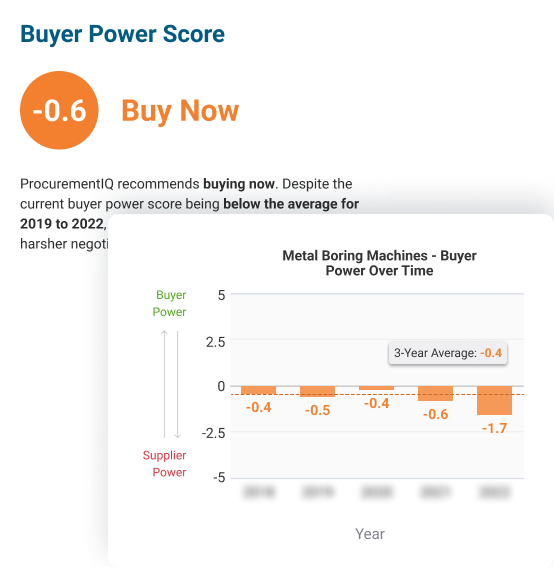
In 2026, buyer power amounts to -0.2 in the United States. Buyer power is most positively impacted by Switching Costs. It is most negatively impacted by Recent Price Volatility. Subscribers can access details on eight other factors that impact buyer power. Learn more
United States

Buyer power forecasts: your glimpse into the future
Develop strategies for the upcoming year and identify unforeseen opportunities for buying now
- Actionable "Buy Now" and "Buy Later" insights
- Near-real-time updates to current and forecast Buyer Power Scores
- Methodology and weightings for Buyer Power Score Components
Supply Chain Risk
The average level of supply chain risk is assessed as Low, which has a positive impact on buyer power. The level of supply chain risk is affected by industry volatility, barriers to entry, competition, import penetration, regulation and industry financial risk. Buyers in this market can mitigate procurement and supply chain management risks by monitoring risk levels for individual first and second tier suppliers:
1st
Tier Suppliers
- Software Publishers
- Computer & Packaged Software Wholesalers
- IT Consultants
2nd
Tier Suppliers
- Intellectual Property Leasing Firms
- Semiconductor Manufacturers
- Computer Manufacturers
Biggest ERP Software Suppliers in the US by Revenue
The largest ERP Software vendors by revenue in the US are Sage Group Plc, Microsoft Corporation and QAD Inc. Subscribers can sort and filter by market share concentration, profit level and other factors. Learn more
| Supplier | Operational Size | Headquarters | Number of Employees | Market Share (%) | Market Share Performance (3yr trend) | Total Revenue ($ million) | Profit Level (%) | Risk Level |
|---|---|---|---|---|---|---|---|---|
| Oracle Corporation | Global | AUSTIN, CA | >10,000 | 10-15 | ||||
| International Business Machines Corporation | Global | ARMONK | >10,000 | 15-20 | ||||
| Sap Se | Global | WALLDORF | >10,000 | 15-20 | ||||
| Microsoft Corporation | Global | Redmond | >10,000 | 5-10 | ||||
| Infor, Inc. | Global | New York, NY | >10,000 | < 5 | ||||
| Dassault Systemes Se | Global | Vélizy-Villacoublay, FRA | >10,001 | < 5 | ||||
| Sage Group Plc | Global | Newcastle, UK | >10,001 | < 5 | ||||
| Epicor Software Corporation | Global | Austin, TX | 1,001-10,000 | < 5 | ||||
| QAD Inc. | International | SANTA BARBARA, CA | 1,001-10,000 | < 5 | ||||
Looking for a list of suppliers by country?
Subscribers can access vendor information on Canadian and European suppliers, too. We also offer custom research services to help with vendor sourcing anywhere in the world.
Profit Analysis
The average profit margin across vendors in the ERP Software market is 17.4% and steady. Profit levels shift depending on suppliers' spend on wages, purchases and overhead. The highest cost component for vendors is Overhead. The cost trend for this component is rising, when considering movement between 2025 and 2026. To understand cost forecasts for 2027 and uncover the implications on profit, start your subscription. Learn more
Vendor & Supply Chain Analysis
Average vendor risk is low in the ERP software market. Vendors face low competition from substitutes and little supply chain risk.
Market share concentration is high in the ERP software market. Several large vendors compete amongst each other, and some smaller vendors focus on serving a small customer base to stay in business.
Supply chain risk in the ERP software market is low because providers do not rely on any critical material inputs to produce and distribute software. Suppliers in this market rely on computers as depreciable assets, so they purchase computers relatively infrequently.
The pace of regulatory change is slow in the ERP software market. Vendors must keep track of some changing state laws, but federal rules are mostly stable in the ERP software market.
The United States is a net importer of computers, meaning it imports more computers than it exports. While lower manufacturing costs abroad drive down prices for imported computers, relying on imports can lead to potential shortages or price increases if there are supply chain disruptions due to geopolitical tensions, trade disputes, or global crises
Supplier Information
Oracle Corporation
Oracle Corporation is a global technology company that provides enterprise information technology (IT) products and services. It comprises three businesses: the Cloud and License business, which offers Oracle Applications, Oracle Database, and Oracle Middleware software offerings, among others, deployed using... Subscribe to learn more
International Business Machines Corporation
International Business Machines Corporation (IBM) is a global integrated computer technology, hardware, software, and services provider. It organizes its business into four segments: Software segment, which provides software solutions for a hybrid cloud platform, data and artificial intelligence, automation,... Subscribe to learn more
Sap Se
Sap Se is a public company operating globally in the information, professional, scientific & technical services and educational services sectors. The company's offerings include warehouse management systems, travel management software, recruitment software, order tracking software, contract management software.... Subscribe to learn more
Microsoft Corporation
Microsoft Corporation is a technology company offering digital technology and artificial intelligence (AI) to businesses and individuals worldwide. It develops cloud-based solutions that deliver customers with software, services, platforms, and content and provides solution support and consulting services.... Subscribe to learn more
Dassault Systemes Se
Dassault Systemes Se is a public company operating globally in the information and professional, scientific & technical services sectors. The company's offerings include supply chain management software, inventory management software, erp software and digital twin solutions. Founded in 1981, the company is... Subscribe to learn more
Epicor Software Corporation
Epicor Software Corporation is a private company operating globally in the information sector. The company's offerings include warehouse management systems, retail planning software, erp software, accounting software, digital transaction management software. Founded in 1972, the company is currently headquartered... Subscribe to learn more
Infor, Inc.
Infor, Inc. is a private company operating globally in the information sector. The company's offerings include erp software, accounting software, expense management software, spend analytics software, maintenance management software. Founded in 2002, the company is currently headquartered in New York, New... Subscribe to learn more
QAD Inc.
QAD Inc. is a public company operating internationally in the information sector. The company's offerings include erp software. Founded in 1979, the company is currently headquartered in SANTA BARBARA, California, United States of America with an estimated 1930 employees. Subscribe to learn more
Sage Group Plc
Sage Group Plc is a public company operating globally in the information and professional, scientific & technical services sectors. The company's offerings include order tracking software, grants management software, erp software, financial analysis software, accounting software. Founded in 1988, the company... Subscribe to learn more
Accelerate the vendor selection process
Get a clear picture of the competition in a market and discover which vendors are best-suited for your sourcing needs. Our supplier profiles include hard-to-find financial ranges for private companies, cover public company data and feature an interactive competitor matrix.
Procurement Management KPIs for the ERP Software Market
Managing vendor performance throughout the contract period is easier when tracking specific key performance indicators (KPIs). For example, buyers should monitor Net Profit (and %) and Net Working Capital (NWC). Buyers may experience better performance throughout their contracts if they establish service level agreements (SLAs) based on Availability and other factors.
| KPI | Level of Importance (1-5) | Measurements | Key Considerations |
|---|---|---|---|
| Net Profit (and %) |
|
Total revenue Total expenses |
The net profit represents the profit after deducting the cost of goods sold and operating expenses. The net profit can be used to determine the amount of profit resulting from operations as a whole. |
| Net Working Capital (NWC) |
|
Current assets Current liabilities |
Net working capital represents a company’s liquidity. Switching costs are high in this market, so buyers should assess a vendor's financial risk before entering long-term contracts. Buyers contracted with a vendor that exits the market can create disruptions of service and very high switching costs, as buyers will need to find a new vendor faster than is typical in this market. |

Questions to Ask During Procurement Negotiations
How can I gain leverage during negotiations?
Contract
What are your licensing policies and rights granted?
How will these terms affect my future licensing purchases for ERP software?
Implementation
How long will it take to implement your ERP software?
What is your track record regarding implementations?
Integration
What relationships or partnerships does your company have with other software publishers?
Have you encountered any legal disputes with other software publishers during the past three years?
The ultimate prep for procurement negotations
View all 31 negotiation questions for this category when you subscribe.
ERP Software RFP Guidelines
What should my RFP include?
Organizational Overview
Buyers should describe their organization(s) in terms of their operational scope, number of employees, departments and organizational structure.
Buyers should provide a list of any ERP software packages they are already using.
Statement Of Need
Buyers should state the number of end users and devices that need to access the ERP software.
Buyers should disclose the specifications of their existing servers and desktop operating system.
Project Budget
Buyers should indicate whether they have an expected budget for the ERP software.
Buyers should describe their preferred terms for invoicing and payment.
The RFP process made easy
Find out how you can access RFP templates for 800+ procurement categories to start writing better, more consistent RFPs.
We display average pricing information, trends and market data.
Our Reports include:
- Opportunity assessment
- Market dynamics
- Recent developments
- Positive and warning trends
- Buyer power levers
- Price environment and market pricing
- Geographic wage rates
- Global market updates
- Total cost of ownership
- Cost structure benchmarks and analysis
- Supply chain and vendors
- Global supplier breakdown
- Market share concentration
- Regulation and business requirements
- Vendor management and KPIs
- Sourcing strategy guidance