Procurement Market Intelligence Report
Expense Management Software
Sourcing Guide & Market Intelligence
Smarter cost management starts with comprehensive market intelligence
 United States
 Europe
 Global
Quick Navigation
Expense Management Software Global Overview
Definition
Summary
Expense management software helps businesses simplify the process of managing expenses and tracking spending trends. Expense management software can increase the transparency of an organization’s spending by automating payment requests, expense reports, timesheets and travel expenses. Typical buyers of this software are companies that have a high frequency and volume of purchases.
This Report Includes:
- Automated Expense Management Software
- Expense Tracking Software
Not in this Report:
- Accounting software
- ERP software
Global Expense Management Software Procurement Trends
Discover the top international trends affecting procurement in the global Expense Management Software market.
Warning Trends
United States announces additional tariffs on China
- In February 2025, the United States announced 10.0% tariffs on imports from China. The tariffs took effect on February 4, 2025.
- The tariff plan applies to all merchandise imported for consumption and applies in addition to other duties and fees that are in place, with limited exceptions.
- In response, China announced a 15.0% tariff on products such as coal and natural gas, as well as a 10.0% tariff on crude oil, agricultural machinery, pickup trucks, and large cars. The tariff executive orders indicate retaliatory tariffs could lead to further escalation in rates.
- Providers in this market rely on inputs often sourced from China. As such, ProcurementIQ will continue to monitor developments in this space and update analysis accordingly.
United States postpones plans for sweeping tariffs on Canada and Mexico
- In February 2025, the United States announced 25.0% tariffs on imports from Canada and Mexico.
- Though initially set to take effect on February 4, 2025, the implementation of tariffs on Canada and Mexico has been postponed 30 days to allow for further negotiation.
- The tariff plan initially proposed by the US applies to all merchandise imported for consumption and applies in addition to other duties or fees that are in place, with limited exceptions.
- Providers in this market rely on input costs often sourced from an affected country. As such, ProcurementIQ will continue to monitor developments in this space and update analysis accordingly.
Positive Trends
The DOJ proposes Google breakup in latest tech antitrust action
- In August, Google was found guilty of operating as a monopoly and engaging in anti-competitive practices through the operation of its search engine business.
- In response to this ruling the Department of Justice (DOJ) has stated it will seek a breakup of Google’s business segments, among other similarly harsh penalties. While the actual penalty Google receives must be approved by the judge, the DOJ’s proposed penalties signal a zero-tolerance policy toward tech monopolies.
- During the last few years, the Federal government has significantly increased its enforcement actions against major technology companies in an effort to contest the high level of market share concentration in this sector.
- These actions include high-profile anti-trust lawsuits against Amazon, Apple, and Meta, in addition to the case against Google. Consequently, the results of these lawsuits could significantly affect the structure of a wide range of tech markets.
Global Expense Management Software Market - Suppliers by Region
| Country/Region | Number of Suppliers |
|---|---|
| #1 Europe | 145 |
| #2 United States | 110 |
| #3 China | 75 |
Explore supplier concentration across the globe
We've uncovered the 11 top regions for global procurement, based on feedback from our most strategic clients. Access vendor counts for each unique region when you subscribe.
2
Geography Drilldown - US & Europe
Average Cost of Expense Management Software
United States
2026 Market Pricing$4.00 to $XX.XX
per user per month
Average Price
Prices in the Expense Management Software market range from $4.00 to $XX.XX, depending on Features, Subscription length, Number of monthly transactions, Deployment model and Level of support. For example, lower prices are associated with Basic expense management functionality ($4.00 to $8.00), whereas higher prices are associated with Full suite of analytical tools ($8.00 to $20.00) and Customizable features ($6.00 to $13.00).
Need the scoop on international price trends?
Between our Europe and Canada collections, we provide price data for 350 markets so you can instantly compare prices across borders. Or, use our custom research services for intel on prices in any region across the globe.
Expense Management Software Category Price Trends
Pricing trends are indicated by the compound annual growth rate (CAGR) during a set period of time. For the Expense Management Software market, prices in the US have grown 1.7% from 2022 to 2025. Meanwhile, the recent three-year CAGR for Europe is +2.3%.
United States (2022-2025)

Europe (2022-2025)
Compound Annual Growth Rate
Wondering where prices are heading?
Price trend forecasts are available to subscribers, along with price driver projections and forward-looking cost structure data.
Cost Analysis - Total Cost of Ownership for Expense Management Software
Total cost of ownership is High in the Expense Management Software market. The average cost of ownership differs depending on the contract but generally includes costs negotiated before the contract begins, costs billed during the contract period and unforeseen costs. For example, unforeseen costs in the form of Obsolescence may raise the total cost of ownership unexpectedly.
Negotiated Before
Customization
Implementation
Billed During
Hardware
Unforeseen
Obsolescence
Buyer Power in Procurement Negotiations
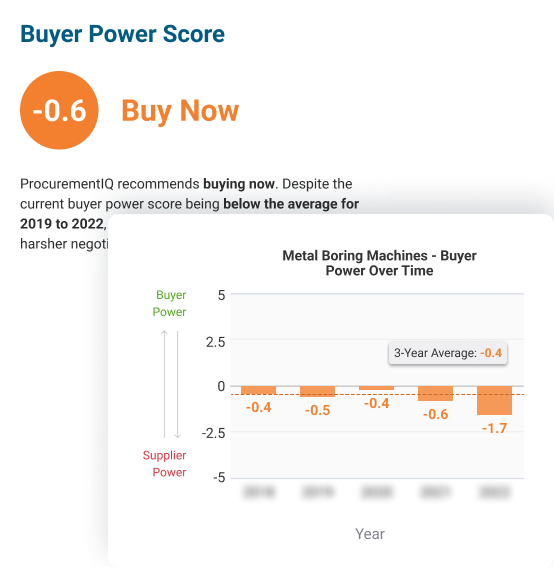
In 2026, buyer power amounts to -0.0 in the United States. Buyer power is most positively impacted by Forecast Price Trend. It is most negatively impacted by Recent Price Volatility. Subscribers can access details on eight other factors that impact buyer power. Learn more
United States

Buyer power forecasts: your glimpse into the future
Develop strategies for the upcoming year and identify unforeseen opportunities for buying now
- Actionable "Buy Now" and "Buy Later" insights
- Near-real-time updates to current and forecast Buyer Power Scores
- Methodology and weightings for Buyer Power Score Components
Supply Chain Risk
The average level of supply chain risk is assessed as Low, which has a positive impact on buyer power. The level of supply chain risk is affected by industry volatility, barriers to entry, competition, import penetration, regulation and industry financial risk. Buyers in this market can mitigate procurement and supply chain management risks by monitoring risk levels for individual first and second tier suppliers:
1st
Tier Suppliers
- Computer Manufacturers
- Intellectual Property Licensing Firms
- Operating Systems & Productivity Software Publishing
2nd
Tier Suppliers
- Semiconductor & Circuit Manufacturers
- Circuit Board & Electronic Component Manufacturing
- Software Publishers
Biggest Expense Management Software Suppliers in the US by Revenue
The largest Expense Management Software vendors by revenue in the US are Software AG, Expensify, Inc. and Ellucian Company LP. Subscribers can sort and filter by market share concentration, profit level and other factors. Learn more
| Supplier | Operational Size | Headquarters | Number of Employees | Market Share (%) | Market Share Performance (3yr trend) | Total Revenue ($ million) | Profit Level (%) | Risk Level |
|---|---|---|---|---|---|---|---|---|
| Infor, Inc. | Global | New York, NY | >10,000 | 5-10 | ||||
| Expensify, Inc. | Global | PORTLAND, OR | 101-250 | 5-10 | ||||
| Oracle Corporation | Global | AUSTIN, CA | >10,000 | < 5 | ||||
| Sap Se | Global | WALLDORF | >10,000 | < 5 | ||||
| Insperity, Inc. | National | KINGWOOD, TX | 1,001-10,000 | < 5 | ||||
| Workday, Inc. | Global | PLEASANTON, CA | >10,000 | < 5 | ||||
| Trinet Group, Inc. | National | DUBLIN, CA | 1,001-10,000 | < 5 | ||||
| Software AG | Global | Darmstadt, DE | 1,001-10,000 | < 5 | ||||
| Coupa Software Inc. | Global | SAN MATEO, CA | 1,001-10,000 | < 5 | ||||
Looking for a list of suppliers by country?
Subscribers can access vendor information on Canadian and European suppliers, too. We also offer custom research services to help with vendor sourcing anywhere in the world.
Profit Analysis
The average profit margin across vendors in the Expense Management Software market is 17.2% and steady. Profit levels shift depending on suppliers' spend on wages, purchases and overhead. The highest cost component for vendors is Overhead. The cost trend for this component is rising, when considering movement between 2025 and 2026. To understand cost forecasts for 2027 and uncover the implications on profit, start your subscription. Learn more
Vendor & Supply Chain Analysis
Average vendor risk is low, due in large part to the high average profit of vendors in this market. As a result, buyers face a negligible risk that a contracted vendor will unexpectedly exit the market for financial reasons.
Supply chain risk is low, as vendors are not particularly reliant on physical distribution networks for inputs or to sell their software. Therefore, the risk of sudden price changes as a result of supply chain disruptions is minimal.
Market share concentration is low, and competition among vendors in this market is intense. As result, individual vendors have less price-setting power.
The pace of regulatory change in this market is slow, meaning buyers face minimal risk of additional compliance costs.
The United States is a net importer of computers, meaning it imports more computers than it exports. While lower manufacturing costs abroad drive down prices for imported computers, relying on imports can lead to potential shortages or price increases if there are supply chain disruptions due to geopolitical tensions, trade disputes, or global crises.
Supplier Information
Expensify, Inc.
Expensify, Inc. is a public company operating globally in the information sector. The company's offerings include expense management software. Founded in 2008, the company is currently headquartered in PORTLAND, Oregon, United States of America with an estimated 138 employees. Subscribe to learn more
Infor, Inc.
Infor, Inc. is a private company operating globally in the information sector. The company's offerings include erp software, accounting software, expense management software, spend analytics software, maintenance management software. Founded in 2002, the company is currently headquartered in New York, New... Subscribe to learn more
Coupa Software Inc.
Coupa Software Inc. is a private company operating globally in the information and professional, scientific and technical services sectors. The company's offerings include procurement software, vendor management software, expense management software and cash management systems. Founded in 2006, the company... Subscribe to learn more
Ellucian Company LP
Ellucian Company LP is a private company operating globally in the information sector. The company's offerings include expense management software and spend analytics software. Founded in 1968, the company is currently headquartered in Reston, Virginia, United States of America with an estimated 5500 employees.... Subscribe to learn more
Insperity, Inc.
Insperity, Inc. is a provider of human resources and business solutions to small and medium-sized businesses. It offers Workforce Optimization® and Workforce Synchronization™ solutions, which include human resources functions, including payroll and employment administration, employee benefits, workers’ compensation,... Subscribe to learn more
Oracle Corporation
Oracle Corporation is a global technology company that provides enterprise information technology (IT) products and services. It comprises three businesses: the Cloud and License business, which offers Oracle Applications, Oracle Database, and Oracle Middleware software offerings, among others, deployed using... Subscribe to learn more
Replicon Inc.
Replicon Inc. is a private company operating globally in the information sector. The company's offerings include expense management software and spend analytics software. Founded in 1996, the company is currently headquartered in Calgary, Anguilla, Canada with an estimated 375 employees. Subscribe to learn more
Sap Se
Sap Se is a public company operating globally in the information, professional, scientific & technical services and educational services sectors. The company's offerings include warehouse management systems, travel management software, recruitment software, order tracking software, contract management software.... Subscribe to learn more
Software AG
Software AG is a public company operating globally in the information sector. The company's offerings include expense management software and spend analytics software. Founded in 2013, the company is currently headquartered in Darmstadt, Germany with an estimated 5500 employees. Subscribe to learn more
Accelerate the vendor selection process
Get a clear picture of the competition in a market and discover which vendors are best-suited for your sourcing needs. Our supplier profiles include hard-to-find financial ranges for private companies, cover public company data and feature an interactive competitor matrix.
Procurement Management KPIs for the Expense Management Software Market
Managing vendor performance throughout the contract period is easier when tracking specific key performance indicators (KPIs). For example, buyers should monitor Average Resolution Time and Critical Bugs. Buyers may experience better performance throughout their contracts if they establish service level agreements (SLAs) based on Availability and other factors.
| KPI | Level of Importance (1-5) | Measurements | Key Considerations |
|---|---|---|---|
| Average Resolution Time |
|
Average resolution time for minor problems Average resolution time for major issues |
It is important that buyers receive adequate customer support to maximize the value of the expense management software and minimize downtime caused by unresolved issues. Generally, minor problems should be resolved in a few hours while major problems should not take more than 2 days to fix. |
| Critical Bugs |
|
Expense compliance rate Expense tracking error rate Number of major errors |
It is important for buyers to ensure that no major errors are occurring in the expense management process as a result of bugs in the expense management software. Therefore, buyers should make sure that expense approval is in line with company policy, expenses are being accurately tracked and bills are being paid correctly. |

Questions to Ask During Procurement Negotiations
How can I gain leverage during negotiations?
Quality Control
How often do you check for general bugs or errors? Do you run a full product sweep?
How often do you offer patches or updates?
Supply Chain Risk
Do you use computers or software with high exposure to market disruptions resulting from the coronavirus? How are you coping with these disruptions?
How diversified is your supplier base for equipment used in providing the service? Do you source from multiple suppliers in different global regions?
Software-Technology
How does your software fit my current expense management procedures?
How do you account for potential input errors? Is there a system to track obvious errors?
The ultimate prep for procurement negotations
View all 29 negotiation questions for this category when you subscribe.
Expense Management Software RFP Guidelines
What should my RFP include?
Organizational Overview
Buyers should provide a general overview of their business, including number of employees and regions in which they operate.
Buyers should state the features of expense management software they desire.
Statement Of Need
Buyers should specify the exact number of users needed.
Buyers should specify the features that are needed in the software.
Project Budget
Buyers should specify the total budget for their software purchase.
Buyers should include details about per-user spending expectations and limitations.
The RFP process made easy
Find out how you can access RFP templates for 800+ procurement categories to start writing better, more consistent RFPs.
We display average pricing information, trends and market data.
Our Reports include:
- Opportunity assessment
- Market dynamics
- Recent developments
- Positive and warning trends
- Buyer power levers
- Price environment and market pricing
- Geographic wage rates
- Global market updates
- Total cost of ownership
- Cost structure benchmarks and analysis
- Supply chain and vendors
- Global supplier breakdown
- Market share concentration
- Regulation and business requirements
- Vendor management and KPIs
- Sourcing strategy guidance