Procurement Market Intelligence Report
License Management Software
Sourcing Guide & Market Intelligence
Smarter cost management starts with comprehensive market intelligence
 United States
 Global
Quick Navigation
License Management Software Global Overview
Definition
Summary
Software publishers use license management software to control and track how their software is used. It also helps monitor the number of licenses used, ensures software compliance, and prevents unauthorized access or use beyond the purchased licenses. Key buyers of license management software include publishers of business software, consumer software, and governmental software.
This Report Includes:
- Software License Audits
- Software Inventory Reports
Not in this Report:
- Software Asset Management Services
- Open-Source License Management Software Options
Take the ProcurementIQ products and data tour
Explore live samples of price trend forecasts, price driver projections, forward-looking cost structure data and more.
Global License Management Software Procurement Trends
Discover the top international trends affecting procurement in the global License Management Software market.
Warning Trends
United States announces additional tariffs on China
- In February 2025, the United States announced 10.0% tariffs on imports from China. The tariffs took effect on February 4, 2025.
- The tariff plan applies to all merchandise imported for consumption and applies in addition to other duties and fees that are in place, with limited exceptions.
- In response, China announced a 15.0% tariff on products such as coal and natural gas, as well as a 10.0% tariff on crude oil, agricultural machinery, pickup trucks, and large cars. The tariff executive orders indicate retaliatory tariffs could lead to further escalation in rates.
- Providers in this market rely on inputs often sourced from China. As such, ProcurementIQ will continue to monitor developments in this space and update analysis accordingly.
Neutral
GSA memo asks agencies to review consulting contracts
- The General Services Administration (GSA) recently issued a memorandum asking government agencies to review their consulting contracts with the ten highest-paid firms. The ten firms are Accenture PLC (Accenture Federal Services), Booz Allen Hamilton Inc., CGI Group Inc. (CGI Federal), Deloitte Touche Tohmatsu (Deloitte Consulting), General Dynamics Corporation (General Dynamics IT), Guidehouse Inc., Huntington Ingalls Industries Inc. (HII Mission Technologies), International Business Machines Corporation (IBM), Leidos Holdings, Inc., and Science Applications International Corporation, Inc. (SAIC).
- The memo states that agencies are strongly encouraged to cut non-essential consulting contracts, providing a list of those intended to be terminated by March 7, 2025. By April 19, 2025, agencies must submit their reviews of non-GSA consulting service contracts.
- According to the GSA, the ten consulting firms identified are set to receive $65.0 billion in fees in 2025. The Department of Defense (DoD) has stated its intention to terminate or descope contracts non-essential to the DoD’s purposes; some of the largest market players with high-value DoD contracts include Booz Allen Hamilton, Deloitte, and Accenture.
- According to the Government Accountability Office, in the fiscal year 2023, government agencies spent $478.0 billion on services, with the DoD accounting for $230.0 billion and non-defense agencies accounting for the rest. The DoD spent $21.3 billion on support, professional, and engineering and technical services, while non-defense agencies spent $21.4 billion on professional services, which includes consulting, training, and support services.
- The Department of Veterans Affairs (VA) initially cancelled 875 contracts (amounting to around $2.0 billion) but has currently paused efforts. However, contract terminations across most agencies are expected to continue.
Positive Trends
The DOJ proposes Google breakup in latest tech antitrust action
- In August, Google was found guilty of operating as a monopoly and engaging in anti-competitive practices through the operation of its search engine business.
- In response to this ruling the Department of Justice (DOJ) has stated it will seek a breakup of Google’s business segments, among other similarly harsh penalties. While the actual penalty Google receives must be approved by the judge, the DOJ’s proposed penalties signal a zero-tolerance policy toward tech monopolies.
- During the last few years, the Federal government has significantly increased its enforcement actions against major technology companies in an effort to contest the high level of market share concentration in this sector.
- These actions include high-profile anti-trust lawsuits against Amazon, Apple, and Meta, in addition to the case against Google. Consequently, the results of these lawsuits could significantly affect the structure of a wide range of tech markets.
Global License Management Software Market - Suppliers by Region
| Country/Region | Number of Suppliers |
|---|---|
| #1 Europe | 145 |
| #2 United States | 110 |
| #3 China | 75 |
Explore supplier concentration across the globe
We've uncovered the 11 top regions for global procurement, based on feedback from our most strategic clients. Access vendor counts for each unique region when you subscribe.
Geography Drilldown - US
Average Cost of License Management Software
United States
2026 Market Pricing$50.00 to $X,XXX.XX
per month per 100 usersAverage Price
Prices in the License Management Software market range from $50.00 to $X,XXX.XX, depending on Features, Number of Licenses, Type of License and Level of Support. For example, lower prices are associated with License key encryption, whereas higher prices are associated with Data backup and archiving, Process automation and Additional report options.
Need the scoop on international price trends?
Between our Europe and Canada collections, we provide price data for 350 markets so you can instantly compare prices across borders. Or, use our custom research services for intel on prices in any region across the globe.
License Management Software Category Price Trends
Pricing trends are indicated by the compound annual growth rate (CAGR) during a set period of time. For the License Management Software market, prices in the US have grown 1.1% from 2022 to 2025. Subscribers can access price trend forecasts, price driver projections and forward-looking cost structure data. Learn more
United States (2022-2025)


Wondering where prices are heading?
Price trend forecasts are available to subscribers, along with price driver projections and forward-looking cost structure data.
Cost Analysis - Total Cost of Ownership for License Management Software
Total cost of ownership is Low in the License Management Software market. The average cost of ownership differs depending on the contract but generally includes costs negotiated before the contract begins, costs billed during the contract period and unforeseen costs. For example, unforeseen costs in the form of Downtime may raise the total cost of ownership unexpectedly.
Negotiated Before
Implementation
Billed During
Upgrades
Training
Maintenance
Unforeseen
Downtime
Buyer Power in Procurement Negotiations
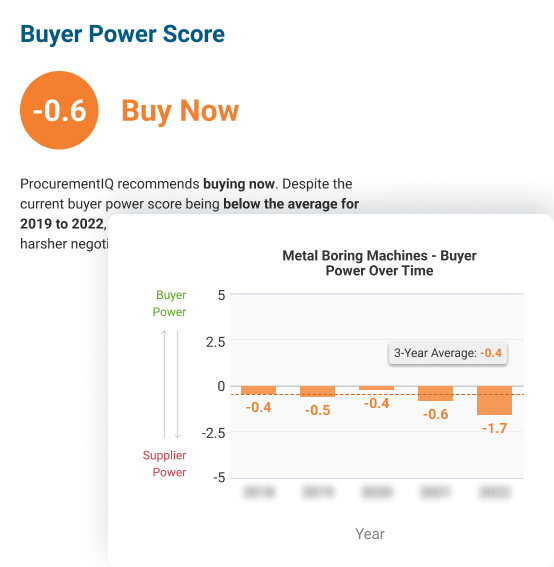
In 2026, buyer power amounts to -0.4 in the United States. Buyer power is most positively impacted by Forecast Price Trend. It is most negatively impacted by Recent Price Volatility. Subscribers can access details on eight other factors that impact buyer power. Learn more
United States
Buyer power forecasts: your glimpse into the future
Develop strategies for the upcoming year and identify unforeseen opportunities for buying now
- Actionable "Buy Now" and "Buy Later" insights
- Near-real-time updates to current and forecast Buyer Power Scores
- Methodology and weightings for Buyer Power Score Components
Supply Chain Risk
The average level of supply chain risk is assessed as Medium, which has a negative impact on buyer power. The level of supply chain risk is affected by industry volatility, barriers to entry, competition, import penetration, regulation and industry financial risk. Buyers in this market can mitigate procurement and supply chain management risks by monitoring risk levels for individual first and second tier suppliers:
1st
Tier Suppliers
- Operating Systems & Productivity Software Publishers
- Computer Manufacturers
- IT Consulting Firms
2nd
Tier Suppliers
- Intellectual Property Licensing Firms
- Semiconductor & Circuit Manufacturers
- Computer & Software Wholesalers
- Office Stationery Manufacturers
Biggest License Management Software Suppliers in the US by Revenue
The largest License Management Software vendors by revenue in the US are Agilis Software LLC, Reprise Software Inc. and Soraco Technologies Inc. Subscribers can sort and filter by market share concentration, profit level and other factors. Learn more
| Supplier | Operational Size | Headquarters | Number of Employees | Market Share (%) | Market Share Performance (3yr trend) | Total Revenue ($ million) | Profit Level (%) | Risk Level |
|---|---|---|---|---|---|---|---|---|
| Oracle Corporation | Global | AUSTIN, CA | >10,000 | 10-15 | ||||
| International Business Machines Corporation | Global | ARMONK | >10,000 | 5-10 | ||||
| Broadcom Inc. | Global | PALO ALTO, CA | >10,000 | 5-10 | ||||
| Steel Connect Inc. | Global | NEW YORK, MA | 1,001-10,000 | 5-10 | ||||
| Thales | Global | Paris, FR | >10,001 | < 5 | ||||
| OpenText Corporation | Global | ONTARIO CANADA | >10,000 | < 5 | ||||
| SolarWinds Inc. | Global | AUSTIN, TX | 1,001-10,000 | < 5 | ||||
| ScienceSoft USA Corporation | International | McKinney, TX | 501-1,000 | < 5 | ||||
| Agilis Software LLC | Global | San Francisco, CA | 51-100 | < 5 | ||||
Looking for a list of suppliers by country?
Subscribers can access vendor information on Canadian and European suppliers, too. We also offer custom research services to help with vendor sourcing anywhere in the world.
Profit Analysis
The average profit margin across vendors in the License Management Software market is 17.4% and steady. Profit levels shift depending on suppliers' spend on wages, purchases and overhead. The highest cost component for vendors is Overhead. The cost trend for this component is rising, when considering movement between 2025 and 2026. To understand cost forecasts for 2027 and uncover the implications on profit, start your subscription. Learn more
Vendor & Supply Chain Analysis
The license management software market has a moderate level of market share concentration, as the top vendors account for an estimated 39.0% of total market revenue, and are well established in multiple markets. Moderate market share concentration suppresses buyer power somewhat as it indicates a number of vendors that operate less competitively within the market.
License management software vendors face a moderate to low level of risk from downstream demand, considering license management software vendors sell exclusively to other software publishers. This focus on a single industry raises the inherent risk for vendors, however, stable demand thus bolsters vendors’ financial security, which, in turn, boosts buyer power by reducing the risk of service interruption.
License management software vendors experience moderate supply chain risks, as the production of this software depends on key material inputs and the labor of software engineers. Even though supply disruptions are unlikely, vendors operate from a base of financial security, which benefits buyers because it allows them to choose a vendor without fearing service cutoffs or sudden supplier bankruptcy.
The United States is a net importer of computers, meaning it imports more computers than it exports. While lower manufacturing costs abroad drive down prices for imported computers, relying on imports can lead to potential shortages or price increases if there are supply chain disruptions due to geopolitical tensions, trade disputes, or global crises.
Supplier Information
Oracle Corporation
Oracle Corporation is a global technology company that provides enterprise information technology (IT) products and services. It comprises three businesses: the Cloud and License business, which offers Oracle Applications, Oracle Database, and Oracle Middleware software offerings, among others, deployed using... Subscribe to learn more
Broadcom Inc.
Broadcom Inc. is a public company operating globally in the manufacturing, information and professional, scientific and technical services sectors. The company's offerings include central processing units, transistors, database management systems, network security equipment, wireless access points. Founded... Subscribe to learn more
International Business Machines Corporation
International Business Machines Corporation (IBM) is a global integrated computer technology, hardware, software, and services provider. It organizes its business into four segments: Software segment, which provides software solutions for a hybrid cloud platform, data and artificial intelligence, automation,... Subscribe to learn more
Steel Connect Inc.
Steel Connect Inc. is a public company operating globally in the information sector. The company's offerings include license management software. Founded in 1968, the company is currently headquartered in WALTHAM, Massachusetts, United States of America with an estimated 1100 employees. Subscribe to learn more
Agilis Software LLC
Agilis Software LLC is a private company operating globally in the information sector. The company's offerings include license management software. Founded in 2002, the company is currently headquartered in San Francisco, California, United States of America with an estimated 75 employees. Subscribe to learn more
OpenText Corporation
Open Text Corporation is an information management company that provides software and services for global enterprises, small and medium-sized businesses, governments, and consumers. It delivers software as a service (SaaS) offerings, application programming interface (API) services, data services, and private... Subscribe to learn more
Reprise Software Inc.
Reprise Software Inc. is a private company operating globally in the information sector. The company's offerings include license management software. Founded in 2006, the company is currently headquartered in San Jose, California, United States of America with an estimated 37 employees. Subscribe to learn more
ScienceSoft USA Corporation
ScienceSoft USA Corporation is a private company operating internationally in the information and professional, scientific & technical services sectors. The company's offerings include license management software, mobile app development services, data mining consulting services, software development services... Subscribe to learn more
SolarWinds Inc.
SolarWinds Inc. is a public company operating globally in the information sector. The company's offerings include it asset management software, license management software, network monitoring software and virtual machine software. Founded in 1999, the company is currently headquartered in AUSTIN, Texas, United... Subscribe to learn more
Accelerate the vendor selection process
Get a clear picture of the competition in a market and discover which vendors are best-suited for your sourcing needs. Our supplier profiles include hard-to-find financial ranges for private companies, cover public company data and feature an interactive competitor matrix.
Procurement Management KPIs for the License Management Software Market
Managing vendor performance throughout the contract period is easier when tracking specific key performance indicators (KPIs). For example, buyers should monitor Average Resolution Time and Customer Satisfaction (CSAT). Buyers may experience better performance throughout their contracts if they establish service level agreements (SLAs) based on Functionality and other factors.
| KPI | Level of Importance (1-5) | Measurements | Key Considerations |
|---|---|---|---|
| Average Resolution Time |
|
Total resolution time Number of resolved tickets |
The average resolution time represents the average amount of time it takes to resolve a support ticket. The average resolution time can be used to determine a company’s support responsiveness. Ideally, vendors must be able to fix critical bugs within 48 hours. |
| Customer Satisfaction (CSAT) |
|
Number of positive customer responses Number of customer responses |
Customer satisfaction with a vendor is indicative of how cooperative and sympathetic they are to customer needs. Positive customer satisfaction shows that the vendor cares for customer success rates when using their software. |

Questions to Ask During Procurement Negotiations
How can I gain leverage during negotiations?
Customer Support
What is your client renewal or repeat business rate? Why do companies choose to renew their contracts with your business?
What method is used to evaluate customer satisfaction and how frequently? Is this information made available to clients?
Experience and Expertise
Why did the last two clients you lost cancel their contracts with you?
What is your renewal/repeat business rate for businesses in my industry and how does that compare to your overall rates?
Competition
How do you attract new clients and retain existing clients?
How does your firm maintain a competitive edge?
The ultimate prep for procurement negotations
View all 25 negotiation questions for this category when you subscribe.
License Management Software RFP Guidelines
What should my RFP include?
Organizational Overview
Buyers should outline the details of their organization, including the number of employees, locations and operating hours.
Buyers should state the reasons for purchasing a new license management software system and state the benefits they expect to receive from the software.
Statement Of Need
Buyers should provide a list of required features that the software includes (e.g. the ability to manage licenses and the ability to generate reports on software activation and usage).
Buyers should describe hardware, including descriptions of CPU, network, and backup devices. Buyers should also describe software requirements, including operating system, system stability, and compatibility.
Project Budget
Buyers should specify their budget for the software.
Buyers should request that vendors specify the cost of implementation.
The RFP process made easy
Find out how you can access RFP templates for 800+ procurement categories to start writing better, more consistent RFPs.
We display average pricing information, trends and market data.
Our Reports include:
- Opportunity assessment
- Market dynamics
- Recent developments
- Positive and warning trends
- Buyer power levers
- Price environment and market pricing
- Geographic wage rates
- Global market updates
- Total cost of ownership
- Cost structure benchmarks and analysis
- Supply chain and vendors
- Global supplier breakdown
- Market share concentration
- Regulation and business requirements
- Vendor management and KPIs
- Sourcing strategy guidance