Procurement Market Intelligence Report
Authentication Software
Sourcing Guide & Market Intelligence
Smarter cost management starts with comprehensive market intelligence
 United States
 Global
Quick Navigation
Authentication Software Global Overview
Definition
Summary
This report is intended to assist buyers of authentication software. Authentication software is used to verify the identity of a person accessing company data. Authentication software prevents unauthorized access from outside parties. Common buyers include financial institutions, healthcare providers and government agencies.
This Report Includes:
- Password-Based Authentication
- Multi-Factor Authentication
- Biometric Authentication
- Token Authentication
Not in this Report:
- ID Card Scanning
- Fraud Detection
- Computers with Pre-Installed Authentication Programs
Global Authentication Software Procurement Trends
Discover the top international trends affecting procurement in the global Authentication Software market.
Warning Trends
The European Union’s Artificial Intelligence (AI) Act enters into force
- In August 2024, the European Union (EU) began enforcing its new regulation on artificial intelligence. Although EU legislation, the act will have a major effect on global technological companies operating in the AI space, similar to the General Data Protection regulation.
- The legislation aims to apply a risk-based framework to AI regulation, meaning different AI applications will be treated differently. The law applies a general ban for “unacceptable” uses, such as social scoring and predictive policing.
- For general-purpose AI models, companies will be required to comply with EU copyright law and intellectual property provisions, carry out regular testing, issue transparency disclosures, and implement adequate cybersecurity protections. For “high-risk” AI applications, such as autonomous vehicles, medical devices, financial services, and biometric identification systems, companies must meet stricter requirements in terms of risk-mitigation systems, documentation, human oversight, and cybersecurity.
- Companies that breach the AI Act may face fines ranging from 7.5 million euros or 1.5% of global annual revenues to 35.0 million euros or 7.0% of global annual revenues, whichever amount is higher.
- While the blanket ban on unacceptable systems entered into force in February 2025, most of the obligations do not take effect for a full year. In August 2025, requirements for general-purpose AI will come into effect, and in August 2026, obligations for high-risk AI systems will be enforced.
The FBI has warned that Chinese government hackers could disrupt critical infrastructure in the United States in the event of a conflict with China.
- The FBI announced on January 31 that it had thwarted an attempt by the Chinese government hacking group “Volt Typhoon” to plant malware onto electric power, water treatment and transportation systems in the United States using compromised end-of-life small office/home office (SOHO) routers from Cisco and Netgear. End-of-life devices have been discontinued by manufacturers and no longer receive software patches to eliminate vulnerabilities, which makes these devices attractive targets for hackers.
- US officials assess that China might disrupt critical US infrastructure to prevent the United States from responding to a Chinese attack on Taiwan. Volt Typhoon has been particularly active in Hawaii and Guam, which house some of the largest US military and naval installations in the Pacific.
- The FBI announced on September 18 that it had disrupted a botnet from another Chinese government hacking group known as “Flax Typhoon”. Flax Typhoon had infected 260,000 networking devices around the world, including SOHO routers, internet protocol (IP) cameras, digital video recorders (DVRs), and network-attached storage (NAS) devices.n
- The Cybersecurity and Infrastructure Security Agency (CISA) recommends that organizations use its Known Exploited Vulnerabilities (KEV) Catalog to identify any vulnerabilities in their systems. Furthermore, organizations can subscribe to receive KEV Catalog updates from the agency and may contact the agency for advice.
Global Authentication Software Market - Suppliers by Region
| Country/Region | Number of Suppliers |
|---|---|
| #1 Europe | 330 |
| #2 United States | 250 |
| #3 China | 165 |
Explore supplier concentration across the globe
We've uncovered the 11 top regions for global procurement, based on feedback from our most strategic clients. Access vendor counts for each unique region when you subscribe.
2
Geography Drilldown - US
Average Cost of Authentication Software
United States
2026 Market Pricing$0.00 to $XX.XX
per user per monthAverage Price
Prices in the Authentication Software market range from $0.00 to $XX.XX, depending on Type of Authentication, Number of Features, Type of Device and Number of Users. For example, lower prices are associated with Universal directory (about $1.00 per user per month) and Single sign-on (about $2.00 per user per month), whereas higher prices are associated with Lifecycle management (about $4.00 per user per month).
Need the scoop on international price trends?
Between our Europe and Canada collections, we provide price data for 350 markets so you can instantly compare prices across borders. Or, use our custom research services for intel on prices in any region across the globe.
Authentication Software Category Price Trends
Pricing trends are indicated by the compound annual growth rate (CAGR) during a set period of time. For the Authentication Software market, prices in the US have grown 0.5% from 2022 to 2025. Subscribers can access price trend forecasts, price driver projections and forward-looking cost structure data. Learn more
United States (2022-2025)


Wondering where prices are heading?
Price trend forecasts are available to subscribers, along with price driver projections and forward-looking cost structure data.
Cost Analysis - Total Cost of Ownership for Authentication Software
Total cost of ownership is Medium in the Authentication Software market. The average cost of ownership differs depending on the contract but generally includes costs negotiated before the contract begins, costs billed during the contract period and unforeseen costs.
Negotiated Before
Installation
Implementation
Billed During
Additional Fees
Maintenance
License fees
Buyer Power in Procurement Negotiations
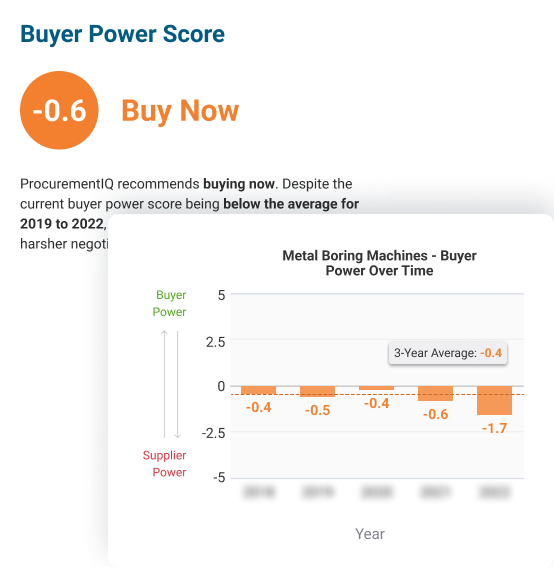
In 2026, buyer power amounts to 0.7 in the United States. Buyer power is most positively impacted by Recent Developments. It is most negatively impacted by Recent Price Volatility. Subscribers can access details on eight other factors that impact buyer power. Learn more
United States
Buyer power forecasts: your glimpse into the future
Develop strategies for the upcoming year and identify unforeseen opportunities for buying now
- Actionable "Buy Now" and "Buy Later" insights
- Near-real-time updates to current and forecast Buyer Power Scores
- Methodology and weightings for Buyer Power Score Components
Supply Chain Risk
The average level of supply chain risk is assessed as Low, which has a positive impact on buyer power. The level of supply chain risk is affected by industry volatility, barriers to entry, competition, import penetration, regulation and industry financial risk. Buyers in this market can mitigate procurement and supply chain management risks by monitoring risk levels for individual first and second tier suppliers:
1st
Tier Suppliers
- Intellectual Property Leasing Firms
- Computer & Packaged Software Wholesalers
- Internet Hosting Service Providers
2nd
Tier Suppliers
- Software Publishers
- Computer Equipment Manufacturers
- Semiconductor Manufacturers
Biggest Authentication Software Suppliers in the US by Revenue
The largest Authentication Software vendors by revenue in the US are Assa Abloy Ab, Thales and OneSpan Inc. Subscribers can sort and filter by market share concentration, profit level and other factors. Learn more
| Supplier | Operational Size | Headquarters | Number of Employees | Market Share (%) | Market Share Performance (3yr trend) | Total Revenue ($ million) | Profit Level (%) | Risk Level |
|---|---|---|---|---|---|---|---|---|
| Cisco Systems, Inc. | Global | SAN JOSE, CA | >10,000 | |||||
| Assa Abloy Ab | Global | Stockholm, SE | >10,001 | 10-15 | ||||
| Dell Technologies Inc. | Global | ROUND ROCK | >10,000 | 10-15 | ||||
| Nortonlifelock Inc. | Global | TEMPE, AZ | 1,001-10,000 | 15-20 | ||||
| Ping Identity Holding Corp. | Global | DENVER, US | 1,001-10,000 | 15-20 | ||||
| Okta, Inc. | Global | San Francisco, CA | 1,001-10,000 | 20-25 | ||||
| Broadcom Inc. | Global | PALO ALTO, CA | >10,000 | 5-10 | ||||
| Thales | Global | Paris, FR | >10,001 | 5-10 | ||||
| Proximus Group | Global | Brussels, BE | >10,001 | < 5 | ||||
Looking for a list of suppliers by country?
Subscribers can access vendor information on Canadian and European suppliers, too. We also offer custom research services to help with vendor sourcing anywhere in the world.
Profit Analysis
The average profit margin across vendors in the Authentication Software market is 29.0% and steady. Profit levels shift depending on suppliers' spend on wages, purchases and overhead. The highest cost component for vendors is Wages. The cost trend for this component is rising, when considering movement between 2025 and 2026. To understand cost forecasts for 2027 and uncover the implications on profit, start your subscription. Learn more
Vendor & Supply Chain Analysis
Ongoing growth in this market helps ensure financial stability for suppliers, which is the primary contributor to low vendor risk. This benefits buyers by reducing the likelihood of a vendor suddenly exiting the market.
Moderate market share concentration may impede buyer power since a few vendors have considerable influence over the market. However, the concentration is decreasing, and competition is still high, which mitigates the downside.
Since suppliers do not rely on material inputs, overall supply chain risk is low. However, reliance on computers exposes them to some supply chain risks stemming from the ongoing semiconductor shortage.
The United States is a net importer of computers, meaning it imports more than it exports. US buyers seeking to import computers should expect higher buying lead times and should assess quality standards.
Supplier Information
Cisco Systems, Inc.
Cisco Systems, Inc. is a public company operating globally in the manufacturing, information and professional, scientific and technical services sectors. The company's offerings include rail signaling systems, office phones, print servers, computer servers, database management systems. Founded in 1984, the... Subscribe to learn more
Assa Abloy Ab
Assa Abloy Ab is a public company operating globally in the manufacturing and information sectors. The company's offerings include automatic sliding doors, blast resistant doors & windows, fire doors, garage doors, biometric devices. Founded in 1994, the company is currently headquartered in Stockholm, Sweden... Subscribe to learn more
Dell Technologies Inc.
Dell Technologies Inc. is a global provider of comprehensive information technology solutions, products, and services. It organizes its business into two segments: the Infrastructure Solutions Group, which offers multi-cloud and big data solutions to simplify, streamline, and automate cloud operations, and... Subscribe to learn more
Nortonlifelock Inc.
Gen Digital Inc. is a global provider of cybersecurity solutions. It offers real-time threat protection against malware, viruses, adware, ransomware, and other online emerging threats under the Norton, Avast, Avira, AVG, and CCleaner brands; identity theft protection for credit reports, the dark web, social... Subscribe to learn more
Ping Identity Holding Corp.
Ping Identity Holding Corp. is an identity solutions provider to enterprises for various use cases. It provides real-time authentication leveraging artificial intelligence and machine learning to enhance customer experience, workforce productivity, access management, and IoT identity management. Its Ping Subscribe to learn more
Okta, Inc.
Okta Inc. is a technology company that provides independent and neutral cloud-based identity solutions. Its Okta Platform can act as a central system for an organization’s connectivity, access, authentication, and identity lifecycle management needs across users, technology, and applications. Its platform... Subscribe to learn more
Broadcom Inc.
Broadcom Inc. is a public company operating globally in the manufacturing, information and professional, scientific and technical services sectors. The company's offerings include central processing units, transistors, database management systems, network security equipment, wireless access points. Founded... Subscribe to learn more
Thales
Thales SA is a public company operating globally in the manufacturing and information sectors. The company's offerings include biometric devices, license management software, identity and access management (iam) solutions and authentication software. Founded in 1991, the company is currently headquartered... Subscribe to learn more
Datacard Corp
Datacard Corp is a private company operating globally in the information sector. The company's offerings include authentication software. Founded in 1969, the company is currently headquartered in Minneapolis, Minnesota, United States of America with an estimated 5500 employees. Subscribe to learn more
Accelerate the vendor selection process
Get a clear picture of the competition in a market and discover which vendors are best-suited for your sourcing needs. Our supplier profiles include hard-to-find financial ranges for private companies, cover public company data and feature an interactive competitor matrix.
Procurement Management KPIs for the Authentication Software Market
Managing vendor performance throughout the contract period is easier when tracking specific key performance indicators (KPIs). For example, buyers should monitor Customer Concentration and Customer Satisfaction (CSAT). Buyers may experience better performance throughout their contracts if they establish service level agreements (SLAs) based on System Availability and other factors.
| KPI | Level of Importance (1-5) | Measurements | Key Considerations |
|---|---|---|---|
| Customer Concentration |
|
Revenue per customer Total revenue |
The customer concentration represents the amount of revenue associated with a single customer. The customer concentration can be used to determine the need to diversify client portfolios. It is recommended that the customer concentration remains at or below 10.0%. |
| Customer Satisfaction (CSAT) |
|
Number of customer responses Number of positive customer responses |
Customer satisfaction represents customers’ overall satisfaction with a company. Customer satisfaction can be used to determine whether customer improvements are required. Customer satisfaction can be used to evaluate a company’s reputation. |
Questions to Ask During Procurement Negotiations
How can I gain leverage during negotiations?
Product Lines
Do your authentication methods include software and hardware tokens?
What tokens or hardware products are required to utilize your software?
Integration
What experience do you have in developing software products that can also protect against internet threats?
How are your relationships with other software publishers?
Customer Service
Do clients have dedicated customer service representatives, or will clients have to call a general support line?
What type of training will you offer for my company's employees? Is it on-site at my facilities?
The ultimate prep for procurement negotations
View all 26 negotiation questions for this category when you subscribe.
Authentication Software RFP Guidelines
What should my RFP include?
Organizational Overview
Buyers should describe their organization and operations and the purpose of the authentication software in those operations.
Buyers should detail the size of their organization and the authentication software users (e.g., employees or clients).
Statement Of Need
Buyers should include the type of authentication software desired.
Buyers should detail the software features they require (e.g., certificate issuing capability, self-learning capability to help protect against malware threats, and tracking capability to detect fraudulent activity) and whether the system must meet any compatibility requirements with their existing infrastructure.
Project Budget
Buyers should state the number of expected software users (if known) and the required level(s) of software access.
Buyers should detail the cost model and contract terms for annual ongoing costs (e.g., system support, upgrade, and maintenance charges).
The RFP process made easy
Find out how you can access RFP templates for 800+ procurement categories to start writing better, more consistent RFPs.
We display average pricing information, trends and market data.
Our Reports include:
- Opportunity assessment
- Market dynamics
- Recent developments
- Positive and warning trends
- Buyer power levers
- Price environment and market pricing
- Geographic wage rates
- Global market updates
- Total cost of ownership
- Cost structure benchmarks and analysis
- Supply chain and vendors
- Global supplier breakdown
- Market share concentration
- Regulation and business requirements
- Vendor management and KPIs
- Sourcing strategy guidance