Procurement Market Intelligence Report
Adhesives
Sourcing Guide & Market Intelligence
Smarter cost management starts with comprehensive market intelligence
 United States
 Europe
 Global
Quick Navigation
Adhesives Global Overview
Definition
Summary
Adhesives are used to bind two surfaces together. Adhesives in this market can be categorized into wet, contact, reaction (single-component reaction and two-component reaction), hot-melted, and pressure-sensitive varieties. Adhesives have diverse applications in the automotive, construction, aerospace, packaging, and manufacturing sectors.
This Report Includes:
- Wet Adhesives
- Contact Adhesives
- Reaction Adhesives
- Hot-Melted Adhesives
- Pressure-Sensitive Adhesives
Not in this Report:
- Tape Products
- Asphalt Adhesives.
- Dental, Medical & Surgical Adhesives
- Natural & Gypsum-Based Adhesives
Global Adhesives Procurement Trends
Discover the top international trends affecting procurement in the global Adhesives market.
Warning Trends
Tariffs to negatively impact building and construction components and supplies sector
- The Trump Administration’s reciprocal tariffs, which impose higher tariffs on all products imported from most foreign nations, are set to take effect on August 7, after the rates were finalized on August 1. As a result, most construction material import sources face higher tariffs, including Mexico (25.0%), Canada (35.0%), Turkiye (15.0%), and China (54.0%).
- According to Realtor.com, about 70.0% of the softwood lumber and drywall gypsum (used for drywall) used in residential construction is imported from Canada and Mexico, respectively. According to the New York Times, drywall prices could rise by 22.0%. Other products like wood utility poles, medium-density fiberboard, particleboard, plywood, wood veneers, and wood pulp will also see higher prices as a result.
- The Yale Budget Lab estimates that construction inputs like cement could see a 3.5% increase in price with higher tariffs on imports. Turkiye, Canada, and Mexico, which account for over 65.0% of US imports, face tariff rates of 10.0%, 25.0%, and 25.0%, respectively.
- Specific steel and aluminum tariffs of 50.0% on all US imports are also negatively affecting buyers of building and construction components and supplies like sheet metal, automatic sliding doors, garage doors, ladders, posts and bollards, and more. In 2024, 23.0% of all steel used in the United States was imported from foreign countries such as Canada and Mexico.
- US manufacturers reliant on imported plastic resins from countries like China will not be impacted by tariffs as key resins, like polyethylene, polypropylene, and PET, will be exempt from the reciprocal tariffs. Other construction components and supplies that are compliant with the United States-Canada-Mexico Agreement will be exempt from tariffs.
Neutral
Crude oil prices dip, but natural gas and fuel prices remain volatile in 2025
- Oil prices have been falling with the introduction of higher tariffs and the predicted decline in global demand. The OPEC+ group of countries also announced they would be unwinding production cuts and increasing their collective output target for May by 411,000 barrels per day.
- Trade wars, ongoing conflict between Hamas and Israel, and general unrest in the Middle East are causing uncertainty surrounding oil prices, which has led to volatility in prices. In the third week of May 2025, crude oil prices hit $63.67 per barrel, but volatility remains as geopolitical concerns remain.
- Natural gas prices rallied early in 2025 with colder-than-usual temperatures in the United States and high demand, topping out at $4.68/MMBtu in March. Prices have since fallen with the onset of trade wars and weakening demand projections to $3.64/MMBtu in the third week of May 2025.
- The national average of gasoline prices has been rising slightly due to refinery maintenance/outages and blending issues, hitting a national average of $3.15 per gallon in the third week of May 2025. However, gasoline futures have been volatile, falling due to fears of oversupply and deepening concerns about weakening demand with tariffs, but rising after trade deals.
Inflation climbs above 3.0% for the first time in seven months
- In January, the Consumer Price Index (CPI) 12-month inflation rate, the most commonly used measure of inflation, rose by 0.1% to 3.0%, the highest it has been since June 2024.
- This uptick in inflation follows cuts to interest rates which may have added to consumer demand, fueling higher consumer prices.
- Additionally, the threat of impending tariff hikes has driven preemptive stockpiling by importers, adding to demand and price growth across a range of industries in the United States.
- While inflation is still low relative to previous years, sustained recent increases in inflation and the potential effects of tariffs, such as the recently implemented 10.0% on all Chinese goods, mean prices are still rising at a faster-than-normal pace.
Global Adhesives Market - Suppliers by Region
| Country/Region | Number of Suppliers |
|---|---|
| #1 China | 3,595 |
| #2 Europe | 2,145 |
| #3 India | 1,765 |
Explore supplier concentration across the globe
We've uncovered the 11 top regions for global procurement, based on feedback from our most strategic clients. Access vendor counts for each unique region when you subscribe.
2
Geography Drilldown - US & Europe
Average Cost of Adhesives
United States
2026 Market Pricing$17.00 to $XXX.XX
per gallon
Average Price
Prices in the Adhesives market range from $17.00 to $XXX.XX, depending on Type of Adhesives, Order Volume, Functionality and Brand. For example, lower prices are associated with Glue products ($915 to 1,100 per gallon), whereas higher prices are associated with Instant adhesives ($1,015 to $1,215 per gallon).
Need the scoop on international price trends?
Between our Europe and Canada collections, we provide price data for 350 markets so you can instantly compare prices across borders. Or, use our custom research services for intel on prices in any region across the globe.
Adhesives Category Price Trends
Pricing trends are indicated by the compound annual growth rate (CAGR) during a set period of time. For the Adhesives market, prices in the US have declined -0.6% from 2022 to 2025. Meanwhile, the recent three-year CAGR for Europe is +0.8%.
United States (2022-2025)

Europe (2022-2025)

Compound Annual Growth Rate
Wondering where prices are heading?
Price trend forecasts are available to subscribers, along with price driver projections and forward-looking cost structure data.
Cost Analysis - Total Cost of Ownership for Adhesives
Total cost of ownership is Medium in the Adhesives market. The average cost of ownership differs depending on the contract but generally includes costs negotiated before the contract begins, costs billed during the contract period and unforeseen costs. For example, unforeseen costs in the form of Duties & Taxes may raise the total cost of ownership unexpectedly.
Negotiated Before
Transportation
Billed During
Hardware
Compliance
Unforeseen
Duties & Taxes
Buyer Power in Procurement Negotiations
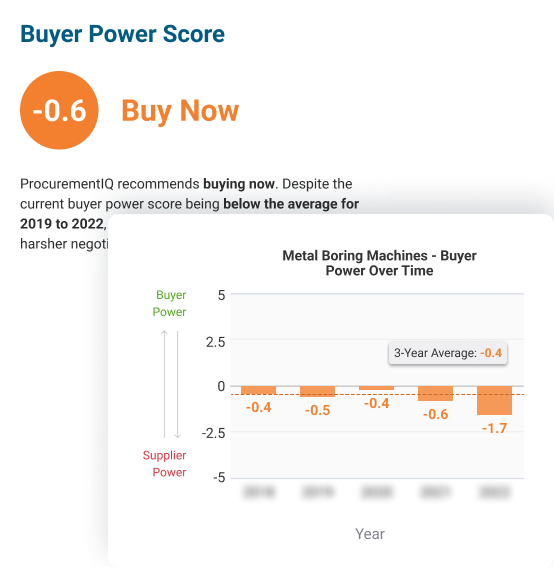
In 2026, buyer power amounts to -1.3 in the United States. Buyer power is most positively impacted by Recent Developments. It is most negatively impacted by Product Specialization. Subscribers can access details on eight other factors that impact buyer power. Learn more
United States

Buyer power forecasts: your glimpse into the future
Develop strategies for the upcoming year and identify unforeseen opportunities for buying now
- Actionable "Buy Now" and "Buy Later" insights
- Near-real-time updates to current and forecast Buyer Power Scores
- Methodology and weightings for Buyer Power Score Components
Supply Chain Risk
The average level of supply chain risk is assessed as High, which has a negative impact on buyer power. The level of supply chain risk is affected by industry volatility, barriers to entry, competition, import penetration, regulation and industry financial risk. Buyers in this market can mitigate procurement and supply chain management risks by monitoring risk levels for individual first and second tier suppliers:
1st
Tier Suppliers
- Chemical Wholesalers
- Plastic & Resin Manufacturers
- Industrial Equipment & Machinery Manufacturers
2nd
Tier Suppliers
- Organic Chemical Manufacturers
- Inorganic Chemical Manufacturers
- Petrochemical Manufacturers
- Chemical Product Manufacturers
- Steel Manufacturers
Biggest Adhesives Suppliers in the US by Revenue
The largest Adhesives vendors by revenue in the US are Ppg Industries, Inc., W.W. Grainger, Inc. and Ashland Global Holdings Inc. Subscribers can sort and filter by market share concentration, profit level and other factors. Learn more
| Supplier | Operational Size | Headquarters | Number of Employees | Market Share (%) | Market Share Performance (3yr trend) | Total Revenue ($ million) | Profit Level (%) | Risk Level |
|---|---|---|---|---|---|---|---|---|
| 3m Company | Global | ST PAUL | >10,000 | 10-15 | ||||
| Henkel Ag & Co. Kgaa | Global | Düsseldorf, DE | >10,001 | 10-15 | ||||
| Fuller H B Co | Global | ST PAUL, MN | 1,001-10,000 | 5-10 | ||||
| W.W. Grainger, Inc. | Global | LAKE FOREST | >10,000 | < 5 | ||||
| Ppg Industries, Inc. | Global | PITTSBURGH, PA | >10,000 | < 5 | ||||
| Lord Corporation | Global | Cleveland, OH | >10,000 | < 5 | ||||
| Eastman Chemical Co | Global | KINGSPORT, TN | >10,000 | < 5 | ||||
| Ashland Global Holdings Inc. | Global | WILMINGTON, DE | 1,001-10,000 | < 5 | ||||
| Franklin International | International | Columbus, OH | 251-500 | < 5 | ||||
Looking for a list of suppliers by country?
Subscribers can access vendor information on Canadian and European suppliers, too. We also offer custom research services to help with vendor sourcing anywhere in the world.
Profit Analysis
The average profit margin across vendors in the Adhesives market is 5.2% and steady. Profit levels shift depending on suppliers' spend on wages, purchases and overhead. The highest cost component for vendors is Purchases. The cost trend for this component is falling, when considering movement between 2025 and 2026. To understand cost forecasts for 2027 and uncover the implications on profit, start your subscription. Learn more
Vendor & Supply Chain Analysis
Moderate market share concentration, high supply chain risk, and a low level of regulations make the average vendor risk for the adhesives market moderate.
Oil, a primary input for adhesive manufacturing, has experienced high price volatility. Thus, plastic and resin manufacturers pose a high risk to the supply chain due to their risk of supply chain interruptions.
Market share concentration is moderate, which allows top suppliers to control a significant portion of market revenue and suppress price-based competition. Buyers in the market may find it difficult to negotiate with these top suppliers due to their pricing power; however, there are small to mid-sized suppliers operating in the market that can provide products similar to these top suppliers.
The United States is a net exporter of adhesives, meaning it exports more than it imports. Closer proximity to adhesive producers may result in shorter lead times, reduced shipping costs, and improved supply chain reliability.
Supplier Information
3m Company
3M Company is a diversified technology company offering a range of products for safety and industrial, transportation and electronics, and consumer markets. It develops, manufactures, and markets, among others, industrial abrasives and finishing for metalworks, autobody repair solutions, industrial specialty... Subscribe to learn more
Henkel Ag & Co. Kgaa
Henkel Ag & Co. Kgaa is a public company operating globally in the manufacturing and professional, scientific & technical services sectors. The company's offerings include waterproofing coatings, adhesives and chemical management services. Founded in 1876, the company is currently headquartered in Düsseldorf,... Subscribe to learn more
Fuller H B Co
Fuller H B Co. is a global formulator, manufacturer, and marketer of adhesives, sealants, and other specialty chemical products serving the consumer goods, construction, and industrial markets. It organizes its business into three segments: the Hygiene, Health, and Consumable Adhesives segment, which produces... Subscribe to learn more
Ashland Global Holdings Inc.
Ashland Global Holdings Inc. is a public company operating globally in the manufacturing sector. The company's offerings include adhesives and water treatment chemicals. Founded in 1924, the company is currently headquartered in WILMINGTON, Delaware, United States of America with an estimated 3900 employees.... Subscribe to learn more
Eastman Chemical Co
Eastman Chemical Co is a public company operating globally in the manufacturing sector. The company's offerings include synthetic fibers, plasticizers, preservatives, methanol, synthetic resins. Founded in 1918, the company is currently headquartered in KINGSPORT, Tennessee, United States of America with Subscribe to learn more
Franklin International
Franklin International is a private company operating internationally in the manufacturing sector. The company's offerings include adhesives. Founded in 1935, the company is currently headquartered in Columbus, Ohio, United States of America with an estimated 375 employees. Subscribe to learn more
Lord Corporation
Lord Corporation is a private company operating globally in the manufacturing sector. The company's offerings include adhesives. Founded in 1917, the company is currently headquartered in Cleveland, Ohio, United States of America with an estimated 10000 employees. Subscribe to learn more
Ppg Industries, Inc.
PPG Industries, Inc. is a manufacturer and distributor of paints, coatings, and specialty products. It organizes its business into three reportable business segments: the Global Architectural Coatings segment, which supplies decorative coatings, adhesives, sealants, and finishes, as well as paint strippers,... Subscribe to learn more
W.W. Grainger, Inc.
WW Grainger, Inc. is a diversified global company that supplies maintenance, repair, and operating (MRO) products and services. It offers products under several categories, including safety and security, material handling and storage, pumps and plumbing equipment, cleaning and maintenance, metalworking, and... Subscribe to learn more
Accelerate the vendor selection process
Get a clear picture of the competition in a market and discover which vendors are best-suited for your sourcing needs. Our supplier profiles include hard-to-find financial ranges for private companies, cover public company data and feature an interactive competitor matrix.
Procurement Management KPIs for the Adhesives Market
Managing vendor performance throughout the contract period is easier when tracking specific key performance indicators (KPIs). For example, buyers should monitor Average Response Time and On-Time Delivery (OTD). Buyers may experience better performance throughout their contracts if they establish service level agreements (SLAs) based on Delivery and other factors.
| KPI | Level of Importance (1-5) | Measurements | Key Considerations |
|---|---|---|---|
| Average Response Time |
|
Total number of inquiries submitted to supplier Total time to response |
The average response time measures how long it takes for a supplier to respond to buyers’ inquiries, questions, or concerns that have been submitted to customer support. A poor average response time can lead to long periods of waiting for buyers while awaiting clarification on any questions regarding products, the request for new products due to defects or incorrect orders, or updates on shipments. |
| On-Time Delivery (OTD) |
|
Total number of deliveries Total number of deliveries completed on-time |
The on-time delivery rate can measure the rate at which suppliers provide orders in a timely manner. The on-time delivery rate can be used to assess the supplier's internal organization, as well as the ability to provide buyers with quality service. A poor on-time delivery rate may lead to inefficiency and downtime for the buyer while awaiting products to arrive. |

Questions to Ask During Procurement Negotiations
How can I gain leverage during negotiations?
Inventory Control
Where are your manufacturing facilities located? What about your warehouses?
Is your entire supply chain and reordering process electronic?
Experience and Expertise
Which industries do you most commonly supply?
How long have you been active in this field? How long have you served operators in my industry?
Cost Containment
During the past three years, what percentage of your revenue has been dedicated to raw input materials? How has that changed?
How do you mitigate sudden price increases in raw materials?
The ultimate prep for procurement negotations
View all 27 negotiation questions for this category when you subscribe.
Adhesives RFP Guidelines
What should my RFP include?
Organizational Overview
Buyers should give an overview of their operations, including industry type (i.e., construction, manufacturing), to help prospective vendors understand their general adhesive needs.
Buyers should provide a detailed description of their operational structure, including to whom vendors will report.
Statement Of Need
Buyers should describe their specific adhesive needs (i.e., wet, contact, pressure-sensitive, etc.).
Buyers should list the level of strength needed for their adhesive, including any environmental factors that could affect its performance.
Project Budget
Buyers should explicitly state the amount for the award.
Buyers should describe the desired type of supply contract, including the desired payment terms.
The RFP process made easy
Find out how you can access RFP templates for 800+ procurement categories to start writing better, more consistent RFPs.
We display average pricing information, trends and market data.
Our Reports include:
- Opportunity assessment
- Market dynamics
- Recent developments
- Positive and warning trends
- Buyer power levers
- Price environment and market pricing
- Geographic wage rates
- Global market updates
- Total cost of ownership
- Cost structure benchmarks and analysis
- Supply chain and vendors
- Global supplier breakdown
- Market share concentration
- Regulation and business requirements
- Vendor management and KPIs
- Sourcing strategy guidance