Procurement Market Intelligence Report
Compressors
Sourcing Guide & Market Intelligence
Smarter cost management starts with comprehensive market intelligence
 United States
 Europe
 Global
Quick Navigation
Compressors Global Overview
Definition
Summary
Compressors increase the pressure being placed on a fluid in order to allow it to be transported through a pipe. Buyers operate in the manufacturing, utility and mining sector.
This Report Includes:
- Air motors
- Packaging compressors
Not in this Report:
- Vacuum pumps
- Other fuel and oil-dispensing pumps
Global Compressors Procurement Trends
Discover the top international trends affecting procurement in the global Compressors market.
Warning Trends
Tariffs to negatively impact the distribution and conditioning systems equipment sector
- The Trump Administration’s reciprocal tariffs, which apply general tariff rate increases to most leading US trade partners, are set to take effect on August 7, after the administration finalized the rates on August 1. These changes will significantly increase the tariff rate on leading distribution and conditioning systems exporting countries, including the European Union (15.0%), Canada (35.0%), China (54.0%), Mexico (25.0%), Japan (15.0%), and South Korea (15.0%).
- Distribution and conditioning systems equipment manufacturers in the United States will pay more for many foreign components and parts, such as heating and cooling equipment. Major manufacturers that operate in these markets, including Carrier, Daikin, Lennox, and Trane, have a manufacturing presence in Mexico and source components from tariff-impacted countries like China.
- According to the Heating, Air-Conditioning, & Refrigeration Distributors International (HARDI), over 66.0% of heating, ventilation, air conditioning, and refrigeration products are made in or use components imported from Canada, China, or Mexico. As price increases are passed down the supply chain, buyers will likely see price increases for key distribution and conditioning systems equipment.
- China is even more prevalent in several distribution and conditioning component markets, raising upstream supply chain risk following these tariffs. For example, according to the International Energy Agency, 95.0% of heat pump compressors were manufactured in China in 2023, and China accounts for half of the global trade in heat pump components.
United States announces new tariffs on all imported steel
- In February 2025, the United States announced 25.0% tariffs on all imported steel with no exemptions or exceptions. The tariffs took effect on March 12, 2025. On June 4th, these tariffs were increased further to 50%. These tariffs were not impacted by a recent court decision that temporarily suspended duties on certain goods as they were implemented under Section 232 of the Trade Expansion Act.
- Previously, countries such as Canada, Mexico, and Brazil, the top exporters of steel to the United States, had exemptions from tariffs. These have now been removed and all imported steel, regardless of origin, will be subject to the 50.0% tariff. However, on May 8th, the US announced an agreement with the United Kingdom to remove all levies on steel exported from the UK.
- When tariffs on steel imports were introduced in March 2018, they contributed to an increase in the price of steel and steel products. According to the Bureau of Labor Statistics, the price of steel-milled products increased by 10.2% in the year after the tariffs were implemented. This market heavily relies on steel as an input and may be impacted by this policy.
The European Commission is proposing the European Supply Chain Act
- Early in 2022, the European Commission (EC) proposed a new law that would impact supply chains throughout the European Union (EU).
- The law consists of provisions requiring companies to identify current and potential negative impacts on human rights and the environment throughout their supply chain and to mitigate these risks.
- Businesses will have to investigate all links of their supply chain, upstream and downstream, and adjust their supply chain to ensure labor rights and environmental standards are not being violated as a result of their operations over the course of two years.
- While many countries have their own national laws similar to the one being proposed by the EC, such as Germany’s German Supply Chain Due Diligence Act, this proposed law supersedes national laws and is stricter in most cases.
Global Compressors Market - Suppliers by Region
| Country/Region | Number of Suppliers |
|---|---|
| #1 China | 9,400 |
| #2 Europe | 9,015 |
| #3 United States | 3,400 |
Explore supplier concentration across the globe
We've uncovered the 11 top regions for global procurement, based on feedback from our most strategic clients. Access vendor counts for each unique region when you subscribe.
2
Geography Drilldown - US & Europe
Average Cost of Compressors
United States
2026 Market Pricing$500.00 to $XX,XXX.XX
per unit (with a 30-horsepower rating)
Average Price
Prices in the Compressors market range from $500.00 to $XX,XXX.XX, depending on Pressurization type, Motor power, Tank volume and Type of materials. For example, lower prices are associated with One-stage pressurization ($7,000 and $9,800 per unit (with a 30-horsepower rating), whereas higher prices are associated with Multistage pressurization ($12,000 to $40,500 per unit (with a 30-horsepower rating).
Need the scoop on international price trends?
Between our Europe and Canada collections, we provide price data for 350 markets so you can instantly compare prices across borders. Or, use our custom research services for intel on prices in any region across the globe.
Compressors Category Price Trends
Pricing trends are indicated by the compound annual growth rate (CAGR) during a set period of time. For the Compressors market, prices in the US have grown 5.5% from 2022 to 2025. Meanwhile, the recent three-year CAGR for Europe is +3.1%.
United States (2022-2025)

Europe (2022-2025)
Compound Annual Growth Rate
Wondering where prices are heading?
Price trend forecasts are available to subscribers, along with price driver projections and forward-looking cost structure data.
Cost Analysis - Total Cost of Ownership for Compressors
Total cost of ownership is High in the Compressors market. The average cost of ownership differs depending on the contract but generally includes costs negotiated before the contract begins, costs billed during the contract period and unforeseen costs. For example, unforeseen costs in the form of Lost Orders may raise the total cost of ownership unexpectedly.
Negotiated Before
Installation
Transportation
Billed During
Maintenance
Unforeseen
Lost Orders
Buyer Power in Procurement Negotiations
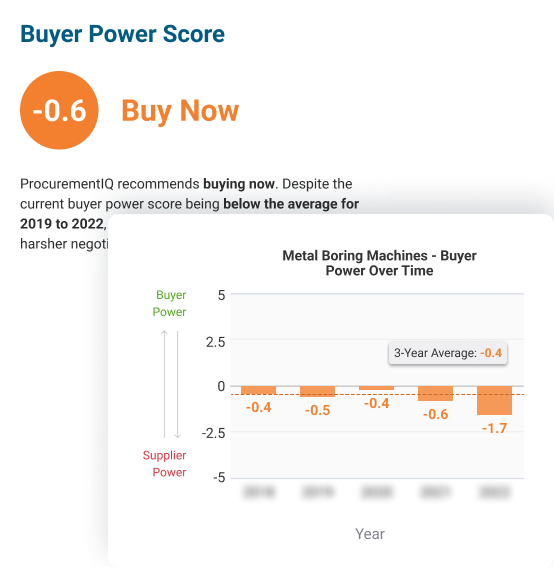
In 2026, buyer power amounts to -2.8 in the United States. Buyer power is most positively impacted by Price Driver Volatility. It is most negatively impacted by Market Share Concentration. Subscribers can access details on eight other factors that impact buyer power. Learn more
United States

Buyer power forecasts: your glimpse into the future
Develop strategies for the upcoming year and identify unforeseen opportunities for buying now
- Actionable "Buy Now" and "Buy Later" insights
- Near-real-time updates to current and forecast Buyer Power Scores
- Methodology and weightings for Buyer Power Score Components
Supply Chain Risk
The average level of supply chain risk is assessed as High, which has a negative impact on buyer power. The level of supply chain risk is affected by industry volatility, barriers to entry, competition, import penetration, regulation and industry financial risk. Buyers in this market can mitigate procurement and supply chain management risks by monitoring risk levels for individual first and second tier suppliers:
1st
Tier Suppliers
- Iron & Steel Manufacturers
- Nonferrous Metal Foundry Product Manufacturers
- Industrial Equipment Supply Wholesalers
2nd
Tier Suppliers
- Coal Miners
- Nonferrous Metal Rolling & Alloying Firms
- Valve Manufacturers
Biggest Compressors Suppliers in the US by Revenue
The largest Compressors vendors by revenue in the US are System Inc., Home Depot, inc. and W.W. Grainger, Inc. Subscribers can sort and filter by market share concentration, profit level and other factors. Learn more
| Supplier | Operational Size | Headquarters | Number of Employees | Market Share (%) | Market Share Performance (3yr trend) | Total Revenue ($ million) | Profit Level (%) | Risk Level |
|---|---|---|---|---|---|---|---|---|
| Hitachi Ltd. | Global | Tokyo, JPN | >10,001 | < 5 | ||||
| Atlas Copco Ab | Global | Stockholm, SE | >10,001 | < 5 | ||||
| Home Depot, inc. | International | ATLANTA | >10,000 | < 5 | ||||
| Siemens Ag | Global | Munich , DE | >10,001 | < 5 | ||||
| Emerson Electric Co. | Global | ST LOUIS, MO | >10,000 | < 5 | ||||
| W.W. Grainger, Inc. | Global | LAKE FOREST | >10,000 | < 5 | ||||
| Ingersoll Rand Inc. | Global | DAVIDSON | >10,000 | < 5 | ||||
| IDEX Corporation | Global | NORTHBROOK | 1,001-10,000 | < 5 | ||||
| System Inc. | National | PORT WASHINGTON | 1,001-10,000 | < 5 | ||||
Looking for a list of suppliers by country?
Subscribers can access vendor information on Canadian and European suppliers, too. We also offer custom research services to help with vendor sourcing anywhere in the world.
Profit Analysis
The average profit margin across vendors in the Compressors market is 5.9% and steady. Profit levels shift depending on suppliers' spend on wages, purchases and overhead. The highest cost component for vendors is Purchases. The cost trend for this component is stagnating, when considering movement between 2025 and 2026. To understand cost forecasts for 2027 and uncover the implications on profit, start your subscription. Learn more
Vendor & Supply Chain Analysis
Low market share concentration benefits buyers by enabling them to shop around for the best price from a variety of suppliers. Low concentration also allows smaller firms to enter the market by offering niche specialization or operating in particular regions.
The high level of supply chain risk harms buyer power because there is an increased likelihood of compressor prices fluctuating as a result of upstream supply chain risk.
Compressor manufacturers have experienced a low level of regulatory change during the past three years. The majority of regulation that affects manufacturers pertains to environmental protection.
The moderate level of vendor financial risk is neutral to buyers as supplier bankruptcy could disrupt supply and cause buyers to lose money if the supplier has already been paid.
As a net importer of compressors, buyers have access to competitively priced products, increased bargaining power, and supplier options, albeit with potential currency and supply chain risks.
Supplier Information
Atlas Copco Ab
Atlas Copco Ab is a public company operating globally in the mining, manufacturing and other services (except public administration) sectors. The company's offerings include drilling & exploration equipment, drill bits, off-highway trucks, pneumatic motors, hydraulic tools. Founded in 1873, the company is... Subscribe to learn more
Emerson Electric Co.
Emerson Electric Co. is a public company operating globally in the manufacturing, professional, scientific and technical services and other services (except public administration) sectors. The company's offerings include downhole instrumentation, welding machines, industrial refrigerators, auxiliary generators,... Subscribe to learn more
Hitachi Ltd.
Hitachi Ltd. is a public company operating globally in the manufacturing and wholesale trade sectors. The company's offerings include forestry & logging equipment, front-end loaders, bulldozers, excavators, building demolition machinery & equipment. Founded in 1910, the company is currently headquartered Subscribe to learn more
Home Depot, inc.
Home Depot, Inc. is a home improvement retailer offering building materials, home improvement products, lawn and garden products, décor products, and related services under national and proprietary brands. Its proprietary brands include, among others, HDX®, Husky®, Hampton Bay®, Home Decorators Collection®,... Subscribe to learn more
IDEX Corporation
IDEX Corp. /DE/ is a global provider of applied solutions serving niche markets. It organizes its business into three segments: the Fluid and Metering Technologies segment, which designs and produces positive displacement pumps, valves, small volume provers, flow meters, injectors, and other fluid-handling... Subscribe to learn more
Ingersoll Rand Inc.
Ingersoll Rand Inc. is a global provider of air, gas, liquid, and solid flow creation technologies. It organizes its business into two segments: the Industrial Technologies and Services segment, which designs, markets, and services a broad range of air and gas compression, vacuum and blower products, fluid... Subscribe to learn more
Northern Tool & Equipment Co.
Northern Tool & Equipment Co. is a private company operating nationally in the manufacturing sector. The company's offerings include platform lifts, portable concrete mixers, welding machines, pallet trucks, industrial trucks. Founded in 1981, the company is currently headquartered in Burnsville, Minnesota,... Subscribe to learn more
Siemens Ag
Siemens Ag is a public company operating globally in the manufacturing, information, real estate & rental & leasing, professional, scientific & technical services, administration, business support and waste management services and other services (except public administration) sectors. The company's offerings... Subscribe to learn more
System Inc.
Global Industrial Co. is a distributor of over a million industrial and maintenance, repair, and operation (MRO) products in North America under the Global™, GlobalIndustrial.com™, Nexel™, Paramount™, and Interion™ trademarks. Its product categories include storage and shelving, safety and security, carts... Subscribe to learn more
Accelerate the vendor selection process
Get a clear picture of the competition in a market and discover which vendors are best-suited for your sourcing needs. Our supplier profiles include hard-to-find financial ranges for private companies, cover public company data and feature an interactive competitor matrix.
Procurement Management KPIs for the Compressors Market
Managing vendor performance throughout the contract period is easier when tracking specific key performance indicators (KPIs). For example, buyers should monitor Defect Density and On-Time Delivery (OTD). Buyers may experience better performance throughout their contracts if they establish service level agreements (SLAs) based on Delivery and Installation Commitments and other factors.
| KPI | Level of Importance (1-5) | Measurements | Key Considerations |
|---|---|---|---|
| Defect Density |
|
Number of units sold Number of defective units |
The defect density represents the share of defective products a company produces. The defect density can be used to determine whether manufacturing, assembly or quality assurance processes require improvement. |
| On-Time Delivery (OTD) |
|
Number of deliveries Number of on-time deliveries |
The on-time delivery rate represents the percentage of orders that are delivered on time. The on-time delivery rate can be used to determine the likelihood of a delayed delivery. |

Questions to Ask During Procurement Negotiations
How can I gain leverage during negotiations?
Competition
How long have you been in the compressor market?
How do your product offerings differ from your competitors' (e.g., represent multiple brands or offer expert installations)?
Key Relationships
How would you describe your relationship with your suppliers?
What could you do to further strengthen those relationships?
Product Lines
How much do you invest in R&D and what type of effect does it have on your bottom line?
Does your company conduct R&D activities in house or through licensing agreements?
The ultimate prep for procurement negotations
View all 35 negotiation questions for this category when you subscribe.
Compressors RFP Guidelines
What should my RFP include?
Organizational Overview
Buyers should briefly summarize the core operations of their business.
Buyers should give an idea of the size of the organization (e.g. number of locations, production volumes).
Statement Of Need
Buyers should detail the specifications the compressors must meet.
Buyers should state the number of compressors and other related goods that are required.
Project Budget
Buyers should suggest terms of payment and preferred contract length.
Buyers can reference the Benchmark Price and Total Cost of Ownership sections of this report to get a better understanding for how much they should pay for compressors.
The RFP process made easy
Find out how you can access RFP templates for 800+ procurement categories to start writing better, more consistent RFPs.
We display average pricing information, trends and market data.
Our Reports include:
- Opportunity assessment
- Market dynamics
- Recent developments
- Positive and warning trends
- Buyer power levers
- Price environment and market pricing
- Geographic wage rates
- Global market updates
- Total cost of ownership
- Cost structure benchmarks and analysis
- Supply chain and vendors
- Global supplier breakdown
- Market share concentration
- Regulation and business requirements
- Vendor management and KPIs
- Sourcing strategy guidance