Procurement Market Intelligence Report
Fiber Optic Cable
Sourcing Guide & Market Intelligence
Smarter cost management starts with comprehensive market intelligence
 United States
 Europe
 Global
Quick Navigation
Fiber Optic Cable Global Overview
Definition
Summary
Fiber optic cables are made from bundled strands of glass encased in a plastic coating. Signals get transmitted through the cable in the form of light pulses. Fiber optics are primarily used in telecommunications to transmit voice, video and other data over long distances. The primary suppliers of fiber optic cables are cable wholesaling specialists, computer and technology equipment wholesalers, as well as fiber optic cable manufacturers. The key buyers of fiber optic cables are wired telecommunication carriers, data hosting centers, hospitals and financial and banking institutions.
This Report Includes:
- Multimode Fiber Optic Cable
- Single Mode Fiber Optic Cable
Not in this Report:
- Ethernet Cables
- Coaxial Cables
Take the ProcurementIQ products and data tour
Explore live samples of price trend forecasts, price driver projections, forward-looking cost structure data and more.
Global Fiber Optic Cable Procurement Trends
Discover the top international trends affecting procurement in the global Fiber Optic Cable market.
Warning Trends
Tariffs may drive up prices and lead times for electrical equipment
- The Trump administration’s reciprocal tariffs, which raise the tariffs on all goods imported from most other countries, are set to take effect on August 7 after the rates were finalized on August 1. The US power generation and distribution sector is highly reliant on imports, with electrical equipment imports accounting for an estimated 56.7% of total annual domestic supply.
- Due to the complexity of most power generation and distribution machinery, most components or raw materials included in these products originate outside the United States, even if the finished machinery is assembled domestically.
- As a result, the Yale Budget Lab currently estimates that the upcoming tariffs will cause electrical equipment prices to increase by 26.6% on average.
- Further, tariffs present complications for the long, often multinational production cycles common for more complex electrical equipment manufacturing, leading American Electric Power and other leaders in the energy sector to warn of shortages and increased lead times for electric equipment.
Global Fiber Optic Cable Market - Suppliers by Region
| Country/Region | Number of Suppliers |
|---|---|
| #1 Europe | 3,440 |
| #2 United States | 2,730 |
| #3 China | 1,770 |
Explore supplier concentration across the globe
We've uncovered the 11 top regions for global procurement, based on feedback from our most strategic clients. Access vendor counts for each unique region when you subscribe.
Geography Drilldown - US & Europe
Average Cost of Fiber Optic Cable
United States
2026 Market Pricing$0.25 to $XX.XX
per foot
Average Price
Prices in the Fiber Optic Cable market range from $0.25 to $XX.XX, depending on Fiber Count, Fiber Core Size, Protection and Cable Length. For example, lower prices are associated with Single fiber ($0.25 to $0.75 per meter) and 2 to 12 fibers ($2.00 to $9.00 per meter), whereas higher prices are associated with More than 12 fibers ($5.00 to $12.00 per meter) and Custom fiber counts ($1.00 to $12.00 per meter).
Need the scoop on international price trends?
Between our Europe and Canada collections, we provide price data for 350 markets so you can instantly compare prices across borders. Or, use our custom research services for intel on prices in any region across the globe.
Fiber Optic Cable Category Price Trends
Pricing trends are indicated by the compound annual growth rate (CAGR) during a set period of time. For the Fiber Optic Cable market, prices in the US have declined -0.5% from 2022 to 2025. Meanwhile, the recent three-year CAGR for Europe is +1.6%.
United States (2022-2025)

Europe (2022-2025)

Compound Annual Growth Rate
Wondering where prices are heading?
Price trend forecasts are available to subscribers, along with price driver projections and forward-looking cost structure data.
Cost Analysis - Total Cost of Ownership for Fiber Optic Cable
Total cost of ownership is Medium in the Fiber Optic Cable market. The average cost of ownership differs depending on the contract but generally includes costs negotiated before the contract begins, costs billed during the contract period and unforeseen costs. For example, unforeseen costs in the form of Delays may raise the total cost of ownership unexpectedly.
Negotiated Before
Installation
Billed During
Capital Tie-Up
Unforeseen
Delays
Buyer Power in Procurement Negotiations
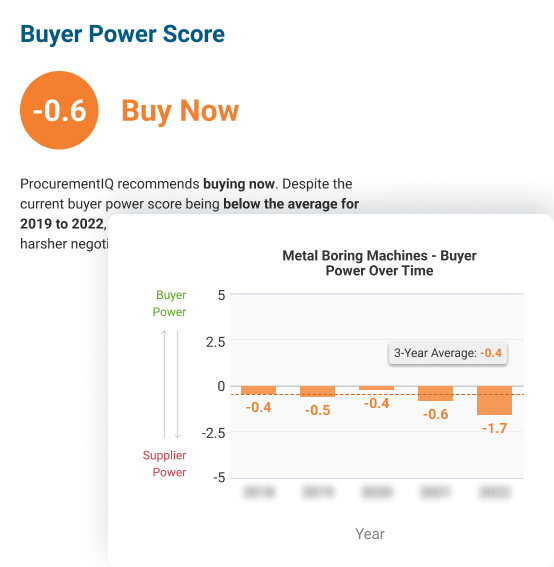
In 2026, buyer power amounts to 0.0 in the United States. Buyer power is most positively impacted by Recent Developments. It is most negatively impacted by Forecast Price Trend. Subscribers can access details on eight other factors that impact buyer power. Learn more
United States

Buyer power forecasts: your glimpse into the future
Develop strategies for the upcoming year and identify unforeseen opportunities for buying now
- Actionable "Buy Now" and "Buy Later" insights
- Near-real-time updates to current and forecast Buyer Power Scores
- Methodology and weightings for Buyer Power Score Components
Supply Chain Risk
The average level of supply chain risk is assessed as High, which has a negative impact on buyer power. The level of supply chain risk is affected by industry volatility, barriers to entry, competition, import penetration, regulation and industry financial risk. Buyers in this market can mitigate procurement and supply chain management risks by monitoring risk levels for individual first and second tier suppliers:
1st
Tier Suppliers
- Glass Product Manufacturers
- Plastic & Resin Manufacturers
- Industrial Machinery & Equipment Wholesalers
2nd
Tier Suppliers
- Sand & Gravel Mining Companies
- Petroleum Refineries
- Iron & Steel Manufacturers
Biggest Fiber Optic Cable Suppliers in the US by Revenue
The largest Fiber Optic Cable vendors by revenue in the US are Furukawa Electric Co. Ltd., Hangzhou Liaison Interactive Information Technology Co. Ltd. and Corning Inc. Subscribers can sort and filter by market share concentration, profit level and other factors. Learn more
| Supplier | Operational Size | Headquarters | Number of Employees | Market Share (%) | Market Share Performance (3yr trend) | Total Revenue ($ million) | Profit Level (%) | Risk Level |
|---|---|---|---|---|---|---|---|---|
| Corning Inc. | Global | CORNING | >10,000 | 10-15 | ||||
| America Fujikura Ltd. | Global | Tokyo, JP | >10,001 | 5-10 | ||||
| Prysmian S.P.A. | Global | Milan, IT | >10,001 | 5-10 | ||||
| Encore Wire Corporation | Local | MCKINNEY, TX | 1,001-10,000 | 5-10 | ||||
| Furukawa Electric Co. Ltd. | Global | Tokyo, JP | >10,001 | < 5 | ||||
| Abb Ltd | Global | Zurich | >10,000 | < 5 | ||||
| CDW Corporation | Global | VERNON HILLS, IL | >10,000 | < 5 | ||||
| Hangzhou Liaison Interactive Information Technology Co. Ltd. | Global | Beijing, CN | >10,001 | < 5 | ||||
| Nexans | Global | Paris, FR | >10,001 | < 5 | ||||
Looking for a list of suppliers by country?
Subscribers can access vendor information on Canadian and European suppliers, too. We also offer custom research services to help with vendor sourcing anywhere in the world.
Profit Analysis
The average profit margin across vendors in the Fiber Optic Cable market is 3.2% and steady. Profit levels shift depending on suppliers' spend on wages, purchases and overhead. The highest cost component for vendors is Purchases. The cost trend for this component is stagnating, when considering movement between 2025 and 2026. To understand cost forecasts for 2027 and uncover the implications on profit, start your subscription. Learn more
Vendor & Supply Chain Analysis
Financial risk in this market is moderate. Vertical integration gives suppliers more control over their input costs and allows them to spread their fixed costs through economies of scope.
Market share concentration among suppliers of fiber optic cables is medium, with the top four vendors in the market generating between 30.0% and 50.0% of revenue. A medium level of market share concentration slightly hampers buyer power by limiting price-based competition.
The supply chain for fiber optic cables has a high level of risk, with recent shortages of helium, mainly sourced from countries with large natural gas reserves, causing longer lead times and potentially higher prices. Additionally, recent tariff increases on imported raw materials and components may further disrupt supply chains and contribute to rising costs.
The United States is a net importer of fiber optic cables, meaning it imports more fiber optic cables than it exports. This fact indicates that US buyers’ procurement strategies will need to focus on building strong, reliable relationships with international suppliers and understanding global market dynamics to ensure a steady supply of fiber optic cables.
Supplier Information
Corning Inc.
Corning Inc. /NY is a technology and manufacturing company specializing in glass science, ceramic science, and optical physics. It produces optical communications, mobile consumer electronics, display technology, automotive emissions control, laboratory products, and other glass products. Its brand portfolio... Subscribe to learn more
America Fujikura Ltd.
America Fujikura Ltd. is a public company operating globally in the manufacturing sector. The company's offerings include fiber optic cable. Founded in 1910, the company is currently headquartered in Duncan, South Carolina, United States of America with an estimated employee count of over 10,000. Subscribe to learn more
Encore Wire Corporation
Encore Wire Corporation is a public company operating locally in the manufacturing sector. The company's offerings include electrical wire, electrical cable and fiber optic cable. Founded in 1989, the company is currently headquartered in MCKINNEY, Texas, United States of America with an estimated 1672 employees.... Subscribe to learn more
Prysmian S.P.A.
Prysmian S.P.A. is a public company operating globally in the manufacturing sector. The company's offerings include electrical wire, electrical cable and fiber optic cable. Founded in 1879, the company is currently headquartered in Milan, Italy with an estimated employee count of over 10,000. Subscribe to learn more
Abb Ltd
ABB Ltd. is a global technology company that offers comprehensive electrification, robotics, automation, and motion solutions, primarily serving the distribution utilities, renewables, and transport & infrastructure markets. It organizes its business into four segments: the Electrification segment, which Subscribe to learn more
Belden Inc.
Belden Inc. is a public company operating globally in the construction and manufacturing sectors. The company's offerings include electrical wire, electrical cable, fiber optic cable and network cable installation. Founded in 1902, the company is currently headquartered in St. Louis, Missouri, United States... Subscribe to learn more
CDW Corporation
CDW Corporation is a public company operating globally in the manufacturing, information and professional, scientific and technical services sectors. The company's offerings include fiber optic cable, uninterruptible power supply systems, phone headsets, print servers, tablet computers. Founded in 1984, the... Subscribe to learn more
Commscope Inc.
Commscope Inc. is a public company operating globally in the construction and manufacturing sectors. The company's offerings include electrical wire, electrical cable, fiber optic cable, radio antennas, modems. Founded in 1976, the company is currently headquartered in HICKORY, North Carolina, United States... Subscribe to learn more
Furukawa Electric Co. Ltd.
Furukawa Electric Co. Ltd. is a public company operating globally in the manufacturing sector. The company's offerings include fiber optic cable. Founded in 1896, the company is currently headquartered in Tokyo, Japan with an estimated employee count of over 10,000. Subscribe to learn more
Accelerate the vendor selection process
Get a clear picture of the competition in a market and discover which vendors are best-suited for your sourcing needs. Our supplier profiles include hard-to-find financial ranges for private companies, cover public company data and feature an interactive competitor matrix.
Procurement Management KPIs for the Fiber Optic Cable Market
Managing vendor performance throughout the contract period is easier when tracking specific key performance indicators (KPIs). For example, buyers should monitor Defect Density and Mean Time to Repair. Buyers may experience better performance throughout their contracts if they establish service level agreements (SLAs) based on Accuracy and other factors.
| KPI | Level of Importance (1-5) | Measurements | Key Considerations |
|---|---|---|---|
| Defect Density |
|
Number of units sold Number of defective units |
Fiber optic cable defect density reflects the percentage of cables with manufacturing flaws, such as improper attenuation, weak signal strength, or physical damage. Assessing defect density in the fiber optic cable market helps identify areas for quality improvement and ensures better network performance for end users. |
| Mean Time to Repair |
|
Number of maintenance hours Number of asset failures |
The mean time to repair (MTTR) is crucial for fiber optic cables, as it measures the average time required to fix or replace malfunctioning cables, affecting network uptime and reliability. The mean time to repair can be used to determine the amount of time it will take to resolve a cable failure. |

Questions to Ask During Procurement Negotiations
How can I gain leverage during negotiations?
Price
What is the reasoning behind the pricing model you apply to your fiber optic cables? Would you consider applying any other pricing models to your cables?
What additional costs am I responsible for?
Value-Added Services
Are there any accessories and related products included with the purchase of your fiber optic cables?
Do you offer any discounts for purchasing related goods or accessories at the time of the fiber optic cable purchase? Do you offer any discounts on future purchases of related goods?
Inventory Control
How large is your current inventory of fiber optic cables? How low do you allow your inventory to get before it is replenished?
How do you forecast the future demand for your products? How do you adjust your inventory to prepare for anticipated demand fluctuations?
The ultimate prep for procurement negotations
View all 28 negotiation questions for this category when you subscribe.
Fiber Optic Cable RFP Guidelines
What should my RFP include?
Organizational Overview
Buyers should provide a description of the layout of their network, such as the distance between devices or nodes, and the general environment through which the fiber optic cable will be run.
Buyers should provide a description of any environmental factors that may be of concern, such as high temperature or damp environment.
Statement Of Need
Buyers should provide a description of their network speed and capacity preferences.
Buyers should describe the quantity of product needed.
Project Budget
Buyers should explicitly state the amount for the award.
Buyers should explain the schedule with which payments will be made.
The RFP process made easy
Find out how you can access RFP templates for 800+ procurement categories to start writing better, more consistent RFPs.
We display average pricing information, trends and market data.
Our Reports include:
- Opportunity assessment
- Market dynamics
- Recent developments
- Positive and warning trends
- Buyer power levers
- Price environment and market pricing
- Geographic wage rates
- Global market updates
- Total cost of ownership
- Cost structure benchmarks and analysis
- Supply chain and vendors
- Global supplier breakdown
- Market share concentration
- Regulation and business requirements
- Vendor management and KPIs
- Sourcing strategy guidance