Procurement Market Intelligence Report
Flow Measurement Instrumentation
Sourcing Guide & Market Intelligence
Smarter cost management starts with comprehensive market intelligence
 United States
 Global
Quick Navigation
Flow Measurement Instrumentation Global Overview
Definition
Summary
Flow measurement instruments determine the flow rate of liquid, gases, or slurries at a single point in a channel. In an industrial setting, accurate flow measurements are required to determine the amount of material going through open or closed channels. These devices are essential in helping buyers maintain product quality and cost, as well as regulatory compliance. Flow measurement instruments include mass, ultrasonic, positive displacement, turbine, paddlewheel, and vortex meters. Methods and accuracy of flow measurement vary across devices. Buyers include biofuel providers, manufacturers, and water companies.
This Report Includes:
- Turbine Flow Meters
- Ultrasonic Flow Meters
- Electromagnetic Flow Meters
Not in this Report:
- Fluid Regulators
- Gas Pressure Regulators
- Downhole Instrumentation
- Pressure Sensors
- Flow Switches and Valves
Global Flow Measurement Instrumentation Procurement Trends
Discover the top international trends affecting procurement in the global Flow Measurement Instrumentation market.
Warning Trends
Elevated Tariffs are increasing prices for law enforcement, security, and safety equipment
- The Trump administration’s reciprocal tariffs, which place broad tariffs on all imports from most US trade partners, are set to take effect on August 7 after the tariff rates were finalized on August 1.
- As a result, all foreign suppliers in law enforcement, security, and safety equipment will face significantly increased costs when selling products to US buyers, and domestic manufacturers of these goods will face higher costs when sourcing key inputs for these products.
- Countries such as China, Germany, Mexico, Thailand, and Vietnam are leading sources of imports in this sector, providing high quantities of goods such as safes, locks, security cameras, security systems, and personal protective equipment. Starting August 7, imports from China, Germany, Mexico, Thailand, and Vietnam will be subject to tariff rates of 54.0%, 15.0%, 25.0%, 20.0%, and 19.0% respectively.
- Elevated tariffs are likely to impact pricing and supply chains in this industry due to the United States’ reliance on imported manufactured goods, which gives foreign suppliers the leverage to pass through the costs of tariffs to buyers and domestic suppliers the leverage to raise prices.
- Consequently, the Yale Budget Lab projects a 39.2% average increase in metal product prices, impacting products such as security gates and safes. Electronic security devices, such as cameras or metal detectors, are projected to rise by 18.7% in price. In the personal protective equipment market, prices are forecast to rise by between 11.0% and 37.5%, depending on the type of equipment and materials used to make it.
Increased tariffs on copper imports take effect
- On August 1, the Trump administration implemented 50.0% tariffs on imported copper. Chile and Canada will be most impacted by these tariffs, as they account for a combined 87.0% of all copper imports in the United States.
- However, these tariffs are less sweeping than initially expected, only applying to semi-finished copper products, while excluding high-purity refined copper and copper input materials, such as ore and concentrate. As leading importers, such as Chile and Canada, have both high copper mining and refining capacities, they will likely avoid most of these tariffs by either exporting the copper in its unrefined form or refining the copper before exporting it to the United States
- These copper tariff exemptions limit the impact on the electronics and electrical equipment sectors because these applications require refined copper due to its optimal conductive properties.
- Thus, the prices of metal alloys that include copper, consumer products made from copper, tools, plumbing, corrosion-resistant alloys, and construction materials made from copper are forecast to rise by an average of 39.2%, according to the Yale Budget Lab.
Global Flow Measurement Instrumentation Market - Suppliers by Region
| Country/Region | Number of Suppliers |
|---|---|
| #1 Oceania & Southeast Asia | 1,280 |
| #2 China | 940 |
| #3 Europe | 845 |
Explore supplier concentration across the globe
We've uncovered the 11 top regions for global procurement, based on feedback from our most strategic clients. Access vendor counts for each unique region when you subscribe.
2
Geography Drilldown - US
Average Cost of Flow Measurement Instrumentation
United States
2026 Market Pricing$75.00 to $XX,XXX.XX
per unitAverage Price
Prices in the Flow Measurement Instrumentation market range from $75.00 to $XX,XXX.XX, depending on Type of Instrument, Performance, Features and Customization. For example, lower prices are associated with Paddlewheel flow meters ($100 to $650 per unit) and Variable area flow meters ($50.00 to $900 per unit), whereas higher prices are associated with Ultrasonic flow meters, Technologically advanced instruments, In-line style meters ($1,000 to $5,500 per unit) and Vortex flow meters ($1,000 to $3,500 per unit).
Need the scoop on international price trends?
Between our Europe and Canada collections, we provide price data for 350 markets so you can instantly compare prices across borders. Or, use our custom research services for intel on prices in any region across the globe.
Flow Measurement Instrumentation Category Price Trends
Pricing trends are indicated by the compound annual growth rate (CAGR) during a set period of time. For the Flow Measurement Instrumentation market, prices in the US have grown 5.1% from 2022 to 2025. Subscribers can access price trend forecasts, price driver projections and forward-looking cost structure data. Learn more
United States (2022-2025)


Wondering where prices are heading?
Price trend forecasts are available to subscribers, along with price driver projections and forward-looking cost structure data.
Cost Analysis - Total Cost of Ownership for Flow Measurement Instrumentation
Total cost of ownership is Medium in the Flow Measurement Instrumentation market. The average cost of ownership differs depending on the contract but generally includes costs negotiated before the contract begins, costs billed during the contract period and unforeseen costs.
Negotiated Before
Installation
Customization
Other Fees
Billed During
Maintenance
Buyer Power in Procurement Negotiations
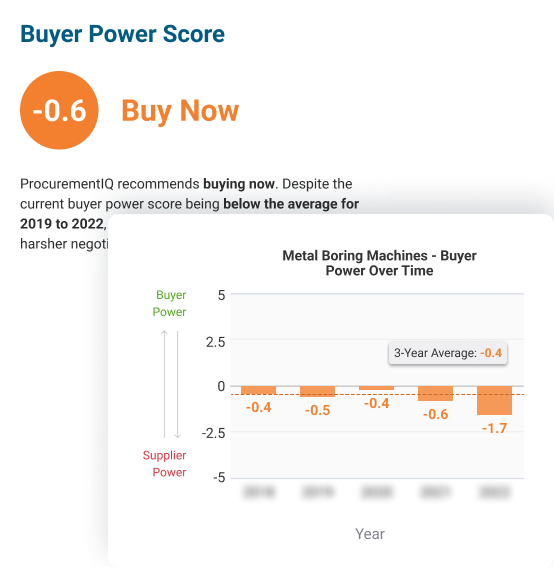
In 2026, buyer power amounts to -2.5 in the United States. Buyer power is most positively impacted by Recent Developments. It is most negatively impacted by Market Share Concentration. Subscribers can access details on eight other factors that impact buyer power. Learn more
United States
Buyer power forecasts: your glimpse into the future
Develop strategies for the upcoming year and identify unforeseen opportunities for buying now
- Actionable "Buy Now" and "Buy Later" insights
- Near-real-time updates to current and forecast Buyer Power Scores
- Methodology and weightings for Buyer Power Score Components
Supply Chain Risk
The average level of supply chain risk is assessed as Medium, which has a negative impact on buyer power. The level of supply chain risk is affected by industry volatility, barriers to entry, competition, import penetration, regulation and industry financial risk. Buyers in this market can mitigate procurement and supply chain management risks by monitoring risk levels for individual first and second tier suppliers:
1st
Tier Suppliers
- Pressure Sensor Manufacturers
- Metal Wholesalers
- Circuit Board & Electronic Component Manufacturers
2nd
Tier Suppliers
- Electrical Equipment Manufacturers
- Nonferrous Metal Rolling & Alloying Manufacturers
- Iron & Steel Manufacturers
- Semiconductor & Circuit Manufacturers
Biggest Flow Measurement Instrumentation Suppliers in the US by Revenue
The largest Flow Measurement Instrumentation vendors by revenue in the US are Dwyer Instruments Inc., W.W. Grainger, Inc. and Emerson Electric Co. Subscribers can sort and filter by market share concentration, profit level and other factors. Learn more
| Supplier | Operational Size | Headquarters | Number of Employees | Market Share (%) | Market Share Performance (3yr trend) | Total Revenue ($ million) | Profit Level (%) | Risk Level |
|---|---|---|---|---|---|---|---|---|
| Dwyer Instruments Inc. | Global | Michigan City, IN | 501-1,000 | 5-10 | ||||
| Yokogawa Electric Corporation | Global | Tokyo, JP | >10,001 | < 5 | ||||
| Siemens Ag | Global | Munich , DE | >10,001 | < 5 | ||||
| General Electric Company | Global | EVENDALE | >10,000 | < 5 | ||||
| Honeywell International Inc. | Global | CHARLOTTE | >10,000 | < 5 | ||||
| Emerson Electric Co. | Global | ST LOUIS, MO | >10,000 | < 5 | ||||
| W.W. Grainger, Inc. | Global | LAKE FOREST | >10,000 | < 5 | ||||
| Endress + Hauser | Global | Reinach, CH | >10,000 | < 5 | ||||
| Krohne Messtechnik GmbH | Global | Duisburg, DE | 1,001-10,000 | < 5 | ||||
Looking for a list of suppliers by country?
Subscribers can access vendor information on Canadian and European suppliers, too. We also offer custom research services to help with vendor sourcing anywhere in the world.
Profit Analysis
The average profit margin across vendors in the Flow Measurement Instrumentation market is 6.1% and steady. Profit levels shift depending on suppliers' spend on wages, purchases and overhead. The highest cost component for vendors is Purchases. The cost trend for this component is falling, when considering movement between 2025 and 2026. To understand cost forecasts for 2027 and uncover the implications on profit, start your subscription. Learn more
Vendor & Supply Chain Analysis
Vendors face moderate supply chain risk due to volatility surrounding semiconductors, nonferrous metals, and plastic. As a result, buyers should expect increased prices to account for increased risk and supply chain shortages.
Market share concentration is low due to a variety of suppliers providing flow measurement instruments. Since multiple suppliers are competing for buyers, prices can decrease.
Vendors face low financial risk due to consistent demand from a variety of industries and a wide range of products and services outside of flow measurement instruments. Consequently, prices are lower since vendors face a low chance of going out of business.
This market has a low ESG level, primarily due to controversial activity in governance and below-average leave benefits and labor standards.
The United States is a net importer of flow measurement instrumentation, suggesting a heightened degree of market competition due to the presence of foreign suppliers. While this offers access to a broader range of products and technologies, it also increases supply chain risk due to potential international trade disruptions or changes in foreign policy.
Supplier Information
Dwyer Instruments Inc.
Dwyer Instruments Inc. is a private company operating globally in the manufacturing sector. The company's offerings include flow measurement instrumentation and air quality testing equipment. Founded in 1931, the company is currently headquartered in Michigan City, Indiana, United States of America with an... Subscribe to learn more
Badger Meter Inc.
Badger Meter Inc. is a public company operating globally in the manufacturing sector. The company's offerings include flow measurement instrumentation and smart meters. Founded in 1905, the company is currently headquartered in Milwaukee, Wisconsin, United States of America with an estimated 1976 employees.... Subscribe to learn more
Emerson Electric Co.
Emerson Electric Co. is a public company operating globally in the manufacturing, professional, scientific and technical services and other services (except public administration) sectors. The company's offerings include downhole instrumentation, welding machines, industrial refrigerators, auxiliary generators,... Subscribe to learn more
Endress + Hauser
Endress + Hauser is a private company operating globally in the manufacturing and professional, scientific & technical services sectors. The company's offerings include temperature measurement instrumentation, pressure measurement instrumentation, flow measurement instrumentation and process control systems... Subscribe to learn more
General Electric Company
General Electric Company (dba GE Aerospace) is a global aerospace company that provides engines, systems, and services to commercial, government, and military markets. It organizes its business into two segments: the Commercial Engines & Services segment, which designs and manufactures jet engines for commercial... Subscribe to learn more
Honeywell International Inc.
Honeywell International Inc. is a global technology and manufacturing company that designs, develops, produces, and markets consumer and industrial products. It organizes its business into four reportable business segments: the Aerospace segment, which supplies products, software, and services for aircraft;... Subscribe to learn more
Krohne Messtechnik GmbH
Krohne Messtechnik GmbH is a private company operating globally in the manufacturing sector. The company's offerings include flow measurement instrumentation. Founded in 1921, the company is currently headquartered in Duisburg, Germany with an estimated 4000 employees. Subscribe to learn more
Siemens Ag
Siemens Ag is a public company operating globally in the manufacturing, information, real estate & rental & leasing, professional, scientific & technical services, administration, business support and waste management services and other services (except public administration) sectors. The company's offerings... Subscribe to learn more
W.W. Grainger, Inc.
WW Grainger, Inc. is a diversified global company that supplies maintenance, repair, and operating (MRO) products and services. It offers products under several categories, including safety and security, material handling and storage, pumps and plumbing equipment, cleaning and maintenance, metalworking, and... Subscribe to learn more
Accelerate the vendor selection process
Get a clear picture of the competition in a market and discover which vendors are best-suited for your sourcing needs. Our supplier profiles include hard-to-find financial ranges for private companies, cover public company data and feature an interactive competitor matrix.
Procurement Management KPIs for the Flow Measurement Instrumentation Market
Managing vendor performance throughout the contract period is easier when tracking specific key performance indicators (KPIs). For example, buyers should monitor Average Time Between Failures and Defect Density. Buyers may experience better performance throughout their contracts if they establish service level agreements (SLAs) based on Compliance and other factors.
| KPI | Level of Importance (1-5) | Measurements | Key Considerations |
|---|---|---|---|
| Average Time Between Failures |
|
Number of failures Time of failure |
Flow meters may be used in sensitive applications where the consequences of failure could be catastrophic. Flow meters that fail more often will require more maintenance and repairs, resulting in higher fees for buyers. |
| Defect Density |
|
Number of units Number of defective units |
The defect density represents the share of defective products a company produces. The defect density can be used to determine whether manufacturing, assembly, or quality assurance processes require improvement. Defective flow measurement instrumentation can result in additional costs for buyers. |

Questions to Ask During Procurement Negotiations
How can I gain leverage during negotiations?
Quality Control
What manufacturing standards do you follow to produce your flow measurement devices?
What have you done to improve the reliability of your flow measurement devices during the past three years?
Product Lines
Do you offer any complementary products or services with the purchase of this flow measurement device? If so, what are they?
What additional products or services do you offer separate from the purchase of this flow measurement instrument?
Competition
What is your reputation like among competitors and customers and how have you developed it?
What sets your product apart from your competitors?
The ultimate prep for procurement negotations
View all 28 negotiation questions for this category when you subscribe.
Flow Measurement Instrumentation RFP Guidelines
What should my RFP include?
Organizational Overview
Buyers should describe their organization and their location(s) of interest for the flow measurement instrumentation.
Buyers should specify the material that will be measured by the flow measurement instrumentation.
Statement Of Need
Buyers should detail the acceptable brand(s), type and number of flow measurement devices needed.
Buyers should state the specifications of the flow measurement instrumentation they require.
Project Budget
Buyers should specify their budgets for flow measurement instrumentation and any desired related services and goods.
Buyers should indicate when payment will occur, such as upon award of the contract or in installments over a period of time.
The RFP process made easy
Find out how you can access RFP templates for 800+ procurement categories to start writing better, more consistent RFPs.
We display average pricing information, trends and market data.
Our Reports include:
- Opportunity assessment
- Market dynamics
- Recent developments
- Positive and warning trends
- Buyer power levers
- Price environment and market pricing
- Geographic wage rates
- Global market updates
- Total cost of ownership
- Cost structure benchmarks and analysis
- Supply chain and vendors
- Global supplier breakdown
- Market share concentration
- Regulation and business requirements
- Vendor management and KPIs
- Sourcing strategy guidance