Procurement Market Intelligence Report
Label Applying & Printing Devices
Sourcing Guide & Market Intelligence
Smarter cost management starts with comprehensive market intelligence
 United States
 Global
Quick Navigation
Label Applying & Printing Devices Global Overview
Definition
Summary
Label applying and printing devices are used primarily in an office or warehouse setting where only a few labels are needed. These devices allow users to customize labels by typing information into the device, immediately printing it on the tape, and then manually applying it to a product. The essential buyers include transportation companies, retailers, and grocery stores. Typical suppliers are printing and packaging companies, specialized labeling equipment suppliers, online retailers, and distributors.
This Report Includes:
- Label Printers
- Identification Press Machines
- Dating and Numbering Machines
- Label-Applying Machines
- Label-Making Machines
Not in this Report:
- Label Systems in Manufacturing Plants
- Label Printers in Manufacturing Plants
Global Label Applying & Printing Devices Procurement Trends
Discover the top international trends affecting procurement in the global Label Applying & Printing Devices market.
Warning Trends
Tariffs to escalate prices for electronics and computing equipment
- The Trump administration’s reciprocating tariffs, which will increase the tariff on all products imported from nearly all US trade partners, are set to take effect on August 7 and are likely to drive price increases across a wide range of sectors.
- The United States is highly reliant on imported electronics, communication equipment, and computing devices, having imported more than $472 billion worth of electronics in 2024, or about half of the total domestic supply. Starting August 7, imports from key computer and electronics producers such as China (54,0%), Japan (15.0%), South Korea (15.0%), Thailand (19.0%), Vietnam (20.0%), and Taiwan (20.0%) will be subject to new tariff rates. Trade deals for many countries are still being negotiated, and these rates are subject to change.
- For this reason, the US electronics industry is highly exposed to price increases and supply chain disruptions when the tariffs take effect. For example, the cost of iPhones, which are predominantly manufactured in China, could rise by as much as 43.0% in response to tariffs, according to projections by Rosenblatt Securities.
- Overall, the Yale Budget Lab anticipates tariffs will increase the average cost of computers and electronics by 18.7% in the short term.
- The tariffs exempt semiconductors, limiting the cost increases for domestic electronics manufacturers, but the lack of domestic electronics assembly capacity means that this exemption will have a limited effect.
China bans exports of rare minerals to the United States
- On December 4, China announced a ban on all exports of gallium, germanium, graphite, and antimony to the United States, escalating existing trade restrictions on these materials.
- China is the leading global producer of each of these metals, producing 98.3%, 67.9%, 62.0%, and 48.2%, respectively, of the world’s gallium, germanium, graphite, and antimony supplies, respectively.
- The United States can still access these resources from other trade partners who make up most of the remaining global supply of the impacted commodities, such as Canada, Japan, and Brazil.
- However, the loss of supply from China, the leading producer of these materials, will increase prices and supply chain risk in a range of markets that rely on the affected metals, such as the semiconductor, batteries, and solar cell markets.
- China’s export ban on these materials is in retaliation to expanded US export bans on advanced semiconductor manufacturing equipment and technologies to China announced two days prior. This ongoing trade dispute adds further uncertainty to technology markets, which are often reliant on components and materials exported from China.
Global Label Applying & Printing Devices Market - Suppliers by Region
| Country/Region | Number of Suppliers |
|---|---|
| #1 Europe | 49,495 |
| #2 Oceania & Southeast Asia | 39,680 |
| #3 China | 33,165 |
Explore supplier concentration across the globe
We've uncovered the 11 top regions for global procurement, based on feedback from our most strategic clients. Access vendor counts for each unique region when you subscribe.
2
Geography Drilldown - US
Average Cost of Label Applying & Printing Devices
United States
2026 Market Pricing$30.00 to $X,XXX.XX
per deviceAverage Price
Prices in the Label Applying & Printing Devices market range from $30.00 to $X,XXX.XX, depending on Functionality, Capacity, Technological Advancement and Brand. For example, lower prices are associated with Low Functionality (e.g., few variations) ($30 to $1,500 per device), whereas higher prices are associated with High Functionality (e.g., different fonts, sizes, colors) ($500 to $4,000 per device).
Need the scoop on international price trends?
Between our Europe and Canada collections, we provide price data for 350 markets so you can instantly compare prices across borders. Or, use our custom research services for intel on prices in any region across the globe.
Label Applying & Printing Devices Category Price Trends
Pricing trends are indicated by the compound annual growth rate (CAGR) during a set period of time. For the Label Applying & Printing Devices market, prices in the US have grown 0.3% from 2022 to 2025. Subscribers can access price trend forecasts, price driver projections and forward-looking cost structure data. Learn more
United States (2022-2025)


Wondering where prices are heading?
Price trend forecasts are available to subscribers, along with price driver projections and forward-looking cost structure data.
Cost Analysis - Total Cost of Ownership for Label Applying & Printing Devices
Total cost of ownership is Medium in the Label Applying & Printing Devices market. The average cost of ownership differs depending on the contract but generally includes costs negotiated before the contract begins, costs billed during the contract period and unforeseen costs. For example, unforeseen costs in the form of Downtime may raise the total cost of ownership unexpectedly.
Negotiated Before
Installation
Other Fees
Billed During
Maintenance
Software
Unforeseen
Downtime
Obsolescence
Buyer Power in Procurement Negotiations
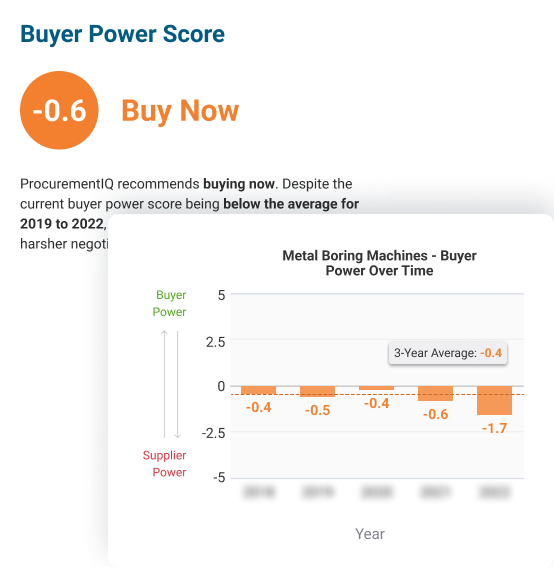
In 2026, buyer power amounts to 0.3 in the United States. Buyer power is most positively impacted by Recent Developments. It is most negatively impacted by Availability of Substitutes. Subscribers can access details on eight other factors that impact buyer power. Learn more
United States
Buyer power forecasts: your glimpse into the future
Develop strategies for the upcoming year and identify unforeseen opportunities for buying now
- Actionable "Buy Now" and "Buy Later" insights
- Near-real-time updates to current and forecast Buyer Power Scores
- Methodology and weightings for Buyer Power Score Components
Supply Chain Risk
The average level of supply chain risk is assessed as Medium, which has a negative impact on buyer power. The level of supply chain risk is affected by industry volatility, barriers to entry, competition, import penetration, regulation and industry financial risk. Buyers in this market can mitigate procurement and supply chain management risks by monitoring risk levels for individual first and second tier suppliers:
1st
Tier Suppliers
- Plastic & Resin Manufacturers
- Semiconductor & Circuit Manufacturers
- Computer & Software Wholesalers
2nd
Tier Suppliers
- Petroleum Refineries
- Semiconductor Machinery Manufacturers
- Software Publishers
Biggest Label Applying & Printing Devices Suppliers in the US by Revenue
The largest Label Applying & Printing Devices vendors by revenue in the US are Brady Corporation, Amcor Limited and Wesco International, Inc. Subscribers can sort and filter by market share concentration, profit level and other factors. Learn more
| Supplier | Operational Size | Headquarters | Number of Employees | Market Share (%) | Market Share Performance (3yr trend) | Total Revenue ($ million) | Profit Level (%) | Risk Level |
|---|---|---|---|---|---|---|---|---|
| Brady Corporation | Global | MILWAUKEE, WI | 1,001-10,000 | 5-10 | ||||
| LINTEC Corporation | Global | Tokyo, JP | 1,001-10,000 | < 5 | ||||
| Honeywell International Inc. | Global | CHARLOTTE | >10,000 | < 5 | ||||
| Hewlett Packard Enterprise Co | Global | SPRING | >10,000 | < 5 | ||||
| Arrow Electronics Inc. | Global | CENTENNIAL, CO | >10,000 | < 5 | ||||
| 3m Company | Global | ST PAUL | >10,000 | < 5 | ||||
| Wesco International, Inc. | Global | PITTSBURGH, PA | >10,000 | < 5 | ||||
| Amcor Limited | Global | WARMLEY, BRISTOL | >10,000 | < 5 | ||||
| Avery Dennison Corporation | Global | MENTOR | >10,000 | < 5 | ||||
Looking for a list of suppliers by country?
Subscribers can access vendor information on Canadian and European suppliers, too. We also offer custom research services to help with vendor sourcing anywhere in the world.
Profit Analysis
The average profit margin across vendors in the Label Applying & Printing Devices market is 6.1% and steady. Profit levels shift depending on suppliers' spend on wages, purchases and overhead. The highest cost component for vendors is Purchases. The cost trend for this component is rising, when considering movement between 2025 and 2026. To understand cost forecasts for 2027 and uncover the implications on profit, start your subscription. Learn more
Vendor & Supply Chain Analysis
Average vendor risk is low for the label applying and printing devices market due to high demand trends and moderate supply chain risk, thus benefiting buyers without worrying about a vendor's financials.
Market share concentration is low in the label applying and printing devices market. Vendors must remain competitive and price their products competitively to maintain market share.
Supply chain risk is moderate in the label applying and printing devices market as some components, such as computer parts, are at risk. Buyers must be careful and ensure they source from vendors with stable supplies.
The United States is a net importer of computers, meaning it imports more computers than it exports. While lower manufacturing costs abroad drive down prices for imported computers, relying on imports can lead to potential shortages or price increases if there are supply chain disruptions due to geopolitical tensions, trade disputes, or global crises.
Supplier Information
Brady Corporation
Brady Corporation is a public company operating globally in the manufacturing and manufacturing sectors. The company's offerings include label applying & printing devices, barricades & barrier tapes, traffic cones & delineators, industrial absorbents, tamper-evident labels. Founded in 1914, the company is... Subscribe to learn more
3m Company
3M Company is a diversified technology company offering a range of products for safety and industrial, transportation and electronics, and consumer markets. It develops, manufactures, and markets, among others, industrial abrasives and finishing for metalworks, autobody repair solutions, industrial specialty... Subscribe to learn more
Amcor Limited
Amcor plc is a packaging company for food, beverage, pharmaceutical, medical, home, and personal-care markets. Its packaging expertise covers all packaging materials, including paper, metal, plastic, recycled, and bio-based materials. It produces flexible and rigid packaging, specialty cartons, and closure... Subscribe to learn more
Arrow Electronics Inc.
Arrow Electronics Inc. is a public company operating globally in the manufacturing sector. The company's offerings include radio antennas and label applying & printing devices. Founded in 1935, the company is currently headquartered in Centennial, Colorado, United States of America with an estimated 22300... Subscribe to learn more
Avery Dennison Corporation
Avery Dennison Corporation is a public company operating globally in the manufacturing, manufacturing and professional, scientific and technical services sectors. The company's offerings include laminated papers, packing tape, radio frequency identification devices, label applying & printing devices, tamper-evident... Subscribe to learn more
Ccl Industries Inc.
Ccl Industries Inc. is a public company operating globally in the manufacturing and manufacturing sectors. The company's offerings include label applying & printing devices, general office supplies, roll-fed label printing, tamper-evident labels and electronic article surveillance tags. Founded in 1951, the... Subscribe to learn more
Hewlett Packard Enterprise Co
Hewlett Packard Enterprise Co. is a global technology company developing intelligent solutions for business and public sector enterprises. It organizes its business into six reportable business segments: the Compute segment, which consists of general purpose servers for multi-workload computing and workload-optimized... Subscribe to learn more
Honeywell International Inc.
Honeywell International Inc. is a global technology and manufacturing company that designs, develops, produces, and markets consumer and industrial products. It organizes its business into four reportable business segments: the Aerospace segment, which supplies products, software, and services for aircraft;... Subscribe to learn more
LINTEC Corporation
LINTEC Corporation is a public company operating globally in the manufacturing sector. The company's offerings include laminated papers, label applying & printing devices and tamper-evident labels. Founded in 1990, the company is currently headquartered in Tokyo, Japan with an estimated 5500 employees. Subscribe to learn more
Accelerate the vendor selection process
Get a clear picture of the competition in a market and discover which vendors are best-suited for your sourcing needs. Our supplier profiles include hard-to-find financial ranges for private companies, cover public company data and feature an interactive competitor matrix.
Procurement Management KPIs for the Label Applying & Printing Devices Market
Managing vendor performance throughout the contract period is easier when tracking specific key performance indicators (KPIs). For example, buyers should monitor Defect Density and On-Time Delivery (OTD). Buyers may experience better performance throughout their contracts if they establish service level agreements (SLAs) based on Pricing and other factors.
| KPI | Level of Importance (1-5) | Measurements | Key Considerations |
|---|---|---|---|
| Defect Density |
|
Number of units sold Number of defective units |
The defect density represents the share of defective products a company produces. The defect density can be used to determine whether manufacturing, assembly or quality assurance processes require improvement. Defects may include products that leak filaments or are incompatible with the buyer's printer due to manufacturing errors. |
| On-Time Delivery (OTD) |
|
Number of deliveries Number of on-Time Deliveries |
The on-time delivery rate represents the percentage of orders that are delivered on time. The on-time delivery rate can be used to determine the likelihood of a delayed delivery. Buyers requiring regular shipments of printer filament should ask vendors what processes are in place to ensure buyers do not miss deliveries in the event that supply chain disruptions emerge. |

Questions to Ask During Procurement Negotiations
How can I gain leverage during negotiations?
Price
If the price of raw materials shifts unexpectedly, how will product prices be impacted? What have you put in place to control your costs?
Do you provide discounts for ordering related goods in advance? If so, how much are the discounts?
Location
Will all devices and related goods ship together or in separate shipments if some products are not in stock at purchase?
What devices or related goods are commonly out of stock? What devices or related goods do you expect will take longer to deliver?
Customer Support
What type of product support do you offer?
If my label device breaks down, do you provide loaner devices while mine is being repaired? If so, is there an additional charge for loaning a device, and is ink and label stock included with the loaned device?
The ultimate prep for procurement negotations
View all 31 negotiation questions for this category when you subscribe.
Label Applying & Printing Devices RFP Guidelines
What should my RFP include?
Organizational Overview
Buyers should describe their organization's line of work.
Buyers should list their business locations and the size of their operations.
Statement Of Need
Buyers should indicate the number of label applying and printing devices requested.
Buyers should indicate the devices' intended use, including the types of products or goods that will be labeled.
Project Budget
If one exists, buyers should specify their budget for the labeling devices and other requested products.
Buyers should outline payment schedules.
The RFP process made easy
Find out how you can access RFP templates for 800+ procurement categories to start writing better, more consistent RFPs.
We display average pricing information, trends and market data.
Our Reports include:
- Opportunity assessment
- Market dynamics
- Recent developments
- Positive and warning trends
- Buyer power levers
- Price environment and market pricing
- Geographic wage rates
- Global market updates
- Total cost of ownership
- Cost structure benchmarks and analysis
- Supply chain and vendors
- Global supplier breakdown
- Market share concentration
- Regulation and business requirements
- Vendor management and KPIs
- Sourcing strategy guidance