Procurement Market Intelligence Report
Lithium-Ion Batteries
Sourcing Guide & Market Intelligence
Smarter cost management starts with comprehensive market intelligence
 United States
 Europe
 Global
Quick Navigation
Lithium-Ion Batteries Global Overview
Definition
Summary
This report is intended to assist buyers of lithium-ion batteries, which are rechargeable and commonly used in consumer electronics, electric vehicles, and aerospace and military applications. The primary suppliers of lithium-ion batteries are manufacturers and wholesalers. Key buyers include electronic vehicle manufacturers, consumer electronics manufacturers, airplane manufacturers, and military agencies.
This Report Includes:
- Lithium-Ion Batteries
Not in this Report:
- Alkaline Batteries
- Nickel-Iron Batteries
- Lead-Acid Batteries
- Battery Recycling Services
Take the ProcurementIQ products and data tour
Explore live samples of price trend forecasts, price driver projections, forward-looking cost structure data and more.
Global Lithium-Ion Batteries Procurement Trends
Discover the top international trends affecting procurement in the global Lithium-Ion Batteries market.
Warning Trends
Tariffs may drive up prices and lead times for electrical equipment
- The Trump administration’s reciprocal tariffs, which raise the tariffs on all goods imported from most other countries, are set to take effect on August 7 after the rates were finalized on August 1. The US power generation and distribution sector is highly reliant on imports, with electrical equipment imports accounting for an estimated 56.7% of total annual domestic supply.
- Due to the complexity of most power generation and distribution machinery, most components or raw materials included in these products originate outside the United States, even if the finished machinery is assembled domestically.
- As a result, the Yale Budget Lab currently estimates that the upcoming tariffs will cause electrical equipment prices to increase by 26.6% on average.
- Further, tariffs present complications for the long, often multinational production cycles common for more complex electrical equipment manufacturing, leading American Electric Power and other leaders in the energy sector to warn of shortages and increased lead times for electric equipment.
China bans exports of rare minerals to the United States
- On December 4, China announced a ban on all exports of gallium, germanium, graphite, and antimony to the United States, escalating existing trade restrictions on these materials.
- China is the leading global producer of each of these metals, producing 98.3%, 67.9%, 62.0%, and 48.2%, respectively, of the world’s gallium, germanium, graphite, and antimony supplies, respectively.
- The United States can still access these resources from other trade partners who make up most of the remaining global supply of the impacted commodities, such as Canada, Japan, and Brazil.
- However, the loss of supply from China, the leading producer of these materials, will increase prices and supply chain risk in a range of markets that rely on the affected metals, such as the semiconductor, batteries, and solar cell markets.
- China’s export ban on these materials is in retaliation to expanded US export bans on advanced semiconductor manufacturing equipment and technologies to China announced two days prior. This ongoing trade dispute adds further uncertainty to technology markets, which are often reliant on components and materials exported from China.
Global Lithium-Ion Batteries Market - Suppliers by Region
| Country/Region | Number of Suppliers |
|---|---|
| #1 China | 5,235 |
| #2 Europe | 3,280 |
| #3 India | 2,700 |
Explore supplier concentration across the globe
We've uncovered the 11 top regions for global procurement, based on feedback from our most strategic clients. Access vendor counts for each unique region when you subscribe.
Geography Drilldown - US & Europe
Average Cost of Lithium-Ion Batteries
United States
2026 Market Pricing$60.00 to $XXX.XX
per kWh
Average Price
Prices in the Lithium-Ion Batteries market range from $60.00 to $XXX.XX, depending on Size of Battery, Battery Output, Charge Speed and Durability. For example, lower prices are associated with Less than 50 ampere-hour (Ah) capacity, whereas higher prices are associated with More than 50 Ah capacity.
Need the scoop on international price trends?
Between our Europe and Canada collections, we provide price data for 350 markets so you can instantly compare prices across borders. Or, use our custom research services for intel on prices in any region across the globe.
Lithium-Ion Batteries Category Price Trends
Pricing trends are indicated by the compound annual growth rate (CAGR) during a set period of time. For the Lithium-Ion Batteries market, prices in the US have declined -12.4% from 2022 to 2025. Meanwhile, the recent three-year CAGR for Europe is --8.7%.
United States (2022-2025)

Europe (2022-2025)
Compound Annual Growth Rate
Wondering where prices are heading?
Price trend forecasts are available to subscribers, along with price driver projections and forward-looking cost structure data.
Cost Analysis - Total Cost of Ownership for Lithium-Ion Batteries
Total cost of ownership is Medium in the Lithium-Ion Batteries market. The average cost of ownership differs depending on the contract but generally includes costs negotiated before the contract begins, costs billed during the contract period and unforeseen costs. For example, unforeseen costs in the form of Spoilage may raise the total cost of ownership unexpectedly.
Negotiated Before
Installation
Billed During
Inspections
Disposal
Unforeseen
Spoilage
Delays
Buyer Power in Procurement Negotiations
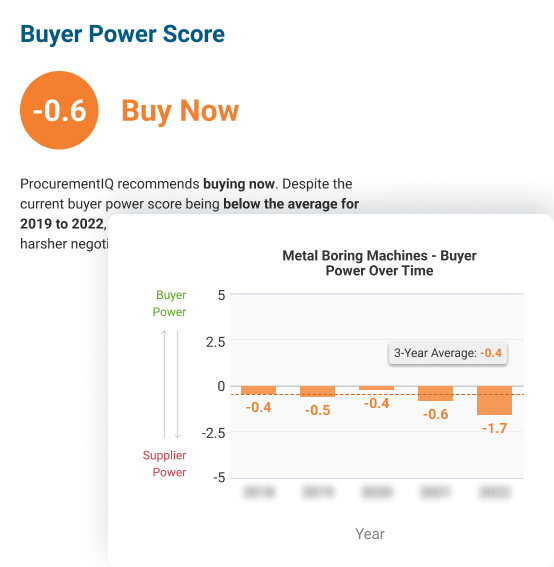
In 2026, buyer power amounts to -0.1 in the United States. Buyer power is most positively impacted by Recent Developments. It is most negatively impacted by Forecast Price Trend. Subscribers can access details on eight other factors that impact buyer power. Learn more
United States
Buyer power forecasts: your glimpse into the future
Develop strategies for the upcoming year and identify unforeseen opportunities for buying now
- Actionable "Buy Now" and "Buy Later" insights
- Near-real-time updates to current and forecast Buyer Power Scores
- Methodology and weightings for Buyer Power Score Components
Supply Chain Risk
The average level of supply chain risk is assessed as High, which has a negative impact on buyer power. The level of supply chain risk is affected by industry volatility, barriers to entry, competition, import penetration, regulation and industry financial risk. Buyers in this market can mitigate procurement and supply chain management risks by monitoring risk levels for individual first and second tier suppliers:
1st
Tier Suppliers
- Plastic & Resin Manufacturers
- Metal Stamping & Forging Manufacturers
- Ferrous Metal Foundry Product Manufacturers
- Nonferrous Mining Refineries
2nd
Tier Suppliers
- Petrochemical Manufacturers
- Iron & Steel Manufacturers
- Steel Rolling & Drawing Suppliers
- Nickel Mining Companies
- Lithium Mining Companies
Biggest Lithium-Ion Batteries Suppliers in the US by Revenue
The largest Lithium-Ion Batteries vendors by revenue in the US are TotalEnergies SE, Exide Technologies and Johnson Controls International Plc. Subscribers can sort and filter by market share concentration, profit level and other factors. Learn more
| Supplier | Operational Size | Headquarters | Number of Employees | Market Share (%) | Market Share Performance (3yr trend) | Total Revenue ($ million) | Profit Level (%) | Risk Level |
|---|---|---|---|---|---|---|---|---|
| LG Electronics Inc. | Global | Seoul, KOR | >10,001 | 10-15 | ||||
| BYD Company Limited | Global | Shenzhen, CN | >10,001 | 15-20 | ||||
| Panasonic Corp | Global | Kadoma, JP | >10,001 | 25+ | ||||
| Johnson Controls International Plc | Global | CORK | >10,000 | 5-10 | ||||
| Contemporary Amperex Technology Co. Limited | Global | Ningde, CN | >10,001 | < 5 | ||||
| TotalEnergies SE | Courbevoie | >10,000 | < 5 | |||||
| Exide Technologies | Global | Milton, GA | 1,001-10,000 | < 5 | ||||
| Enersys | Global | READING, PA | >10,000 | < 5 | ||||
| Energizer Holdings, Inc. | Global | SAINT LOUIS, MO | 1,001-10,000 | < 5 | ||||
Looking for a list of suppliers by country?
Subscribers can access vendor information on Canadian and European suppliers, too. We also offer custom research services to help with vendor sourcing anywhere in the world.
Profit Analysis
The average profit margin across vendors in the Lithium-Ion Batteries market is 9.2% and steady. Profit levels shift depending on suppliers' spend on wages, purchases and overhead. The highest cost component for vendors is Purchases. The cost trend for this component is falling, when considering movement between 2025 and 2026. To understand cost forecasts for 2027 and uncover the implications on profit, start your subscription. Learn more
Vendor & Supply Chain Analysis
Average vendor risk is moderate in the lithium-ion batteries market. Vendors face supply chain risks but have a wide customer base and are buoyed by growing demand for batteries alongside increased demand for consumer electronics.
Market share concentration is high in the lithium-ion batteries market. Most of the market is controlled by several large vendors, with some competition from medium-sized vendors.
Supply chain risk is high in the lithium-ion batteries market due largely to increasing tariffs on imports from China and other key trade partners that are leading to price and supply chain uncertainty. An estimated 70.0% of global lithium-ion battery cell production is attributable to China, and most leading manufacturers of finished lithium-ion batteries, such as Singapore and Canada, also face increased tariffs.
The pace of regulatory change is moderate in the lithium-ion batteries market. Buyers must comply with state and federal regulations when disposing of batteries to avoid legal liability.
The United States is a net importer of lithium-ion batteries, meaning it imports more than it exports. Buyers in the United States should prioritize diversifying their supply sources to mitigate risks associated with geopolitical tensions, supply chain disruptions, and reliance on a single country or supplier.
Supplier Information
LG Electronics Inc.
LG Electronics Inc. is a public company operating globally in the manufacturing sector. The company's offerings include lithium-ion batteries, battery energy storage systems, photovoltaic panels, smartphones, lcd panels & monitors. Founded in 2002, the company is currently headquartered in Seoul, Korea, South... Subscribe to learn more
BYD Company Limited
BYD Company Limited is a public company operating globally in the manufacturing sector. The company's offerings include forklifts, lithium-ion batteries and battery energy storage systems. Founded in 1995, the company is currently headquartered in Shenzhen, China with an estimated 900608 employees. Subscribe to learn more
Panasonic Corp
Panasonic Corp is a public company operating globally in the manufacturing and information sectors. The company's offerings include warehouse management systems, commercial refrigerators & freezers, industrial freezers, alkaline batteries, lithium-ion batteries. Founded in 1918, the company is currently headquartered... Subscribe to learn more
Johnson Controls International Plc
Johnson Controls International plc is a holding company that provides engineering, manufacturing, and commissioning of building products and systems. It designs, sells, installs, and services HVAC equipment and systems, control systems, security systems, fire detection, and fire suppression systems and equipment.... Subscribe to learn more
Contemporary Amperex Technology Co. Limited
Contemporary Amperex Technology Co. Limited is a public company operating globally in the manufacturing sector. The company's offerings include lithium-ion batteries and battery energy storage systems. Founded in 2011, the company is currently headquartered in Ningde, China with an estimated employee count... Subscribe to learn more
Crown Battery Manufacturing Company
Crown Battery Manufacturing Company is a private company operating nationally in the manufacturing sector. The company's offerings include industrial battery chargers, lead-acid batteries and lithium-ion batteries. Founded in 1926, the company is currently headquartered in Fremont, Ohio, United States of Subscribe to learn more
EnerDel Inc.
EnerDel Inc. is a private company operating nationally in the manufacturing sector. The company's offerings include lithium-ion batteries. Founded in 2004, the company is currently headquartered in Indianapolis, Indiana, United States of America with an estimated 175 employees. Subscribe to learn more
Energizer Holdings, Inc.
Energizer Holdings, Inc. is a public company operating globally in the manufacturing sector. The company's offerings include alkaline batteries and lithium-ion batteries. Founded in 1896, the company is currently headquartered in SAINT LOUIS, Missouri, United States of America with an estimated 5500 employees.... Subscribe to learn more
Enersys
Enersys is a public company operating globally in the manufacturing sector. The company's offerings include industrial battery chargers, lead-acid batteries, lithium-ion batteries and ev battery packs. Founded in 2000, the company is currently headquartered in READING, Pennsylvania, United States of America... Subscribe to learn more
Accelerate the vendor selection process
Get a clear picture of the competition in a market and discover which vendors are best-suited for your sourcing needs. Our supplier profiles include hard-to-find financial ranges for private companies, cover public company data and feature an interactive competitor matrix.
Procurement Management KPIs for the Lithium-Ion Batteries Market
Managing vendor performance throughout the contract period is easier when tracking specific key performance indicators (KPIs). For example, buyers should monitor Customer Satisfaction (CSAT) and Defect Density. Buyers may experience better performance throughout their contracts if they establish service level agreements (SLAs) based on Delivery and other factors.
| KPI | Level of Importance (1-5) | Measurements | Key Considerations |
|---|---|---|---|
| Customer Satisfaction (CSAT) |
|
Number of Positive Customer Responses Number of Customer Responses |
Customer satisfaction represents customers’ overall satisfaction with a company. For buyers purchasing consumer-grade batteries, vendors often have many reviews listed online. Buyers of commercial-grade batteries may need to inquire about customer testimonials to gauge a vendor's reputation. |
| Defect Density |
|
Number of Units Sold Number of Defective Units |
The defect density represents the share of defective products a company produces. Defective batteries can cause safety issues or equipment damage, thus buyers should only purchase batteries from reputable companies. |
Questions to Ask During Procurement Negotiations
How can I gain leverage during negotiations?
Experience and Expertise
What is your repeat business rate for businesses in my industry? How does that compare with your overall rates?
What are some similar clients you have provided batteries for, along with dates and service period?
Location
If I am located in a different region, do you anticipate any difficulties in delivering the batteries?
What are your shipping rates to my facilities? Do shipping rates vary if I need products shipped to more than one location?
Competition
How are your batteries better than your competitors' batteries?
How do you win and retain business?
The ultimate prep for procurement negotations
View all 33 negotiation questions for this category when you subscribe.
Lithium-Ion Batteries RFP Guidelines
What should my RFP include?
Organizational Overview
Buyers should describe their operations (i.e., commercial, industrial, municipal, etc.) to help vendors get an idea of their battery usage and general operating environment.
Buyers should provide a detailed description of their operational structure, including who vendors will report to.
Statement Of Need
Buyers should identify which brands are preferred and which are not.
Buyers should specify the order volume and expected frequency of future deliveries.
Project Budget
Buyers should explicitly state the amount for the award.
Buyers should explain their desired payment schedule.
The RFP process made easy
Find out how you can access RFP templates for 800+ procurement categories to start writing better, more consistent RFPs.
We display average pricing information, trends and market data.
Our Reports include:
- Opportunity assessment
- Market dynamics
- Recent developments
- Positive and warning trends
- Buyer power levers
- Price environment and market pricing
- Geographic wage rates
- Global market updates
- Total cost of ownership
- Cost structure benchmarks and analysis
- Supply chain and vendors
- Global supplier breakdown
- Market share concentration
- Regulation and business requirements
- Vendor management and KPIs
- Sourcing strategy guidance