Procurement Market Intelligence Report
Pharmacy Automation Systems
Sourcing Guide & Market Intelligence
Smarter cost management starts with comprehensive market intelligence
 United States
 Global
Quick Navigation
Pharmacy Automation Systems Global Overview
Definition
Summary
This report is intended to assist buyers of pharmacy automation systems, such as automated labeling and packaging systems, tabletop counting devices and robotic dispensers. Pharmacies are the main purchasers of pharmacy automation systems. Pharmacy automation systems help pharmacies and other healthcare facilities automate and streamline the process of measuring powders and liquids and counting tablets for compounding and tracking customer records in databases. Although floor-mounted or tabletop devices usually require little space and are suitable for a wide range of pharmacies, robotic dispensing systems are typically used by pharmacies that regularly fill a high number of prescriptions.
This Report Includes:
- Pharmacy Automation Systems
- Automated Labeling Systems
- Automated Packaging Systems
- Tabletop Counting Devices
- Robotic Dispensers
Not in this Report:
- Electronic Medical Records Software
- IT Consulting
Global Pharmacy Automation Systems Procurement Trends
Discover the top international trends affecting procurement in the global Pharmacy Automation Systems market.
Warning Trends
China bans exports of rare minerals to the United States
- On December 4, China announced a ban on all exports of gallium, germanium, graphite, and antimony to the United States, escalating existing trade restrictions on these materials.
- China is the leading global producer of each of these metals, producing 98.3%, 67.9%, 62.0%, and 48.2%, respectively, of the world’s gallium, germanium, graphite, and antimony supplies, respectively.
- The United States can still access these resources from other trade partners who make up most of the remaining global supply of the impacted commodities, such as Canada, Japan, and Brazil.
- However, the loss of supply from China, the leading producer of these materials, will increase prices and supply chain risk in a range of markets that rely on the affected metals, such as the semiconductor, batteries, and solar cell markets.
- China’s export ban on these materials is in retaliation to expanded US export bans on advanced semiconductor manufacturing equipment and technologies to China announced two days prior. This ongoing trade dispute adds further uncertainty to technology markets, which are often reliant on components and materials exported from China.
Russian invasion of Ukraine is putting additional strain on US chip supply
- Until recently, the United States sourced nearly all of its neon gas (an essential material in the laser imprinting process to produce semiconductors) from Ukrainian and Russian producers. Previous conflicts between the two nations, specifically related to the Crimea conflict in 2014, resulted in a nearly 600.0% increase in the price of neon.
- The Russian Ministry of Industry and Trade announced in early June that it would be limiting neon gas exports as part of its sanctions against countries it views as unfriendly. This move will add to lead times and prices for neon.
- Downstream semiconductor manufacturers keep stockpiles of neon gas that have allowed them to continue manufacturing chips, though it is unknown how long these stockpiles will last. Semiconductor manufacturers will likely pay higher prices for neon gas outside Ukraine as global supplies dwindle.
Global Pharmacy Automation Systems Market - Suppliers by Region
| Country/Region | Number of Suppliers |
|---|---|
| #1 Europe | 1,745 |
| #2 India | 1,230 |
| #3 United States | 960 |
Explore supplier concentration across the globe
We've uncovered the 11 top regions for global procurement, based on feedback from our most strategic clients. Access vendor counts for each unique region when you subscribe.
2
Geography Drilldown - US
Average Cost of Pharmacy Automation Systems
United States
2026 Market Pricing$5,000.00 to $XXX,XXX.XX
per systemAverage Price
Prices in the Pharmacy Automation Systems market range from $5,000.00 to $XXX,XXX.XX, depending on Product Type & Functionality, Product Features, Capacity and Customization. For example, lower prices are associated with Less functionality ($5,000 to $70,000 per system), whereas higher prices are associated with More functionality ($80,000 to $1,00,000 per system).
Need the scoop on international price trends?
Between our Europe and Canada collections, we provide price data for 350 markets so you can instantly compare prices across borders. Or, use our custom research services for intel on prices in any region across the globe.
Pharmacy Automation Systems Category Price Trends
Pricing trends are indicated by the compound annual growth rate (CAGR) during a set period of time. For the Pharmacy Automation Systems market, prices in the US have grown 3.6% from 2022 to 2025. Subscribers can access price trend forecasts, price driver projections and forward-looking cost structure data. Learn more
United States (2022-2025)


Wondering where prices are heading?
Price trend forecasts are available to subscribers, along with price driver projections and forward-looking cost structure data.
Cost Analysis - Total Cost of Ownership for Pharmacy Automation Systems
Total cost of ownership is High in the Pharmacy Automation Systems market. The average cost of ownership differs depending on the contract but generally includes costs negotiated before the contract begins, costs billed during the contract period and unforeseen costs. For example, unforeseen costs in the form of Cancellations may raise the total cost of ownership unexpectedly.
Negotiated Before
Customization
Billed During
Support
Unforeseen
Cancellations
Buyer Power in Procurement Negotiations
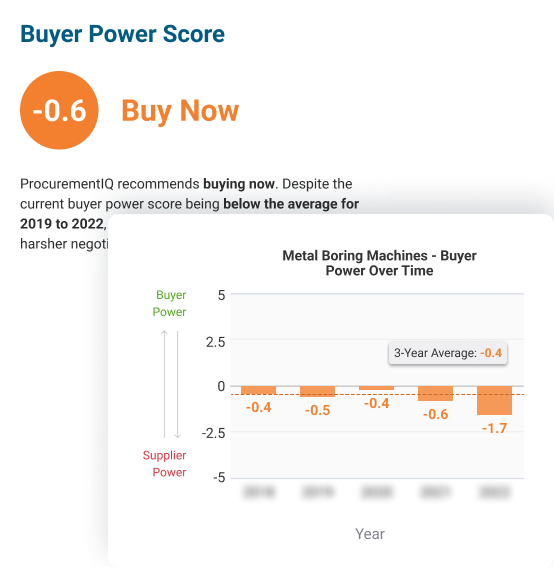
In 2026, buyer power amounts to -2.1 in the United States. Buyer power is most positively impacted by Recent Developments. It is most negatively impacted by Market Share Concentration. Subscribers can access details on eight other factors that impact buyer power. Learn more
United States
Buyer power forecasts: your glimpse into the future
Develop strategies for the upcoming year and identify unforeseen opportunities for buying now
- Actionable "Buy Now" and "Buy Later" insights
- Near-real-time updates to current and forecast Buyer Power Scores
- Methodology and weightings for Buyer Power Score Components
Supply Chain Risk
The average level of supply chain risk is assessed as High, which has a negative impact on buyer power. The level of supply chain risk is affected by industry volatility, barriers to entry, competition, import penetration, regulation and industry financial risk. Buyers in this market can mitigate procurement and supply chain management risks by monitoring risk levels for individual first and second tier suppliers:
1st
Tier Suppliers
- Operating Systems Software Publishers
- Computer Manufacturers
- IT Consulting Firms
2nd
Tier Suppliers
- Intellectual Property Licensing Providers
- Semiconductor & Circuit Manufacturers
- Computer & Software Wholesalers
Biggest Pharmacy Automation Systems Suppliers in the US by Revenue
The largest Pharmacy Automation Systems vendors by revenue in the US are Capsa Healthcare LLC, Intelligent Hospital Systems and Parata Systems LLC. Subscribers can sort and filter by market share concentration, profit level and other factors. Learn more
| Supplier | Operational Size | Headquarters | Number of Employees | Market Share (%) | Market Share Performance (3yr trend) | Total Revenue ($ million) | Profit Level (%) | Risk Level |
|---|---|---|---|---|---|---|---|---|
| Becton, Dickinson And Company | Global | FRANKLIN LAKES | >10,000 | 5-10 | ||||
| Mckesson Corporation | Global | IRVING | >10,000 | < 5 | ||||
| Midea Group Co. Ltd | Global | Foshan, CN | >10,001 | < 5 | ||||
| Baxter International Inc. | Global | DEERFIELD, IL | >10,000 | < 5 | ||||
| Cerner Corporation | Global | NORTH KANSAS CITY, MO | >10,000 | < 5 | ||||
| Yuyama USA Inc. | International | ElK Grove Villiage, IL | 1,001-10,000 | < 5 | ||||
| Omnicell Inc | Global | FORT WORTH, CA | 1,001-10,000 | < 5 | ||||
| Capsa Healthcare LLC | National | Portland, OR | 251-500 | < 5 | ||||
| Intelligent Hospital Systems | National | Winnipeg, CA | 101-250 | < 5 | ||||
Looking for a list of suppliers by country?
Subscribers can access vendor information on Canadian and European suppliers, too. We also offer custom research services to help with vendor sourcing anywhere in the world.
Profit Analysis
The average profit margin across vendors in the Pharmacy Automation Systems market is 24.5% and steady. Profit levels shift depending on suppliers' spend on wages, purchases and overhead. The highest cost component for vendors is Wages. The cost trend for this component is falling, when considering movement between 2025 and 2026. To understand cost forecasts for 2027 and uncover the implications on profit, start your subscription. Learn more
Vendor & Supply Chain Analysis
The average vendor risk in the market is moderate, having a neutral effect on buyers.
The market share concentration level is low due to intense competition in the market, benefiting buyers by allowing them to leverage competitors' offerings during the negotiation process.
Supply chain risk in the market is moderate due to a mixture of elements. While the global chip shortage has made it difficult to manufacture systems, the software aspect remains minimally risky.
The United States is a net importer of computers, meaning it imports more computers than it exports. While lower manufacturing costs abroad drive down prices for imported computers, relying on imports can lead to potential shortages or price increases if there are supply chain disruptions due to geopolitical tensions, trade disputes, or global crises.
Supplier Information
Becton, Dickinson And Company
Becton, Dickinson, and Company is a global medical technology company that develops, manufactures, and sells medical supplies, devices, laboratory equipment, and diagnostic products. Its business comprises three segments: BD Medical, which produces medical technologies and devices for medication delivery Subscribe to learn more
Baxter International Inc.
Baxter International Inc. is a public company operating globally in the manufacturing sector. The company's offerings include medical tissue closures, medical syringes, pharmacy automation systems and anesthetic drugs. Founded in 1931, the company is currently headquartered in Deerfield, Illinois, United Subscribe to learn more
Capsa Healthcare LLC
Capsa Healthcare LLC is a private company operating nationally in the manufacturing sector. The company's offerings include pharmacy automation systems. Founded in 1968, the company is currently headquartered in Canal Winchester, Ohio, United States of America with an estimated 375 employees. Subscribe to learn more
Cerner Corporation
Cerner Corporation is a public company operating globally in the manufacturing and information sectors. The company's offerings include electronic medical records software and pharmacy automation systems. Founded in 1979, the company is currently headquartered in KANSAS CITY, Missouri, United States of America... Subscribe to learn more
Intelligent Hospital Systems
Intelligent Hospital Systems is a private company operating nationally in the manufacturing sector. The company's offerings include pharmacy automation systems. Founded in 2006, the company is currently headquartered in Winnipeg, Manitoba, Canada with an estimated 175 employees. Subscribe to learn more
Mckesson Corporation
McKesson Corporation is a global, diversified healthcare services company. It distributes branded, generic, specialty, biosimilar, and over-the-counter pharmaceutical drugs and other healthcare-related products in the US, Canada, and Europe; provides prescription technology solutions that connect patients,... Subscribe to learn more
Midea Group Co. Ltd
Midea Group Co. Ltd is a public company operating globally in the manufacturing sector. The company's offerings include industrial robots, conveyor systems, automatic palletizers and pharmacy automation systems. Founded in 2000, the company is currently headquartered in Foshan, China with an estimated employee... Subscribe to learn more
Omnicell Inc
Omnicell, Inc. is a global healthcare technology company that provides automation systems for medication management in healthcare settings and pharmacies. It offers automated dispensing systems for medications and supplies, central pharmacy dispensing services, IV compounding services through robotics technology,... Subscribe to learn more
Parata Systems LLC
Parata Systems LLC is a private company operating internationally in the manufacturing sector. The company's offerings include pharmacy automation systems. Founded in 2001, the company is currently headquartered in Durham, North Carolina, United States of America with an estimated 432 employees. Subscribe to learn more
Accelerate the vendor selection process
Get a clear picture of the competition in a market and discover which vendors are best-suited for your sourcing needs. Our supplier profiles include hard-to-find financial ranges for private companies, cover public company data and feature an interactive competitor matrix.
Procurement Management KPIs for the Pharmacy Automation Systems Market
Managing vendor performance throughout the contract period is easier when tracking specific key performance indicators (KPIs). For example, buyers should monitor Average Resolution Time and Customer Satisfaction (CSAT). Buyers may experience better performance throughout their contracts if they establish service level agreements (SLAs) based on Pricing and other factors.
| KPI | Level of Importance (1-5) | Measurements | Key Considerations |
|---|---|---|---|
| Average Resolution Time |
|
Number of resolved tickets Total resolution time |
The average resolution time refers to the time frame in which a vendor is able to address and resolve a buyer’s question, problem or concern. The average resolution time can be used to determine a company’s support responsiveness. |
| Customer Satisfaction (CSAT) |
|
Number of positive customer responses Number of customer responses |
Overall customer satisfaction with a vendor is indicative of how cooperative and sympathetic they are to customer needs. Positive customer satisfaction shows that the vendor cares for the success of the buyers with their medical record software product. |

Questions to Ask During Procurement Negotiations
How can I gain leverage during negotiations?
Quality Control
What is your pharmacy automation systems’ average error rate?
What measures have you been undertaking to improve your product quality during the past three years?
Customer Service
How long does it usually take to receive and install your pharmacy automation systems?
How often is maintenance performed? On average, how long does it normally take to perform maintenance?
Experience and Expertise
How many years of experience in pharmacy automation system manufacturing or distribution do you have?
What clients have you worked with in the past?
The ultimate prep for procurement negotations
View all 27 negotiation questions for this category when you subscribe.
Pharmacy Automation Systems RFP Guidelines
What should my RFP include?
Organizational Overview
Buyers should provide a general overview of their organization, including facility type and size.
Buyers should specify in which cities, states and countries they operate.
Statement Of Need
Buyers should explain the desired use of pharmacy automation systems.
Buyers should specify the desired types of pharmacy automation systems, such as tabletop counting devices or robotic dispensers.
Project Budget
If one exists, buyers should specify their budget for the desired pharmacy automation systems and related products and services.
Buyers should request detailed information about shipping and handling fees.
The RFP process made easy
Find out how you can access RFP templates for 800+ procurement categories to start writing better, more consistent RFPs.
We display average pricing information, trends and market data.
Our Reports include:
- Opportunity assessment
- Market dynamics
- Recent developments
- Positive and warning trends
- Buyer power levers
- Price environment and market pricing
- Geographic wage rates
- Global market updates
- Total cost of ownership
- Cost structure benchmarks and analysis
- Supply chain and vendors
- Global supplier breakdown
- Market share concentration
- Regulation and business requirements
- Vendor management and KPIs
- Sourcing strategy guidance