Procurement Market Intelligence Report
Medical Equipment Leasing
Sourcing Guide & Market Intelligence
Smarter cost management starts with comprehensive market intelligence
 United States
 Global
Quick Navigation
Medical Equipment Leasing Global Overview
Definition
Summary
Leasing medical equipment, rather than buying the equipment, yields buyers multiple benefits, including protection against technological obsolescence, fewer maintenance responsibilities, lower initial capital requirements and the flexibility to change suppliers and upgrade equipment as needed. Key buyers include hospitals and clinics, physicians, nursing care facilities, and group purchasing organizations.
This Report Includes:
- Medical Equipment Available for Rent for Healthcare Institutions
- Medical Equipment Available for Lease for Healthcare Institutions
Not in this Report:
- Medical Equipment Rent for Consumers
- Medical Equipment Lease for Consumers
Take the ProcurementIQ products and data tour
Explore live samples of price trend forecasts, price driver projections, forward-looking cost structure data and more.
Global Medical Equipment Leasing Procurement Trends
Discover the top international trends affecting procurement in the global Medical Equipment Leasing market.
Warning Trends
Public sector demand slumps as the government enters shutdown
- On October 1, the US federal government entered a shutdown after negotiations for a new appropriations bill failed.
- During a government shutdown, essential federal government operations, such as law enforcement, air-traffic control, and social security, persist, while nonessential operations are paused and workers involved in these operations are furloughed. Thus, the current shutdown is expected to result in 750,000 federal workers being furloughed, representing a $400 million reduction in daily expenditure by the federal government.
- This significant reduction in federal spending and operations will affect the entire US economy, weakening aggregate demand and slowing economic growth. For example, the 35-day government shutdown in Q1, 2019, reduced aggregate demand in both the public and private sectors, resulting in a 0.2% reduction in GDP growth that quarter.
- The effects of the shutdown are likely to be most acute in markets where the public sector is a major buyer segment, weakening demand and increasing average vendor risk by destabilizing important revenue streams.
- As negotiations for a new appropriations bill to reopen the government remain ongoing, ProcurementIQ will continue to monitor the situation and update this story with the latest information.
Reciprocal tariffs to increase prices and supply chain risk in the medical equipment industry
- The Trump administration’s reciprocal tariffs, which impose increased general tariffs on all products imported from most nations, are set to take effect on August 7 after rates were finalized on August 1.
- The US medical equipment industry is highly reliant on imported products, with medical equipment imports totaling $122 billion in 2024, or about 19.2% of the total market supply.
- The European Union, Mexico, and China are key importers of medical equipment, accounting for 28.1%, 11.0%, and 9.6% of total medical equipment imports, respectively.
- Thus, the 15.0%, 25.0%, and 54.0% tariffs on imports from the European Union, Mexico, and China will significantly increase the prices of medical equipment. Steel and aluminum imports, common materials in medical equipment manufacturing, also currently face 50.0% tariffs when imported from any nation other than the United Kingdom.
- The Yale Budget Lab projects that key inputs for medical equipment, such as electronic components, metals, plastic, and rubber, will increase in price by 10.4% to 37.6% due to tariffs, indicating domestic producers will face sharp cost increases as well.
Global Medical Equipment Leasing Market - Suppliers by Region
| Country/Region | Number of Suppliers |
|---|---|
| #1 China | 945 |
| #2 Europe | 770 |
| #3 United States | 670 |
Explore supplier concentration across the globe
We've uncovered the 11 top regions for global procurement, based on feedback from our most strategic clients. Access vendor counts for each unique region when you subscribe.
Geography Drilldown - US
Average Cost of Medical Equipment Leasing
United States
2026 Market Pricing$400.00 to $XX,XXX.XX
per monthAverage Price
Prices in the Medical Equipment Leasing market range from $400.00 to $XX,XXX.XX, depending on Type of Medical Equipment, New vs. Used Equipment, Lease Duration, Type of Lease and Buyer Creditworthiness. For example, lower prices are associated with Diagnostic equipment such as medical imaging and surgical equipment ($2,000 to $3,000 per month), whereas higher prices are associated with Advanced technology such as magnetic resonance imaging (MRI) machines ($10,000 to $45,000 per month).
Need the scoop on international price trends?
Between our Europe and Canada collections, we provide price data for 350 markets so you can instantly compare prices across borders. Or, use our custom research services for intel on prices in any region across the globe.
Medical Equipment Leasing Category Price Trends
Pricing trends are indicated by the compound annual growth rate (CAGR) during a set period of time. For the Medical Equipment Leasing market, prices in the US have grown 2.5% from 2022 to 2025. Subscribers can access price trend forecasts, price driver projections and forward-looking cost structure data. Learn more
United States (2022-2025)


Wondering where prices are heading?
Price trend forecasts are available to subscribers, along with price driver projections and forward-looking cost structure data.
Cost Analysis - Total Cost of Ownership for Medical Equipment Leasing
Total cost of ownership is Low in the Medical Equipment Leasing market. The average cost of ownership differs depending on the contract but generally includes costs negotiated before the contract begins, costs billed during the contract period and unforeseen costs. For example, unforeseen costs in the form of Hidden Fees may raise the total cost of ownership unexpectedly.
Negotiated Before
Financing
Billed During
Support
Unforeseen
Hidden Fees
Buyer Power in Procurement Negotiations
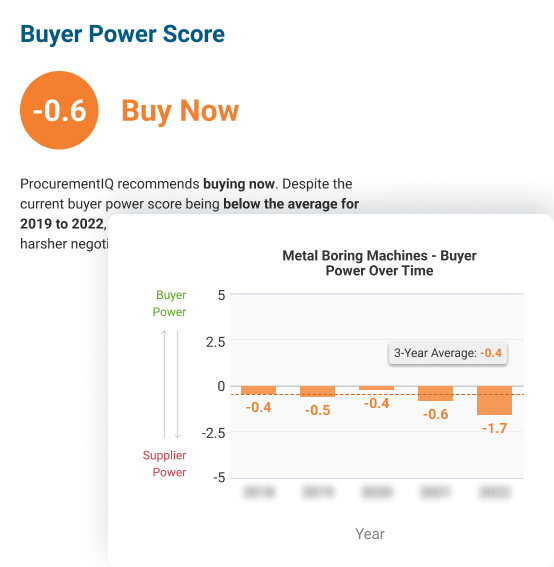
In 2026, buyer power amounts to -1.8 in the United States. Buyer power is most positively impacted by Recent Developments. It is most negatively impacted by Price Driver Volatility. Subscribers can access details on eight other factors that impact buyer power. Learn more
United States
Buyer power forecasts: your glimpse into the future
Develop strategies for the upcoming year and identify unforeseen opportunities for buying now
- Actionable "Buy Now" and "Buy Later" insights
- Near-real-time updates to current and forecast Buyer Power Scores
- Methodology and weightings for Buyer Power Score Components
Supply Chain Risk
The average level of supply chain risk is assessed as Medium, which has a negative impact on buyer power. The level of supply chain risk is affected by industry volatility, barriers to entry, competition, import penetration, regulation and industry financial risk. Buyers in this market can mitigate procurement and supply chain management risks by monitoring risk levels for individual first and second tier suppliers:
1st
Tier Suppliers
- Medical Equipment Wholesalers
- Commercial Real Estate Leasing Companies
- Computer & Software Wholesalers
- Freight Trucking Companies
2nd
Tier Suppliers
- Medical Equipment Manufacturers
- Real Estate Sales & Brokerage Companies
- Computer & Software Manufacturers
- Gasoline & Petroleum Wholesalers
Biggest Medical Equipment Leasing Suppliers in the US by Revenue
The largest Medical Equipment Leasing vendors by revenue in the US are Stryker Corporation, Prudential Leasing Inc. and US Med-Equip Inc. Subscribers can sort and filter by market share concentration, profit level and other factors. Learn more
| Supplier | Operational Size | Headquarters | Number of Employees | Market Share (%) | Market Share Performance (3yr trend) | Total Revenue ($ million) | Profit Level (%) | Risk Level |
|---|---|---|---|---|---|---|---|---|
| Siemens Ag | Global | Munich , DE | >10,001 | 10-15 | ||||
| General Electric Company | Global | EVENDALE | >10,000 | 10-15 | ||||
| Koninklijke Philips Nv | Global | Amsterdam, NL | >10,001 | 10-15 | ||||
| Agiliti Health, Inc. | National | Eden Prairie, MN | 1,001-10,000 | 10-15 | ||||
| Getinge Ab | Global | Gothenburg, SE | >10,001 | 15-20 | ||||
| Stryker Corporation | US | 15-20 | ||||||
| Medtronic Plc | Global | GALWAY | >10,000 | < 5 | ||||
| Prudential Leasing Inc. | National | Dallas, TX | 25-50 | < 5 | ||||
| US Med-Equip Inc. | National | Houston, TX | 101-250 | < 5 | ||||
Looking for a list of suppliers by country?
Subscribers can access vendor information on Canadian and European suppliers, too. We also offer custom research services to help with vendor sourcing anywhere in the world.
Profit Analysis
The average profit margin across vendors in the Medical Equipment Leasing market is 15.5% and steady. Profit levels shift depending on suppliers' spend on wages, purchases and overhead. The highest cost component for vendors is Overhead. The cost trend for this component is rising, when considering movement between 2025 and 2026. To understand cost forecasts for 2027 and uncover the implications on profit, start your subscription. Learn more
Vendor & Supply Chain Analysis
Average vendor risk in this market is at a moderate level. Taking into consideration that this market has reached mid-maturity, this stage is beneficial for because demand growth is stable and they can better anticipate price trends, thus easing purchasing decisions, and taking into account rising demands for healthcare services, sales have been growing steadily.
The market exhibits a high level of concentration, with the top four players capturing more than 50.0% of total market revenue. Despite rising consolidation activity, the plethora of suppliers and stiff market competition will help sustain buyer negotiation power.
There is a medium level of risk in the medical equipment leasing supply chain. Although leasing companies are less dependent on critical inputs that could severely affect the supply chain, they are still subject to various macroeconomic conditions that can impact their operating costs.
As a net importer in the medical equipment leasing market, US buyers' procurement strategies may be influenced by cost considerations and international competition, and will need to carefully evaluate pricing options and potentially seek out more cost-effective solutions. Being a net importer can restrict buyer power and reduce their ability to dictate terms and conditions in procurement transactions, and will have less control over pricing, quality, and availability of the goods or services they need.
Supplier Information
Agiliti Health, Inc.
Agiliti Health, Inc. is a private company operating nationally in the real estate & rental & leasing, healthcare & social assistance and other services (except public administration) sectors. The company's offerings include physical therapy services, medical & surgical equipment repair and medical equipment... Subscribe to learn more
General Electric Company
General Electric Company (dba GE Aerospace) is a global aerospace company that provides engines, systems, and services to commercial, government, and military markets. It organizes its business into two segments: the Commercial Engines & Services segment, which designs and manufactures jet engines for commercial... Subscribe to learn more
Koninklijke Philips Nv
Koninklijke Philips Nv is a public company operating globally in the manufacturing, real estate & rental & leasing and other services (except public administration) sectors. The company's offerings include capacitors, security lighting, ct scanners, mri scanners, automated external defibrillators. Founded... Subscribe to learn more
Siemens Ag
Siemens Ag is a public company operating globally in the manufacturing, information, real estate & rental & leasing, professional, scientific & technical services, administration, business support and waste management services and other services (except public administration) sectors. The company's offerings... Subscribe to learn more
Getinge Ab
Getinge Ab is a public company operating globally in the manufacturing and real estate & rental & leasing sectors. The company's offerings include laboratory sterilizers and medical equipment leasing. Founded in 1904, the company is currently headquartered in Gothenburg, Sweden with an estimated employee Subscribe to learn more
Stryker Corporation
Stryker Corporation is a private company operating in the manufacturing and real estate and rental and leasing sectors. The company's offerings include automated external defibrillators and medical equipment leasing. Founded in 2017, the company is currently headquartered in United States of America. Subscribe to learn more
Medtronic Plc
Medtronic plc is a global healthcare technology company that develops, designs, manufactures, and sells medical instruments and services for various conditions. It organizes its business into four reportable segments: the Cardiovascular Portfolio, which includes, among others, pacemakers, insertable cardiac... Subscribe to learn more
Prudential Leasing Inc.
Prudential Leasing Inc. is a private company operating nationally in the real estate & rental & leasing sector. The company's offerings include medical equipment leasing. Founded in 1998, the company is currently headquartered in Dallas, Texas, United States of America with an estimated 37 employees. Subscribe to learn more
US Med-Equip Inc.
US Med-Equip Inc. is a private company operating nationally in the real estate & rental & leasing sector. The company's offerings include medical equipment leasing. Founded in 2003, the company is currently headquartered in Houston, Texas, United States of America with an estimated 175 employees. Subscribe to learn more
Accelerate the vendor selection process
Get a clear picture of the competition in a market and discover which vendors are best-suited for your sourcing needs. Our supplier profiles include hard-to-find financial ranges for private companies, cover public company data and feature an interactive competitor matrix.
Procurement Management KPIs for the Medical Equipment Leasing Market
Managing vendor performance throughout the contract period is easier when tracking specific key performance indicators (KPIs). For example, buyers should monitor Cost of Goods Sold and Customer Satisfaction (CSAT). Buyers may experience better performance throughout their contracts if they establish service level agreements (SLAs) based on Delivery and other factors.
| KPI | Level of Importance (1-5) | Measurements | Key Considerations |
|---|---|---|---|
| Cost of Goods Sold |
|
Total revenue Total labor cost Total material cost Total service cost Total delivery cost |
Knowing the cost of goods sold is used to determine market profitability, which is helpful to gauge the performance of the service for a vendor. Knowing the cost of goods sold is beneficial to the vendor for the price determination of their leasing services. |
| Customer Satisfaction (CSAT) |
|
Number of positive customer responses Number of customer responses |
Customer satisfaction represents customers’ overall satisfaction with a company or vendor. Customer satisfaction can be used to evaluate a company’s overall reputation for quality and well-priced medical equipment. |

Questions to Ask During Procurement Negotiations
How can I gain leverage during negotiations?
Regulation
How have changing regulations affected your operations?
How has increased regulation affected your pricing? How will changes in regulation affect pricing during a contract's duration?
Service & Maintenance
Do you have a preventive maintenance program in place?
What testing procedures do you perform before leasing out medical equipment?
Customer Service
Who will be my point-of-contact person at your company and what is their role?
If I am not satisfied with my leasing policy, can you make immediate changes to it?
The ultimate prep for procurement negotations
View all 28 negotiation questions for this category when you subscribe.
Medical Equipment Leasing RFP Guidelines
What should my RFP include?
Organizational Overview
Buyers should provide a general overview of their organization, including facility type and size (e.g., hospital, clinic, or nursing care facility).
Buyers should provide information about the location and number of sites.
Statement Of Need
Buyers should state the desired duration of a leasing agreement in addition to other terms and conditions.
Buyers should explicitly state the type(s) of medical equipment and the number of units they wish to lease under this agreement.
Project Budget
If one exists, buyers should specify their budget for the desired pharmacy automation systems and related products and services.
Buyers should inquire about any delivery charges and whether they are factored into the leasing rate.
The RFP process made easy
Find out how you can access RFP templates for 800+ procurement categories to start writing better, more consistent RFPs.
We display average pricing information, trends and market data.
Our Reports include:
- Opportunity assessment
- Market dynamics
- Recent developments
- Positive and warning trends
- Buyer power levers
- Price environment and market pricing
- Geographic wage rates
- Global market updates
- Total cost of ownership
- Cost structure benchmarks and analysis
- Supply chain and vendors
- Global supplier breakdown
- Market share concentration
- Regulation and business requirements
- Vendor management and KPIs
- Sourcing strategy guidance