Procurement Market Intelligence Report
Tanks & Cylinders
Sourcing Guide & Market Intelligence
Smarter cost management starts with comprehensive market intelligence
 United States
 Global
Quick Navigation
Tanks & Cylinders Global Overview
Definition
Summary
Tanks and cylinders are pressure vessels that are designed to store liquids or gases. Products in this market include reservoirs, air and gas tanks, calibration tanks, and large industrial storage tanks. Although tanks and cylinders have similar applications, tanks are available in a variety of shapes, whereas cylinders have parallel sides and a circular or oval cross section. Typical buyers are industrial facility construction companies, breweries, distilleries, petroleum refineries, and oxygen and hydrogen gas manufacturers.
This Report Includes:
- Resevoirs
- Air & Gas Tanks
- Calibration Tanks
- Cylinders
Not in this Report:
- Tank Hoses
- Tank Fuel & Gas
Global Tanks & Cylinders Procurement Trends
Discover the top international trends affecting procurement in the global Tanks & Cylinders market.
Warning Trends
Increased tariffs on copper imports take effect
- On August 1, the Trump administration implemented 50.0% tariffs on imported copper. Chile and Canada will be most impacted by these tariffs, as they account for a combined 87.0% of all copper imports in the United States.
- However, these tariffs are less sweeping than initially expected, only applying to semi-finished copper products, while excluding high-purity refined copper and copper input materials, such as ore and concentrate. As leading importers, such as Chile and Canada, have both high copper mining and refining capacities, they will likely avoid most of these tariffs by either exporting the copper in its unrefined form or refining the copper before exporting it to the United States
- These copper tariff exemptions limit the impact on the electronics and electrical equipment sectors because these applications require refined copper due to its optimal conductive properties.
- Thus, the prices of metal alloys that include copper, consumer products made from copper, tools, plumbing, corrosion-resistant alloys, and construction materials made from copper are forecast to rise by an average of 39.2%, according to the Yale Budget Lab.
Reciprocal tariffs drive up packaging product prices
- The Trump administration’s reciprocal tariffs, which apply general tariff rate increases to all products imported from most nations, are set to take effect on August 7 after the national tariff rates were finalized on August 1. Additionally, 50.0% tariffs on all steel and aluminum imports, except those from the United Kingdom, went into effect in June.
- These tariffs will have a significant effect across the packaging industry as the United States imports a combined total of more than $127 billion worth of plastic, steel, and lumber annually, the three most common materials in packaging products.
- Leading packaging product importers include Canada, Mexico, and China, which face tariff rates of 35.0%, 25.0%, and 20.0%, respectively, with the Chinese import tariff rate set to rise to 54.0% in August. However, United States-Mexico-Canada Trade Agreement (USMCA)-originating goods, meaning those produced entirely in Canada or Mexico, are exempt from these tariffs.
- China accounts for 48.6% of imported plastic products in the United States, making current and upcoming tariffs on Chinese goods particularly impactful for the price of plastic packaging materials, which the Yale Budget Lab projects will rise in price by 11.0%.
- Likewise, Canada and Mexico provide a combined 51.6% of lumber imports, driving a 6.8% increase in the price of wooden products. Steel and aluminum tariffs are projected to fuel a 39.2% increase in the cost of metal packaging products on average.
Neutral
Crude oil prices dip, but natural gas and fuel prices remain volatile in 2025
- Oil prices have been falling with the introduction of higher tariffs and the predicted decline in global demand. The OPEC+ group of countries also announced they would be unwinding production cuts and increasing their collective output target for May by 411,000 barrels per day.
- Trade wars, ongoing conflict between Hamas and Israel, and general unrest in the Middle East are causing uncertainty surrounding oil prices, which has led to volatility in prices. In the third week of May 2025, crude oil prices hit $63.67 per barrel, but volatility remains as geopolitical concerns remain.
- Natural gas prices rallied early in 2025 with colder-than-usual temperatures in the United States and high demand, topping out at $4.68/MMBtu in March. Prices have since fallen with the onset of trade wars and weakening demand projections to $3.64/MMBtu in the third week of May 2025.
- The national average of gasoline prices has been rising slightly due to refinery maintenance/outages and blending issues, hitting a national average of $3.15 per gallon in the third week of May 2025. However, gasoline futures have been volatile, falling due to fears of oversupply and deepening concerns about weakening demand with tariffs, but rising after trade deals.
- With the ongoing volatility in oil and natural gas markets, prices and availability in the tanks and cylinders market are subject to instability due to varying demand.
Global Tanks & Cylinders Market - Suppliers by Region
| Country/Region | Number of Suppliers |
|---|---|
| #1 Europe | 5,080 |
| #2 China | 3,980 |
| #3 India | 2,890 |
Explore supplier concentration across the globe
We've uncovered the 11 top regions for global procurement, based on feedback from our most strategic clients. Access vendor counts for each unique region when you subscribe.
2
Geography Drilldown - US
Average Cost of Tanks & Cylinders
United States
2026 Market Pricing$50.00 to $X,XXX,XXX.XX
per tankAverage Price
Prices in the Tanks & Cylinders market range from $50.00 to $X,XXX,XXX.XX, depending on Capacity, Materials, Thickness, Customization and Size. For example, lower prices are associated with Less than 1,000 gallons ($200 to $10,000 per tank), whereas higher prices are associated with 1,000 to 10,000 gallons ($600 to $30,000 per tank) and Over 10,000 gallons ($10,000 to $1,000,000 per tank).
Need the scoop on international price trends?
Between our Europe and Canada collections, we provide price data for 350 markets so you can instantly compare prices across borders. Or, use our custom research services for intel on prices in any region across the globe.
Tanks & Cylinders Category Price Trends
Pricing trends are indicated by the compound annual growth rate (CAGR) during a set period of time. For the Tanks & Cylinders market, prices in the US have grown 5.6% from 2022 to 2025. Subscribers can access price trend forecasts, price driver projections and forward-looking cost structure data. Learn more
United States (2022-2025)


Wondering where prices are heading?
Price trend forecasts are available to subscribers, along with price driver projections and forward-looking cost structure data.
Cost Analysis - Total Cost of Ownership for Tanks & Cylinders
Total cost of ownership is Medium in the Tanks & Cylinders market. The average cost of ownership differs depending on the contract but generally includes costs negotiated before the contract begins, costs billed during the contract period and unforeseen costs. For example, unforeseen costs in the form of Emergencies may raise the total cost of ownership unexpectedly.
Negotiated Before
Installation
Transportation
Billed During
Maintenance
Disposal
Unforeseen
Emergencies
Buyer Power in Procurement Negotiations
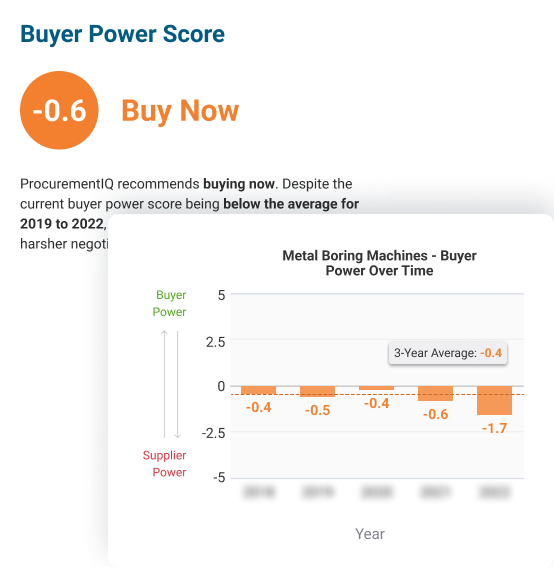
In 2026, buyer power amounts to -3.7 in the United States. Buyer power is most positively impacted by Recent Developments. It is most negatively impacted by Market Share Concentration. Subscribers can access details on eight other factors that impact buyer power. Learn more
United States
Buyer power forecasts: your glimpse into the future
Develop strategies for the upcoming year and identify unforeseen opportunities for buying now
- Actionable "Buy Now" and "Buy Later" insights
- Near-real-time updates to current and forecast Buyer Power Scores
- Methodology and weightings for Buyer Power Score Components
Supply Chain Risk
The average level of supply chain risk is assessed as High, which has a negative impact on buyer power. The level of supply chain risk is affected by industry volatility, barriers to entry, competition, import penetration, regulation and industry financial risk. Buyers in this market can mitigate procurement and supply chain management risks by monitoring risk levels for individual first and second tier suppliers:
1st
Tier Suppliers
- Metal Pipe & Tube Manufacturers
- Steel Rolling & Drawing Suppliers
- Nonferrous Metal Foundry Product Manufacturers
2nd
Tier Suppliers
- Ferrous Metal Foundry Product Manufacturers
- Iron & Steel Manufacturers
- Aluminum Manufacturers
Biggest Tanks & Cylinders Suppliers in the US by Revenue
The largest Tanks & Cylinders vendors by revenue in the US are Highland Tank & Manufacturing Company Inc., Tank Holding Corp. and Tank-Depot.Com, Inc. Subscribers can sort and filter by market share concentration, profit level and other factors. Learn more
| Supplier | Operational Size | Headquarters | Number of Employees | Market Share (%) | Market Share Performance (3yr trend) | Total Revenue ($ million) | Profit Level (%) | Risk Level |
|---|---|---|---|---|---|---|---|---|
| Trinity Industries Inc. | National | DALLAS, TX | 1,001-10,000 | 10-15 | ||||
| Worthington Industries, Inc. | Global | COLUMBUS | 1,001-10,000 | 5-10 | ||||
| Hitachi Ltd. | Global | Tokyo, JPN | >10,001 | < 5 | ||||
| Chart Industries, Inc. | Global | BALL GROUND | >10,000 | < 5 | ||||
| General Industries | National | Goldsboro, NC | 51-100 | < 5 | ||||
| Highland Tank & Manufacturing Company Inc. | National | Stoystown, PA | 251-500 | < 5 | ||||
| Tank Holding Corp. | International | Bonifacius, MN | 501-1,000 | < 5 | ||||
| Tank-Depot.Com, Inc. | National | Pompano Beach, FL | <25 | < 5 | ||||
| The Paul Mueller Company | Global | Springfield, US | 501-1,000 | < 5 | ||||
Looking for a list of suppliers by country?
Subscribers can access vendor information on Canadian and European suppliers, too. We also offer custom research services to help with vendor sourcing anywhere in the world.
Profit Analysis
The average profit margin across vendors in the Tanks & Cylinders market is 2.4% and steady. Profit levels shift depending on suppliers' spend on wages, purchases and overhead. The highest cost component for vendors is Purchases. The cost trend for this component is rising, when considering movement between 2025 and 2026. To understand cost forecasts for 2027 and uncover the implications on profit, start your subscription. Learn more
Vendor & Supply Chain Analysis
Low market share concentration promotes price-based competition in the market, thus giving buyers leverage in negotiations with multiple suppliers.
The tanks and cylinders market faces high supply chain risk due to the instability of many of the upstream metal production and forging markets. This risk has also been increased by higher tariffs on aluminum and steel, which limit the viability of foreign-made products in the US market, while also subjecting the market to sudden price shocks.
Moderate vendor financial risk harms buyers as potential disruptions to service and price spikes may occur due to vendors’ financial situations and profit levels.
Because the United States is a net importer of tanks and cylinders, buyers benefit from access to internationally sourced tanks and cylinders, which may be cheaper or help offset domestic supply issues.
Supplier Information
Trinity Industries Inc.
Trinity Industries Inc. is a public company operating nationally in the manufacturing and real estate and rental and leasing sectors. The company's offerings include tanks & cylinders and rail tank car leasing services. Founded in 1933, the company is currently headquartered in DALLAS, Texas, United States... Subscribe to learn more
Worthington Industries, Inc.
Worthington Enterprises, Inc. is an industrial manufacturing company focusing on value-added steel processing, laser welded solutions, electrical steel laminations, and manufactured consumer, building, and sustainable mobility products. Its manufactured products include pressure cylinders for liquefied petroleum... Subscribe to learn more
Chart Industries, Inc.
Chart Industries, Inc. is a global designer, engineer, and manufacturer of process technologies and equipment for gas and liquid molecule handling for the Nexus of Clean™. It provides technology, equipment, and services related to liquefied natural gas, hydrogen, biogas, carbon capture, and other applications.... Subscribe to learn more
General Industries
General Industries is a private company operating nationally in the manufacturing sector. The company's offerings include tanks & cylinders. Founded in 1954, the company is currently headquartered in Goldsboro, North Carolina, United States of America with an estimated 75 employees. Subscribe to learn more
Highland Tank & Manufacturing Company Inc.
Highland Tank & Manufacturing Company Inc. is a private company operating nationally in the manufacturing sector. The company's offerings include tanks & cylinders. Founded in 1946, the company is currently headquartered in Stoystown, Pennsylvania, United States of America with an estimated 450 employees.... Subscribe to learn more
Hitachi Ltd.
Hitachi Ltd. is a public company operating globally in the manufacturing and wholesale trade sectors. The company's offerings include forestry & logging equipment, front-end loaders, bulldozers, excavators, building demolition machinery & equipment. Founded in 1910, the company is currently headquartered Subscribe to learn more
Tank Holding Corp.
Tank Holding Corp. is a private company operating internationally in the manufacturing and administration, business support and waste management services sectors. The company's offerings include tanks & cylinders and septic tanks. Founded in 1939, the company is currently headquartered in Bonifacius, Minnesota,... Subscribe to learn more
Tank-Depot.Com, Inc.
Tank-Depot.Com, Inc. is a private company operating nationally in the manufacturing and administration, business support and waste management services sectors. The company's offerings include tanks & cylinders and septic tanks. Founded in 1998, the company is currently headquartered in Pompano Beach, Florida,... Subscribe to learn more
The Paul Mueller Company
The Paul Mueller Company is a public company operating globally in the manufacturing sector. The company's offerings include field-erected tanks and tanks & cylinders. Founded in 1940, the company is currently headquartered in Springfield, United States of America with an estimated 750 employees. Subscribe to learn more
Accelerate the vendor selection process
Get a clear picture of the competition in a market and discover which vendors are best-suited for your sourcing needs. Our supplier profiles include hard-to-find financial ranges for private companies, cover public company data and feature an interactive competitor matrix.
Procurement Management KPIs for the Tanks & Cylinders Market
Managing vendor performance throughout the contract period is easier when tracking specific key performance indicators (KPIs). For example, buyers should monitor Average Order Value and Employee Training Rate. Buyers may experience better performance throughout their contracts if they establish service level agreements (SLAs) based on Quality and other factors.
| KPI | Level of Importance (1-5) | Measurements | Key Considerations |
|---|---|---|---|
| Average Order Value |
|
Total revenue Number of orders |
Average order value can be used to evaluate the vendor's previous client’s willingness to spend money on their tanks and cylinders. A high average order value can be used as an indication that the company has a high reputation within the market, as customers are choosing this specific vendor to purchase very expensive products from. |
| Employee Training Rate |
|
Number of hours of training required Employee evaluation pass rate Employee certifications |
A high employee training rate signifies that a large portion of the vendor's workforce should be able to correctly install, maintain, and inspect the equipment. A highly trained workforce can prevent future malfunctions or emergencies, ultimately reducing the amount of downtime and lost revenue that is associated with these failures. |

Questions to Ask During Procurement Negotiations
How can I gain leverage during negotiations?
Experience and Expertise
What experience do you have working with buyers in my industry or with operations similar to mine?
How long have you provided tanks and cylinders to your longest-tenured client?
Location
If I am located in a different region, do you anticipate any difficulties in delivering tanks or cylinders to my location?
Will all of the products in my order be delivered at the same time? If not, how will the related goods in the order impact the delivery of the tanks and cylinders?
Customer Service
What type of customer service support do you offer?
How have you addressed customers' issues in the past?
The ultimate prep for procurement negotations
View all 27 negotiation questions for this category when you subscribe.
Tanks & Cylinders RFP Guidelines
What should my RFP include?
Organizational Overview
Buyers should provide an overview of their business and describe their general use of tanks and cylinders within the scope of their operations.
Buyers should specify the typical amounts of liquid and gas handled in their tanks and cylinders.
Statement Of Need
Buyers should provide buyers with descriptions of each location requiring a tank as well as the specifications and quantity of each type.
Buyers should list the specific services that are and are not included within the scope of the contract
Project Budget
Buyers should specify their budget for each individual tank and cylinder as well as a total budget, including costs for labor, maintenance, and any additional parts.
Buyers should break down their total budget based on per hour service rates.
The RFP process made easy
Find out how you can access RFP templates for 800+ procurement categories to start writing better, more consistent RFPs.
We display average pricing information, trends and market data.
Our Reports include:
- Opportunity assessment
- Market dynamics
- Recent developments
- Positive and warning trends
- Buyer power levers
- Price environment and market pricing
- Geographic wage rates
- Global market updates
- Total cost of ownership
- Cost structure benchmarks and analysis
- Supply chain and vendors
- Global supplier breakdown
- Market share concentration
- Regulation and business requirements
- Vendor management and KPIs
- Sourcing strategy guidance