Procurement Market Intelligence Report
Television Advertising
Sourcing Guide & Market Intelligence
Smarter cost management starts with comprehensive market intelligence
 United States
 Global
Quick Navigation
Television Advertising Global Overview
Definition
Summary
Television advertising is programming during which commercials produced and paid for by organizations are aired. These services are used to promote a variety of goods, services and ideas. Common buyers of television advertising include automobile manufacturers, wireless telecommunication companies and restaurants.
This Report Includes:
- Daytime Television Commercials
- Primetime Television Commercials
Not in this Report:
- Digital Advertising Services
- Physical Media Advertising
- Television Advertisement Production
Classification:
Take the ProcurementIQ products and data tour
Explore live samples of price trend forecasts, price driver projections, forward-looking cost structure data and more.
Global Television Advertising Market - Suppliers by Region
| Country/Region | Number of Suppliers |
|---|---|
| #1 Europe | 5,465 |
| #2 South America | 2,305 |
| #3 China | 1,805 |
Explore supplier concentration across the globe
We've uncovered the 11 top regions for global procurement, based on feedback from our most strategic clients. Access vendor counts for each unique region when you subscribe.
Geography Drilldown - US
Average Cost of Television Advertising
United States
2026 Market Pricing$200.00 to $X,XXX,XXX.XX
per 30-second time slotAverage Price
Prices in the Television Advertising market range from $200.00 to $X,XXX,XXX.XX, depending on Daypart, Selected Program, Designated Market Area (DMA), Length and Purchase Volume. For example, lower prices are associated with Daytime ($120 to $15,000 per 30-second time slot), whereas higher prices are associated with Primetime ($8,000 to $850,000 per 30-second time slot).
Need the scoop on international price trends?
Between our Europe and Canada collections, we provide price data for 350 markets so you can instantly compare prices across borders. Or, use our custom research services for intel on prices in any region across the globe.
Television Advertising Category Price Trends
Pricing trends are indicated by the compound annual growth rate (CAGR) during a set period of time. For the Television Advertising market, prices in the US have grown 2.0% from 2022 to 2025. Subscribers can access price trend forecasts, price driver projections and forward-looking cost structure data. Learn more
United States (2022-2025)


Wondering where prices are heading?
Price trend forecasts are available to subscribers, along with price driver projections and forward-looking cost structure data.
Cost Analysis - Total Cost of Ownership for Television Advertising
Total cost of ownership is High in the Television Advertising market. The average cost of ownership differs depending on the contract but generally includes costs negotiated before the contract begins, costs billed during the contract period and unforeseen costs.
Negotiated Before
Set Up Fees
Billed During
Additional Fees
Buyer Power in Procurement Negotiations
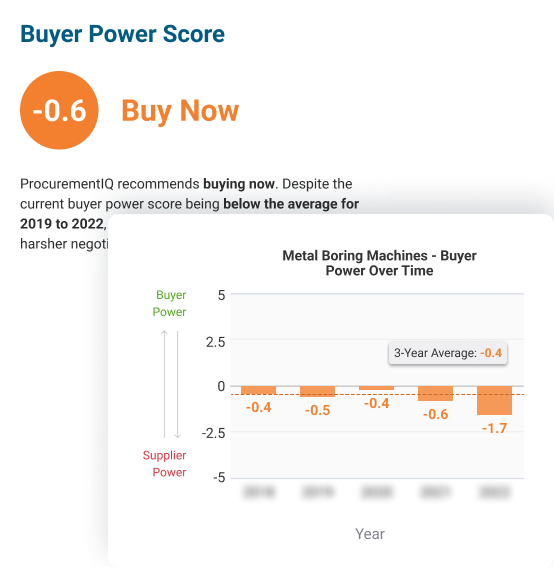
In 2026, buyer power amounts to -1.3 in the United States. Buyer power is most positively impacted by Market Share Concentration. It is most negatively impacted by Switching Costs. Subscribers can access details on eight other factors that impact buyer power. Learn more
United States
Buyer power forecasts: your glimpse into the future
Develop strategies for the upcoming year and identify unforeseen opportunities for buying now
- Actionable "Buy Now" and "Buy Later" insights
- Near-real-time updates to current and forecast Buyer Power Scores
- Methodology and weightings for Buyer Power Score Components
Supply Chain Risk
The average level of supply chain risk is assessed as Medium, which has a negative impact on buyer power. The level of supply chain risk is affected by industry volatility, barriers to entry, competition, import penetration, regulation and industry financial risk. Buyers in this market can mitigate procurement and supply chain management risks by monitoring risk levels for individual first and second tier suppliers:
1st
Tier Suppliers
- Television Producers
- Movie & Video Producers
- Communication Equipment Manufacturers
2nd
Tier Suppliers
- Celebrity & Sports Agents
- Video Postproduction Service Providers
- Electrical Equipment Manufacturers
Biggest Television Advertising Suppliers in the US by Revenue
The largest Television Advertising vendors by revenue in the US are Univision Communications Inc., At&T Inc. and Comcast Corporation. Subscribers can sort and filter by market share concentration, profit level and other factors. Learn more
| Supplier | Operational Size | Headquarters | Number of Employees | Market Share (%) | Market Share Performance (3yr trend) | Total Revenue ($ million) | Profit Level (%) | Risk Level |
|---|---|---|---|---|---|---|---|---|
| At&T Inc. | Global | DALLAS, TX | >10,000 | 10-15 | ||||
| Viacomcbs Inc. | NEW YORK, NY | >10,000 | 10-15 | |||||
| Comcast Corporation | Global | PHILADELPHIA, PA | >10,000 | 15-20 | ||||
| Walt Disney Co | Global | BURBANK, CA | >10,000 | 15-20 | ||||
| Discovery Inc. | Global | NEW YORK, NY | >10,000 | 5-10 | ||||
| Fox Corporation | International | NEW YORK | >10,000 | 5-10 | ||||
| Hearst Communications Inc. | Global | New York, NY | >10,000 | 5-10 | ||||
| AMC Networks Inc. | Global | New York, NY | 1,001-10,000 | < 5 | ||||
| Univision Communications Inc. | International | Miami, FL | 1,001-10,000 | < 5 | ||||
Looking for a list of suppliers by country?
Subscribers can access vendor information on Canadian and European suppliers, too. We also offer custom research services to help with vendor sourcing anywhere in the world.
Profit Analysis
The average profit margin across vendors in the Television Advertising market is 9.9% and steady. Profit levels shift depending on suppliers' spend on wages, purchases and overhead. The highest cost component for vendors is Overhead. The cost trend for this component is stagnating, when considering movement between 2025 and 2026. To understand cost forecasts for 2027 and uncover the implications on profit, start your subscription. Learn more
Vendor & Supply Chain Analysis
While high overall profitability helps keep vendor financial risk low on average, risk levels vary slightly across vendors, with suppliers that have higher profit margins facing less financial risk than those with medium or low margins.
Supply chain risk for television advertising suppliers is moderate. Upstream risk primarily stems from video production and postproduction suppliers, which inherit significant risk from the growing popularity of digital advertising over film and television media.
Heavy regulation is the predominant factor underscoring a high level of market share concentration. Suppliers are required to purchase licenses to operate television stations, making it difficult for new firms to enter the market and boosting market concentration.
The United States is a net importer of broadcasting equipment, meaning it imports more than it exports. While importation ensures a steady supply of broadcasting equipment even if domestic manufacturing faces disruptions, servicing and maintenance may be more challenging if the original equipment manufacturer is located overseas.
Supplier Information
At&T Inc.
At&T Inc. is a public company operating globally in the manufacturing, information and professional, scientific and technical services sectors. The company's offerings include electronic logging devices, smartphones, office phones, air cards, mobile enterprise application platforms. Founded in 1885, the company... Subscribe to learn more
Viacomcbs Inc.
Paramount Global is a global media, streaming, and entertainment company that creates content and experiences under the CBS, Paramount Pictures, Nickelodeon, MTV, Comedy Central, BET, CMT, Paramount+, and Pluto TV brands. It offers streaming services and digital video products, as well as production, distribution,... Subscribe to learn more
Comcast Corporation
Comcast Corporation is a public company operating globally in the information and accommodation and food services sectors. The company's offerings include air cards, pbx phone systems, online advertising, internet services, network voice services. Founded in 1963, the company is currently headquartered in... Subscribe to learn more
Walt Disney Co
Walt Disney Co is a public company operating globally in the information sector. The company's offerings include online advertising and television advertising. Founded in 1923, the company is currently headquartered in BURBANK, California, United States of America with an estimated 220000 employees. Subscribe to learn more
Discovery Inc.
Discovery Inc. is a public company operating globally in the information sector. The company's offerings include television advertising. Founded in 1985, the company is currently headquartered in NEW YORK, New York, United States of America with an estimated 37500 employees. Subscribe to learn more
Fox Corporation
Fox Corporation is a news, sports, and entertainment company. Its iconic brands include FOX News Media, FOX Sports, FOX Entertainment, and FOX Television Stations. It organizes its business into three business segments: Cable Network Programming segment, which consists of the production and licensing of news... Subscribe to learn more
Hearst Communications Inc.
Hearst Communications Inc. is a private company operating globally in the information and professional, scientific & technical services sectors. The company's offerings include commodity price forecasting services, search engine marketing services, magazine advertising, newspaper advertising and television... Subscribe to learn more
AMC Networks Inc.
AMC Networks Inc. is a public company operating globally in the information sector. The company's offerings include television advertising. Founded in 1980, the company is currently headquartered in New York, New York, United States of America with an estimated 1948 employees. Subscribe to learn more
Lions Gate Entertainment Corp.
Starz Entertainment Corp. /CN/ is a global media entertainment company that provides subscription-based video programming to consumers in the US and Canada. It offers STARZ, which includes original series and recently released and library movies, without advertisements, as well as STARZ ENCORE and MOVIEPLEX,... Subscribe to learn more
Accelerate the vendor selection process
Get a clear picture of the competition in a market and discover which vendors are best-suited for your sourcing needs. Our supplier profiles include hard-to-find financial ranges for private companies, cover public company data and feature an interactive competitor matrix.
Procurement Management KPIs for the Television Advertising Market
Managing vendor performance throughout the contract period is easier when tracking specific key performance indicators (KPIs). For example, buyers should monitor Cost per Acquisition and Customer Lifetime Value. Buyers may experience better performance throughout their contracts if they establish service level agreements (SLAs) based on Broadcast Quality and other factors.
| KPI | Level of Importance (1-5) | Measurements | Key Considerations |
|---|---|---|---|
| Cost per Acquisition |
|
Cost of advertisement Number of customers acquired from advertisement |
The cost per acquisition measures how much it costs to acquire one customer. While television advertisements can be expensive, the tradeoff is they have a large reach, which should theoretically keep the cost per acquisition low. Buyers can use the cost per acquisition to determine the cost-effectiveness of television advertising compared to other types of advertising. |
| Customer Lifetime Value |
|
Average order total Average number of purchases per year Average retention time |
The customer lifetime value represents the value of a single customer relationship to a business. The customer lifetime value can be used to prioritize customer relationships; it costs less to retain existing customers than to acquire new customers. The customer lifetime value can be used to determine how much of a lasting impression television advertisements leave on viewers. |

Questions to Ask During Procurement Negotiations
How can I gain leverage during negotiations?
Specifications
How long are the time slots you offer?
What pricing model do you use for your television advertising?
Experience and Expertise
What channels does your company manage?
What are the demographics of your channels' viewers?
Vendor Financial Risk
Is your company at risk of bankruptcy?
How does your company drive sales when the economy is growing?
The ultimate prep for procurement negotations
View all 33 negotiation questions for this category when you subscribe.
Television Advertising RFP Guidelines
What should my RFP include?
Organizational Overview
Buyers should describe their organization, including operating sector, years in business, number of employees and operating location.
Buyers should disclose contact information for the individual to which bid queries and questions should be directed.
Statement Of Need
Buyers should disclose the network or program for which they expect to procure television advertising.
Buyers should identify the specific DMA they prefer television advertisements to air.
Project Budget
Buyers should indicate their total budget for television advertising.
Buyers should disclose the method they expect to use to purchase ad spots (up-front vs. scatter).
The RFP process made easy
Find out how you can access RFP templates for 800+ procurement categories to start writing better, more consistent RFPs.
We display average pricing information, trends and market data.
Our Reports include:
- Opportunity assessment
- Market dynamics
- Recent developments
- Positive and warning trends
- Buyer power levers
- Price environment and market pricing
- Geographic wage rates
- Global market updates
- Total cost of ownership
- Cost structure benchmarks and analysis
- Supply chain and vendors
- Global supplier breakdown
- Market share concentration
- Regulation and business requirements
- Vendor management and KPIs
- Sourcing strategy guidance