Procurement Market Intelligence Report
Wastewater Treatment & Disposal
Sourcing Guide & Market Intelligence
Smarter cost management starts with comprehensive market intelligence
 United States
 Canada
 Europe
 Global
Quick Navigation
Wastewater Treatment & Disposal Global Overview
Definition
Summary
Suppliers provide solutions that are compliant with Environmental Protection Agency (EPA) regulations for operations that produce wastewater. Suppliers conduct various processes to remove contaminants from water in order to properly dispose of effluent or reuse it. Wastewater is produced from operations such as manufacturing, construction, mining, and oil and gas extraction. Operators in these industries are key buyers of these services.
This Report Includes:
- Brine Treatment
- Solid Removal
- Heavy Metal Removal
- Grease Removal
- Membrane Treatment
Not in this Report:
- Municipal Water Supply & Sewage Treatment
- Utility Wastewater Treatment
- Liquid Waste Disposal Services
Global Wastewater Treatment & Disposal Procurement Trends
Discover the top international trends affecting procurement in the global Wastewater Treatment & Disposal market.
Warning Trends
Tariffs could negatively impact the cleaning equipment and supplies sector
- The Trump Administration’s reciprocal tariffs, which apply general tariff rate increases to most leading US trade partners, are set to take effect on August 7, after the administration finalized the rates on August 1.
- According to CleanLink, increases in tariffs are expected to impact the cleaning equipment and supplies industry by raising the cost of manufacturing and, thus, the price of products. The tariff increase could also spark supply-chain disruptions, which could further put upward pressure on pricing if goods are in limited supply.
- China, a major exporter to the United States of many products in the cleaning equipment and supplies industry, faces a base tariff of 54.0%. Likewise, Germany, a major exporter of chemicals and cleaning products, and the rest of the European Union face a 15.0% tariff, which will raise the cost of imported cleaning supplies and manufacturers' operating costs, putting upward pressure on market prices.
- Canada and Mexico, major sources for a variety of cleaning equipment and supplies, will now face 35.0% and 25.0% tariff rates, respectively, for exports to the United States. These tariffs will make it more difficult for Mexican and Canadian suppliers to compete in the US market, driving up domestic prices and pressuring supply chains.
Increased tariffs on copper imports take effect
- On August 1, the Trump administration implemented 50.0% tariffs on imported copper. Chile and Canada will be most impacted by these tariffs, as they account for a combined 87.0% of all copper imports in the United States.
- However, these tariffs are less sweeping than initially expected, only applying to semi-finished copper products, while excluding high-purity refined copper and copper input materials, such as ore and concentrate. As leading importers, such as Chile and Canada, have both high copper mining and refining capacities, they will likely avoid most of these tariffs by either exporting the copper in its unrefined form or refining the copper before exporting it to the United States
- These copper tariff exemptions limit the impact on the electronics and electrical equipment sectors because these applications require refined copper due to its optimal conductive properties.
- Thus, the prices of metal alloys that include copper, consumer products made from copper, tools, plumbing, corrosion-resistant alloys, and construction materials made from copper are forecast to rise by an average of 39.2%, according to the Yale Budget Lab.
The European Commission is proposing the European Supply Chain Act
- Early in 2022, the European Commission (EC) proposed a new law that would impact supply chains throughout the European Union (EU).
- The law consists of provisions requiring companies to identify current and potential negative impacts on human rights and the environment throughout their supply chain and to mitigate these risks.
- Businesses will have to investigate all links of their supply chain, upstream and downstream, and adjust their supply chain to ensure labor rights and environmental standards are not being violated as a result of their operations over the course of two years.
- While many countries have their own national laws similar to the one being proposed by the EC, such as Germany’s German Supply Chain Due Diligence Act, this proposed law supersedes national laws and is stricter in most cases.
Global Wastewater Treatment & Disposal Market - Suppliers by Region
| Country/Region | Number of Suppliers |
|---|---|
| #1 Europe | 3,425 |
| #2 China | 1,775 |
| #3 India | 1,450 |
Explore supplier concentration across the globe
We've uncovered the 11 top regions for global procurement, based on feedback from our most strategic clients. Access vendor counts for each unique region when you subscribe.
2
Geography Drilldown - US, Canada & Europe
Average Cost of Wastewater Treatment & Disposal
United States
2026 Market Pricing$2.06 to $XX.XX
per 1,000 gallons
Average Price
Prices in the Wastewater Treatment & Disposal market range from $2.06 to $XX.XX, depending on Type of Contaminant, Level of Contamination, Size of Supplier, Region and Type of Operations. For example, lower prices are associated with Solid filtration, whereas higher prices are associated with Nitrate removal.
Need the scoop on international price trends?
Between our Europe and Canada collections, we provide price data for 350 markets so you can instantly compare prices across borders. Or, use our custom research services for intel on prices in any region across the globe.
Wastewater Treatment & Disposal Category Price Trends
Pricing trends are indicated by the compound annual growth rate (CAGR) during a set period of time. For the Wastewater Treatment & Disposal market, prices in the US have grown 3.3% from 2022 to 2025. and +0.4% in Europe.
United States (2022-2025)

Europe (2022-2025)
Compound Annual Growth Rate
Wondering where prices are heading?
Price trend forecasts are available to subscribers, along with price driver projections and forward-looking cost structure data.
Cost Analysis - Total Cost of Ownership for Wastewater Treatment & Disposal
Total cost of ownership is Medium in the Wastewater Treatment & Disposal market. The average cost of ownership differs depending on the contract but generally includes costs negotiated before the contract begins, costs billed during the contract period and unforeseen costs. For example, unforeseen costs in the form of Delays may raise the total cost of ownership unexpectedly.
Negotiated Before
Transportation
Billed During
Fuel
Disposal
Unforeseen
Delays
Emergencies
Buyer Power in Procurement Negotiations
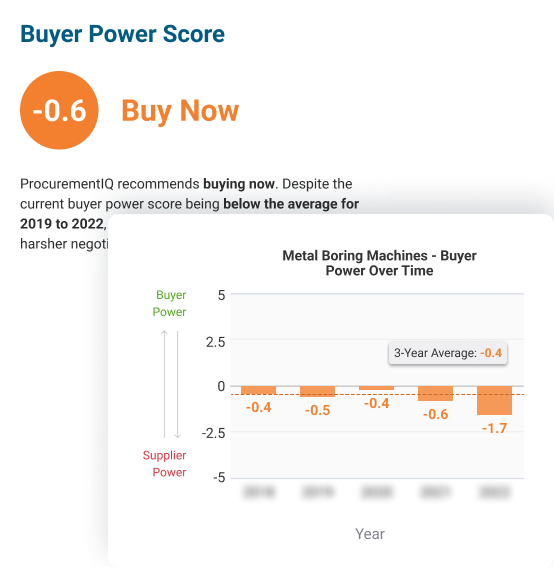
In 2026, buyer power amounts to -2.2 in the United States. Buyer power is most positively impacted by Product Specialization. It is most negatively impacted by Market Share Concentration. Subscribers can access details on eight other factors that impact buyer power. Learn more
United States

Buyer power forecasts: your glimpse into the future
Develop strategies for the upcoming year and identify unforeseen opportunities for buying now
- Actionable "Buy Now" and "Buy Later" insights
- Near-real-time updates to current and forecast Buyer Power Scores
- Methodology and weightings for Buyer Power Score Components
Supply Chain Risk
The average level of supply chain risk is assessed as Medium, which has a negative impact on buyer power. The level of supply chain risk is affected by industry volatility, barriers to entry, competition, import penetration, regulation and industry financial risk. Buyers in this market can mitigate procurement and supply chain management risks by monitoring risk levels for individual first and second tier suppliers:
1st
Tier Suppliers
- Chemical Wholesalers
- Truck Manufacturers
- Engineering Firms
2nd
Tier Suppliers
- Inorganic Chemical Manufacturers
- Organic Chemical Manufacturers
- Automobile Engine & Parts Manufacturers
- Tire Manufacturers
- Industrial Machinery & Equipment Wholesalers
Biggest Wastewater Treatment & Disposal Suppliers in the US by Revenue
The largest Wastewater Treatment & Disposal vendors by revenue in the US are Nuverra Environmental Solutions Inc., Jacobs Engineering Group Inc. and Dupont De Nemours, Inc. Subscribers can sort and filter by market share concentration, profit level and other factors. Learn more
| Supplier | Operational Size | Headquarters | Number of Employees | Market Share (%) | Market Share Performance (3yr trend) | Total Revenue ($ million) | Profit Level (%) | Risk Level |
|---|---|---|---|---|---|---|---|---|
| Siemens Ag | Global | Munich , DE | >10,001 | 5-10 | ||||
| Aecom | Global | DALLAS, TX | >10,000 | 5-10 | ||||
| Jacobs Engineering Group Inc. | Global | DALLAS | 1,001-10,000 | 5-10 | ||||
| Xylem Inc. | Global | WASHINGTON, NY | >10,000 | 5-10 | ||||
| Clean Harbors Inc. | International | NORWELL, MA | >10,000 | 5-10 | ||||
| Veolia Environnement | Global | Aubervilliers, FR | >10,001 | < 5 | ||||
| Dupont De Nemours, Inc. | Global | WILMINGTON | >10,000 | < 5 | ||||
| American Water Works Company, Inc. | International | CAMDEN, NJ | 1,001-10,000 | < 5 | ||||
| Brown & Caldwell Inc. | International | Walnut Creek, CA | 1,001-10,000 | < 5 | ||||
Looking for a list of suppliers by country?
Subscribers can access vendor information on Canadian and European suppliers, too. We also offer custom research services to help with vendor sourcing anywhere in the world.
Profit Analysis
The average profit margin across vendors in the Wastewater Treatment & Disposal market is 9.4% and steady. Profit levels shift depending on suppliers' spend on wages, purchases and overhead. The highest cost component for vendors is Overhead. The cost trend for this component is rising, when considering movement between 2025 and 2026. To understand cost forecasts for 2027 and uncover the implications on profit, start your subscription. Learn more
Vendor & Supply Chain Analysis
Vendor risk is moderate throughout the market, indicating that buyers should assess a vendor’s financial stability before signing a contract to ensure service continuity.
Supply chain risk in this market is moderate, indicating that buyers may face some service disruptions as a result of complications with vendors' upstream suppliers.
Market share concentration is low in the wastewater treatment and disposal market because the average supplier’s area of operations has been limited to the region directly surrounding their facilities. As a result, prices are primarily driven by trends in demand and not influenced by any major players in the market.
The pace of regulatory change in the wastewater treatment and disposal market has been moderate during the past three years. As result, buyers may face additional costs related to regulatory changes.
The United States is a net importer of water treatment chemicals like iodine, chlorine, bromine, and fluorine, meaning it imports more than it exports. While the service-based nature of wastewater treatment and disposal reduces the risk of importing water treatment chemicals, buyers intending to choose supplier that operates in multiple countries should ensure these vendors have a stable supply chain and multiple sources of water treatment chemicals.
Supplier Information
Aecom
Aecom is a public company operating globally in the construction, professional, scientific and technical services, administration, business support and waste management services and healthcare and social assistance sectors. The company's offerings include general contractor services, industrial building &... Subscribe to learn more
Clean Harbors Inc.
Clean Harbors Inc. is a public company operating internationally in the manufacturing, real estate and rental and leasing, professional, scientific and technical services and administration, business support and waste management services sectors. The company's offerings include lubricating oils, dumpster Subscribe to learn more
Jacobs Engineering Group Inc.
Jacobs Solutions Inc. is a technical, professional, and construction services company. It offers two lines of business: the Critical Mission Solutions segment, which focuses on digital transformation and modernization, national security and defense, space exploration, digital asset management, the clean energy... Subscribe to learn more
Siemens Ag
Siemens Ag is a public company operating globally in the manufacturing, information, real estate & rental & leasing, professional, scientific & technical services, administration, business support and waste management services and other services (except public administration) sectors. The company's offerings... Subscribe to learn more
Xylem Inc.
Xylem Inc. is a public company operating globally in the manufacturing and administration, business support and waste management services sectors. The company's offerings include heat exchangers, gas pressure regulators, smart meters, water quality testing equipment and wastewater treatment & disposal. Founded... Subscribe to learn more
American Water Works Company, Inc.
American Water Works Company, Inc. is a public company operating internationally in the administration, business support and waste management services sector. The company's offerings include wastewater treatment & disposal and water & sewer utilities. Founded in 1886, the company is currently headquartered... Subscribe to learn more
Brown & Caldwell Inc.
Brown & Caldwell Inc. is a private company operating internationally in the administration, business support and waste management services sector. The company's offerings include wastewater treatment & disposal. Founded in 1947, the company is currently headquartered in Walnut Creek, California, United States... Subscribe to learn more
Dupont De Nemours, Inc.
DuPont de Nemours, Inc. is a global company that develops technology-based materials, ingredients, and solutions for electronics, transportation, building and construction, health and wellness, food, and worker safety markets. It organizes its business into two reportable segments: the Electronics & Industrial... Subscribe to learn more
Nuverra Environmental Solutions Inc.
Nuverra Environmental Solutions, Inc. is a provider of water logistics and oilfield services to the oil and natural gas industry. It focuses on the development and ongoing production of oil and natural gas from shale formations in the United States, including the Bakken Shale area that covers western North... Subscribe to learn more
Accelerate the vendor selection process
Get a clear picture of the competition in a market and discover which vendors are best-suited for your sourcing needs. Our supplier profiles include hard-to-find financial ranges for private companies, cover public company data and feature an interactive competitor matrix.
Procurement Management KPIs for the Wastewater Treatment & Disposal Market
Managing vendor performance throughout the contract period is easier when tracking specific key performance indicators (KPIs). For example, buyers should monitor Employee Training Rate and Employee Turnover Rate. Buyers may experience better performance throughout their contracts if they establish service level agreements (SLAs) based on Compliance & Reporting and other factors.
| KPI | Level of Importance (1-5) | Measurements | Key Considerations |
|---|---|---|---|
| Employee Training Rate |
|
Time between new regulatory changes and employee training Number of annual trainings held for non-new employees |
The employee training rate represents the share of employees a company is able to successfully train. Vendors should maintain a regular training schedule to ensure that employees are trained on updated treatment procedures and informed of any new regulation changes. |
| Employee Turnover Rate |
|
Average tenure length of employees Average new hires per year |
Vendors that have a high turnover rate indicate that new employees are being frequently hired, thus reducing the overall experience level of their staff. A high turnover rate may indicate that the quality of work at the vendor's facility is not optimized, as new employees require time to gain familiarity with processes, thereby potentially leading to backlogs of waste intake. |
Questions to Ask During Procurement Negotiations
How can I gain leverage during negotiations?
Experience and Expertise
How long has your company been a supplier of wastewater treatment and disposal services?
Who are your top customers?
Regulation
In the event that your company does not properly follow regulations, how does this affect me as the buyer?
What measures do you take to ensure that your company is meeting all local regulations?
Competition
How does your company stand out from other similarly sized competitors?
How many of your customers are repeat customers?
The ultimate prep for procurement negotations
View all 25 negotiation questions for this category when you subscribe.
Wastewater Treatment & Disposal RFP Guidelines
What should my RFP include?
Organizational Overview
Buyers should provide an overview of their organization, including the number of establishments and date of incorporation.
Buyers should provide information regarding the amount of water used in their processes.
Statement Of Need
All buyers should list any equipment and materials that will be furnished to suppliers, as well as equipment and materials that suppliers are responsible for providing.
All buyers should detail the scope of work to be performed on their properties.
Project Budget
Buyers should specify their total budget for the project.
Buyers should suggest the best method of billing.
The RFP process made easy
Find out how you can access RFP templates for 800+ procurement categories to start writing better, more consistent RFPs.
We display average pricing information, trends and market data.
Our Reports include:
- Opportunity assessment
- Market dynamics
- Recent developments
- Positive and warning trends
- Buyer power levers
- Price environment and market pricing
- Geographic wage rates
- Global market updates
- Total cost of ownership
- Cost structure benchmarks and analysis
- Supply chain and vendors
- Global supplier breakdown
- Market share concentration
- Regulation and business requirements
- Vendor management and KPIs
- Sourcing strategy guidance