Procurement Market Intelligence Report
Workers' Compensation Insurance
Sourcing Guide & Market Intelligence
Smarter cost management starts with comprehensive market intelligence
 United States
 Global
Quick Navigation
Workers' Compensation Insurance Global Overview
Definition
Summary
Workers’ compensation insurance provides the injured employee with wage replacement and medical benefits. In return, the employee relinquishes the right to sue their employer for negligence. Buyers can procure workers’ compensation insurance from insurance carriers or state insurance funds.
This Report Includes:
- Wage Replacement
- Medical Benefits
Not in this Report:
- Disability Insurance
Global Workers' Compensation Insurance Market - Suppliers by Region
| Country/Region | Number of Suppliers |
|---|---|
| #1 China | 425 |
| #2 United States | 300 |
| #3 Europe | 270 |
Explore supplier concentration across the globe
We've uncovered the 11 top regions for global procurement, based on feedback from our most strategic clients. Access vendor counts for each unique region when you subscribe.
2
Geography Drilldown - US
Average Cost of Workers' Compensation Insurance
United States
2026 Market Pricing$0.12 to $XX.XX
per $100 of payrollAverage Price
Prices in the Workers' Compensation Insurance market range from $0.12 to $XX.XX, depending on Occupation, Level of Coverage and Company Safety History. For example, lower prices are associated with Finance and accounting workers ($0.17 to $1.85 per $100 of payroll) and IT workers ($0.17 to $2.75 per $100 of payroll), whereas higher prices are associated with Retail workers ($0.60 to $10.00 per $100 of payroll), Manufacturing workers ($1.00 to $8.00 per $100 of payroll), Maintenance, repair, and installation workers ($1.25 to $20.35 per $100 of payroll) and Construction workers ($1.30 to $20.35 per $100 of payroll).
Need the scoop on international price trends?
Between our Europe and Canada collections, we provide price data for 350 markets so you can instantly compare prices across borders. Or, use our custom research services for intel on prices in any region across the globe.
Workers' Compensation Insurance Category Price Trends
Pricing trends are indicated by the compound annual growth rate (CAGR) during a set period of time. For the Workers' Compensation Insurance market, prices in the US have grown 0.8% from 2022 to 2025. Subscribers can access price trend forecasts, price driver projections and forward-looking cost structure data. Learn more
United States (2022-2025)


Wondering where prices are heading?
Price trend forecasts are available to subscribers, along with price driver projections and forward-looking cost structure data.
Cost Analysis - Total Cost of Ownership for Workers' Compensation Insurance
Total cost of ownership is Low in the Workers' Compensation Insurance market. The average cost of ownership differs depending on the contract but generally includes costs negotiated before the contract begins, costs billed during the contract period and unforeseen costs. For example, unforeseen costs in the form of Wage Inflation may raise the total cost of ownership unexpectedly.
Negotiated Before
Pre-evaluation
Billed During
Training
Unforeseen
Wage Inflation
Buyer Power in Procurement Negotiations
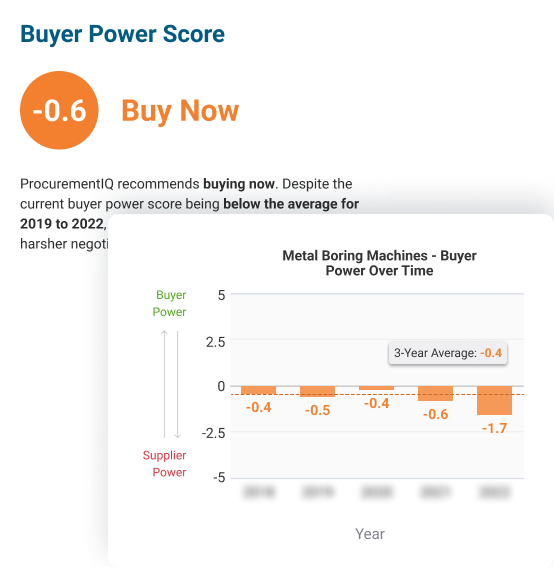
In 2026, buyer power amounts to 0.1 in the United States. Buyer power is most positively impacted by Availability of Substitutes. It is most negatively impacted by Product Specialization. Subscribers can access details on eight other factors that impact buyer power. Learn more
United States
Buyer power forecasts: your glimpse into the future
Develop strategies for the upcoming year and identify unforeseen opportunities for buying now
- Actionable "Buy Now" and "Buy Later" insights
- Near-real-time updates to current and forecast Buyer Power Scores
- Methodology and weightings for Buyer Power Score Components
Supply Chain Risk
The average level of supply chain risk is assessed as Medium, which has a negative impact on buyer power. The level of supply chain risk is affected by industry volatility, barriers to entry, competition, import penetration, regulation and industry financial risk. Buyers in this market can mitigate procurement and supply chain management risks by monitoring risk levels for individual first and second tier suppliers:
1st
Tier Suppliers
- Reinsurance Carriers
- Computer & Packaged Software Wholsalers
- Commercial Leasing Firms
- Portfolio Management Firms
2nd
Tier Suppliers
- Insurance Brokers and Agencies
- Computer Manufacturers
- Real Estate Sales & Brokerage Firms
- Securities Brokerage Firms
Biggest Workers' Compensation Insurance Suppliers in the US by Revenue
The largest Workers' Compensation Insurance vendors by revenue in the US are W. R. Berkley Corp, The Hartford Financial Services Group, Inc. and American International Group, Inc. Subscribers can sort and filter by market share concentration, profit level and other factors. Learn more
| Supplier | Operational Size | Headquarters | Number of Employees | Market Share (%) | Market Share Performance (3yr trend) | Total Revenue ($ million) | Profit Level (%) | Risk Level |
|---|---|---|---|---|---|---|---|---|
| State Compensation Insurance Fund | Regional | Pleasanton, CA | 1,001-10,000 | 10-15 | ||||
| Berkshire Hathaway Inc. | Global | Omaha, NE | >10,000 | 5-10 | ||||
| Zurich Insurance Group Ltd. | Global | Zurich, CH | >10,001 | 5-10 | ||||
| Chubb Ltd | Global | ZURICH | >10,000 | 5-10 | ||||
| The Travelers Companies, Inc. | Global | SAINT PAUL, MN | >10,000 | 5-10 | ||||
| The Hartford Financial Services Group, Inc. | National | HARTFORD | >10,000 | 5-10 | ||||
| Amtrust Financial Services, Inc. | International | New York City, NY | 1,001-10,000 | 5-10 | ||||
| Liberty Mutual Insurance Group Inc. | Global | Boston, MA | >10,000 | 5-10 | ||||
| American International Group, Inc. | Global | NEW YORK, NY | >10,000 | < 5 | ||||
Looking for a list of suppliers by country?
Subscribers can access vendor information on Canadian and European suppliers, too. We also offer custom research services to help with vendor sourcing anywhere in the world.
Profit Analysis
The average profit margin across vendors in the Workers' Compensation Insurance market is 7.9% and steady. Profit levels shift depending on suppliers' spend on wages, purchases and overhead. The highest cost component for vendors is Overhead. The cost trend for this component is stagnating, when considering movement between 2025 and 2026. To understand cost forecasts for 2027 and uncover the implications on profit, start your subscription. Learn more
Vendor & Supply Chain Analysis
Low market share concentration benefits buyers by increasing price-based competition among suppliers because no single vendor in the market has control of pricing. Buyers can leverage the availability of multiple providers in the market to secure lower premiums.
Supply chain risk is moderate, mainly as a result of pandemic-related business disruptions from upstream suppliers, which can threaten vendors' financial health and thus buyers’ ability to source market services.
Average vendor risk in the market often depends on the type of vendor. Overall, though, vendor risk is moderate, which hurts buyers as providers have less room to negotiate premiums due to thin profit margins.
The United States is a net importer of computers, meaning it imports more computers than it exports. While lower manufacturing costs abroad drive down prices for imported computers, relying on imports can lead to potential shortages or price increases if there are supply chain disruptions due to geopolitical tensions, trade disputes, or global crises
Supplier Information
State Compensation Insurance Fund
State Compensation Insurance Fund is a private company operating regionally in the finance & insurance sector. The company's offerings include workers' compensation insurance. Founded in 1914, the company is currently headquartered in Pleasanton, California, United States of America with an estimated 5500... Subscribe to learn more
Amtrust Financial Services, Inc.
Amtrust Financial Services, Inc. is a private company operating internationally in the finance & insurance sector. The company's offerings include product warranty insurance, commercial auto & truck insurance and workers' compensation insurance. Founded in 1998, the company is currently headquartered in New... Subscribe to learn more
Berkshire Hathaway Inc.
Berkshire Hathaway Inc. is a public company operating globally in the utilities, manufacturing and finance and insurance sectors. The company's offerings include truck trailers, natural gas, commercial auto & truck insurance, professional indemnity insurance, group travel insurance. Founded in 1929, the company... Subscribe to learn more
Chubb Ltd
Chubb Ltd is a public company operating globally in the finance and insurance sector. The company's offerings include commercial auto & truck insurance, cargo insurance, marine insurance, business interruption insurance, supply chain insurance. Founded in 1882, the company is currently headquartered in ZURICH,... Subscribe to learn more
Liberty Mutual Insurance Group Inc.
Liberty Mutual Insurance Group Inc. is a private company operating globally in the finance & insurance sector. The company's offerings include building & contents insurance, cargo insurance, business interruption insurance, professional indemnity insurance, workers' compensation insurance. Founded in 1912,... Subscribe to learn more
The Hartford Financial Services Group, Inc.
Hartford Insurance Group, Inc. is a global insurance holding company that provides property and casualty (P&C) insurance, group benefits insurance and services, and mutual funds and exchange-traded funds (ETFs) to individuals and businesses in the United States, the United Kingdom, and other international... Subscribe to learn more
The Travelers Companies, Inc.
The Travelers Companies, Inc. is a public company operating globally in the finance and insurance sector. The company's offerings include commercial auto & truck insurance, cargo insurance, marine insurance, business interruption insurance, supply chain insurance. Founded in 1853, the company is currently... Subscribe to learn more
Zurich Insurance Group Ltd.
Zurich Insurance Group Ltd. is a public company operating globally in the finance & insurance sector. The company's offerings include product warranty insurance, building & contents insurance, commercial auto & truck insurance, cargo insurance, marine insurance. Founded in 2000, the company is currently headquartered... Subscribe to learn more
American International Group, Inc.
American International Group, Inc. is a public company operating globally in the finance and insurance sector. The company's offerings include product warranty insurance, building & contents insurance, commercial auto & truck insurance, cargo insurance, marine insurance. Founded in 1919, the company is currently... Subscribe to learn more
Accelerate the vendor selection process
Get a clear picture of the competition in a market and discover which vendors are best-suited for your sourcing needs. Our supplier profiles include hard-to-find financial ranges for private companies, cover public company data and feature an interactive competitor matrix.
Procurement Management KPIs for the Workers' Compensation Insurance Market
Managing vendor performance throughout the contract period is easier when tracking specific key performance indicators (KPIs). For example, buyers should monitor Average Response Time and Employee Satisfaction Rating. Buyers may experience better performance throughout their contracts if they establish service level agreements (SLAs) based on Claims Submission and other factors.
| KPI | Level of Importance (1-5) | Measurements | Key Considerations |
|---|---|---|---|
| Average Response Time |
|
Total number of inquiries submitted to supplier Total time to response to inquiries from supplier |
A low average response time indicates that the vendor's customer support is well equipped to deal with any and all issues related to service. A low average response time allows workers to receive critical information to their claims more quickly. |
| Employee Satisfaction Rating |
|
Total number of employees submitting feedback Total number of employees submitting positive feedback |
It is critical that employees are satisfied with the handling of their workers' compensation claims, as this indicates that the vendor has not been operating in bad faith. Bad faith refers to the vendor failing to properly handle claims filed from workers, which can lead to workers leaving the company due to the insurer's actions, as well as additional legal action. |

Questions to Ask During Procurement Negotiations
How can I gain leverage during negotiations?
Customer Support
Will an account manager be assigned to our company?
How many claims adjusters and support personnel do you employ?
Experience and Expertise
How long has your business provided workers' compensation insurance in our state?
How long has your business provided workers' compensation insurance to employers in our sector?
Vendor Financial Risk
What is your company's internal audit process?
How frequently are internal audits performed?
The ultimate prep for procurement negotations
View all 23 negotiation questions for this category when you subscribe.
Workers' Compensation Insurance RFP Guidelines
What should my RFP include?
Organizational Overview
Buyers should include a description of their organizations, disclosing information such as size and the states they operate in.
Buyers should give a brief overview of their business operations, including the sector that they operate in.
Statement Of Need
Buyers need to give a detailed overview of the employees that need to be insured, including the number of employees, where they are located and what their positions are.
Buyers should describe any significant risks that employees face on routine and daily basis.
Project Budget
Buyers should indicate whether they have any expectations for premium amounts, such as the buyer's ideal yearly or monthly price range.
Buyers should disclose their expectations for payments, including schedules and methods.
The RFP process made easy
Find out how you can access RFP templates for 800+ procurement categories to start writing better, more consistent RFPs.
We display average pricing information, trends and market data.
Our Reports include:
- Opportunity assessment
- Market dynamics
- Recent developments
- Positive and warning trends
- Buyer power levers
- Price environment and market pricing
- Geographic wage rates
- Global market updates
- Total cost of ownership
- Cost structure benchmarks and analysis
- Supply chain and vendors
- Global supplier breakdown
- Market share concentration
- Regulation and business requirements
- Vendor management and KPIs
- Sourcing strategy guidance