Procurement Market Intelligence Report
Network Switches
Sourcing Guide & Market Intelligence
Smarter cost management starts with comprehensive market intelligence
 United States
 Europe
 Global
Quick Navigation
Network Switches Global Overview
Definition
Summary
Network switches are computer networking equipment used to connect devices together within an internal network via packet switching to manage data packet traffic. Most devices use Ethernet connections to communicate data from one device to another; therefore, only electrical devices that have Ethernet slots, such as computers, printers, servers and routers, are capable of communicating through switches.
This Report Includes:
- Electrical Devices With Ethernet Slots
- Network Equipment
Not in this Report:
- Routers
- Modems
- Hubs
- Bridges
Global Network Switches Procurement Trends
Discover the top international trends affecting procurement in the global Network Switches market.
Warning Trends
Tariffs to escalate prices for electronics and computing equipment
- The Trump administration’s reciprocating tariffs, which will increase the tariff on all products imported from nearly all US trade partners, are set to take effect on August 7 and are likely to drive price increases across a wide range of sectors.
- The United States is highly reliant on imported electronics, communication equipment, and computing devices, having imported more than $472 billion worth of electronics in 2024, or about half of the total domestic supply. Starting August 7, imports from key computer and electronics producers such as China (54,0%), Japan (15.0%), South Korea (15.0%), Thailand (19.0%), Vietnam (20.0%), and Taiwan (20.0%) will be subject to new tariff rates. Trade deals for many countries are still being negotiated, and these rates are subject to change.
- For this reason, the US electronics industry is highly exposed to price increases and supply chain disruptions when the tariffs take effect. For example, the cost of iPhones, which are predominantly manufactured in China, could rise by as much as 43.0% in response to tariffs, according to projections by Rosenblatt Securities.
- Overall, the Yale Budget Lab anticipates tariffs will increase the average cost of computers and electronics by 18.7% in the short term.
- The tariffs exempt semiconductors, limiting the cost increases for domestic electronics manufacturers, but the lack of domestic electronics assembly capacity means that this exemption will have a limited effect.
China bans exports of rare minerals to the United States
- On December 4, China announced a ban on all exports of gallium, germanium, graphite, and antimony to the United States, escalating existing trade restrictions on these materials.
- China is the leading global producer of each of these metals, producing 98.3%, 67.9%, 62.0%, and 48.2%, respectively, of the world’s gallium, germanium, graphite, and antimony supplies, respectively.
- The United States can still access these resources from other trade partners who make up most of the remaining global supply of the impacted commodities, such as Canada, Japan, and Brazil.
- However, the loss of supply from China, the leading producer of these materials, will increase prices and supply chain risk in a range of markets that rely on the affected metals, such as the semiconductor, batteries, and solar cell markets.
- China’s export ban on these materials is in retaliation to expanded US export bans on advanced semiconductor manufacturing equipment and technologies to China announced two days prior. This ongoing trade dispute adds further uncertainty to technology markets, which are often reliant on components and materials exported from China.
The FBI has warned that Chinese government hackers could disrupt critical infrastructure in the United States in the event of a conflict with China.
- The FBI announced on January 31 that it had thwarted an attempt by the Chinese government hacking group “Volt Typhoon” to plant malware onto electric power, water treatment and transportation systems in the United States using compromised end-of-life small office/home office (SOHO) routers from Cisco and Netgear. End-of-life devices have been discontinued by manufacturers and no longer receive software patches to eliminate vulnerabilities, which makes these devices attractive targets for hackers.
- US officials assess that China might disrupt critical US infrastructure to prevent the United States from responding to a Chinese attack on Taiwan. Volt Typhoon has been particularly active in Hawaii and Guam, which house some of the largest US military and naval installations in the Pacific.
- The FBI announced on September 18 that it had disrupted a botnet from another Chinese government hacking group known as “Flax Typhoon”. Flax Typhoon had infected 260,000 networking devices around the world, including SOHO routers, internet protocol (IP) cameras, digital video recorders (DVRs), and network-attached storage (NAS) devices.n
- The Cybersecurity and Infrastructure Security Agency (CISA) recommends that organizations use its Known Exploited Vulnerabilities (KEV) Catalog to identify any vulnerabilities in their systems. Furthermore, organizations can subscribe to receive KEV Catalog updates from the agency and may contact the agency for advice.
Global Network Switches Market - Suppliers by Region
| Country/Region | Number of Suppliers |
|---|---|
| #1 Oceania & Southeast Asia | 32,065 |
| #2 Europe | 21,080 |
| #3 United States | 8,500 |
Explore supplier concentration across the globe
We've uncovered the 11 top regions for global procurement, based on feedback from our most strategic clients. Access vendor counts for each unique region when you subscribe.
2
Geography Drilldown - US & Europe
Average Cost of Network Switches
United States
2026 Market Pricing$25.00 to $XX,XXX.XX
per network switch
Average Price
Prices in the Network Switches market range from $25.00 to $XX,XXX.XX, depending on Brand Name, Managed or Unmanaged, Number of Ports, Speed and Ancillary Features. For example, lower prices are associated with Lessor known or reputable brands ($120 to $30,000 per network switch), whereas higher prices are associated with Trusted brand names ($1,500 to $72,000 per network switch).
Need the scoop on international price trends?
Between our Europe and Canada collections, we provide price data for 350 markets so you can instantly compare prices across borders. Or, use our custom research services for intel on prices in any region across the globe.
Network Switches Category Price Trends
Pricing trends are indicated by the compound annual growth rate (CAGR) during a set period of time. For the Network Switches market, prices in the US have grown 1.9% from 2022 to 2025. Meanwhile, the recent three-year CAGR for Europe is +1.1%.
United States (2022-2025)

Europe (2022-2025)
Compound Annual Growth Rate
Wondering where prices are heading?
Price trend forecasts are available to subscribers, along with price driver projections and forward-looking cost structure data.
Cost Analysis - Total Cost of Ownership for Network Switches
Total cost of ownership is Medium in the Network Switches market. The average cost of ownership differs depending on the contract but generally includes costs negotiated before the contract begins, costs billed during the contract period and unforeseen costs. For example, unforeseen costs in the form of Downtime may raise the total cost of ownership unexpectedly.
Negotiated Before
Installation
Billed During
Upgrades
Unforeseen
Downtime
Buyer Power in Procurement Negotiations
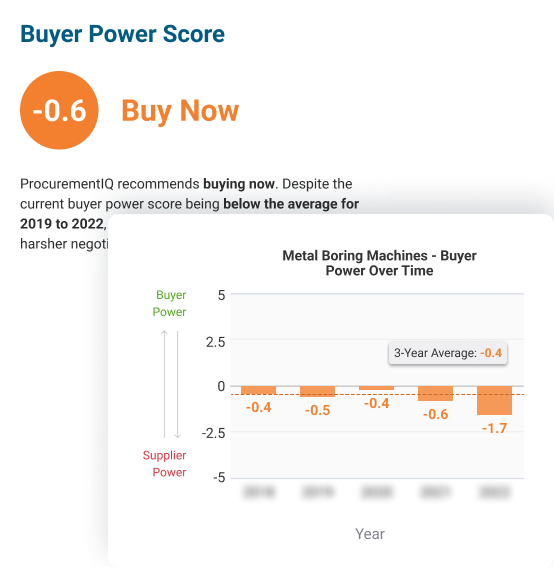
In 2026, buyer power amounts to -2.0 in the United States. Buyer power is most positively impacted by Recent Developments. It is most negatively impacted by Recent Price Volatility. Subscribers can access details on eight other factors that impact buyer power. Learn more
United States

Buyer power forecasts: your glimpse into the future
Develop strategies for the upcoming year and identify unforeseen opportunities for buying now
- Actionable "Buy Now" and "Buy Later" insights
- Near-real-time updates to current and forecast Buyer Power Scores
- Methodology and weightings for Buyer Power Score Components
Supply Chain Risk
The average level of supply chain risk is assessed as High, which has a negative impact on buyer power. The level of supply chain risk is affected by industry volatility, barriers to entry, competition, import penetration, regulation and industry financial risk. Buyers in this market can mitigate procurement and supply chain management risks by monitoring risk levels for individual first and second tier suppliers:
1st
Tier Suppliers
- Semiconductor & Circuit Manufacturers
- Wire & Cable Manufacturers
- Telecommunication Networking Equipment Manufacturers
2nd
Tier Suppliers
- Semiconductor Machinery Manufacturers
- Aluminum Manufacturers
- Copper Rolling, Drawing & Extruding Suppliers
Biggest Network Switches Suppliers in the US by Revenue
The largest Network Switches vendors by revenue in the US are CDW Corporation, Nokia Oyj and Barracuda Networks Inc. Subscribers can sort and filter by market share concentration, profit level and other factors. Learn more
| Supplier | Operational Size | Headquarters | Number of Employees | Market Share (%) | Market Share Performance (3yr trend) | Total Revenue ($ million) | Profit Level (%) | Risk Level |
|---|---|---|---|---|---|---|---|---|
| Hewlett Packard Enterprise Co | Global | SPRING | >10,000 | 10-15 | ||||
| Cisco Systems, Inc. | Global | SAN JOSE, CA | >10,000 | 25+ | ||||
| Arista Networks, Inc. | Global | Santa Clara, CA | 1,001-10,000 | 5-10 | ||||
| Hon Hai Precision Industry Co. Ltd | Global | Taipei, TW | >10,001 | < 5 | ||||
| ASUSTek Computer Inc. | Global | Taipei, TW | >10,001 | < 5 | ||||
| Dell Technologies Inc. | Global | ROUND ROCK | >10,000 | < 5 | ||||
| Nokia Oyj | Global | Espoo, FI | >10,001 | < 5 | ||||
| CDW Corporation | Global | VERNON HILLS, IL | >10,000 | < 5 | ||||
| Juniper Networks B.V. | Global | SUNNYVALE | >10,000 | < 5 | ||||
Looking for a list of suppliers by country?
Subscribers can access vendor information on Canadian and European suppliers, too. We also offer custom research services to help with vendor sourcing anywhere in the world.
Profit Analysis
The average profit margin across vendors in the Network Switches market is 3.0% and steady. Profit levels shift depending on suppliers' spend on wages, purchases and overhead. The highest cost component for vendors is Purchases. The cost trend for this component is stagnating, when considering movement between 2025 and 2026. To understand cost forecasts for 2027 and uncover the implications on profit, start your subscription. Learn more
Vendor & Supply Chain Analysis
Many large manufacturers in the market have healthy financials with strong profit margins, thereby lowering average vendor risk in the market.
Market share concentration in the market for network switches is high, with four suppliers making up nearly 50.0% of total revenue. This restricts price-based competition in the market.
Supply chain risk in the market is high as critical inputs such as semiconductors, aluminum and other telecommunication equipment are currently experiencing high levels of volatility.
The United States is a net importer of network switches, meaning it imports more than it exports. US buyers seeking to import network switches should expect higher buying lead times and should assess quality standards.
Supplier Information
Hewlett Packard Enterprise Co
Hewlett Packard Enterprise Co. is a global technology company developing intelligent solutions for business and public sector enterprises. It organizes its business into six reportable business segments: the Compute segment, which consists of general purpose servers for multi-workload computing and workload-optimized... Subscribe to learn more
Cisco Systems, Inc.
Cisco Systems, Inc. is a public company operating globally in the manufacturing, information and professional, scientific and technical services sectors. The company's offerings include rail signaling systems, office phones, print servers, computer servers, database management systems. Founded in 1984, the... Subscribe to learn more
Arista Networks, Inc.
Arista Networks, Inc. is a public company operating globally in the manufacturing sector. The company's offerings include network switches. Founded in 2004, the company is currently headquartered in Santa Clara, California, United States of America with an estimated 3612 employees. Subscribe to learn more
ASUSTek Computer Inc.
ASUSTek Computer Inc. is a public company operating globally in the manufacturing sector. The company's offerings include graphics & video accelerator cards, computer motherboards, network attached storage devices, laptop computers, desktop computers. Founded in 1989, the company is currently headquartered... Subscribe to learn more
Barracuda Networks Inc.
Barracuda Networks Inc. is a private company operating globally in the manufacturing and information sectors. The company's offerings include network firewall security equipment, network security equipment, network switches, spend analytics software and data archiving & storage services. Founded in 2013, Subscribe to learn more
CDW Corporation
CDW Corporation is a public company operating globally in the manufacturing, information and professional, scientific and technical services sectors. The company's offerings include fiber optic cable, uninterruptible power supply systems, phone headsets, print servers, tablet computers. Founded in 1984, the... Subscribe to learn more
Dell Technologies Inc.
Dell Technologies Inc. is a global provider of comprehensive information technology solutions, products, and services. It organizes its business into two segments: the Infrastructure Solutions Group, which offers multi-cloud and big data solutions to simplify, streamline, and automate cloud operations, and... Subscribe to learn more
Hon Hai Precision Industry Co. Ltd
Hon Hai Precision Industry Co. Ltd is a public company operating globally in the manufacturing and real estate & rental & leasing sectors. The company's offerings include power adapters & inverters, usb flash drives, network switches, network routers, server racks & cabinets. Founded in 1974, the company Subscribe to learn more
Huawei Technologies Co. Ltd.
Huawei Technologies Co. Ltd. is a private company operating globally in the manufacturing sector. The company's offerings include tablet computers, network switches, pbx phone systems, phone & video conference equipment and smoke detectors. Founded in 2001, the company is currently headquartered in Shenzhen,... Subscribe to learn more
Accelerate the vendor selection process
Get a clear picture of the competition in a market and discover which vendors are best-suited for your sourcing needs. Our supplier profiles include hard-to-find financial ranges for private companies, cover public company data and feature an interactive competitor matrix.
Procurement Management KPIs for the Network Switches Market
Managing vendor performance throughout the contract period is easier when tracking specific key performance indicators (KPIs). For example, buyers should monitor Defect Density and Mean Time to Failure (MTTF). Buyers may experience better performance throughout their contracts if they establish service level agreements (SLAs) based on Warranties and other factors.
| KPI | Level of Importance (1-5) | Measurements | Key Considerations |
|---|---|---|---|
| Defect Density |
|
Number of items purchased from supplier Number of defective items provided by supplier |
The defect density measures how many defects there are in an order. Defect density can be used to determine whether manufacturing, assembly or the quality assurance processes requires improvement. |
| Mean Time to Failure (MTTF) |
|
Average time between malfunctions Average product life span |
A high equipment failure rate may indicate that the vendor is unable to provide a quality product, or has misled the buyer about the quality of the product. A high equipment failure rate can reduce efficiency within the business due to repair times and costs. Buyers should be sure to have a satisfactory warranty for products that have high failure rates. |

Questions to Ask During Procurement Negotiations
How can I gain leverage during negotiations?
Quality Control
How many reports of network switch malfunctions has your company received in the past three years? How do you handle the discovery of faulty network switches?
How many of your products have been recalled in the past three years? What were the primary reasons for these recalls?
Inventory Control
How large is your current inventory of network switches? How low do you allow your inventory to get before it is replenished?
How do you forecast future demand for your products, and how do you adjust your inventory to prepare for anticipated demand fluctuations?
Accessibility
What parts of your product are outsourced? To whom and to where are they outsourced?
For parts of production that are outsourced overseas, are there any geopolitical factors that have disrupted production in the past or might disrupt production in the future?
The ultimate prep for procurement negotations
View all 28 negotiation questions for this category when you subscribe.
Network Switches RFP Guidelines
What should my RFP include?
Organizational Overview
Buyers should describe the size of their organization, their location(s) and some information about their operations.
Buyers should include information about their organization type, such as if they are a school, office building or government building.
Statement Of Need
Buyers should include as much information as possible about the scope of the required products. Relevant information includes an estimate of the number of units required, a list of suitable manufacturers or brands and if installation is needed.
Buyers should provide as much information as possible about the capabilities required from the network switch. This includes information such as speed, number of ports, unmanaged or managed and cable types.
Project Budget
Buyers should include as much information about the total scope of the project as possible. If buyers require an exact number of network switches, this should be specified here.
Buyers should include information about the payment schedule (i.e. if it is incremental or done at the completion of the project).
The RFP process made easy
Find out how you can access RFP templates for 800+ procurement categories to start writing better, more consistent RFPs.
We display average pricing information, trends and market data.
Our Reports include:
- Opportunity assessment
- Market dynamics
- Recent developments
- Positive and warning trends
- Buyer power levers
- Price environment and market pricing
- Geographic wage rates
- Global market updates
- Total cost of ownership
- Cost structure benchmarks and analysis
- Supply chain and vendors
- Global supplier breakdown
- Market share concentration
- Regulation and business requirements
- Vendor management and KPIs
- Sourcing strategy guidance