Procurement Market Intelligence Report
Chemical Management Services
Sourcing Guide & Market Intelligence
Smarter cost management starts with comprehensive market intelligence
 United States
 Global
Quick Navigation
Chemical Management Services Global Overview
Definition
Summary
Chemical management services refer to specialized services that help businesses manage and optimize their chemical usage throughout various processes and operations. These services involve the procurement, storage, handling, usage, and disposal of chemicals in a safe, compliant, and efficient manner. Suppliers in the chemical management services (CMS) market oversee various aspects of buyers’ chemical management, including procurement, inventory, training, use, monitoring, reporting, treatment, and disposal. CMS suppliers typically provide staff to oversee the buyer's on-site operations and outsource the key services required to manage the chemicals. Major buyers of CMS include automotive, aerospace, electronics, and consumer packaged goods manufacturers.
This Report Includes:
- Chemical Management Services
- Chemical Consulting Services
- Chemical Tracking Software
Not in this Report:
- Biological Management Services
- Chemical Management Software
Classification:
- Management Consulting Services
- Merger & Acquisition Consulting Services
- Procurement Consulting Services
- IT Consulting Services
- Energy & Utility Consulting Services
- Risk Management Consulting Services
- Scientific Research & Development Services
- Construction Project Management Services
- Chemical Management Services
Global Chemical Management Services Market - Suppliers by Region
| Country/Region | Number of Suppliers |
|---|---|
| #1 Europe | 3,975 |
| #2 China | 3,660 |
| #3 United States | 2,600 |
Explore supplier concentration across the globe
We've uncovered the 11 top regions for global procurement, based on feedback from our most strategic clients. Access vendor counts for each unique region when you subscribe.
2
Geography Drilldown - US
Average Cost of Chemical Management Services
United States
2026 Market Pricing$30.00 to $XX.XX
of savings achievedAverage Price
Prices in the Chemical Management Services market range from $30.00 to $XX.XX, depending on Scope of the Project, Size of the Buyer, Chemical Types and Experience and Expertise. For example, lower prices are associated with Chemical procurement, tracking and reporting, whereas higher prices are associated with Outsourcing full cradle-to-grave management of chemicals.
Need the scoop on international price trends?
Between our Europe and Canada collections, we provide price data for 350 markets so you can instantly compare prices across borders. Or, use our custom research services for intel on prices in any region across the globe.
Chemical Management Services Category Price Trends
Pricing trends are indicated by the compound annual growth rate (CAGR) during a set period of time. For the Chemical Management Services market, prices in the US have grown 3.2% from 2022 to 2025. Subscribers can access price trend forecasts, price driver projections and forward-looking cost structure data. Learn more
United States (2022-2025)


Wondering where prices are heading?
Price trend forecasts are available to subscribers, along with price driver projections and forward-looking cost structure data.
Cost Analysis - Total Cost of Ownership for Chemical Management Services
Total cost of ownership is High in the Chemical Management Services market. The average cost of ownership differs depending on the contract but generally includes costs negotiated before the contract begins, costs billed during the contract period and unforeseen costs. For example, unforeseen costs in the form of Hidden Fees may raise the total cost of ownership unexpectedly.
Negotiated Before
Financing
Billed During
Additional Fees
Unforeseen
Hidden Fees
Buyer Power in Procurement Negotiations
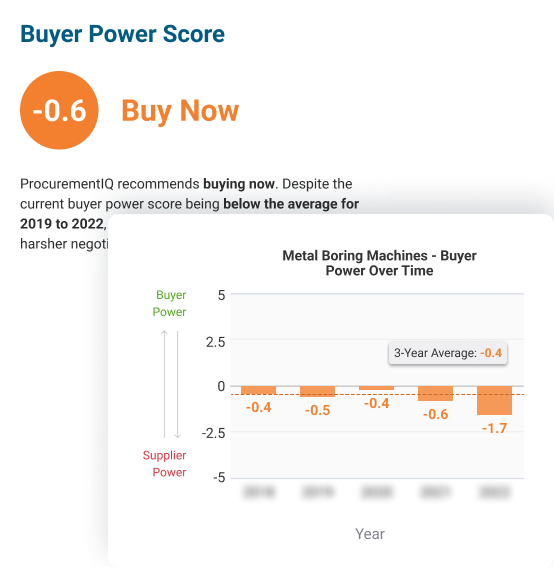
In 2026, buyer power amounts to -1.2 in the United States. Buyer power is most positively impacted by Recent Price Trend. It is most negatively impacted by Recent Price Volatility. Subscribers can access details on eight other factors that impact buyer power. Learn more
United States
Buyer power forecasts: your glimpse into the future
Develop strategies for the upcoming year and identify unforeseen opportunities for buying now
- Actionable "Buy Now" and "Buy Later" insights
- Near-real-time updates to current and forecast Buyer Power Scores
- Methodology and weightings for Buyer Power Score Components
Supply Chain Risk
The average level of supply chain risk is assessed as Medium, which has a negative impact on buyer power. The level of supply chain risk is affected by industry volatility, barriers to entry, competition, import penetration, regulation and industry financial risk. Buyers in this market can mitigate procurement and supply chain management risks by monitoring risk levels for individual first and second tier suppliers:
1st
Tier Suppliers
- Transportation Service Providers
- Computer & Software Wholesalers
- Hazardous Waste Collectors
- Chemical Wholesalers
2nd
Tier Suppliers
- Gasoline & Petroleum Wholesalers
- Software Publishers
- Truck & Bus Manufacturers
- Chemical Manufacturers
Biggest Chemical Management Services Suppliers in the US by Revenue
The largest Chemical Management Services vendors by revenue in the US are Air Products And Chemicals, Inc., Ppg Industries, Inc. and Quaker Chemical Corporation. Subscribers can sort and filter by market share concentration, profit level and other factors. Learn more
| Supplier | Operational Size | Headquarters | Number of Employees | Market Share (%) | Market Share Performance (3yr trend) | Total Revenue ($ million) | Profit Level (%) | Risk Level |
|---|---|---|---|---|---|---|---|---|
| Ppg Industries, Inc. | Global | PITTSBURGH, PA | >10,000 | 10-15 | ||||
| Basf Se | Global | Ludwigshafen, DE | >10,001 | 5-10 | ||||
| Quaker Chemical Corporation | Global | CONSHOHOCKEN | 1,001-10,000 | 5-10 | ||||
| Wesco Aircraft Holdings, Inc. | Global | Fort Worth, TX | 1,001-10,000 | 5-10 | ||||
| Veolia Environnement | Global | Aubervilliers, FR | >10,001 | < 5 | ||||
| Henkel Ag & Co. Kgaa | Global | Düsseldorf, DE | >10,001 | < 5 | ||||
| Air Products And Chemicals, Inc. | Global | ALLENTOWN, PA | >10,000 | < 5 | ||||
| Solvay SA | Global | Brussels, BE | >10,001 | < 5 | ||||
Looking for a list of suppliers by country?
Subscribers can access vendor information on Canadian and European suppliers, too. We also offer custom research services to help with vendor sourcing anywhere in the world.
Profit Analysis
The average profit margin across vendors in the Chemical Management Services market is 7.5% and steady. Profit levels shift depending on suppliers' spend on wages, purchases and overhead. The highest cost component for vendors is Overhead. The cost trend for this component is falling, when considering movement between 2025 and 2026. To understand cost forecasts for 2027 and uncover the implications on profit, start your subscription. Learn more
Vendor & Supply Chain Analysis
Average vendor risk for chemical management services is low. Considering that the market is in early maturity, the market consists of suppliers with considerable amounts of experience within the field to be considered knowledable and acquired, and considering that chemical management services are a grand necessity for all business establishments that handle chemicals, services will always be in dire need.
The CMS market has a low level of concentration, with the top four companies accounting for 25.0% of the domestic market. Market share concentration is expected to increase as more mergers and acquisitions occur during the next three years and number of vendors will likely swell in response to rising demand.
There is a moderate level of supply chain risk in the CMS market, as vendors procure chemicals from chemical wholesalers, which generally carry moderate risk despite their widespread scope and availability. Wholesalers present some risk because chemical manufacturers, which are their suppliers, are fewer in number and more sensitive to shocks in the cost of certain production inputs.
As a net importer in the chemical management services market, the United States must rely on other countries for goods related to this service, such as chemical products. The reliance on imports is accompanied by fluctuating transportation costs and lead times; being a net importer hurts buyer power because the US has limited control over the supply chain and creates high dependence on foreign suppliers.
Supplier Information
Ppg Industries, Inc.
PPG Industries, Inc. is a manufacturer and distributor of paints, coatings, and specialty products. It organizes its business into three reportable business segments: the Global Architectural Coatings segment, which supplies decorative coatings, adhesives, sealants, and finishes, as well as paint strippers,... Subscribe to learn more
Basf Se
Basf Se is a public company operating globally in the manufacturing, manufacturing and professional, scientific & technical services sectors. The company's offerings include pesticides, refining catalysts, plasticizers, preservatives, waterproofing coatings. Founded in 1865, the company is currently headquartered... Subscribe to learn more
Quaker Chemical Corporation
Quaker Chemical Corporation is an industrial process fluids company operating under the trade name Quaker Houghton. It develops, produces, and markets formulated specialty chemical products, primarily metal removal fluids, rolling lubricants, and hydraulic fluids. It also offers chemical management services... Subscribe to learn more
Wesco Aircraft Holdings, Inc.
Wesco Aircraft Holdings, Inc. is a private company operating globally in the professional, scientific & technical services sector. The company's offerings include chemical management services. Founded in 2020, the company is currently headquartered in Fort Worth, Texas, United States of America with an estimated... Subscribe to learn more
Air Products And Chemicals, Inc.
Air Products & Chemicals, Inc. is a global provider of essential industrial gases, related equipment, and services to various industries, including refining, chemicals, metals, electronics, manufacturing, and food and beverage. It supplies atmospheric gases, such as oxygen, nitrogen, and argon; process gases,... Subscribe to learn more
Henkel Ag & Co. Kgaa
Henkel Ag & Co. Kgaa is a public company operating globally in the manufacturing and professional, scientific & technical services sectors. The company's offerings include waterproofing coatings, adhesives and chemical management services. Founded in 1876, the company is currently headquartered in Düsseldorf,... Subscribe to learn more
Solvay SA
Solvay SA is a public company operating globally in the manufacturing and professional, scientific & technical services sectors. The company's offerings include ice & snow surface treatments and chemical management services. Founded in 1863, the company is currently headquartered in Brussels, Belgium with... Subscribe to learn more
Veolia Environnement
Veolia Environnement is a public company operating globally in the manufacturing, professional, scientific & technical services and administration, business support and waste management services sectors. The company's offerings include septic tanks, water treatment chemicals, total waste management & recycling,... Subscribe to learn more
Accelerate the vendor selection process
Get a clear picture of the competition in a market and discover which vendors are best-suited for your sourcing needs. Our supplier profiles include hard-to-find financial ranges for private companies, cover public company data and feature an interactive competitor matrix.
Procurement Management KPIs for the Chemical Management Services Market
Managing vendor performance throughout the contract period is easier when tracking specific key performance indicators (KPIs). For example, buyers should monitor Customer Acquisition Cost and Customer Satisfaction (CSAT). Buyers may experience better performance throughout their contracts if they establish service level agreements (SLAs) based on Quality and other factors.
| KPI | Level of Importance (1-5) | Measurements | Key Considerations |
|---|---|---|---|
| Customer Acquisition Cost |
|
Total marketing costs Total sales cost Number of customers acquired |
Determining how much it costs to establish a customer relationship is essential in negotiation and price planning. Buyers may notice higher service pricing based on how much a customer acquisition may be. Using customer acquisition cost can be used to determine the efficiency of customer acquisition process. |
| Customer Satisfaction (CSAT) |
|
Number of positive customer responses Number of customer responses |
Overall customer satisfaction with a vendor is indicative of how cooperative and sympathetic they are to a client's needs. Positive customer satisfaction shows that the vendor cares about client success rates with using their chemical management services. |

Questions to Ask During Procurement Negotiations
How can I gain leverage during negotiations?
Technology
What software options do you offer? Is software a required part of your contract partnerships?
What do your other clients say about this software? How easy is it for employees to use? How easy is it for administrators to use?
Legal Concerns
What is your record for accidents in the workplace once your management system is in place?
What is your record for regulatory compliance? Have you or your clients ever been fined for failing to comply with regulations? Which party pays these fines?
Supply Chain Risk
What third-party vendors do you maintain relationships with to source various management needs?
How reliable are your upstream suppliers? Have you ever experienced supply disruptions?
The ultimate prep for procurement negotations
View all 32 negotiation questions for this category when you subscribe.
Chemical Management Services RFP Guidelines
What should my RFP include?
Organizational Overview
Buyers should describe their organization, including the primary activities that they are engaged in.
Buyers should state the number of facilities that they wish to procure chemical management services for, and should detail their locations.
Statement Of Need
Buyers should specify which services they are looking to contract from a single CMS provider.
Buyers should indicate whether or not they are interested in procuring additional services, including facility renovation, through the provider.
Project Budget
Buyers should state the overall budget for any up-front costs required for CMS services.
Buyers should request a detailed list of additional costs that fall outside of the agreed-upon contract price, including estimates for unknown costs (e.g. facility renovations, pending an assessment).
The RFP process made easy
Find out how you can access RFP templates for 800+ procurement categories to start writing better, more consistent RFPs.
We display average pricing information, trends and market data.
Our Reports include:
- Opportunity assessment
- Market dynamics
- Recent developments
- Positive and warning trends
- Buyer power levers
- Price environment and market pricing
- Geographic wage rates
- Global market updates
- Total cost of ownership
- Cost structure benchmarks and analysis
- Supply chain and vendors
- Global supplier breakdown
- Market share concentration
- Regulation and business requirements
- Vendor management and KPIs
- Sourcing strategy guidance