Procurement Market Intelligence Report
Commercial Lighting Fixtures
Sourcing Guide & Market Intelligence
Smarter cost management starts with comprehensive market intelligence
 United States
 Canada
 Global
Quick Navigation
Commercial Lighting Fixtures Global Overview
Definition
Summary
This report is intended to assist buyers of commercial lighting fixtures, which are lights fixed to a workspace. Commercial lighting fixtures are typically built from a mixture of metal, plastic and glass, and are shaped to complement their end use. Suppliers cater to a broad range of buyers in warehousing, manufacturing, healthcare, retail, office, commercial and industrial operations.
This Report Includes:
- High Bay Lights
- Strip Lights
- Troffers
- Wraparound Lights
Not in this Report:
- Building Lighting Control Systems
- Light Bulbs and Tubes
Global Commercial Lighting Fixtures Procurement Trends
Discover the top international trends affecting procurement in the global Commercial Lighting Fixtures market.
Warning Trends
Tariffs to negatively impact the electrical systems and lighting components sector
- The Trump Administration’s reciprocal tariffs, which apply general tariff rate increases to most leading US trade partners, are set to take effect on August 7, after the administration finalized the rates on August 1. These changes will significantly increase the tariff rate on leading electrical system and lighting component exporting countries, including China (54.0%), Mexico (25.0%), Vietnam (20.0%), and Taiwan (20.0%).
- The United States also raised tariffs on aluminum and steel, common inputs in electrical systems and components, to 50.0% in July, adding to rising costs in this sector.
- Lighting companies, such as Signify, commonly operate factories in Mexico and import components from China, indicating that higher tariffs will increase operating costs for suppliers with domestic manufacturing operations, in addition to increasing the cost of imported finished products.
- As many electrical systems and components, such as electrical transformers and switchgear systems, are already facing shortages and price increases, higher tariffs are likely to drive up prices further. For example, electrical transformer prices have already risen 70.0% to 100.0% since 2020, and higher tariffs are expected to push up prices further as Mexico, Canada, and China supply 80.0% of the transformers used in the United States.
- Likewise, the United States is reliant on imports for many major lighting components. For example, according to the Department of Energy, 94.0% of all LED imports to the United States were manufactured in China.
United States announces new tariffs on all imported steel
- In February 2025, the United States announced 25.0% tariffs on all imported steel with no exemptions or exceptions. The tariffs took effect on March 12, 2025. On June 4th, these tariffs were increased further to 50%. These tariffs were not impacted by a recent court decision that temporarily suspended duties on certain goods as they were implemented under Section 232 of the Trade Expansion Act.
- Previously, countries such as Canada, Mexico, and Brazil, the top exporters of steel to the United States, had exemptions from tariffs. These have now been removed and all imported steel, regardless of origin, will be subject to the 50.0% tariff. However, on May 8th, the US announced an agreement with the United Kingdom to remove all levies on steel exported from the UK.
- When tariffs on steel imports were introduced in March 2018, they contributed to an increase in the price of steel and steel products. According to the Bureau of Labor Statistics, the price of steel-milled products increased by 10.2% in the year after the tariffs were implemented. This market heavily relies on steel as an input and may be impacted by this policy.
United States announces new tariffs on all imported aluminum
- In February 2025, the United States announced 25.0% tariffs on all imported aluminum with no exemptions or exceptions. The tariffs took effect on March 12, 2025. On June 4th, these tariffs were increased further to 50%. These tariffs were not impacted by a recent court decision that temporarily suspended duties on certain goods as they were implemented under Section 232 of the Trade Expansion Act.
- Previously, countries such as Canada and Mexico, two of the top exporters of aluminum to the United States, had exemptions from tariffs and the rate was only 10.0%. These have now been removed and all imported aluminum, regardless of origin, will be subject to the 50.0% tariff.
- When tariffs on imported aluminum were implemented in March 2018, aluminum prices rose modestly. According to the Bureau of Labor Statistics (BLS), prices rose 1.2% in the year after the tariffs were introduced. Because this market relies on aluminum as an input, it may be impacted by this policy.
Global Commercial Lighting Fixtures Market - Suppliers by Region
| Country/Region | Number of Suppliers |
|---|---|
| #1 China | 5,370 |
| #2 Europe | 4,415 |
| #3 India | 2,490 |
Explore supplier concentration across the globe
We've uncovered the 11 top regions for global procurement, based on feedback from our most strategic clients. Access vendor counts for each unique region when you subscribe.
2
Geography Drilldown - US & Canada
Average Cost of Commercial Lighting Fixtures
United States
2026 Market Pricing$30.00 to $XXX.XX
per fixture
Average Price
Prices in the Commercial Lighting Fixtures market range from $30.00 to $XXX.XX, depending on Lighting Technology, Specialty Options and Lumen Capacity. For example, lower prices are associated with Basic LED fixtures ($20.00 to $50.00 per 4ft LED strip light), whereas higher prices are associated with Fixtures with smart features (IoT) ($200 to $300 per 4ft LED strip light).
Need the scoop on international price trends?
Between our Europe and Canada collections, we provide price data for 350 markets so you can instantly compare prices across borders. Or, use our custom research services for intel on prices in any region across the globe.
Commercial Lighting Fixtures Category Price Trends
Pricing trends are indicated by the compound annual growth rate (CAGR) during a set period of time. For the Commercial Lighting Fixtures market, prices in the US have grown 1.6% from 2022 to 2025. Meanwhile, the recent three-year CAGR for Canada is --1.5%.
United States (2022-2025)


Wondering where prices are heading?
Price trend forecasts are available to subscribers, along with price driver projections and forward-looking cost structure data.
Cost Analysis - Total Cost of Ownership for Commercial Lighting Fixtures
Total cost of ownership is High in the Commercial Lighting Fixtures market. The average cost of ownership differs depending on the contract but generally includes costs negotiated before the contract begins, costs billed during the contract period and unforeseen costs.
Negotiated Before
Installation
Billed During
Utilities
Buyer Power in Procurement Negotiations
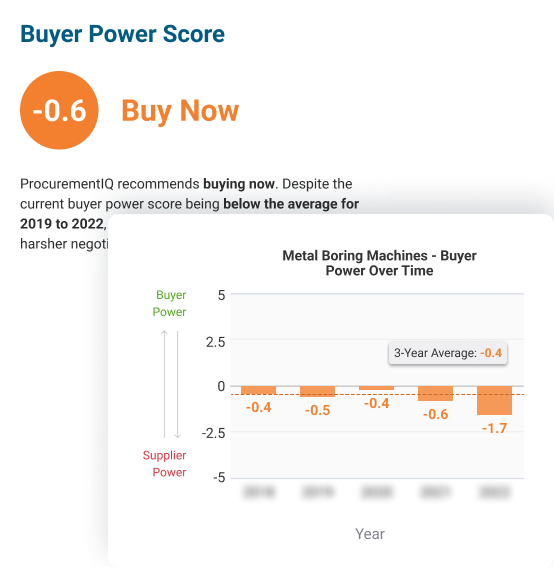
In 2026, buyer power amounts to -2.3 in the United States. Buyer power is most positively impacted by Recent Developments. It is most negatively impacted by Market Share Concentration. Subscribers can access details on eight other factors that impact buyer power. Learn more
United States

Buyer power forecasts: your glimpse into the future
Develop strategies for the upcoming year and identify unforeseen opportunities for buying now
- Actionable "Buy Now" and "Buy Later" insights
- Near-real-time updates to current and forecast Buyer Power Scores
- Methodology and weightings for Buyer Power Score Components
Supply Chain Risk
The average level of supply chain risk is assessed as Medium, which has a negative impact on buyer power. The level of supply chain risk is affected by industry volatility, barriers to entry, competition, import penetration, regulation and industry financial risk. Buyers in this market can mitigate procurement and supply chain management risks by monitoring risk levels for individual first and second tier suppliers:
1st
Tier Suppliers
- Iron & Steel Manufacturing
- Nonferrous Metal Foundry Products Manufacturing
- Glass Product Manufacturing
- Plastic & Resin Manufacturing
2nd
Tier Suppliers
- Iron Ore Mining
- Aluminum Manufacturing
- Sand & Gravel Mining
- Petroleum Refining
Biggest Commercial Lighting Fixtures Suppliers in the US by Revenue
The largest Commercial Lighting Fixtures vendors by revenue in the US are American Industrial Partners LP, Current Lighting Solutions, LLC and Regency Lighting, Inc. Subscribers can sort and filter by market share concentration, profit level and other factors. Learn more
| Supplier | Operational Size | Headquarters | Number of Employees | Market Share (%) | Market Share Performance (3yr trend) | Total Revenue ($ million) | Profit Level (%) | Risk Level |
|---|---|---|---|---|---|---|---|---|
| MLS CO., LTD. | Global | Zhongshan, CN | >10,001 | 5-10 | ||||
| Signify N.V. | Global | Eindhoven, NL | >10,001 | 5-10 | ||||
| Acuity Brands, Inc. | Global | ATLANTA, GA | >10,000 | 5-10 | ||||
| American Industrial Partners LP | 5-10 | |||||||
| Current Lighting Solutions, LLC | Global | Cleveland, OH | 501-1,000 | 5-10 | ||||
| Home Depot, inc. | International | ATLANTA | >10,000 | < 5 | ||||
| Lowes Companies Inc. | International | MOORESVILLE | >10,000 | < 5 | ||||
| Wesco International, Inc. | Global | PITTSBURGH, PA | >10,000 | < 5 | ||||
| W.W. Grainger, Inc. | Global | LAKE FOREST | >10,000 | < 5 | ||||
Looking for a list of suppliers by country?
Subscribers can access vendor information on Canadian and European suppliers, too. We also offer custom research services to help with vendor sourcing anywhere in the world.
Profit Analysis
The average profit margin across vendors in the Commercial Lighting Fixtures market is 6.0% and steady. Profit levels shift depending on suppliers' spend on wages, purchases and overhead. The highest cost component for vendors is Purchases. The cost trend for this component is rising, when considering movement between 2025 and 2026. To understand cost forecasts for 2027 and uncover the implications on profit, start your subscription. Learn more
Vendor & Supply Chain Analysis
The commercial lighting fixtures market has a low level of concentration, with the top four suppliers accounting for less than 30.0% of market revenue. Buyers should leverage the level of competition within the market to secure lower market prices.
The commercial lighting fixtures market has a medium rate of regulatory change. As with other companies, commercial lighting fixture suppliers are subject to laws regulating the storage, treatment and disposal of hazardous waste, as well as limits on the release of pollutants into the air and water.
Vendor risk in the commercial lighting fixtures market is moderate, as suppliers have moderate but stable profit margins on average.
Supply chain risk is moderate, as steel and aluminum are key inputs, both of which have recently been displaying extremely high levels of volatility. However, most vendors have long-term contracts with suppliers of these inputs to help mitigate risks.
As the United States is a net importer of lighting fixtures, buyers can effectively leverage the option of sourcing from an international supplier against a domestic supplier. However, recent tariffs on imported fixtures have raised the total cost of overseas products, reducing their price advantage and leading buyers to compare overall expenses more closely when choosing between international and domestic suppliers.
Supplier Information
Acuity Brands, Inc.
Acuity Inc. (DE) is an industrial technology company that designs and manufactures space and lighting solutions. Its operations comprise two reportable segments: the Acuity Brands Lighting segment, which offers sustainable and intelligent lighting solutions under various brands, including, among others, Aculux™,... Subscribe to learn more
American Industrial Partners LP
American Industrial Partners LP is a private company operating in the manufacturing sector. The company's offerings include commercial lighting fixtures.. Subscribe to learn more
Current Lighting Solutions, LLC
Current Lighting Solutions, LLC is a private company operating globally in the manufacturing sector. The company's offerings include commercial lighting fixtures. Founded in 2019, the company is currently headquartered in Cleveland, Ohio, United States of America with an estimated 750 employees. Subscribe to learn more
MLS CO., LTD.
MLS CO., LTD. is a public company operating globally in the manufacturing sector. The company's offerings include commercial lighting fixtures. Founded in 1997, the company is currently headquartered in Zhongshan, China with an estimated employee count of over 10,000. Subscribe to learn more
Signify N.V.
Signify N.V. is a public company operating globally in the manufacturing sector. The company's offerings include light bulbs & tubes, commercial lighting fixtures, street lighting fixtures, flood lights, emergency lighting systems. Founded in 1997, the company is currently headquartered in Eindhoven, Netherlands... Subscribe to learn more
Home Depot, inc.
Home Depot, Inc. is a home improvement retailer offering building materials, home improvement products, lawn and garden products, décor products, and related services under national and proprietary brands. Its proprietary brands include, among others, HDX®, Husky®, Hampton Bay®, Home Decorators Collection®,... Subscribe to learn more
Ideal Industries, Inc.
Ideal Industries, Inc. is a private company operating globally in the manufacturing sector. The company's offerings include precision hand tools, light bulbs & tubes and commercial lighting fixtures. Founded in 1916, the company is currently headquartered in Sycamore, Illinois, United States of America with... Subscribe to learn more
Leviton Manufacturing Co., Inc.
Leviton Manufacturing Co., Inc. is a private company operating globally in the construction and manufacturing sectors. The company's offerings include electric vehicle charging station construction & maintenance, electric vehicle charging stations, commercial lighting fixtures, panelboards, electrical safety... Subscribe to learn more
Lowes Companies Inc.
Lowe's Companies, Inc. is a home improvement retailer for maintenance, repair, remodeling, and decorating markets. Its product portfolio includes appliances, seasonal & outdoor living, lumber, lawn & garden, kitchen & bath, hardware, building materials, millwork, paint, rough plumbing, tools, electrical, Subscribe to learn more
Accelerate the vendor selection process
Get a clear picture of the competition in a market and discover which vendors are best-suited for your sourcing needs. Our supplier profiles include hard-to-find financial ranges for private companies, cover public company data and feature an interactive competitor matrix.
Procurement Management KPIs for the Commercial Lighting Fixtures Market
Managing vendor performance throughout the contract period is easier when tracking specific key performance indicators (KPIs). For example, buyers should monitor Current Ratio (Assets/Liabilities) and Defect Density. Buyers may experience better performance throughout their contracts if they establish service level agreements (SLAs) based on Expected Useful Life and other factors.
| KPI | Level of Importance (1-5) | Measurements | Key Considerations |
|---|---|---|---|
| Current Ratio (Assets/Liabilities) |
|
Current assets Current liabilities |
The current ratio represents a company’s liquidity. The current ratio can be used to determine a company’s ability to pay its short-term obligations. |
| Defect Density |
|
Number of units Number of defective units |
The defect density represents the share of defective lighting fixtuers. The defect density can be used to determine whether manufacturing, assembly or quality assurance processes require improvement. |

Questions to Ask During Procurement Negotiations
How can I gain leverage during negotiations?
Quality Control
How does the advertised energy usage of this fixture compare with actual case studies?
How does the advertised luminosity of the fixture compare with its actual luminosity?
Recent Developments
Do you source materials with high exposure to market disruptions resulting from the coronavirus pandemic? How are you coping with these disruptions?
How diversified is your supplier base for inputs? Do you source from multiple suppliers in different global regions?
Experience Qualifications
How long have you been active in this market?
What similar clients have you serviced?
The ultimate prep for procurement negotations
View all 32 negotiation questions for this category when you subscribe.
Commercial Lighting Fixtures RFP Guidelines
What should my RFP include?
Organizational Overview
Buyers should describe their organization(s) and the scope of their operations (e.g. commercial office, industrial facility)
Buyers should provide contact information for RFP-related questions.
Statement Of Need
Buyers should provide information on the type of lighting fixtures required and the volume of fixtures needed.
Buyers should provide information regarding the locations of the proposed fixtures, including floor plans and other pertinent details.
Project Budget
Buyers should explicitly state the awarder budget, if possible.
Buyers should explain their desired payment schedule.
The RFP process made easy
Find out how you can access RFP templates for 800+ procurement categories to start writing better, more consistent RFPs.
We display average pricing information, trends and market data.
Our Reports include:
- Opportunity assessment
- Market dynamics
- Recent developments
- Positive and warning trends
- Buyer power levers
- Price environment and market pricing
- Geographic wage rates
- Global market updates
- Total cost of ownership
- Cost structure benchmarks and analysis
- Supply chain and vendors
- Global supplier breakdown
- Market share concentration
- Regulation and business requirements
- Vendor management and KPIs
- Sourcing strategy guidance