Procurement Market Intelligence Report
Commercial Truck Tires
Sourcing Guide & Market Intelligence
Smarter cost management starts with comprehensive market intelligence
 United States
 Canada
 Global
Quick Navigation
Commercial Truck Tires Global Overview
Definition
Summary
This report is intended to assist buyers of commercial truck tires, which are installed on large commercial trucks and trailers. These trucks are typically classified in classes 6, 7 and 8.
This Report Includes:
- New Commercial Truck Tires
- Recycled Commercial Truck Tires
- Replacement Commercial Truck Tires
Not in this Report:
- Car Tires
- Light Truck Tires
- Heavy-Duty Off-Road Vehicle Tires
Global Commercial Truck Tires Procurement Trends
Discover the top international trends affecting procurement in the global Commercial Truck Tires market.
Warning Trends
Tariffs to negatively impact the commercial vehicles and components sector
- In June, the Trump Administration implemented 25.0% tariffs on all automobile and automobile parts imported into the United States, except for those imported from the United Kingdom, which face a reduced 10.0% tariff rate. Additionally, the administration raised tariffs on the import of aluminum, copper, and steel to 50.0%, all vital inputs for automotive manufacturing, and raised the tariffs on heavy trucks made outside the United States to 25.0%.
- In 2024, the value of automotive imports totaled $388.9 billion, which accounted for over a quarter of the total US automotive market revenue that year. Thus, these tariffs are likely to significantly increase the cost of motor vehicles, parts, and maintenance services, as both foreign manufacturers and domestic manufacturers with foreign sub-suppliers face higher import costs.
- According to the US International Trade Commission, Mexico and Canada account for 47.4% of motor vehicle imports to the United States, and 54.1% of motor vehicles bodies and parts. According to Anderson Economic Group (AEG), a Michigan-based economic consultancy, the broad-based 25.0% tariff could raise new car prices by $1,000 to $4,000, and up to $10,000 if manufacturers are unable to mitigate the tariff’s impact.
- Germany is a major exporter of crane trucks, vehicles, vehicle seating and interior trim, and other components in the sector. The higher automotive and metals tariffs will mean that many German companies, even those operating in the United States, will face higher costs to import subcomponents to their facilities in the United States.
- According to Telemetry Insights, many auto parts suppliers will be unable to absorb the tariffs or adjust to mitigate the tariff impact (e.g., relocating their facilities or splitting efforts across three countries). The introduction of 50.0% metals tariffs could drive up production costs further.
United States announces new tariffs on all imported steel
- In February 2025, the United States announced 25.0% tariffs on all imported steel with no exemptions or exceptions. The tariffs took effect on March 12, 2025. On June 4th, these tariffs were increased further to 50%. These tariffs were not impacted by a recent court decision that temporarily suspended duties on certain goods as they were implemented under Section 232 of the Trade Expansion Act.
- Previously, countries such as Canada, Mexico, and Brazil, the top exporters of steel to the United States, had exemptions from tariffs. These have now been removed and all imported steel, regardless of origin, will be subject to the 50.0% tariff. However, on May 8th, the US announced an agreement with the United Kingdom to remove all levies on steel exported from the UK.
- When tariffs on steel imports were introduced in March 2018, they contributed to an increase in the price of steel and steel products. According to the Bureau of Labor Statistics, the price of steel-milled products increased by 10.2% in the year after the tariffs were implemented. This market heavily relies on steel as an input and may be impacted by this policy.
Global Commercial Truck Tires Market - Suppliers by Region
| Country/Region | Number of Suppliers |
|---|---|
| #1 Europe | 11,920 |
| #2 Oceania & Southeast Asia | 9,555 |
| #3 China | 7,990 |
Explore supplier concentration across the globe
We've uncovered the 11 top regions for global procurement, based on feedback from our most strategic clients. Access vendor counts for each unique region when you subscribe.
2
Geography Drilldown - US & Canada
Average Cost of Commercial Truck Tires
United States
2026 Market Pricing$80.00 to $XXX.XX
per tire
Average Price
Prices in the Commercial Truck Tires market range from $80.00 to $XXX.XX, depending on Size, Construction, Materials and Retreaded or New. For example, lower prices are associated with Smaller tires, 19.5 inches to 22.5 inches in diameter ($200 to $350 per tire), whereas higher prices are associated with Wider tires, 22.5 inches to 24.5 inches in diameter ($400 to $600 per tire).
Need the scoop on international price trends?
Between our Europe and Canada collections, we provide price data for 350 markets so you can instantly compare prices across borders. Or, use our custom research services for intel on prices in any region across the globe.
Commercial Truck Tires Category Price Trends
Pricing trends are indicated by the compound annual growth rate (CAGR) during a set period of time. For the Commercial Truck Tires market, prices in the US have grown 1.7% from 2022 to 2025. Meanwhile, the recent three-year CAGR for Canada is +1.2%.
United States (2022-2025)

Wondering where prices are heading?
Price trend forecasts are available to subscribers, along with price driver projections and forward-looking cost structure data.
Cost Analysis - Total Cost of Ownership for Commercial Truck Tires
Total cost of ownership is Low in the Commercial Truck Tires market. The average cost of ownership differs depending on the contract but generally includes costs negotiated before the contract begins, costs billed during the contract period and unforeseen costs.
Negotiated Before
Installation
Billed During
Maintenance
Buyer Power in Procurement Negotiations
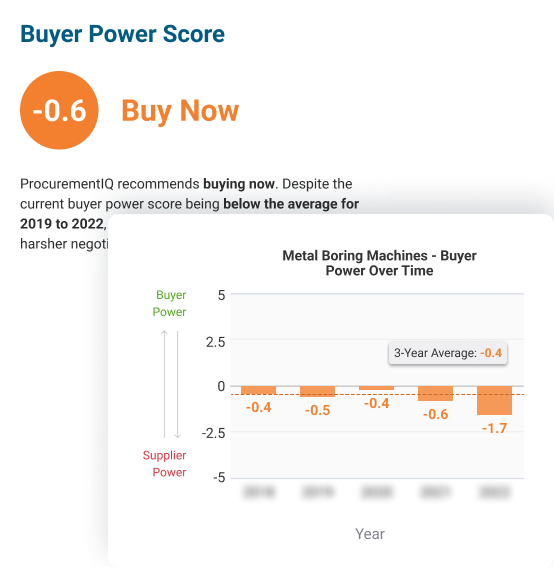
In 2026, buyer power amounts to -2.1 in the United States. Buyer power is most positively impacted by Recent Developments. It is most negatively impacted by Forecast Price Trend. Subscribers can access details on eight other factors that impact buyer power. Learn more
United States

Buyer power forecasts: your glimpse into the future
Develop strategies for the upcoming year and identify unforeseen opportunities for buying now
- Actionable "Buy Now" and "Buy Later" insights
- Near-real-time updates to current and forecast Buyer Power Scores
- Methodology and weightings for Buyer Power Score Components
Supply Chain Risk
The average level of supply chain risk is assessed as High, which has a negative impact on buyer power. The level of supply chain risk is affected by industry volatility, barriers to entry, competition, import penetration, regulation and industry financial risk. Buyers in this market can mitigate procurement and supply chain management risks by monitoring risk levels for individual first and second tier suppliers:
1st
Tier Suppliers
- Plastic & Resin Manufacturing in the US
- Rubber Product Manufacturing in the US
- Steel Rolling & Drawing in the US
- Inorganic Chemical Manufacturing in the US
2nd
Tier Suppliers
- Industrial Machinery & Equipment Wholesaling in the US
- Petrochemical Manufacturing in the US
- Iron & Steel Manufacturing in the US
- Mineral & Phosphate Mining in the US
Biggest Commercial Truck Tires Suppliers in the US by Revenue
The largest Commercial Truck Tires vendors by revenue in the US are The Goodyear Tire & Rubber Company, Cooper Tire & Rubber Co and Compagnie Generale Des Etablissements Michelin. Subscribers can sort and filter by market share concentration, profit level and other factors. Learn more
| Supplier | Operational Size | Headquarters | Number of Employees | Market Share (%) | Market Share Performance (3yr trend) | Total Revenue ($ million) | Profit Level (%) | Risk Level |
|---|---|---|---|---|---|---|---|---|
| The Yokohama Rubber Co., Ltd | Global | Tokyo, JP | >10,001 | 10-15 | ||||
| The Goodyear Tire & Rubber Company | Global | AKRON | >10,000 | 10-15 | ||||
| Compagnie Generale Des Etablissements Michelin | Global | Clermont-Ferrand, FR | >10,001 | 15-20 | ||||
| Bridgestone Corporation | Global | Tokyo, JP | >10,001 | 25+ | ||||
| Continental Ag | Global | Hanover, DE | >10,001 | 5-10 | ||||
| Pirelli & C. S.P.A. | Global | Milan, IT | >10,001 | 5-10 | ||||
| Hankook Tire | Global | Seongnam-si, KR | >10,001 | < 5 | ||||
| Toyo Tire & Rubber Co. Ltd. | Global | Itami, JP | >10,001 | < 5 | ||||
| Cooper Tire & Rubber Co | Global | FINDLAY, OH | 1,001-10,000 | < 5 | ||||
Looking for a list of suppliers by country?
Subscribers can access vendor information on Canadian and European suppliers, too. We also offer custom research services to help with vendor sourcing anywhere in the world.
Profit Analysis
The average profit margin across vendors in the Commercial Truck Tires market is 3.1% and steady. Profit levels shift depending on suppliers' spend on wages, purchases and overhead. The highest cost component for vendors is Purchases. The cost trend for this component is rising, when considering movement between 2025 and 2026. To understand cost forecasts for 2027 and uncover the implications on profit, start your subscription. Learn more
Vendor & Supply Chain Analysis
First tier industries such as steel rolling and drawing also impart risk to the supply chain. Steel prices are notoriously volatile as a result of the global demand for steel products, especially from rapidly developing regions.
As a result of supply chain disruptions, the risk of product shortages and delayed deliveries of this market’s production materials from upstream providers abroad are currently heightened.
The diversity of buying industries for commercial truck tires will provide tire suppliers with steady sales and financial security in the upcoming period. Downstream industries do not typically pose a threat to the commercial tire market as a whole, nevertheless, they are still affected by macroeconomic trends.
The pace of regulation in this market has been slow primarily due to the highly standardized nature of commercial truck tires
The commercial truck tires market is highly concentrated. In fact, the four largest manufacturers (Bridgestone, Michelin, Goodyear and Yokohama) combined account for about 70.0% of market sales each year.
As the United States imports more truck tires than it exports, buyers can effectively leverage the option of sourcing from an international supplier against a domestic supplier.
Supplier Information
The Goodyear Tire & Rubber Company
Goodyear Tire & Rubber Co. (OH) is a global designer, developer, and distributor of tires for automobiles, motorcycles, trucks, aircraft, and related applications. Its brand portfolio includes, among others, Goodyear, Cooper, Dunlop, Kelly, Mastercraft, Roadmaster, Debica, Sava, Fulda, Mickey Thompson, Avon,... Subscribe to learn more
The Yokohama Rubber Co., Ltd
The Yokohama Rubber Co., Ltd is a public company operating globally in the manufacturing sector. The company's offerings include commercial truck tires and automobile & light truck tires. Founded in 1917, the company is currently headquartered in Tokyo, Japan with an estimated employee count of over 10,000.... Subscribe to learn more
Compagnie Generale Des Etablissements Michelin
Compagnie Generale Des Etablissements Michelin is a public company operating globally in the manufacturing and manufacturing sectors. The company's offerings include commercial truck tires, automobile & light truck tires and industrial wheels. Founded in 1889, the company is currently headquartered in Clermont-Ferrand,... Subscribe to learn more
Bridgestone Corporation
Bridgestone Corporation is a public company operating globally in the manufacturing, manufacturing and other services (except public administration) sectors. The company's offerings include truck wheels, commercial truck tires, automobile & light truck tires and vehicle inspection services. Founded in 1931,... Subscribe to learn more
Continental Ag
Continental Ag is a public company operating globally in the manufacturing and manufacturing sectors. The company's offerings include conveyor systems, commercial truck tires and automobile & light truck tires. Founded in 1871, the company is currently headquartered in Hanover, Germany with an estimated employee... Subscribe to learn more
Pirelli & C. S.P.A.
Pirelli & C. S.P.A. is a public company operating globally in the manufacturing sector. The company's offerings include commercial truck tires and automobile & light truck tires. Founded in 1872, the company is currently headquartered in Milan, Italy with an estimated employee count of over 10,000. Subscribe to learn more
Cooper Tire & Rubber Co
Cooper Tire & Rubber Co is a public company operating globally in the manufacturing sector. The company's offerings include commercial truck tires, heavy-duty otr tires and automobile & light truck tires. Founded in 1914, the company is currently headquartered in FINDLAY, Ohio, United States of America with... Subscribe to learn more
Dreamstime.com LLC
Dreamstime.com LLC is a private company operating internationally in the manufacturing sector. The company's offerings include commercial truck tires and digital stock images. Founded in 2004, the company is currently headquartered in Brentwood, Tennessee, United States of America with an estimated 375 employees.... Subscribe to learn more
Hankook Tire
Hankook Tire is a public company operating globally in the manufacturing sector. The company's offerings include commercial truck tires and automobile & light truck tires. Founded in 1941, the company is currently headquartered in Seongnam-si, South Korea with an estimated employee count of over 10,000. Subscribe to learn more
Accelerate the vendor selection process
Get a clear picture of the competition in a market and discover which vendors are best-suited for your sourcing needs. Our supplier profiles include hard-to-find financial ranges for private companies, cover public company data and feature an interactive competitor matrix.
Procurement Management KPIs for the Commercial Truck Tires Market
Managing vendor performance throughout the contract period is easier when tracking specific key performance indicators (KPIs). For example, buyers should monitor Current Ratio (Assets/Liabilities) and Customer Retention Rate. Buyers may experience better performance throughout their contracts if they establish service level agreements (SLAs) based on Delivery Timelines and other factors.
| KPI | Level of Importance (1-5) | Measurements | Key Considerations |
|---|---|---|---|
| Current Ratio (Assets/Liabilities) |
|
Current assets Current liabilities |
The current ratio can be used to determine a company’s ability to pay its short-term obligations. The current ratio can be used to determine a company’s ability to utilize its current assets to satisfy its current liabilities. |
| Customer Retention Rate |
|
Number of customers at start of period Number of customers added within period |
The customer retention rate represents the number of customers a company is able to retain over a set timeframe. The customer retention rate can be used to determine the extent to which a company’s customer base fluctuates over time. |

Questions to Ask During Procurement Negotiations
How can I gain leverage during negotiations?
Quality Control
What is the primary benefit of choosing your product over a competitor’s?
What methods do you employ to ensure a minimum quality threshold?
Shipping
What shipping supplier do you use? How long have you been using them?
Have you ever had an issue with your current shipping method? How did you fix it? Has the coronavirus brought any issues to your shipping method?
Customer Service
How many customer service personnel do you employ?
Will a single employee be assigned to my account? Will I be able to contact them directly?
The ultimate prep for procurement negotations
View all 25 negotiation questions for this category when you subscribe.
Commercial Truck Tires RFP Guidelines
What should my RFP include?
Organizational Overview
Buyers should provide a description of their business and a brief outline of their company history and structure.
Buyers should state the purpose of issuing an RFP and the intended usage of the tires being requested.
Statement Of Need
Buyers should provide a list of the tires needed, including the quantity of each type, the size and brands, if applicable.
Buyers should describe the requirements the tires must meet, such as the preferred mileage traveled before needing to be replaced and any special weather or surface conditions they must withstand.
Project Budget
Buyers should state their total budget.
If buyers require an ongoing supply contract, buyers should provide their monthly and annual budgets.
The RFP process made easy
Find out how you can access RFP templates for 800+ procurement categories to start writing better, more consistent RFPs.
We display average pricing information, trends and market data.
Our Reports include:
- Opportunity assessment
- Market dynamics
- Recent developments
- Positive and warning trends
- Buyer power levers
- Price environment and market pricing
- Geographic wage rates
- Global market updates
- Total cost of ownership
- Cost structure benchmarks and analysis
- Supply chain and vendors
- Global supplier breakdown
- Market share concentration
- Regulation and business requirements
- Vendor management and KPIs
- Sourcing strategy guidance