Procurement Market Intelligence Report
Credit Card Payment Processing Services
Sourcing Guide & Market Intelligence
Smarter cost management starts with comprehensive market intelligence
 United States
 Canada
 Europe
 Global
Quick Navigation
Credit Card Payment Processing Services Global Overview
Definition
Summary
This report is intended to assist buyers of credit card payment processing services. A credit card payment processor acts as a liaison between the buyer, or merchant, and the cardholder's issuing bank during a credit card transaction. Suppliers communicate with issuing banks through a secured network referred to as the payment gateway, wherein the payment is requested, authorized and routed back to the merchant. This service can be purchased as a combination of payment gateway, processor and merchant account services.
This Report Includes:
- Credit card payment processing
- Debit card payment processing
Not in this Report:
- Credit card services
- Point-of-sale terminals
Global Credit Card Payment Processing Services Procurement Trends
Discover the top international trends affecting procurement in the global Credit Card Payment Processing Services market.
Warning Trends
Fed lowers rates for the first time in 2025
- On September 17, the Federal Reserve’s Federal Open Market Committee (FOMC) voted to lower interest rates to a target range of 4.0% to 4.25%, down 0.25% from the rate it had been holding since November of last year.
- Despite indications at the start of the year that steady reductions to the relatively high 4.25% to 4.5% rate were on the horizon, the Fed held off on rate cuts for much of the year due to concerns that the combination of higher tariffs and a reduction in borrowing costs could cause rebounding inflation.
- The September cut to Fed interest rates signals a shift in this strategy, indicating that the Fed now considers weakening employment figures a greater threat than inflation. As a result, FOMC officials have also signaled that two additional rate cuts are likely before the end of the year in an effort to fight unemployment and stimulate the economy.
- Declining Fed funds rates will provide relief to borrowers by lowering the market interest rates for consumer and business loans. This reduction in the cost of borrowing will reduce the cost of many banking and financial services, and may spur increases in demand across the economy.
Neutral
Inflation climbs above 3.0% for the first time in seven months
- In January, the Consumer Price Index (CPI) 12-month inflation rate, the most commonly used measure of inflation, rose by 0.1% to 3.0%, the highest it has been since June 2024.
- This uptick in inflation follows cuts to interest rates which may have added to consumer demand, fueling higher consumer prices.
- Additionally, the threat of impending tariff hikes has driven preemptive stockpiling by importers, adding to demand and price growth across a range of industries in the United States.
- While inflation is still low relative to previous years, sustained recent increases in inflation and the potential effects of tariffs, such as the recently implemented 10.0% on all Chinese goods, mean prices are still rising at a faster-than-normal pace.
Global Credit Card Payment Processing Services Market - Suppliers by Region
| Country/Region | Number of Suppliers |
|---|---|
| #1 China | 4,225 |
| #2 Europe | 3,980 |
| #3 Oceania & Southeast Asia | 3,430 |
Explore supplier concentration across the globe
We've uncovered the 11 top regions for global procurement, based on feedback from our most strategic clients. Access vendor counts for each unique region when you subscribe.
2
Geography Drilldown - US, Canada & Europe
Average Cost of Credit Card Payment Processing Services
United States
2026 Market Pricing$2.30 to $X.XX
fee per transaction
Average Price
Prices in the Credit Card Payment Processing Services market range from $2.30 to $X.XX, depending on Type of Transaction, Processing Volume, Average Ticket Size and Type of Credit Card. For example, lower prices are associated with Swiped transaction (1.94% to 2.70% per transaction), whereas higher prices are associated with Nonswiped transaction (2.51% to 3.50% per transaction).
Need the scoop on international price trends?
Between our Europe and Canada collections, we provide price data for 350 markets so you can instantly compare prices across borders. Or, use our custom research services for intel on prices in any region across the globe.
Credit Card Payment Processing Services Category Price Trends
Pricing trends are indicated by the compound annual growth rate (CAGR) during a set period of time. For the Credit Card Payment Processing Services market, prices in the US have grown 0.1% from 2022 to 2025. and +0.1% in Europe.
United States (2022-2025)

Europe (2022-2025)
Compound Annual Growth Rate
Wondering where prices are heading?
Price trend forecasts are available to subscribers, along with price driver projections and forward-looking cost structure data.
Cost Analysis - Total Cost of Ownership for Credit Card Payment Processing Services
Total cost of ownership is Medium in the Credit Card Payment Processing Services market. The average cost of ownership differs depending on the contract but generally includes costs negotiated before the contract begins, costs billed during the contract period and unforeseen costs. For example, unforeseen costs in the form of Cancellations may raise the total cost of ownership unexpectedly.
Negotiated Before
Implementation
Billed During
Hardware
Additional Fees
Unforeseen
Cancellations
Buyer Power in Procurement Negotiations
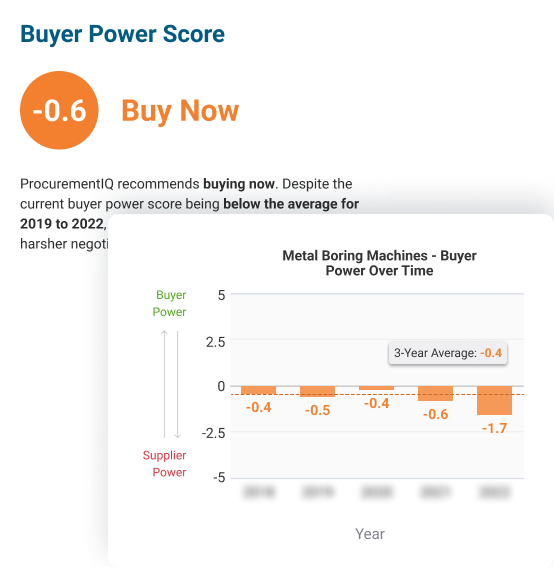
In 2026, buyer power amounts to 0.8 in the United States. Buyer power is most positively impacted by Recent Developments. It is most negatively impacted by Recent Price Volatility. Subscribers can access details on eight other factors that impact buyer power. Learn more
United States

Buyer power forecasts: your glimpse into the future
Develop strategies for the upcoming year and identify unforeseen opportunities for buying now
- Actionable "Buy Now" and "Buy Later" insights
- Near-real-time updates to current and forecast Buyer Power Scores
- Methodology and weightings for Buyer Power Score Components
Supply Chain Risk
The average level of supply chain risk is assessed as Low, which has a positive impact on buyer power. The level of supply chain risk is affected by industry volatility, barriers to entry, competition, import penetration, regulation and industry financial risk. Buyers in this market can mitigate procurement and supply chain management risks by monitoring risk levels for individual first and second tier suppliers:
1st
Tier Suppliers
- Commercial Banks
- Software Publishers
- Computer Peripheral Manufacturers
- Wired Telecommunications Carriers
2nd
Tier Suppliers
- Operating Systems & Productivity Software Publishers
- Semiconductor & Circuit Manufacturers
- Wire & Cable Manufacturers
Biggest Credit Card Payment Processing Services Suppliers in the US by Revenue
The largest Credit Card Payment Processing Services vendors by revenue in the US are National Bankcard Inc., Stripe, Inc. and Flagship Merchant Services. Subscribers can sort and filter by market share concentration, profit level and other factors. Learn more
| Supplier | Operational Size | Headquarters | Number of Employees | Market Share (%) | Market Share Performance (3yr trend) | Total Revenue ($ million) | Profit Level (%) | Risk Level |
|---|---|---|---|---|---|---|---|---|
| Jpmorgan Chase & Co | Global | NEW YORK | >10,000 | 10-15 | ||||
| Fidelity National Information Services, Inc. | Global | JACKSONVILLE, FL | >10,000 | 10-15 | ||||
| Fiserv, Inc. | Global | MILWAUKEE, WI | >10,000 | 15-20 | ||||
| Global Payments Inc. | Global | ATLANTA | >10,000 | 5-10 | ||||
| Bank Of America Corporation | Global | CHARLOTTE, NC | >10,000 | < 5 | ||||
| Paypal Holdings, Inc. | Global | SAN JOSE, CA | >10,000 | < 5 | ||||
| Block, Inc. | Global | OAKLAND, CA | >10,000 | < 5 | ||||
| National Bankcard Inc. | National | Melville, NY | 51-100 | < 5 | ||||
| Stripe, Inc. | Global | San Francisco, CA | 1,001-10,000 | < 5 | ||||
Looking for a list of suppliers by country?
Subscribers can access vendor information on Canadian and European suppliers, too. We also offer custom research services to help with vendor sourcing anywhere in the world.
Profit Analysis
The average profit margin across vendors in the Credit Card Payment Processing Services market is 19.3% and steady. Profit levels shift depending on suppliers' spend on wages, purchases and overhead. The highest cost component for vendors is Overhead. The cost trend for this component is stagnating, when considering movement between 2025 and 2026. To understand cost forecasts for 2027 and uncover the implications on profit, start your subscription. Learn more
Vendor & Supply Chain Analysis
Supply chain risk is low because vendors do not rely heavily on imported components. Low supply chain risk boosts buyer power because it means there is a low risk of events that could force increases in service prices.
Low vendor risk boosts buyer power by ensuring the continuity of operations for suppliers and minimizing the risk of service disruptions for buyers.
A moderate level of market share concentration limits buyer power because the top players can exert some influence over rates for services. Market share has been rising in the past three years as a result of mergers by the largest vendors.
The United States is a net importer of computers, importing more computers than it exports. However, this does not affect the provision of credit card payment processing services as computers are inputs that are purchased by service providers.
Supplier Information
Fidelity National Information Services, Inc.
Fidelity National Information Services, Inc. is a global financial technology company. It organizes its business into three reportable segments: the Banking segment, which offers core processing and transaction processing software and complementary applications and services; the Merchant segment, which serves... Subscribe to learn more
Jpmorgan Chase & Co
JPMorgan Chase & Co. is a global financial holding company. It specializes in investment banking, financial services for consumers and small businesses, commercial banking, financial transaction processing, and asset management. It operates through its bank subsidiary, JPMorgan Chase Bank, National Association,... Subscribe to learn more
Fiserv, Inc.
Fiserv, Inc. is a global provider of financial services technology to banks, credit unions, other financial institutions, and merchants. Its business consists of three segments: First Data segment, which provides merchant acquiring, e-commerce, mobile commerce, and other business solutions at the point-of-sale;... Subscribe to learn more
Global Payments Inc.
Global Payments Inc. is a global payments technology company. It organizes its business into two reportable segments: the Merchant Solutions segment, which offers, among others, authorization, settlement, and funding services, customer support, chargeback resolution, terminal rental, sales and deployment,... Subscribe to learn more
Bank Of America Corporation
Bank of America Corp. /DE/ is a holding company for various bank and non-bank subsidiaries, providing a full range of banking, investing, asset management, and other financial and risk management products and services. It operates through its four business segments: Consumer Banking segment, which offers Subscribe to learn more
Block, Inc.
Block, Inc. is a developer of connected ecosystems that integrate commerce solutions, financial services, software, hardware, and networks for individuals and small businesses. It organizes its business into two reportable segments: the Square segment, which enables businesses to accept card payments through... Subscribe to learn more
Flagship Merchant Services
Flagship Merchant Services is a private company operating nationally in the finance & insurance sector. The company's offerings include credit card payment processing services. Founded in 2001, the company is currently headquartered in Charlestown, Massachusetts, United States of America with an estimated... Subscribe to learn more
National Bankcard Inc.
National Bankcard Inc. is a private company operating nationally in the finance & insurance sector. The company's offerings include credit card payment processing services. Founded in 2007, the company is currently headquartered in Melville, New York, United States of America with an estimated 56 employees.... Subscribe to learn more
Paypal Holdings, Inc.
Paypal Holdings, Inc. is a public company operating globally in the information and finance and insurance sectors. The company's offerings include online payment gateway software and credit card payment processing services. Founded in 1998, the company is currently headquartered in SAN JOSE, California, United... Subscribe to learn more
Accelerate the vendor selection process
Get a clear picture of the competition in a market and discover which vendors are best-suited for your sourcing needs. Our supplier profiles include hard-to-find financial ranges for private companies, cover public company data and feature an interactive competitor matrix.
Procurement Management KPIs for the Credit Card Payment Processing Services Market
Managing vendor performance throughout the contract period is easier when tracking specific key performance indicators (KPIs). For example, buyers should monitor Average Resolution Time and Average Response Time. Buyers may experience better performance throughout their contracts if they establish service level agreements (SLAs) based on Availability and other factors.
| KPI | Level of Importance (1-5) | Measurements | Key Considerations |
|---|---|---|---|
| Average Resolution Time |
|
Average resolution time Percentage of problems resolved within 1 week |
Average resolution time matters because credit card payment processing is a critical function and service must be restored quickly when outages occur. The buyer can specify an average resolution time goal which the supplier must meet during a given period. |
| Average Response Time |
|
Average response time Percentage of queries responded to within 24 hours |
A low average response time indicates responsive customer service. Buyers should set a maximum average response time which the supplier must not exceed during a given period. |

Questions to Ask During Procurement Negotiations
How can I gain leverage during negotiations?
Experience and Expertise
What is your renewal and repeat business rate?
Why did your last three clients that canceled their contracts do so? Who are they using now?
Customer Support
Where is your customer support located, geographically?
How do you handle customer complaints? How have services changed in response to customer complaints and suggestions?
Competition
How do you attract and retain clients?
As a small company, how do you compete with the reputation of large established service providers?
The ultimate prep for procurement negotations
View all 41 negotiation questions for this category when you subscribe.
Credit Card Payment Processing Services RFP Guidelines
What should my RFP include?
Organizational Overview
Buyers should give an overview of their organization (e.g. products and services offered, profile of constituents served, number of constituents served yearly).
Buyers should give details about their credit card transactions (e.g. average transaction size, total volume of transactions per year).
Statement Of Need
Buyers should list the hardware/software currently supporting their payment systems.
Buyers should outline their preference for integrating card acceptance hardware/software with their existing systems.
Project Budget
Buyers should include the desired pricing model.
Vendors should include a pricing proposal, which should define and list all fees (e.g. reporting, charge backs, monthly minimums, authorizations, settlements) associated with each type of transaction (i.e. online, face to face).
The RFP process made easy
Find out how you can access RFP templates for 800+ procurement categories to start writing better, more consistent RFPs.
We display average pricing information, trends and market data.
Our Reports include:
- Opportunity assessment
- Market dynamics
- Recent developments
- Positive and warning trends
- Buyer power levers
- Price environment and market pricing
- Geographic wage rates
- Global market updates
- Total cost of ownership
- Cost structure benchmarks and analysis
- Supply chain and vendors
- Global supplier breakdown
- Market share concentration
- Regulation and business requirements
- Vendor management and KPIs
- Sourcing strategy guidance