Procurement Market Intelligence Report
Intermodal Container Rental
Sourcing Guide & Market Intelligence
Smarter cost management starts with comprehensive market intelligence
 United States
 Global
Quick Navigation
Intermodal Container Rental Global Overview
Definition
Summary
Intermodal containers are standardized steel boxes used primarily to secure and transport goods internationally; they can be used across multiple forms of transportation, including ships, trains and trucks. Typical buyers are shipping line operators, freight forwarders and long-distance trucking companies.
This Report Includes:
- Dry-Cargo Container Rental
- Specialized Container Rental
Not in this Report:
- Intermodal Container Sales
- Other Logistics & Supply Chain Services
Take the ProcurementIQ products and data tour
Explore live samples of price trend forecasts, price driver projections, forward-looking cost structure data and more.
Global Intermodal Container Rental Market - Suppliers by Region
| Country/Region | Number of Suppliers |
|---|---|
| #1 Europe | 65 |
| #2 United States | 35 |
| #3 Oceania & Southeast Asia | 35 |
Explore supplier concentration across the globe
We've uncovered the 11 top regions for global procurement, based on feedback from our most strategic clients. Access vendor counts for each unique region when you subscribe.
Geography Drilldown - US
Average Cost of Intermodal Container Rental
United States
2026 Market Pricing$50.00 to $XXX.XX
per 40-foot container per monthAverage Price
Prices in the Intermodal Container Rental market range from $50.00 to $XXX.XX, depending on Container Size, Container Type, Contract Length and Number of Containers. For example, lower prices are associated with 10-foot containers ($50.00 to $100 per container per month) and 20-foot containers ($100 to $220 per container per month), whereas higher prices are associated with 40-foot containers ($140 to $280 per container per month).
Need the scoop on international price trends?
Between our Europe and Canada collections, we provide price data for 350 markets so you can instantly compare prices across borders. Or, use our custom research services for intel on prices in any region across the globe.
Intermodal Container Rental Category Price Trends
Pricing trends are indicated by the compound annual growth rate (CAGR) during a set period of time. For the Intermodal Container Rental market, prices in the US have grown 4.8% from 2022 to 2025. Subscribers can access price trend forecasts, price driver projections and forward-looking cost structure data. Learn more
United States (2022-2025)


Wondering where prices are heading?
Price trend forecasts are available to subscribers, along with price driver projections and forward-looking cost structure data.
Cost Analysis - Total Cost of Ownership for Intermodal Container Rental
Total cost of ownership is Medium in the Intermodal Container Rental market. The average cost of ownership differs depending on the contract but generally includes costs negotiated before the contract begins, costs billed during the contract period and unforeseen costs.
Billed During
Insurance
Transfers
Buyer Power in Procurement Negotiations
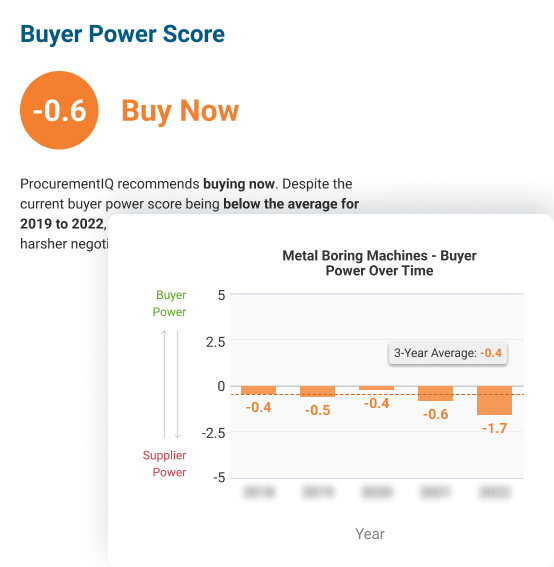
In 2026, buyer power amounts to -2.1 in the United States. Buyer power is most positively impacted by Price Driver Volatility. It is most negatively impacted by Product Specialization. Subscribers can access details on eight other factors that impact buyer power. Learn more
United States
Buyer power forecasts: your glimpse into the future
Develop strategies for the upcoming year and identify unforeseen opportunities for buying now
- Actionable "Buy Now" and "Buy Later" insights
- Near-real-time updates to current and forecast Buyer Power Scores
- Methodology and weightings for Buyer Power Score Components
Supply Chain Risk
The average level of supply chain risk is assessed as Medium, which has a negative impact on buyer power. The level of supply chain risk is affected by industry volatility, barriers to entry, competition, import penetration, regulation and industry financial risk. Buyers in this market can mitigate procurement and supply chain management risks by monitoring risk levels for individual first and second tier suppliers:
1st
Tier Suppliers
- Metal Tank Manufacturers
- Stevedoring & Marine Cargo Handling Service Providers
- Freight Trucking Service Providers
2nd
Tier Suppliers
- Steel Rolling & Drawing Firms
- Engineering Service Providers
- Truck Manufacturers
Biggest Intermodal Container Rental Suppliers in the US by Revenue
The largest Intermodal Container Rental vendors by revenue in the US are Blue Sky Intermodal (Uk) Ltd., Capital Intermodal GmBH and CARU Containers B.V. Subscribers can sort and filter by market share concentration, profit level and other factors. Learn more
| Supplier | Operational Size | Headquarters | Number of Employees | Market Share (%) | Market Share Performance (3yr trend) | Total Revenue ($ million) | Profit Level (%) | Risk Level |
|---|---|---|---|---|---|---|---|---|
| China Cosco Shipping Corporation Limited | Global | Shanghai, CN | >10,001 | 10-15 | ||||
| Cai International, Inc. | Global | San Francisco, CA | 51-100 | 5-10 | ||||
| SeaCube Container Leasing Ltd. | Global | PARK RIDGE, NJ | 51-100 | 5-10 | ||||
| HNA Group Co. Ltd. | Global | Haikou, CN | >10,000 | < 5 | ||||
| Blue Sky Intermodal (Uk) Ltd. | Global | Marlow, UK | 51-100 | < 5 | ||||
| Capital Intermodal GmBH | Global | Hamburg, DE | <25 | < 5 | ||||
| CARU Containers B.V. | Global | Rotterdam, NL | 101-250 | < 5 | ||||
| Touax SCA | Global | Paris, FR | 101-250 | < 5 | ||||
Looking for a list of suppliers by country?
Subscribers can access vendor information on Canadian and European suppliers, too. We also offer custom research services to help with vendor sourcing anywhere in the world.
Profit Analysis
The average profit margin across vendors in the Intermodal Container Rental market is 30.1% and steady. Profit levels shift depending on suppliers' spend on wages, purchases and overhead. The highest cost component for vendors is Overhead. The cost trend for this component is stagnating, when considering movement between 2025 and 2026. To understand cost forecasts for 2027 and uncover the implications on profit, start your subscription. Learn more
Vendor & Supply Chain Analysis
Intermodal container leasing is capital intensive, and many market providers take on considerable debt to accumulate their container fleets. However, suppliers’ high profit margins give them some cushion in times of financial hardship, leading to a moderate level of vendor financial risk on average.
Supply chain risk for intermodal container rental is moderate. Intermodal containers are made of steel, the price of which is inherently volatile due to its commoditized nature.
The market is highly concentrated due to the significant amounts of initial investment capital needed to provide services. Intermodal containers are typically expensive, and suppliers must purchase a large quantity of them to provide competitive prices and meet the large orders that shipping lines often require.
The United States is a net importer of intermodal containers, demonstrating the strong competition from foreign manufacturers within the market. This increased reliance on overseas supply could add to supply chain complexities and potential risks tied to varied trade policies and global economic conditions.
Supplier Information
China Cosco Shipping Corporation Limited
China Cosco Shipping Corporation Limited is a public company operating globally in the real estate & rental & leasing sector. The company's offerings include deep sea cargo transportation services, water cargo transportation services and intermodal container rental. Founded in 1997, the company is currently... Subscribe to learn more
Cai International, Inc.
Cai International, Inc. is a public company operating globally in the real estate and rental and leasing sector. The company's offerings include intermodal container rental. Founded in 1989, the company is currently headquartered in San Francisco, California, United States of America with an estimated 99 Subscribe to learn more
SeaCube Container Leasing Ltd.
SeaCube Container Leasing Ltd. is a public company operating globally in the real estate and rental and leasing sector. The company's offerings include intermodal container rental. Founded in 2010, the company is currently headquartered in PARK RIDGE, New Jersey, United States of America with an estimated... Subscribe to learn more
Blue Sky Intermodal (Uk) Ltd.
Blue Sky Intermodal (Uk) Ltd. is a private company operating globally in the real estate & rental & leasing sector. The company's offerings include intermodal container rental. Founded in 2003, the company is currently headquartered in Marlow, Buckinghamshire, United Kingdom with an estimated 37 employees.... Subscribe to learn more
Capital Intermodal GmBH
Capital Intermodal GmBH is a private company operating globally in the finance & insurance and real estate & rental & leasing sectors. The company's offerings include intermodal container rental. Founded in 2008, the company is currently headquartered in Hamburg, Germany with an estimated 25 employees. Subscribe to learn more
CARU Containers B.V.
CARU Containers B.V. is a private company operating globally in the real estate & rental & leasing sector. The company's offerings include intermodal container rental. Founded in 2000, the company is currently headquartered in Rotterdam, South Holland, Netherlands with an estimated 125 employees. Subscribe to learn more
HNA Group Co. Ltd.
HNA Group Co. Ltd. is a private company operating globally in the information and real estate & rental & leasing sectors. The company's offerings include graphics & video accelerator cards, optical character recognition systems and intermodal container rental. Founded in 1993, the company is currently headquartered... Subscribe to learn more
Touax SCA
Touax SCA is a public company operating globally in the real estate & rental & leasing sector. The company's offerings include intermodal container rental. Founded in 1954, the company is currently headquartered in Paris, France with an estimated 175 employees. Subscribe to learn more
Accelerate the vendor selection process
Get a clear picture of the competition in a market and discover which vendors are best-suited for your sourcing needs. Our supplier profiles include hard-to-find financial ranges for private companies, cover public company data and feature an interactive competitor matrix.
Procurement Management KPIs for the Intermodal Container Rental Market
Managing vendor performance throughout the contract period is easier when tracking specific key performance indicators (KPIs). For example, buyers should monitor Defect Density and Mean Time to Failure (MTTF). Buyers may experience better performance throughout their contracts if they establish service level agreements (SLAs) based on Availability and other factors.
| KPI | Level of Importance (1-5) | Measurements | Key Considerations |
|---|---|---|---|
| Defect Density |
|
Number of units Number of defective units |
The defect density represents the share of defective or damaged containers a vendor provides. The defect density can be used to determine whether quality assurance processes require improvement. Buyers that frequently receive damaged containers may face increased maintenance costs and disruptions to their operations if the damage is not immediately detected. |
| Mean Time to Failure (MTTF) |
|
Number of operational hours Number of assets in use |
The mean time to failure represents the average time it takes for an operational asset to become inoperative. The mean time to failure can be used to determine the average lifespan of an asset. The mean time to failure reflects the quality and condition of the containers supplied by vendors. |

Questions to Ask During Procurement Negotiations
How can I gain leverage during negotiations?
Contract
How much notice is required prior to canceling a contract?
Is there any way to waive cancellation fees?
Logistics
What drop-off locations are available for your containers?
What are the penalties for dropping off containers at an incorrect location?
Value-Added Services
How often is your tracking data updated?
Do you keep track of when the containers are opened?
The ultimate prep for procurement negotations
View all 26 negotiation questions for this category when you subscribe.
Intermodal Container Rental RFP Guidelines
What should my RFP include?
Organizational Overview
Buyers should provide a description of their organization, including size and geographic location.
Buyers should describe the type of goods being shipped in the intermodal containers.
Statement Of Need
Buyers should indicate how many intermodal containers they wish to rent and the size they need.
Buyers should include a detailed description of the quantity of goods being delivered.
Project Budget
Buyers should disclose the total value of their contract budget for intermodal container rental.
Buyers should indicate what their expectations for payment are, including the preferred billing schedule.
The RFP process made easy
Find out how you can access RFP templates for 800+ procurement categories to start writing better, more consistent RFPs.
We display average pricing information, trends and market data.
Our Reports include:
- Opportunity assessment
- Market dynamics
- Recent developments
- Positive and warning trends
- Buyer power levers
- Price environment and market pricing
- Geographic wage rates
- Global market updates
- Total cost of ownership
- Cost structure benchmarks and analysis
- Supply chain and vendors
- Global supplier breakdown
- Market share concentration
- Regulation and business requirements
- Vendor management and KPIs
- Sourcing strategy guidance