Procurement Market Intelligence Report
Propane
Sourcing Guide & Market Intelligence
Smarter cost management starts with comprehensive market intelligence
 United States
 Canada
 Europe
 Global
Quick Navigation
Propane Global Overview
Definition
Summary
Propane is a colorless, odorless, nontoxic type of liquefied petroleum gas (LPG). The primary buyers of propane include companies in the utilities, fuel, commercial, industrial, and agricultural industries. Specifically, propane is used in furnaces, outdoor grills, air conditioners, fireplaces, irrigation pumps, water heaters, and appliances, as well as in propane-driven forklifts and some fleet vehicles.
This Report Includes:
- HD5 Propane
- HD10 Propane
- Commercial Propane
Not in this Report:
- Butane
- Coal Gas
- Methane
Take the ProcurementIQ products and data tour
Explore live samples of price trend forecasts, price driver projections, forward-looking cost structure data and more.
Global Propane Procurement Trends
Discover the top international trends affecting procurement in the global Propane market.
Warning Trends
Tariffs on fuel additives, lubricants, and anti-corrosive materials to increase costs in the sector
- On August 1, the Trump Administration finalized sweeping tariffs on most major US import partners, in addition to the already announced 25.0% and 35.0% tariffs on Mexico and Canada, and a 10.0% tariff on energy imports from Canada. According to the Energy Information Administration, Canada and Mexico account for 71.2% of US crude oil imports, 35.7% of US petroleum product imports, and 99.6% of US natural gas imports.
- These tariffs will increase both the cost of importing fuel additives, lubricants, and anti-corrosive materials and the cost of sourcing primary inputs necessary for making these products, affecting both international and domestic suppliers. However, reduced oil and gas demand tied to higher tariffs and a possible economic slowdown may counteract some of the tariff price increases in this market.
- Tariffs on steel and aluminum and falling oil prices are also increasing vendor risk for upstream suppliers in the sector; according to the New York Times, tariffs on steel have pushed up the cost of new oil and gas wells by 10.0% to 20.0%. According to S&P Global, oil country tubular goods, made from steel, are anticipated to rise 15.0% in price with the increase in tariffs, and because these expenses account for 8.0% to 10.0% of drilling and completion costs, the fuel additives, lubricants, and anti-corrosive materials supply chain will see increased risk of disruption.
The European Commission is proposing the European Supply Chain Act
- Early in 2022, the European Commission (EC) proposed a new law that would impact supply chains throughout the European Union (EU).
- The law consists of provisions requiring companies to identify current and potential negative impacts on human rights and the environment throughout their supply chain and to mitigate these risks.
- Businesses will have to investigate all links of their supply chain, upstream and downstream, and adjust their supply chain to ensure labor rights and environmental standards are not being violated as a result of their operations over the course of two years.
- While many countries have their own national laws similar to the one being proposed by the EC, such as Germany’s German Supply Chain Due Diligence Act, this proposed law supersedes national laws and is stricter in most cases.
Neutral
Crude oil prices dip, but natural gas and fuel prices remain volatile in 2025
- Oil prices have been falling with the introduction of higher tariffs and the predicted decline in global demand. The OPEC+ group of countries also announced they would be unwinding production cuts and increasing their collective output target for May by 411,000 barrels per day.
- Trade wars, ongoing conflict between Hamas and Israel, and general unrest in the Middle East are causing uncertainty surrounding oil prices, which has led to volatility in prices. In the third week of May 2025, crude oil prices hit $63.67 per barrel, but volatility remains as geopolitical concerns remain.
- Natural gas prices rallied early in 2025 with colder-than-usual temperatures in the United States and high demand, topping out at $4.68/MMBtu in March. Prices have since fallen with the onset of trade wars and weakening demand projections to $3.64/MMBtu in the third week of May 2025.
- The national average of gasoline prices has been rising slightly due to refinery maintenance/outages and blending issues, hitting a national average of $3.15 per gallon in the third week of May 2025. However, gasoline futures have been volatile, falling due to fears of oversupply and deepening concerns about weakening demand with tariffs, but rising after trade deals.
Global Propane Market - Suppliers by Region
| Country/Region | Number of Suppliers |
|---|---|
| #1 China | 11,055 |
| #2 India | 4,680 |
| #3 Europe | 4,175 |
Explore supplier concentration across the globe
We've uncovered the 11 top regions for global procurement, based on feedback from our most strategic clients. Access vendor counts for each unique region when you subscribe.
Geography Drilldown - US, Canada & Europe
Average Cost of Propane
United States
2026 Market Pricing$0.86 to $X.XX
per gallon
Average Price
Prices in the Propane market range from $0.86 to $X.XX, depending on Grade, Purity and Mix & Compositions. For example, lower prices are associated with HD5 grade ($0.75 to $0.95 per gallon), Industrial grade propane ($0.70 to $0.85 per gallon) and Mixed Propane, whereas higher prices are associated with HD10 grade ($1.00 to $1.15 per gallon), Propane for residential heating with high BTU rating and Specialty Propane ($1.00 to $1.15 per gallon).
Need the scoop on international price trends?
Between our Europe and Canada collections, we provide price data for 350 markets so you can instantly compare prices across borders. Or, use our custom research services for intel on prices in any region across the globe.
Propane Category Price Trends
Pricing trends are indicated by the compound annual growth rate (CAGR) during a set period of time. For the Propane market, prices in the US have grown 3.8% from 2022 to 2025. and --2.9% in Europe.
United States (2022-2025)

Europe (2022-2025)

Compound Annual Growth Rate
Wondering where prices are heading?
Price trend forecasts are available to subscribers, along with price driver projections and forward-looking cost structure data.
Cost Analysis - Total Cost of Ownership for Propane
Total cost of ownership is High in the Propane market. The average cost of ownership differs depending on the contract but generally includes costs negotiated before the contract begins, costs billed during the contract period and unforeseen costs. For example, unforeseen costs in the form of Downtime may raise the total cost of ownership unexpectedly.
Negotiated Before
Installation
Transportation
Billed During
Maintenance
Utilities
Annual Fees
Unforeseen
Downtime
Restocking
Buyer Power in Procurement Negotiations
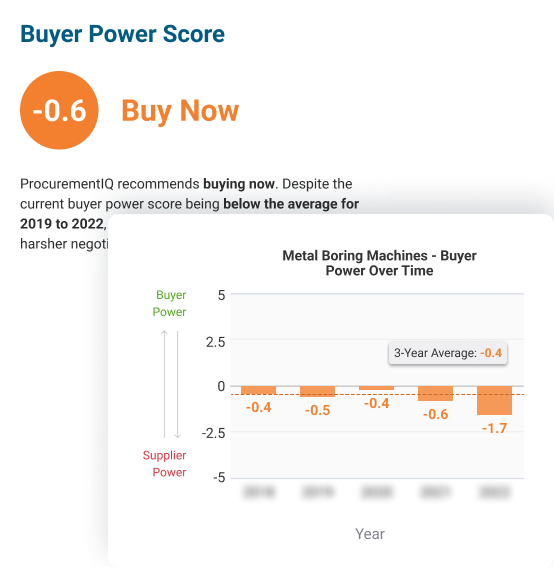
In 2026, buyer power amounts to -2.9 in the United States. Buyer power is most positively impacted by Price Driver Volatility. It is most negatively impacted by Product Specialization. Subscribers can access details on eight other factors that impact buyer power. Learn more
United States

Buyer power forecasts: your glimpse into the future
Develop strategies for the upcoming year and identify unforeseen opportunities for buying now
- Actionable "Buy Now" and "Buy Later" insights
- Near-real-time updates to current and forecast Buyer Power Scores
- Methodology and weightings for Buyer Power Score Components
Supply Chain Risk
The average level of supply chain risk is assessed as Very High, which has a negative impact on buyer power. The level of supply chain risk is affected by industry volatility, barriers to entry, competition, import penetration, regulation and industry financial risk. Buyers in this market can mitigate procurement and supply chain management risks by monitoring risk levels for individual first and second tier suppliers:
1st
Tier Suppliers
- Oil Drilling & Gas Extraction Firms
- Gas Pipeline Transportation Firms
- Truck & Bus Manufacturers
2nd
Tier Suppliers
- Oil & Gas Field Service Providers
- Oil & Gas Pipeline Construction Firms
- Steel Rolling & Drawing Firms
- Semiconductor & Circuit Manufacturers
Biggest Propane Suppliers in the US by Revenue
The largest Propane vendors by revenue in the US are Valero Energy Corp, Suburban Propane Partners, L.P. and Star Group LP. Subscribers can sort and filter by market share concentration, profit level and other factors. Learn more
| Supplier | Operational Size | Headquarters | Number of Employees | Market Share (%) | Market Share Performance (3yr trend) | Total Revenue ($ million) | Profit Level (%) | Risk Level |
|---|---|---|---|---|---|---|---|---|
| Exxon Mobil Corporation | Global | SPRING | >10,000 | 5-10 | ||||
| Conocophillips Co | Global | HOUSTON, TX | 1,001-10,000 | 5-10 | ||||
| Ferrellgas Partners, L.P. | National | Liberty | 1,001-10,000 | 5-10 | ||||
| Star Group LP | Regional | STAMFORD, CT | 1,001-10,000 | 5-10 | ||||
| Suburban Propane Partners, L.P. | National | WIPPANY, NJ | 1,001-10,000 | 5-10 | ||||
| Valero Energy Corp | Global | SAN ANTONIO, TX | 1,001-10,000 | < 5 | ||||
| Enterprise Products Partners L.P. | National | HOUSTON, TX | 1,001-10,000 | < 5 | ||||
| Chs Inc. | Global | Inver Grove Heights, MN | >10,000 | < 5 | ||||
| UGI Corporation | International | KING OF PRUSSIA, PA | 1,001-10,000 | < 5 | ||||
Looking for a list of suppliers by country?
Subscribers can access vendor information on Canadian and European suppliers, too. We also offer custom research services to help with vendor sourcing anywhere in the world.
Profit Analysis
The average profit margin across vendors in the Propane market is 19.7% and steady. Profit levels shift depending on suppliers' spend on wages, purchases and overhead. The highest cost component for vendors is Overhead. The cost trend for this component is stagnating, when considering movement between 2025 and 2026. To understand cost forecasts for 2027 and uncover the implications on profit, start your subscription. Learn more
Vendor & Supply Chain Analysis
The top four suppliers of propane account for less than 30.0% of total market revenue, indicating a low level of market share concentration. The resulting effect is substantial market price competition that works to keep propane prices low.
The average vendor in this market possesses notable financial risk, indicating some exposure to supplier bankruptcy or other financial distress.
Due to the highly commoditized nature of propane, there is a considerable risk of significant spikes and dips in the level of propane production as well as the demand for and price of propane, indicating a high level of supply chain risk.
With the United States being a net exporter of Propane, buyers have access to an abundant supply of propane and reduced shipping and costs, providing faster and more reliable delivery times. Being a net exporter also indicates a diverse range of suppliers, providing buyers with increased options for sourcing.
Supplier Information
Conocophillips Co
Conocophillips Co is a public company operating globally in the mining and manufacturing sectors. The company's offerings include diesel fuel, bunker fuel, propane and butane. Founded in 1875, the company is currently headquartered in HOUSTON, Texas, United States of America with an estimated 9500 employees.... Subscribe to learn more
Exxon Mobil Corporation
Exxon Mobil Corporation is a public company operating globally in the mining, manufacturing, manufacturing and finance and insurance sectors. The company's offerings include refining catalysts, plasticizers, paraffins, lubricating oils, synthetic resins. Founded in 1999, the company is currently headquartered... Subscribe to learn more
Ferrellgas Partners, L.P.
Ferrellgas Partners, LP is a retail distributor of propane and related equipment and supplies to residential, industrial, commercial, portable tank exchange, agricultural, wholesale, and other customers across the United States, the District of Columbia, and Puerto Rico. It operates a fleet of portable tanks... Subscribe to learn more
Star Group LP
Star Group, L.P. is a provider of heating-related products and services to residential and commercial customers in the Northeast and Mid-Atlantic US regions. It offers home heating oil and propane, as well as gasoline and diesel fuel. It installs, maintains, and repairs heating and air conditioning equipment... Subscribe to learn more
Suburban Propane Partners, L.P.
Suburban Propane Partners, L.P. is a public company operating nationally in the mining sector. The company's offerings include propane. Founded in 1928, the company is currently headquartered in WIPPANY, New Jersey, United States of America with an estimated 3174 employees. Subscribe to learn more
Chs Inc.
Chs Inc. is a public company operating globally in the mining and manufacturing sectors. The company's offerings include ethanol and propane. Founded in 1931, the company is currently headquartered in Inver Grove Heights, Minnesota, United States of America with an estimated 10014 employees. Subscribe to learn more
Enterprise Products Partners L.P.
Enterprise Products Partners L.P. is a midstream natural gas and crude oil pipeline company. It owns and operates natural gas liquids-related businesses of Enterprise Products Company and provides midstream energy services to producers and consumers of natural gas, NGLs, crude oil, petrochemicals, and refined... Subscribe to learn more
Growmark, Inc.
Growmark, Inc. is a private company operating internationally in the wholesale trade sector. The company's offerings include propane. Founded in 1927, the company is currently headquartered in Normal, Illinois, United States of America with an estimated 5500 employees. Subscribe to learn more
UGI Corporation
UGI Corp. /PA/ is a holding company that distributes, stores, transports, and markets energy products and related services. It owns and operates a natural gas utility that serves customers in Pennsylvania, Maryland, and West Virginia; an electric distribution utility that serves customers in Luzerne and Wyoming... Subscribe to learn more
Accelerate the vendor selection process
Get a clear picture of the competition in a market and discover which vendors are best-suited for your sourcing needs. Our supplier profiles include hard-to-find financial ranges for private companies, cover public company data and feature an interactive competitor matrix.
Procurement Management KPIs for the Propane Market
Managing vendor performance throughout the contract period is easier when tracking specific key performance indicators (KPIs). For example, buyers should monitor Average Order Value and Debt to Equity Ratio. Buyers may experience better performance throughout their contracts if they establish service level agreements (SLAs) based on Tracking and other factors.
| KPI | Level of Importance (1-5) | Measurements | Key Considerations |
|---|---|---|---|
| Average Order Value |
|
Average order value Average cost per order |
The supplier's average order value can provide insight into the typical buyers' purchasing patterns, as well as provide some indication of supplier reliability; high order values can indicate that buyers are comfortable relying on the supplier to provide large quantities of product. Although suppliers are unlikely to disclose per-order and overall profit margins, the supplier's average cost per order, combined with the average order value, can help buyers develop a rough idea of the supplier's profitability. |
| Debt to Equity Ratio |
|
Debt-to-equity ratio Current ratio |
Oil and gas operations are inherently capital intensive, thus increasing the likelihood that market suppliers are heavily leveraged. A high debt-to-equity ratio indicates the supplier's financing stems largely from debt rather than equity. A low current ratio indicates the supplier is at higher risk of financial distress or default. Suppliers that are more exposed to financial distress are more likely to be unable to fulfill obligations to buyers, thereby posing the risk of disrupting buyers' operations. |

Questions to Ask During Procurement Negotiations
How can I gain leverage during negotiations?
Quality Control
What systems do you have in place to measure the quality of your propane?
Do you conduct water and contaminant tests? If so, how frequently?
Supply Chain Risk
How often do you evaluate your suppliers' prices to ensure they are still competitive?
How do you adjust your operations in times of high demand and low demand? How do you mitigate demand volatility?
Competition
How does your company stand out from other similarly sized competitors?
How many of your buyers are repeat customers?
The ultimate prep for procurement negotations
View all 26 negotiation questions for this category when you subscribe.
Propane RFP Guidelines
What should my RFP include?
Organizational Overview
Buyers should describe the size of their organization and their location.
Buyers should specify the cities and state(s) where they require propane deliveries.
Statement Of Need
Buyers should specify the grade(s) of propane required.
Buyers should specify the acceptable mixes of propylene, butane, and other gaseous fuels.
Project Budget
Buyers should specify the total budget for the purchase.
Buyers should state their preference for a pricing model.
The RFP process made easy
Find out how you can access RFP templates for 800+ procurement categories to start writing better, more consistent RFPs.
We display average pricing information, trends and market data.
Our Reports include:
- Opportunity assessment
- Market dynamics
- Recent developments
- Positive and warning trends
- Buyer power levers
- Price environment and market pricing
- Geographic wage rates
- Global market updates
- Total cost of ownership
- Cost structure benchmarks and analysis
- Supply chain and vendors
- Global supplier breakdown
- Market share concentration
- Regulation and business requirements
- Vendor management and KPIs
- Sourcing strategy guidance