Procurement Market Intelligence Report
Railroad Track
Sourcing Guide & Market Intelligence
Smarter cost management starts with comprehensive market intelligence
 United States
 Global
Quick Navigation
Railroad Track Global Overview
Definition
Summary
Suppliers manufacture, fabricate and distribute steel rail, crossties, ballast, joints, switches and track accessories. Some suppliers also provide track construction services, although this report does not cover installation services. All other railroad products and services are excluded from this report, including locomotives and rail transportation services.
This Report Includes:
- Tangent Track
- Curved Track
- Track Transition Curve
Not in this Report:
- Track Construction Services
- Rail Transportation Services
- Locomotives
Global Railroad Track Procurement Trends
Discover the top international trends affecting procurement in the global Railroad Track market.
Warning Trends
Tariffs to negatively impact the commercial vehicles and components sector
- In June, the Trump Administration implemented 25.0% tariffs on all automobile and automobile parts imported into the United States, except for those imported from the United Kingdom, which face a reduced 10.0% tariff rate. Additionally, the administration raised tariffs on the import of aluminum, copper, and steel to 50.0%, all vital inputs for automotive manufacturing, and raised the tariffs on heavy trucks made outside the United States to 25.0%.
- In 2024, the value of automotive imports totaled $388.9 billion, which accounted for over a quarter of the total US automotive market revenue that year. Thus, these tariffs are likely to significantly increase the cost of motor vehicles, parts, and maintenance services, as both foreign manufacturers and domestic manufacturers with foreign sub-suppliers face higher import costs.
- According to the US International Trade Commission, Mexico and Canada account for 47.4% of motor vehicle imports to the United States, and 54.1% of motor vehicles bodies and parts. According to Anderson Economic Group (AEG), a Michigan-based economic consultancy, the broad-based 25.0% tariff could raise new car prices by $1,000 to $4,000, and up to $10,000 if manufacturers are unable to mitigate the tariff’s impact.
- Germany is a major exporter of crane trucks, vehicles, vehicle seating and interior trim, and other components in the sector. The higher automotive and metals tariffs will mean that many German companies, even those operating in the United States, will face higher costs to import subcomponents to their facilities in the United States.
- According to Telemetry Insights, many auto parts suppliers will be unable to absorb the tariffs or adjust to mitigate the tariff impact (e.g., relocating their facilities or splitting efforts across three countries). The introduction of 50.0% metals tariffs could drive up production costs further.
United States announces new tariffs on all imported steel
- In February 2025, the United States announced 25.0% tariffs on all imported steel with no exemptions or exceptions. The tariffs took effect on March 12, 2025. On June 4th, these tariffs were increased further to 50%. These tariffs were not impacted by a recent court decision that temporarily suspended duties on certain goods as they were implemented under Section 232 of the Trade Expansion Act.
- Previously, countries such as Canada, Mexico, and Brazil, the top exporters of steel to the United States, had exemptions from tariffs. These have now been removed and all imported steel, regardless of origin, will be subject to the 50.0% tariff. However, on May 8th, the US announced an agreement with the United Kingdom to remove all levies on steel exported from the UK.
- When tariffs on steel imports were introduced in March 2018, they contributed to an increase in the price of steel and steel products. According to the Bureau of Labor Statistics, the price of steel-milled products increased by 10.2% in the year after the tariffs were implemented. This market heavily relies on steel as an input and may be impacted by this policy.
Global Railroad Track Market - Suppliers by Region
| Country/Region | Number of Suppliers |
|---|---|
| #1 Europe | 10,580 |
| #2 China | 8,295 |
| #3 India | 6,015 |
Explore supplier concentration across the globe
We've uncovered the 11 top regions for global procurement, based on feedback from our most strategic clients. Access vendor counts for each unique region when you subscribe.
2
Geography Drilldown - US
Average Cost of Railroad Track
United States
2026 Market Pricing$500,000.00 to $X,XXX,XXX.XX
per mileAverage Price
Prices in the Railroad Track market range from $500,000.00 to $X,XXX,XXX.XX, depending on Weight & Type, Type of Tie Used, Cost of Other Track Material (OTM) and Design Elements. For example, lower prices are associated with 25-40 lb/yard rail ($500,000 to $2,000,000 per mile), Light-duty yard rails and Repurposed or relay rails, whereas higher prices are associated with 150 lb/yard rail ($1,000,000 to $3,000,000 per mile), High-strength steel rails and Heavy-duty mainline rails.
Need the scoop on international price trends?
Between our Europe and Canada collections, we provide price data for 350 markets so you can instantly compare prices across borders. Or, use our custom research services for intel on prices in any region across the globe.
Railroad Track Category Price Trends
Pricing trends are indicated by the compound annual growth rate (CAGR) during a set period of time. For the Railroad Track market, prices in the US have grown 0.7% from 2022 to 2025. Subscribers can access price trend forecasts, price driver projections and forward-looking cost structure data. Learn more
United States (2022-2025)


Wondering where prices are heading?
Price trend forecasts are available to subscribers, along with price driver projections and forward-looking cost structure data.
Cost Analysis - Total Cost of Ownership for Railroad Track
Total cost of ownership is Low in the Railroad Track market. The average cost of ownership differs depending on the contract but generally includes costs negotiated before the contract begins, costs billed during the contract period and unforeseen costs. For example, unforeseen costs in the form of Delays may raise the total cost of ownership unexpectedly.
Negotiated Before
Transportation
Customization
Set Up Fees
Billed During
Maintenance
Repairs
Inspections
Unforeseen
Delays
Emergencies
Buyer Power in Procurement Negotiations
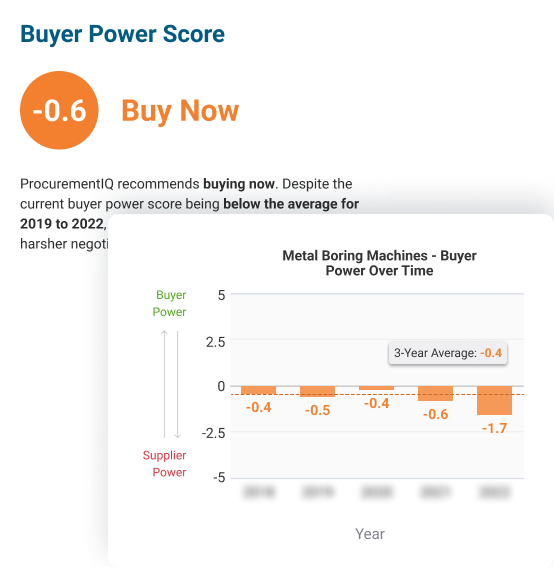
In 2026, buyer power amounts to -1.8 in the United States. Buyer power is most positively impacted by Recent Developments. It is most negatively impacted by Market Share Concentration. Subscribers can access details on eight other factors that impact buyer power. Learn more
United States
Buyer power forecasts: your glimpse into the future
Develop strategies for the upcoming year and identify unforeseen opportunities for buying now
- Actionable "Buy Now" and "Buy Later" insights
- Near-real-time updates to current and forecast Buyer Power Scores
- Methodology and weightings for Buyer Power Score Components
Supply Chain Risk
The average level of supply chain risk is assessed as High, which has a negative impact on buyer power. The level of supply chain risk is affected by industry volatility, barriers to entry, competition, import penetration, regulation and industry financial risk. Buyers in this market can mitigate procurement and supply chain management risks by monitoring risk levels for individual first and second tier suppliers:
1st
Tier Suppliers
- Steel Rolling & Drawing Companies
- Engineered Wood Product Manufacturers
- Concrete Contractors
- Stone, Concrete & Clay Wholesalers
2nd
Tier Suppliers
- Iron Ore Mines
- Woodworking Machinery Manufacturers
- Ready-Mix Concrete Manufacturers
- Stone Mines
Biggest Railroad Track Suppliers in the US by Revenue
The largest Railroad Track vendors by revenue in the US are Westinghouse Air Brake Technologies Corp, Vossloh AG and Evraz Plc. Subscribers can sort and filter by market share concentration, profit level and other factors. Learn more
| Supplier | Operational Size | Headquarters | Number of Employees | Market Share (%) | Market Share Performance (3yr trend) | Total Revenue ($ million) | Profit Level (%) | Risk Level |
|---|---|---|---|---|---|---|---|---|
| Caterpillar Inc. | Global | IRVING, IL | >10,000 | 5-10 | ||||
| Arcelormittal | Global | Luxembourg, LU | >10,001 | 5-10 | ||||
| Steel Dynamics, Inc. | National | FORT WAYNE, IN | >10,000 | 5-10 | ||||
| L.B. Foster Company | Global | PITTSBURGH, PA | 1,001-10,000 | 5-10 | ||||
| Evraz Plc | Global | London, UK | >10,001 | < 5 | ||||
| Westinghouse Air Brake Technologies Corp | Global | PITTSBURGH, PA | >10,000 | < 5 | ||||
| Vossloh AG | Global | Werdohl, DE | 1,001-10,000 | < 5 | ||||
| Harmer Steel Ltd. | International | Portland, OR | 51-100 | < 5 | ||||
| A&K Railroad Materials Inc. | International | Salt Lake City, UT | 101-250 | < 5 | ||||
Looking for a list of suppliers by country?
Subscribers can access vendor information on Canadian and European suppliers, too. We also offer custom research services to help with vendor sourcing anywhere in the world.
Profit Analysis
The average profit margin across vendors in the Railroad Track market is 3.6% and steady. Profit levels shift depending on suppliers' spend on wages, purchases and overhead. The highest cost component for vendors is Purchases. The cost trend for this component is falling, when considering movement between 2025 and 2026. To understand cost forecasts for 2027 and uncover the implications on profit, start your subscription. Learn more
Vendor & Supply Chain Analysis
Market share concentration has increased slightly due to more frequent mergers and acquisitions. Despite rising concentration, the railroad track market is still highly fragmented due to the geographically varied nature of track installation requirements, so buyers have benefited from price-based competition.
Lower profit margins and strong demand translate to a moderate level of average vendor risk for railroad track suppliers.
The supply chain for railroad track has a high degree of risk. Among upstream markets, iron ore mines and steel rolling and drawing suppliers carry the most risk because they often adjust prices in response to shifting demand and fluctuating steel costs; there is currently a global steel shortage, which has added to supply chain risk.
The United States is a net importer of railroad tracks, providing buyers with numerous suppliers they may consider and leverage when entering into contract negotiations. Buyers should be aware that the prices offered by global suppliers will depend on several factors, including the cost of transport and handling and the economic conditions of the suppliers' home countries.
Supplier Information
Arcelormittal
Arcelormittal is a public company operating globally in the manufacturing sector. The company's offerings include oil & gas casing & tubing, railroad track, sheet metal and nonelectric iron & steel wire. Founded in 2007, the company is currently headquartered in Luxembourg, Luxembourg with an estimated 125416... Subscribe to learn more
Caterpillar Inc.
Caterpillar Inc. is a public company operating globally in the manufacturing, manufacturing, manufacturing, wholesale trade, real estate and rental and leasing and other services (except public administration) sectors. The company's offerings include antifreeze, drilling & exploration equipment, drilling Subscribe to learn more
L.B. Foster Company
Foster L B Co. is a global technology solutions provider of engineered, manufactured products and services to build and support infrastructure. It organizes its business into three segments: the Rail, Technologies, and Services segment, which includes its manufacturing, distribution, and service businesses... Subscribe to learn more
Steel Dynamics, Inc.
Steel Dynamics, Inc. is a public company operating nationally in the manufacturing sector. The company's offerings include railroad track and sheet metal. Founded in 1993, the company is currently headquartered in FORT WAYNE, Indiana, United States of America with an estimated 12060 employees. Subscribe to learn more
A&K Railroad Materials Inc.
A&K Railroad Materials Inc. is a private company operating internationally in the manufacturing sector. The company's offerings include railroad track. Founded in 1959, the company is currently headquartered in Salt Lake City, Utah, United States of America with an estimated 175 employees. Subscribe to learn more
Evraz Plc
Evraz Plc is a public company operating globally in the manufacturing sector. The company's offerings include oil & gas casing & tubing, railroad track, grinding media and industrial welded carbon steel pipes. Founded in 1992, the company is currently headquartered in London, United Kingdom with an estimated... Subscribe to learn more
Harmer Steel Ltd.
Harmer Steel Ltd. is a private company operating internationally in the manufacturing sector. The company's offerings include railroad track. Founded in 1928, the company is currently headquartered in Portland, Oregon, United States of America with an estimated 37 employees. Subscribe to learn more
Healey Railroad Corporation
Healey Railroad Corporation is a private company operating nationally in the manufacturing sector. The company's offerings include railroad track. Founded in 1949, the company is currently headquartered in Jacksonville, Florida, United States of America with an estimated 175 employees. Subscribe to learn more
Vossloh AG
Vossloh AG is a public company operating globally in the manufacturing sector. The company's offerings include railroad track and rail signaling systems. Founded in 1989, the company is currently headquartered in Werdohl, Germany with an estimated 5500 employees. Subscribe to learn more
Accelerate the vendor selection process
Get a clear picture of the competition in a market and discover which vendors are best-suited for your sourcing needs. Our supplier profiles include hard-to-find financial ranges for private companies, cover public company data and feature an interactive competitor matrix.
Procurement Management KPIs for the Railroad Track Market
Managing vendor performance throughout the contract period is easier when tracking specific key performance indicators (KPIs). For example, buyers should monitor Customer Complaints and Customer Satisfaction (CSAT). Buyers may experience better performance throughout their contracts if they establish service level agreements (SLAs) based on Quality and other factors.
| KPI | Level of Importance (1-5) | Measurements | Key Considerations |
|---|---|---|---|
| Customer Complaints |
|
Negative reviews Client testimonials |
Customer complaints are a key way for buyers to uncover any points of weakness associated with a supplier. Customer complaints may relate to customer service, product quality, transparency, value, and other factors. Customer complaints relating to the quality of the railroad track should be given extra consideration. |
| Customer Satisfaction (CSAT) |
|
Positive customer reviews Client testimonials Referrals |
Strong customer satisfaction indicates that vendors are delivering goods and services as requested in the buyer's RFP. If vendors have a need for railroad track of a specific quality or characteristic, buyers can reference customer satisfaction scores to determine whether buyers similar to themselves were satisfied with the vendor's performance. |

Questions to Ask During Procurement Negotiations
How can I gain leverage during negotiations?
Supply Chain Risk
Has high volatility in the price of steel affected your business in the past three years?
What suppliers do you rely on? Do you have any backup suppliers in case your primary suppliers fail?
Inventory Control
How large is your current inventory?
How long will your current inventory last if there is a supply disruption?
Shipping
How do you ensure on-time delivery?
Who are your primary shipping suppliers? How long have you been using them?
The ultimate prep for procurement negotations
View all 24 negotiation questions for this category when you subscribe.
Railroad Track RFP Guidelines
What should my RFP include?
Organizational Overview
Buyers should give an overview of their organizations, including industry, products and services offered, location(s) and type of ownership (i.e., private).
Buyers should explain their current solutions and need for a new solution.
Statement Of Need
Buyers should provide specifications for the desired rail (e.g., type, weight, etc.).
Buyers should provide specifications for other rail parts (e.g., ties, ballasts, etc.).
Project Budget
Buyers should specify the total budget for the railroad track.
Vendors should include a cost schedule for their products, as well as any other costs for which buyers are responsible (e.g., shipping).
The RFP process made easy
Find out how you can access RFP templates for 800+ procurement categories to start writing better, more consistent RFPs.
We display average pricing information, trends and market data.
Our Reports include:
- Opportunity assessment
- Market dynamics
- Recent developments
- Positive and warning trends
- Buyer power levers
- Price environment and market pricing
- Geographic wage rates
- Global market updates
- Total cost of ownership
- Cost structure benchmarks and analysis
- Supply chain and vendors
- Global supplier breakdown
- Market share concentration
- Regulation and business requirements
- Vendor management and KPIs
- Sourcing strategy guidance