Procurement Market Intelligence Report
Unmanned Aerial Vehicles
Sourcing Guide & Market Intelligence
Smarter cost management starts with comprehensive market intelligence
 United States
 Global
Quick Navigation
Unmanned Aerial Vehicles Global Overview
Definition
Summary
Unmanned aerial vehicles (UAVs) are also referred to as drones. The Federal Aviation Administration (FAA) defines unmanned aerial vehicles as aircraft that are operated without the possibility of human intervention from within or on the aircraft. These machines must have the ability to be controlled remotely or fly autonomously if desired, which is what separates UAVs from recreational radio-controlled aircraft. They are also generally equipped with cameras and sensors.
This Report Includes:
- Drones
- Remote Controlled Unmanned Aerial Vehicles
Not in this Report:
- UAVs Used in Military Applications
- Unmanned Vehicles Without Flight Capabilities
Global Unmanned Aerial Vehicles Procurement Trends
Discover the top international trends affecting procurement in the global Unmanned Aerial Vehicles market.
Warning Trends
Public sector demand slumps as the government enters shutdown
- On October 1, the US federal government entered a shutdown after negotiations for a new appropriations bill failed.
- During a government shutdown, essential federal government operations, such as law enforcement, air-traffic control, and social security, persist, while nonessential operations are paused and workers involved in these operations are furloughed. Thus, the current shutdown is expected to result in 750,000 federal workers being furloughed, representing a $400 million reduction in daily expenditure by the federal government.
- This significant reduction in federal spending and operations will affect the entire US economy, weakening aggregate demand and slowing economic growth. For example, the 35-day government shutdown in Q1, 2019, reduced aggregate demand in both the public and private sectors, resulting in a 0.2% reduction in GDP growth that quarter.
- The effects of the shutdown are likely to be most acute in markets where the public sector is a major buyer segment, weakening demand and increasing average vendor risk by destabilizing important revenue streams.
- As negotiations for a new appropriations bill to reopen the government remain ongoing, ProcurementIQ will continue to monitor the situation and update this story with the latest information.
Tariffs to negatively impact the commercial vehicles and components sector
- In June, the Trump Administration implemented 25.0% tariffs on all automobile and automobile parts imported into the United States, except for those imported from the United Kingdom, which face a reduced 10.0% tariff rate. Additionally, the administration raised tariffs on the import of aluminum, copper, and steel to 50.0%, all vital inputs for automotive manufacturing, and raised the tariffs on heavy trucks made outside the United States to 25.0%.
- In 2024, the value of automotive imports totaled $388.9 billion, which accounted for over a quarter of the total US automotive market revenue that year. Thus, these tariffs are likely to significantly increase the cost of motor vehicles, parts, and maintenance services, as both foreign manufacturers and domestic manufacturers with foreign sub-suppliers face higher import costs.
- According to the US International Trade Commission, Mexico and Canada account for 47.4% of motor vehicle imports to the United States, and 54.1% of motor vehicles bodies and parts. According to Anderson Economic Group (AEG), a Michigan-based economic consultancy, the broad-based 25.0% tariff could raise new car prices by $1,000 to $4,000, and up to $10,000 if manufacturers are unable to mitigate the tariff’s impact.
- Germany is a major exporter of crane trucks, vehicles, vehicle seating and interior trim, and other components in the sector. The higher automotive and metals tariffs will mean that many German companies, even those operating in the United States, will face higher costs to import subcomponents to their facilities in the United States.
- According to Telemetry Insights, many auto parts suppliers will be unable to absorb the tariffs or adjust to mitigate the tariff impact (e.g., relocating their facilities or splitting efforts across three countries). The introduction of 50.0% metals tariffs could drive up production costs further.
United States announces new tariffs on all imported aluminum
- In February 2025, the United States announced 25.0% tariffs on all imported aluminum with no exemptions or exceptions. The tariffs took effect on March 12, 2025. On June 4th, these tariffs were increased further to 50%. These tariffs were not impacted by a recent court decision that temporarily suspended duties on certain goods as they were implemented under Section 232 of the Trade Expansion Act.
- Previously, countries such as Canada and Mexico, two of the top exporters of aluminum to the United States, had exemptions from tariffs and the rate was only 10.0%. These have now been removed and all imported aluminum, regardless of origin, will be subject to the 50.0% tariff.
- When tariffs on imported aluminum were implemented in March 2018, aluminum prices rose modestly. According to the Bureau of Labor Statistics (BLS), prices rose 1.2% in the year after the tariffs were introduced. Because this market relies on aluminum as an input, it may be impacted by this policy.
Global Unmanned Aerial Vehicles Market - Suppliers by Region
| Country/Region | Number of Suppliers |
|---|---|
| #1 China | 200 |
| #2 United States | 75 |
| #3 Europe | 30 |
Explore supplier concentration across the globe
We've uncovered the 11 top regions for global procurement, based on feedback from our most strategic clients. Access vendor counts for each unique region when you subscribe.
2
Geography Drilldown - US
Average Cost of Unmanned Aerial Vehicles
United States
2026 Market Pricing$100.00 to $XXX,XXX.XX
per unitAverage Price
Prices in the Unmanned Aerial Vehicles market range from $100.00 to $XXX,XXX.XX, depending on Flight Capabilities, Equipped Technology and Raw Materials. For example, lower prices are associated with Basic capabilities (30mph max speed, 1-pound payload, etc.) ($500 to $6,000 per unit), whereas higher prices are associated with Advanced capabilities (e.g., 100mph max speed, 5-pound payload, etc.) ($2,500 to $350,000 per unit).
Need the scoop on international price trends?
Between our Europe and Canada collections, we provide price data for 350 markets so you can instantly compare prices across borders. Or, use our custom research services for intel on prices in any region across the globe.
Unmanned Aerial Vehicles Category Price Trends
Pricing trends are indicated by the compound annual growth rate (CAGR) during a set period of time. For the Unmanned Aerial Vehicles market, prices in the US have grown 1.5% from 2022 to 2025. Subscribers can access price trend forecasts, price driver projections and forward-looking cost structure data. Learn more
United States (2022-2025)


Wondering where prices are heading?
Price trend forecasts are available to subscribers, along with price driver projections and forward-looking cost structure data.
Cost Analysis - Total Cost of Ownership for Unmanned Aerial Vehicles
Total cost of ownership is High in the Unmanned Aerial Vehicles market. The average cost of ownership differs depending on the contract but generally includes costs negotiated before the contract begins, costs billed during the contract period and unforeseen costs. For example, unforeseen costs in the form of Duties & Taxes may raise the total cost of ownership unexpectedly.
Negotiated Before
Pre-evaluation
Billed During
Repairs
Training
Unforeseen
Duties & Taxes
Buyer Power in Procurement Negotiations
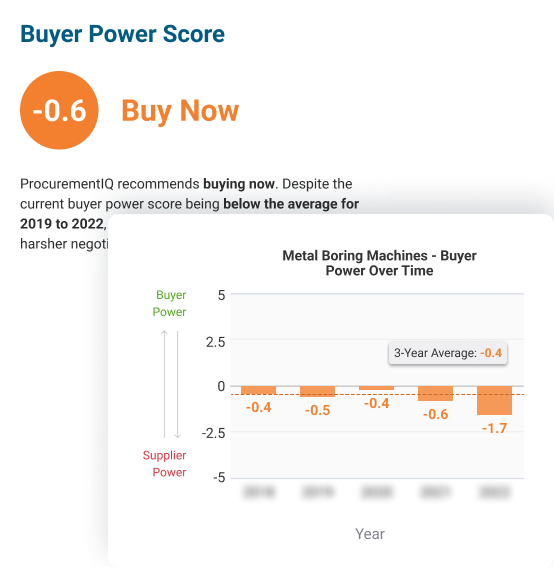
In 2026, buyer power amounts to -2.5 in the United States. Buyer power is most positively impacted by Recent Developments. It is most negatively impacted by Availability of Substitutes. Subscribers can access details on eight other factors that impact buyer power. Learn more
United States
Buyer power forecasts: your glimpse into the future
Develop strategies for the upcoming year and identify unforeseen opportunities for buying now
- Actionable "Buy Now" and "Buy Later" insights
- Near-real-time updates to current and forecast Buyer Power Scores
- Methodology and weightings for Buyer Power Score Components
Supply Chain Risk
The average level of supply chain risk is assessed as Very High, which has a negative impact on buyer power. The level of supply chain risk is affected by industry volatility, barriers to entry, competition, import penetration, regulation and industry financial risk. Buyers in this market can mitigate procurement and supply chain management risks by monitoring risk levels for individual first and second tier suppliers:
1st
Tier Suppliers
- Nonferrous Metal Product Manufacturers
- Fabricated Plastic Product Manufacturers
- Circuit Board & Electronic Component Manufacturers
2nd
Tier Suppliers
- Aluminum Manufacturers
- Petroleum Refiners
- Semiconductor & Circuit Manufacturers
Biggest Unmanned Aerial Vehicles Suppliers in the US by Revenue
The largest Unmanned Aerial Vehicles vendors by revenue in the US are Textron Inc., FLIR Systems Inc. and SZ DJI Technology Co., Ltd. Subscribers can sort and filter by market share concentration, profit level and other factors. Learn more
| Supplier | Operational Size | Headquarters | Number of Employees | Market Share (%) | Market Share Performance (3yr trend) | Total Revenue ($ million) | Profit Level (%) | Risk Level |
|---|---|---|---|---|---|---|---|---|
| SZ DJI Technology Co., Ltd. | Global | Shenzhen, CN | >10,000 | 25+ | ||||
| Lockheed Martin Corporation | Global | BETHESDA | >10,000 | < 5 | ||||
| Boeing Co | Global | ARLINGTON, WA | >10,000 | < 5 | ||||
| Intel Corporation | Global | SANTA CLARA | >10,000 | < 5 | ||||
| Northrop Grumman Corp | Global | Falls Church | >10,000 | < 5 | ||||
| Textron Inc. | Global | PROVIDENCE, RI | >10,000 | < 5 | ||||
| 3D Robotics Inc. | International | Albuquerque, NM | 51-100 | < 5 | ||||
| Elbit Systems Ltd | HAIFA, ISRAEL | >10,000 | < 5 | |||||
| FLIR Systems Inc. | Global | WILSONVILLE | 1,001-10,000 | < 5 | ||||
Looking for a list of suppliers by country?
Subscribers can access vendor information on Canadian and European suppliers, too. We also offer custom research services to help with vendor sourcing anywhere in the world.
Profit Analysis
The average profit margin across vendors in the Unmanned Aerial Vehicles market is 10.0% and steady. Profit levels shift depending on suppliers' spend on wages, purchases and overhead. The highest cost component for vendors is Purchases. The cost trend for this component is falling, when considering movement between 2025 and 2026. To understand cost forecasts for 2027 and uncover the implications on profit, start your subscription. Learn more
Vendor & Supply Chain Analysis
Average vendor risk is low in the market. Buyers are at minimal risk of business disruptions due to poor vendor financial health.
High market share concentration harms buyer power because a small number of companies maintain a significant influence on pricing. Nonetheless, because this market is in its growth stage, competition is still fairly strong, which helps to limit high concentration.
The majority of supply chain risk comes from suppliers’ reliance on nonferrous metals, such as aluminum. Because many of these metals are traded on the global market, they are subject to high volatility stemming from global supply and demand trends.
The United States is a net importer of UAVs, meaning it imports more UAVs than it exports. This adds risk for buyers as the supply of UAVs can be negatively effected by factors like currency exchange rates and trade policies.
Supplier Information
SZ DJI Technology Co., Ltd.
SZ DJI Technology Co., Ltd. is a private company operating globally in the manufacturing sector. The company's offerings include unmanned aerial vehicles. Founded in 2006, the company is currently headquartered in Shenzhen, Nanshan District, China with an estimated 10000 employees. Subscribe to learn more
3D Robotics Inc.
3D Robotics Inc. is a private company operating internationally in the manufacturing sector. The company's offerings include unmanned aerial vehicles. Founded in 2024, the company is currently headquartered in Albuquerque, New Mexico, United States of America with an estimated 75 employees. Subscribe to learn more
Aerovironment, Inc.
Aerovironment, Inc. is a public company operating in the manufacturing sector. The company's offerings include unmanned aerial vehicles. Founded in 2017, the company is currently headquartered in ARLINGTON, Virginia, United States of America with an estimated 1214 employees. Subscribe to learn more
Boeing Co
Boeing Co is a public company operating globally in the manufacturing sector. The company's offerings include unmanned aerial vehicles, aircraft maintenance & repair and aeronautical engineering services. Founded in 1916, the company is currently headquartered in Seattle, Washington, United States of America... Subscribe to learn more
Elbit Systems Ltd
Elbit Systems Ltd is a public company operating in the manufacturing sector. The company's offerings include unmanned aerial vehicles and night vision equipment. Founded in 2014, the company is currently headquartered in HAIFA with an estimated 18407 employees. Subscribe to learn more
FLIR Systems Inc.
FLIR Systems, Inc. is a designer, manufacturer, and marketer of thermal imaging and other sensing products and systems for the global government, industrial and commercial markets applications. It organizes its business into two segments: the Industrial Technologies segment, which develops and manufactures... Subscribe to learn more
Intel Corporation
Intel Corporation is a global integrated device manufacturer that designs, develops, manufactures, markets, and services central processing units (CPUs) and related solutions. It offers CPUs and chipsets, a system on a chip (SoC), or a multichip package based on Intel® architecture that processes data and... Subscribe to learn more
Lockheed Martin Corporation
Lockheed Martin Corporation is a global security and aerospace company serving the US and international customers in the defense, space, intelligence, homeland security, and information technology industries. It researches, designs, develops, manufactures, integrates, and sustains advanced military aircraft... Subscribe to learn more
Northrop Grumman Corp
Northrop Grumman Corporation is a global aerospace and defense technology company that delivers products, services, and solutions to support national security priorities. It organizes its business into four segments: the Aeronautics Systems segment, which develops military aircraft systems; the Defense Systems... Subscribe to learn more
Accelerate the vendor selection process
Get a clear picture of the competition in a market and discover which vendors are best-suited for your sourcing needs. Our supplier profiles include hard-to-find financial ranges for private companies, cover public company data and feature an interactive competitor matrix.
Procurement Management KPIs for the Unmanned Aerial Vehicles Market
Managing vendor performance throughout the contract period is easier when tracking specific key performance indicators (KPIs). For example, buyers should monitor Average Order Value and Customer Satisfaction (CSAT). Buyers may experience better performance throughout their contracts if they establish service level agreements (SLAs) based on Accuracy and other factors.
| KPI | Level of Importance (1-5) | Measurements | Key Considerations |
|---|---|---|---|
| Average Order Value |
|
Total revenue Number of orders |
The average order value represents the revenue generated from the average order. The average order value can be used to evaluate a company’s reputation. |
| Customer Satisfaction (CSAT) |
|
Number of positive customer responses Number of customer responses |
Customer satisfaction represents customers’ overall satisfaction with a company. Customer satisfaction can be used to evaluate a company’s reputation. |

Questions to Ask During Procurement Negotiations
How can I gain leverage during negotiations?
Experience and Expertise
How long have you been manufacturing drones?
How long have you served operators in my market?
Supply Chain Risk
Do you source materials with high exposure to market disruptions resulting from the coronavirus? How are you coping with these disruptions?
How diversified is your supplier base for inputs? Do you source from multiple suppliers in different global regions?
Quality Control
Do you have an established quality control department?
What kind of quality control procedures does your company have in place?
The ultimate prep for procurement negotations
View all 30 negotiation questions for this category when you subscribe.
Unmanned Aerial Vehicles RFP Guidelines
What should my RFP include?
Organizational Overview
Buyers should include an overview of their operations (industrial, construction, marketing, real estate, etc.).
Buyers should provide a detailed description of their operational structure, including to whom vendors will report.
Statement Of Need
Buyers should list their specific applications for UAVs.
Beyond performing the application, buyers should state how they would like the UAVs to improve operations (e.g. cost savings, time savings, etc.).
Project Budget
Buyers should explicitly state the amount for the award.
Buyers should explain the schedule with which payments will be made.
The RFP process made easy
Find out how you can access RFP templates for 800+ procurement categories to start writing better, more consistent RFPs.
We display average pricing information, trends and market data.
Our Reports include:
- Opportunity assessment
- Market dynamics
- Recent developments
- Positive and warning trends
- Buyer power levers
- Price environment and market pricing
- Geographic wage rates
- Global market updates
- Total cost of ownership
- Cost structure benchmarks and analysis
- Supply chain and vendors
- Global supplier breakdown
- Market share concentration
- Regulation and business requirements
- Vendor management and KPIs
- Sourcing strategy guidance