Procurement Market Intelligence Report
Surveillance Cameras
Sourcing Guide & Market Intelligence
Smarter cost management starts with comprehensive market intelligence
 United States
 Canada
 Europe
 Global
Quick Navigation
Surveillance Cameras Global Overview
Definition
Summary
This report is intended to assist buyers of surveillance and security cameras. Surveillance cameras are used to monitor behavior or locations, usually with the intention of protecting people or property. Common suppliers of surveillance cameras include technology companies and security companies. Key buyers include government agencies, retailers, property managers, hotels and casinos.
This Report Includes:
- Surveillance cameras
- Night vision cameras
- Wide lens cameras
Not in this Report:
- Recording devices
- Monitors
- Alarm systems
- Motion detectors
- Body Cameras
Global Surveillance Cameras Procurement Trends
Discover the top international trends affecting procurement in the global Surveillance Cameras market.
Warning Trends
Elevated Tariffs are increasing prices for law enforcement, security, and safety equipment
- The Trump administration’s reciprocal tariffs, which place broad tariffs on all imports from most US trade partners, are set to take effect on August 7 after the tariff rates were finalized on August 1.
- As a result, all foreign suppliers in law enforcement, security, and safety equipment will face significantly increased costs when selling products to US buyers, and domestic manufacturers of these goods will face higher costs when sourcing key inputs for these products.
- Countries such as China, Germany, Mexico, Thailand, and Vietnam are leading sources of imports in this sector, providing high quantities of goods such as safes, locks, security cameras, security systems, and personal protective equipment. Starting August 7, imports from China, Germany, Mexico, Thailand, and Vietnam will be subject to tariff rates of 54.0%, 15.0%, 25.0%, 20.0%, and 19.0% respectively.
- Elevated tariffs are likely to impact pricing and supply chains in this industry due to the United States’ reliance on imported manufactured goods, which gives foreign suppliers the leverage to pass through the costs of tariffs to buyers and domestic suppliers the leverage to raise prices.
- Consequently, the Yale Budget Lab projects a 39.2% average increase in metal product prices, impacting products such as security gates and safes. Electronic security devices, such as cameras or metal detectors, are projected to rise by 18.7% in price. In the personal protective equipment market, prices are forecast to rise by between 11.0% and 37.5%, depending on the type of equipment and materials used to make it.
The FBI has warned that Chinese government hackers could disrupt critical infrastructure in the United States in the event of a conflict with China.
- The FBI announced on January 31 that it had thwarted an attempt by the Chinese government hacking group “Volt Typhoon” to plant malware onto electric power, water treatment and transportation systems in the United States using compromised end-of-life small office/home office (SOHO) routers from Cisco and Netgear. End-of-life devices have been discontinued by manufacturers and no longer receive software patches to eliminate vulnerabilities, which makes these devices attractive targets for hackers.
- US officials assess that China might disrupt critical US infrastructure to prevent the United States from responding to a Chinese attack on Taiwan. Volt Typhoon has been particularly active in Hawaii and Guam, which house some of the largest US military and naval installations in the Pacific.
- The FBI announced on September 18 that it had disrupted a botnet from another Chinese government hacking group known as “Flax Typhoon”. Flax Typhoon had infected 260,000 networking devices around the world, including SOHO routers, internet protocol (IP) cameras, digital video recorders (DVRs), and network-attached storage (NAS) devices.n
- The Cybersecurity and Infrastructure Security Agency (CISA) recommends that organizations use its Known Exploited Vulnerabilities (KEV) Catalog to identify any vulnerabilities in their systems. Furthermore, organizations can subscribe to receive KEV Catalog updates from the agency and may contact the agency for advice.
Neutral
The EU finalizes the Cyber Resilience Act
- On September 15, 2022, the EU proposed the Cyber Resilience Act (CRA), which aims to increase the focus on cybersecurity throughout the development lifecycle of digital products, protecting consumers and businesses from increasingly dangerous cyber threats.
- Other objectives include creating a coherent cybersecurity framework for producers to comply with, creating an obligation to secure products for the entire lifecycle of the products, as well as increasing the visibility of security properties in digital products.
- The goal of the Act is to ultimately create hardware and software products that are more secure against cyberattacks. Fines can reach up to a maximum of €15 million or 2.5% of global turnover, whichever is the higher of the two.
- On November 30, 2023, The European Commission, Council, and Parliament came to an agreement on the text of the Cyber Resilience Act and formally adopted the act on March 12, 2024.
- The CRA will be rolled out through a phased transition plan during the second half of 2024. The majority of the provisions will be enforceable in 2027, three years after publication.
Global Surveillance Cameras Market - Suppliers by Region
| Country/Region | Number of Suppliers |
|---|---|
| #1 Oceania & Southeast Asia | 32,255 |
| #2 China | 23,630 |
| #3 Europe | 21,205 |
Explore supplier concentration across the globe
We've uncovered the 11 top regions for global procurement, based on feedback from our most strategic clients. Access vendor counts for each unique region when you subscribe.
2
Geography Drilldown - US, Canada & Europe
Average Cost of Surveillance Cameras
United States
2026 Market Pricing$50.00 to $XX,XXX.XX
per camera
Average Price
Prices in the Surveillance Cameras market range from $50.00 to $XX,XXX.XX, depending on Compatibility, Image Quality, Additional features and Brand. For example, lower prices are associated with Analog-based systems ($50.00 to $250 per camera), whereas higher prices are associated with Internet protocol (IP) cameras ($50.00 to $14,000 per camera).
Need the scoop on international price trends?
Between our Europe and Canada collections, we provide price data for 350 markets so you can instantly compare prices across borders. Or, use our custom research services for intel on prices in any region across the globe.
Surveillance Cameras Category Price Trends
Pricing trends are indicated by the compound annual growth rate (CAGR) during a set period of time. For the Surveillance Cameras market, prices in the US have grown 1.3% from 2022 to 2025. and +0.3% in Europe.
United States (2022-2025)

Europe (2022-2025)
Compound Annual Growth Rate
Wondering where prices are heading?
Price trend forecasts are available to subscribers, along with price driver projections and forward-looking cost structure data.
Cost Analysis - Total Cost of Ownership for Surveillance Cameras
Total cost of ownership is Medium in the Surveillance Cameras market. The average cost of ownership differs depending on the contract but generally includes costs negotiated before the contract begins, costs billed during the contract period and unforeseen costs. For example, unforeseen costs in the form of Cancellations may raise the total cost of ownership unexpectedly.
Negotiated Before
Installation
Billed During
Maintenance
Unforeseen
Cancellations
Buyer Power in Procurement Negotiations
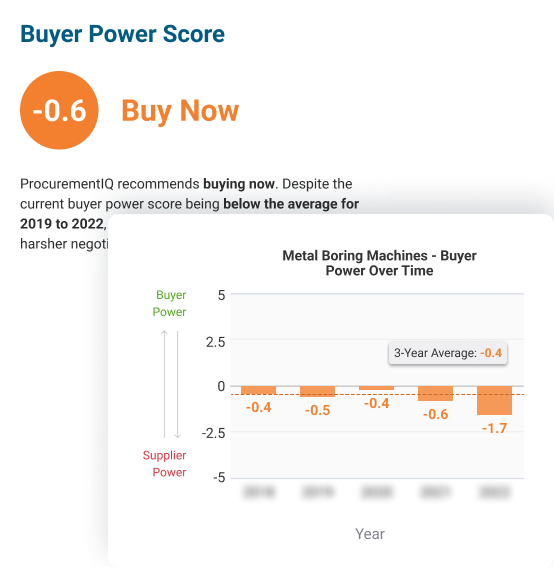
In 2026, buyer power amounts to -1.1 in the United States. Buyer power is most positively impacted by Price Driver Volatility. It is most negatively impacted by Market Share Concentration. Subscribers can access details on eight other factors that impact buyer power. Learn more
United States

Buyer power forecasts: your glimpse into the future
Develop strategies for the upcoming year and identify unforeseen opportunities for buying now
- Actionable "Buy Now" and "Buy Later" insights
- Near-real-time updates to current and forecast Buyer Power Scores
- Methodology and weightings for Buyer Power Score Components
Supply Chain Risk
The average level of supply chain risk is assessed as Medium, which has a negative impact on buyer power. The level of supply chain risk is affected by industry volatility, barriers to entry, competition, import penetration, regulation and industry financial risk. Buyers in this market can mitigate procurement and supply chain management risks by monitoring risk levels for individual first and second tier suppliers:
1st
Tier Suppliers
- Laminated Plastics Manufacturers
- Circuit Board & Electronic Component Manufacturers
- Wire & Cable Manufacturers
2nd
Tier Suppliers
- Plastic and Resin Manufacturers
- Semiconductor & Circuit Manufacturers
- Copper rolling, drawing
Biggest Surveillance Cameras Suppliers in the US by Revenue
The largest Surveillance Cameras vendors by revenue in the US are Hanwha Corp., Mobotix Ag and Robert Bosch GmbH. Subscribers can sort and filter by market share concentration, profit level and other factors. Learn more
| Supplier | Operational Size | Headquarters | Number of Employees | Market Share (%) | Market Share Performance (3yr trend) | Total Revenue ($ million) | Profit Level (%) | Risk Level |
|---|---|---|---|---|---|---|---|---|
| Canon Inc. | Global | Tokyo, JP | >10,001 | 5-10 | ||||
| Hikvision Digital Technology Company Ltd. | Global | Hangzhou, CN | >10,001 | 5-10 | ||||
| Zhejiang Dahua Technology Company Ltd. | Global | Hangzhou, CN | >10,001 | 5-10 | ||||
| Panasonic Corp | Global | Kadoma, JP | >10,001 | < 5 | ||||
| Cisco Systems, Inc. | Global | SAN JOSE, CA | >10,000 | < 5 | ||||
| Honeywell International Inc. | Global | CHARLOTTE | >10,000 | < 5 | ||||
| Johnson Controls International Plc | Global | CORK | >10,000 | < 5 | ||||
| Wesco International, Inc. | Global | PITTSBURGH, PA | >10,000 | < 5 | ||||
| Western Digital Corporation | Global | SAN JOSE, CA | >10,000 | < 5 | ||||
Looking for a list of suppliers by country?
Subscribers can access vendor information on Canadian and European suppliers, too. We also offer custom research services to help with vendor sourcing anywhere in the world.
Profit Analysis
The average profit margin across vendors in the Surveillance Cameras market is 4.9% and steady. Profit levels shift depending on suppliers' spend on wages, purchases and overhead. The highest cost component for vendors is Purchases. The cost trend for this component is falling, when considering movement between 2025 and 2026. To understand cost forecasts for 2027 and uncover the implications on profit, start your subscription. Learn more
Vendor & Supply Chain Analysis
Market share concentration is low in this market. As a result, vendors frequently engage in price-based competition to the benefit of buyers.
Supply chain risk is moderate in this market though it is unlikely to be detrimental to a buyer's operations. Nonetheless, ongoing shortages of semiconductors are increasing the risk of delivery delays and price spikes for surveillance cameras.
Despite low profit margins on average, the average financial risk among surveillance camera vendors is moderate. The widespread use and consistent demand for surveillance cameras among many different buying industries help ensure vendor continuity to an extent.
The United States is a net importer of surveillance cameras, meaning it imports more cameras than it exports. Buyers have greater access to competitive goods that may have lower prices or unique features.
Supplier Information
Canon Inc.
Canon Inc. is a public company operating globally in the manufacturing, manufacturing, information and real estate & rental & leasing sectors. The company's offerings include printing & writing paper, print servers, computer printers, video management software, printer toner. Founded in 1937, the company Subscribe to learn more
Hikvision Digital Technology Company Ltd.
Hikvision Digital Technology Company Ltd. is a public company operating globally in the manufacturing sector. The company's offerings include surveillance cameras and closed-circuit television systems. Founded in 2001, the company is currently headquartered in Hangzhou, China with an estimated employee count... Subscribe to learn more
Zhejiang Dahua Technology Company Ltd.
Zhejiang Dahua Technology Company Ltd. is a public company operating globally in the manufacturing sector. The company's offerings include surveillance cameras and closed-circuit television systems. Founded in 2013, the company is currently headquartered in Hangzhou, China with an estimated employee count... Subscribe to learn more
Cisco Systems, Inc.
Cisco Systems, Inc. is a public company operating globally in the manufacturing, information and professional, scientific and technical services sectors. The company's offerings include rail signaling systems, office phones, print servers, computer servers, database management systems. Founded in 1984, the... Subscribe to learn more
Hanwha Corp.
Hanwha Corp. is a public company operating in the utilities and manufacturing sectors. The company's offerings include cnc lathes & turning centers, surveillance cameras and closed-circuit television systems.. Subscribe to learn more
Honeywell International Inc.
Honeywell International Inc. is a global technology and manufacturing company that designs, develops, produces, and markets consumer and industrial products. It organizes its business into four reportable business segments: the Aerospace segment, which supplies products, software, and services for aircraft;... Subscribe to learn more
Johnson Controls International Plc
Johnson Controls International plc is a holding company that provides engineering, manufacturing, and commissioning of building products and systems. It designs, sells, installs, and services HVAC equipment and systems, control systems, security systems, fire detection, and fire suppression systems and equipment.... Subscribe to learn more
Mobotix Ag
Mobotix Ag is a public company operating in the manufacturing and information sectors. The company's offerings include surveillance cameras. Founded in 2013, the company is currently headquartered in United States of America. Subscribe to learn more
Motorola Solutions, inc.
Motorola Solutions, Inc. is a global technology company focusing on safety and security. It designs and advances on-premises, cloud-based, and hybrid software solutions and services, such as cybersecurity subscription services and managed and support services, across land mobile radio communications, video... Subscribe to learn more
Accelerate the vendor selection process
Get a clear picture of the competition in a market and discover which vendors are best-suited for your sourcing needs. Our supplier profiles include hard-to-find financial ranges for private companies, cover public company data and feature an interactive competitor matrix.
Procurement Management KPIs for the Surveillance Cameras Market
Managing vendor performance throughout the contract period is easier when tracking specific key performance indicators (KPIs). For example, buyers should monitor Customer Retention Rate and Defect Density. Buyers may experience better performance throughout their contracts if they establish service level agreements (SLAs) based on Installation and Configuration and other factors.
| KPI | Level of Importance (1-5) | Measurements | Key Considerations |
|---|---|---|---|
| Customer Retention Rate |
|
Number of customers at start of period Number of customers at end of period Number of customers added within period |
The customer retention rate represents the number of customers a company is able to retain over a set timeframe. This is an indication of how successful a company is at attracting and retaining customers. |
| Defect Density |
|
Number of units Number of defective units |
The defect density represents the share of defective products a company produces. The defect density can be used to determine whether manufacturing, assembly or quality assurance processes require improvement. |

Questions to Ask During Procurement Negotiations
How can I gain leverage during negotiations?
Logistics
Where are your domestic and international distribution facilities located?
What partners do you work with to ensure timely deliveries? How long have you been working together?
Supply Chain Risk
Do you source materials with high exposure to market disruptions resulting from the coronavirus pandemic? How are you coping with these disruptions?
How diversified is your supplier base for inputs? Do you source from multiple suppliers in different regions across the globe?
Cost Containment
How have fluctuations in raw material prices impacted surveillance camera prices in the past three years? What do you expect in the next three years?
How do you maintain competitive product prices even when your overhead costs fluctuate?
The ultimate prep for procurement negotations
View all 39 negotiation questions for this category when you subscribe.
Surveillance Cameras RFP Guidelines
What should my RFP include?
Organizational Overview
Buyers should describe the size of their organization and provide information about their operations.
Buyers should specify their location and the type of environment that the cameras will be recording in. This should include information about potential hazards that could disrupt recording.
Statement Of Need
Buyers should state the type of surveillance cameras required and the quantity needed. If specific brands or resolutions are required, buyers should include this as well.
Buyers should include information about the total surveillance system in order to ensure product compatibility and operational efficiency.
Project Budget
Buyers should either specify their budget for surveillance cameras or the number of units required.
Buyers should provide information about when payment will occur, such as whether payment is awarded upon the arrival of the goods or over a period of time.
The RFP process made easy
Find out how you can access RFP templates for 800+ procurement categories to start writing better, more consistent RFPs.
We display average pricing information, trends and market data.
Our Reports include:
- Opportunity assessment
- Market dynamics
- Recent developments
- Positive and warning trends
- Buyer power levers
- Price environment and market pricing
- Geographic wage rates
- Global market updates
- Total cost of ownership
- Cost structure benchmarks and analysis
- Supply chain and vendors
- Global supplier breakdown
- Market share concentration
- Regulation and business requirements
- Vendor management and KPIs
- Sourcing strategy guidance