Procurement Market Intelligence Report
Air Handling Units
Sourcing Guide & Market Intelligence
Smarter cost management starts with comprehensive market intelligence
 United States
 Global
Quick Navigation
Air Handling Units Global Overview
Definition
Summary
Air handling units are components of heating, ventilation, and air-conditioning (HVAC) systems made up of an evaporator coil, blower motor, and electric heat strips. The air handler unit is a vital component for all-electric HVAC systems, designed to either condition outside air and circulates it through an HVAC system or condition and recirculate air from inside a building. Key buyers include residential, construction, hospitality, and industrial sectors.
This Report Includes:
- Warm Air Heating Combination Units
- Packaged Terminal Air Conditioners (PTACs)
Not in this Report:
- Filters
- Heating Coils
Global Air Handling Units Procurement Trends
Discover the top international trends affecting procurement in the global Air Handling Units market.
Warning Trends
Tariffs to negatively impact the distribution and conditioning systems equipment sector
- The Trump Administration’s reciprocal tariffs, which apply general tariff rate increases to most leading US trade partners, are set to take effect on August 7, after the administration finalized the rates on August 1. These changes will significantly increase the tariff rate on leading distribution and conditioning systems exporting countries, including the European Union (15.0%), Canada (35.0%), China (54.0%), Mexico (25.0%), Japan (15.0%), and South Korea (15.0%).
- Distribution and conditioning systems equipment manufacturers in the United States will pay more for many foreign components and parts, such as heating and cooling equipment. Major manufacturers that operate in these markets, including Carrier, Daikin, Lennox, and Trane, have a manufacturing presence in Mexico and source components from tariff-impacted countries like China.
- According to the Heating, Air-Conditioning, & Refrigeration Distributors International (HARDI), over 66.0% of heating, ventilation, air conditioning, and refrigeration products are made in or use components imported from Canada, China, or Mexico. As price increases are passed down the supply chain, buyers will likely see price increases for key distribution and conditioning systems equipment.
- China is even more prevalent in several distribution and conditioning component markets, raising upstream supply chain risk following these tariffs. For example, according to the International Energy Agency, 95.0% of heat pump compressors were manufactured in China in 2023, and China accounts for half of the global trade in heat pump components.
Aluminum and steel tariffs are extended to the metals content of imported appliances
- On June 3rd, the Trump Administration announced an increase of aluminum and steel tariffs to 50.0%, up from the 25.0% rate imposed a few months prior.
- The administration has since introduced plans to apply these tariffs to the aluminum and steel content of imported appliances starting June 23rd.
- Under the new rule, imported appliances and appliance components will face 50.0% tariffs on the value of their aluminum and steel content. Aluminum and Steel account for more than a third of the total value of the average appliance, meaning this rule change will significantly increase the average import fees on appliances.
- In response to this rule change, appliance retailers, such as Home Depot, have indicated they will rely more heavily on domestic manufacturers to avoid the tariffs, creating a risk of shortages and long order backlogs. Alternatively, Walmart’s CEO has indicated the company will raise prices to compensate for the higher appliance costs.
- While differing tariff response strategies will result in varying supply chain and price impacts, the Yale Budget Lab projects machinery and equipment prices to rise by 9.4% on average due to this policy.
United States announces new tariffs on all imported steel
- In February 2025, the United States announced 25.0% tariffs on all imported steel with no exemptions or exceptions. The tariffs took effect on March 12, 2025. On June 4th, these tariffs were increased further to 50%. These tariffs were not impacted by a recent court decision that temporarily suspended duties on certain goods as they were implemented under Section 232 of the Trade Expansion Act.
- Previously, countries such as Canada, Mexico, and Brazil, the top exporters of steel to the United States, had exemptions from tariffs. These have now been removed and all imported steel, regardless of origin, will be subject to the 50.0% tariff. However, on May 8th, the US announced an agreement with the United Kingdom to remove all levies on steel exported from the UK.
- When tariffs on steel imports were introduced in March 2018, they contributed to an increase in the price of steel and steel products. According to the Bureau of Labor Statistics, the price of steel-milled products increased by 10.2% in the year after the tariffs were implemented. This market heavily relies on steel as an input and may be impacted by this policy.
Global Air Handling Units Market - Suppliers by Region
| Country/Region | Number of Suppliers |
|---|---|
| #1 China | 7,665 |
| #2 Europe | 7,355 |
| #3 United States | 2,775 |
Explore supplier concentration across the globe
We've uncovered the 11 top regions for global procurement, based on feedback from our most strategic clients. Access vendor counts for each unique region when you subscribe.
2
Geography Drilldown - US
Average Cost of Air Handling Units
United States
2026 Market Pricing$3,059.00 to $XX,XXX.XX
per unitAverage Price
Prices in the Air Handling Units market range from $3,059.00 to $XX,XXX.XX, depending on Blower Type, Brand Name, Energy Efficiency Rating and Output Capacity. For example, lower prices are associated with Multispeed, whereas higher prices are associated with High-efficiency multispeed and Variable speed.
Need the scoop on international price trends?
Between our Europe and Canada collections, we provide price data for 350 markets so you can instantly compare prices across borders. Or, use our custom research services for intel on prices in any region across the globe.
Air Handling Units Category Price Trends
Pricing trends are indicated by the compound annual growth rate (CAGR) during a set period of time. For the Air Handling Units market, prices in the US have declined -0.0% from 2022 to 2025. Subscribers can access price trend forecasts, price driver projections and forward-looking cost structure data. Learn more
United States (2022-2025)


Wondering where prices are heading?
Price trend forecasts are available to subscribers, along with price driver projections and forward-looking cost structure data.
Cost Analysis - Total Cost of Ownership for Air Handling Units
Total cost of ownership is Medium in the Air Handling Units market. The average cost of ownership differs depending on the contract but generally includes costs negotiated before the contract begins, costs billed during the contract period and unforeseen costs.
Negotiated Before
Installation
Billed During
Maintenance
Fuel
Repairs
Buyer Power in Procurement Negotiations
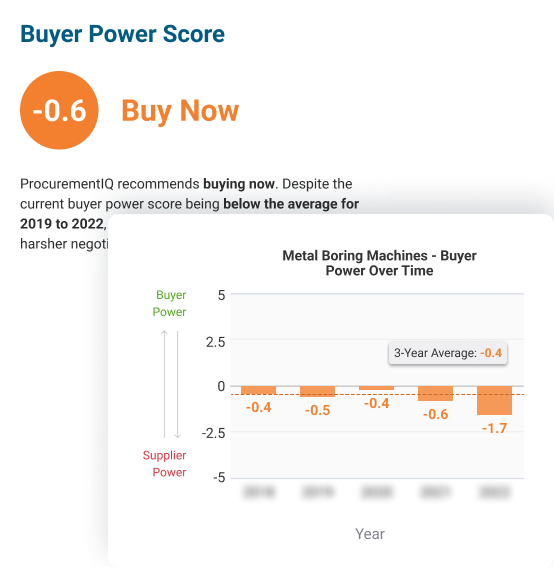
In 2026, buyer power amounts to -1.8 in the United States. Buyer power is most positively impacted by Recent Developments. It is most negatively impacted by Market Share Concentration. Subscribers can access details on eight other factors that impact buyer power. Learn more
United States
Buyer power forecasts: your glimpse into the future
Develop strategies for the upcoming year and identify unforeseen opportunities for buying now
- Actionable "Buy Now" and "Buy Later" insights
- Near-real-time updates to current and forecast Buyer Power Scores
- Methodology and weightings for Buyer Power Score Components
Supply Chain Risk
The average level of supply chain risk is assessed as High, which has a negative impact on buyer power. The level of supply chain risk is affected by industry volatility, barriers to entry, competition, import penetration, regulation and industry financial risk. Buyers in this market can mitigate procurement and supply chain management risks by monitoring risk levels for individual first and second tier suppliers:
1st
Tier Suppliers
- Iron & Steel Manufacturers
- Aluminum Manufacturers
- Plastic & Resin Manufacturers
- Semiconductor & Circuit Manufacturers
2nd
Tier Suppliers
- Iron Ore Miners
- Bauxite Miners
- Gasoline & Petroleum Wholesalers
- Metal Pipe & Tube Manufacturers
Biggest Air Handling Units Suppliers in the US by Revenue
The largest Air Handling Units vendors by revenue in the US are W.W. Grainger, Inc., Paloma Co. Ltd. and Carrier Global Corporation. Subscribers can sort and filter by market share concentration, profit level and other factors. Learn more
| Supplier | Operational Size | Headquarters | Number of Employees | Market Share (%) | Market Share Performance (3yr trend) | Total Revenue ($ million) | Profit Level (%) | Risk Level |
|---|---|---|---|---|---|---|---|---|
| Daikin Industries Ltd. | Global | Osaka, JP | >10,001 | 5-10 | ||||
| Raytheon Technologies Corporation | Global | WALTHAM, MA | >10,000 | 5-10 | ||||
| Johnson Controls International Plc | Global | CORK | >10,000 | 5-10 | ||||
| Honeywell International Inc. | Global | CHARLOTTE | >10,000 | < 5 | ||||
| Carrier Global Corporation | Global | PALM BEACH GARDENS, FL | >10,000 | < 5 | ||||
| W.W. Grainger, Inc. | Global | LAKE FOREST | >10,000 | < 5 | ||||
| Ingersoll Rand Inc. | Global | DAVIDSON | >10,000 | < 5 | ||||
| Lennox International Inc. | Global | RICHARDSON | >10,000 | < 5 | ||||
| Gea Group Aktiengesellschaft | Global | Düsseldorf, DE | >10,001 | < 5 | ||||
Looking for a list of suppliers by country?
Subscribers can access vendor information on Canadian and European suppliers, too. We also offer custom research services to help with vendor sourcing anywhere in the world.
Profit Analysis
The average profit margin across vendors in the Air Handling Units market is 6.0% and steady. Profit levels shift depending on suppliers' spend on wages, purchases and overhead. The highest cost component for vendors is Purchases. The cost trend for this component is stagnating, when considering movement between 2025 and 2026. To understand cost forecasts for 2027 and uncover the implications on profit, start your subscription. Learn more
Vendor & Supply Chain Analysis
Average vendor risk is low in the market, primarily due to stable demand trends. Buyers face minimal risk that vendors are in poor financial health.
Market share concentration is low, enhancing buyer power through increased competition between vendors in the market.
Supply chain risks are high for the air handling unit market, largely due to manufacturing disruptions overseas among top suppliers, and disruptions among upstream suppliers such as iron and steel manufacturers.
As a net importer in the air handling units market, US buyers' procurement strategies may be influenced by factors such as cost considerations and international competition and will need to carefully evaluate pricing options and potentially seek out more cost-effective solutions. Being a net importer can restrict buyer power and reduce their ability to dictate terms and conditions in procurement transactions, and will have less control over pricing, quality, and availability of the goods or services they need.
Supplier Information
Daikin Industries Ltd.
Daikin Industries Ltd. is a public company operating globally in the manufacturing and wholesale trade sectors. The company's offerings include commercial refrigerators & freezers, walk-in refrigerators, refrigerants, industrial refrigerators, industrial fans & ventilation equipment. Founded in 1924, the Subscribe to learn more
Johnson Controls International Plc
Johnson Controls International plc is a holding company that provides engineering, manufacturing, and commissioning of building products and systems. It designs, sells, installs, and services HVAC equipment and systems, control systems, security systems, fire detection, and fire suppression systems and equipment.... Subscribe to learn more
Raytheon Technologies Corporation
Raytheon Technologies Corporation is a public company operating globally in the construction, manufacturing, information, professional, scientific and technical services and other services (except public administration) sectors. The company's offerings include gas turbines, dampers, strobe & warning lights,... Subscribe to learn more
Carrier Global Corporation
Carrier Global Corp is a global provider of building and cold chain solutions, including heating, ventilating, and air conditioning (HVAC), refrigeration, fire, security, and building automation technologies. Its portfolio includes Carrier, Kidde, Edwards, LenelS2, and Automated Logic. Its operations comprise... Subscribe to learn more
Gea Group Aktiengesellschaft
Gea Group Aktiengesellschaft is a public company operating globally in the manufacturing sector. The company's offerings include packaging machines, industrial beverage processing machinery, air handling units and heat exchangers. Founded in 1881, the company is currently headquartered in Düsseldorf, Germany... Subscribe to learn more
Honeywell International Inc.
Honeywell International Inc. is a global technology and manufacturing company that designs, develops, produces, and markets consumer and industrial products. It organizes its business into four reportable business segments: the Aerospace segment, which supplies products, software, and services for aircraft;... Subscribe to learn more
Ingersoll Rand Inc.
Ingersoll Rand Inc. is a global provider of air, gas, liquid, and solid flow creation technologies. It organizes its business into two segments: the Industrial Technologies and Services segment, which designs, markets, and services a broad range of air and gas compression, vacuum and blower products, fluid... Subscribe to learn more
Lennox International Inc.
Lennox International Inc. is a global provider of heating, ventilation, air conditioning, and refrigeration (HVACR) solutions for homes and buildings. It designs, manufactures, and sells furnaces, air conditioners, heat pumps, heating and cooling systems, indoor air quality equipment, comfort control products,... Subscribe to learn more
Paloma Co. Ltd.
Paloma Co. Ltd. is a private company operating globally in the manufacturing sector. The company's offerings include air handling units, furnaces, heat pumps, commercial water heaters and air filters. Founded in 1911, the company is currently headquartered in Nagoya, Aichi, Japan with an estimated 10000 employees.... Subscribe to learn more
Accelerate the vendor selection process
Get a clear picture of the competition in a market and discover which vendors are best-suited for your sourcing needs. Our supplier profiles include hard-to-find financial ranges for private companies, cover public company data and feature an interactive competitor matrix.
Procurement Management KPIs for the Air Handling Units Market
Managing vendor performance throughout the contract period is easier when tracking specific key performance indicators (KPIs). For example, buyers should monitor Cash Flow and Customer Retention Rate. Buyers may experience better performance throughout their contracts if they establish service level agreements (SLAs) based on Regulatory Compliance and other factors.
| KPI | Level of Importance (1-5) | Measurements | Key Considerations |
|---|---|---|---|
| Cash Flow |
|
Press reports |
Vendors with positive cash flow are preferred because it signifies a higher level of profitability and solvency of the vendor. These factors minimize the risk of a supplier abruptly exiting the market. |
| Customer Retention Rate |
|
Client testimonials Press reports |
Vendors with a higher customer retention rate indicate a higher quality of service. Customer retention rates also give insight into the financial health of a market supplier. |

Questions to Ask During Procurement Negotiations
How can I gain leverage during negotiations?
Competition
How long have you been in the air handling unit market?
How do you stay competitive in the market?
Product Lines
How many different air handler brands do you carry?
Can you describe typical volume of air handlers that you have ready to be sold? Have you experienced supply shortages of any types or specific brands in the past?
Quality Control
What standards do you use to measure the reliability and quality of your air handlers?
What is the average life expectancy of your air handlers?
The ultimate prep for procurement negotations
View all 26 negotiation questions for this category when you subscribe.
Air Handling Units RFP Guidelines
What should my RFP include?
Organizational Overview
Buyers should describe the location of their operations and the climate/weather conditions that the air handling unit will be exposed to.
Buyers should describe their organizations and what their need for air handling units is (e.g., their specific industry).
Statement Of Need
Buyers should explain the specifications the air handling units must meet.
Buyers should state the size of the unit required and its output capacity.
Project Budget
Buyers should explicitly state the amount of the contract award.
Buyers should explain when and how many payments will be made.
The RFP process made easy
Find out how you can access RFP templates for 800+ procurement categories to start writing better, more consistent RFPs.
We display average pricing information, trends and market data.
Our Reports include:
- Opportunity assessment
- Market dynamics
- Recent developments
- Positive and warning trends
- Buyer power levers
- Price environment and market pricing
- Geographic wage rates
- Global market updates
- Total cost of ownership
- Cost structure benchmarks and analysis
- Supply chain and vendors
- Global supplier breakdown
- Market share concentration
- Regulation and business requirements
- Vendor management and KPIs
- Sourcing strategy guidance