Procurement Market Intelligence Report
Risk Management Software
Sourcing Guide & Market Intelligence
Smarter cost management starts with comprehensive market intelligence
 United States
 Europe
 Global
Quick Navigation
Risk Management Software Global Overview
Definition
Summary
Companies use risk management software to identify, evaluate, monitor and minimize risks to their operations. Risks are generally analyzed to determine the likelihood that they will occur and their potential impact. By managing risk, buyers can protect assets and provide stability to their operations. This software pulls data from a variety of sources to provide risk assessment on issues such as financial stability, cybersecurity and legal liabilities. Buyers include financial institutions, insurance companies and government institutions.
This Report Includes:
- On-Premises Risk Management Software
- Cloud-Based Risk Management Software
Not in this Report:
- Risk Management Consulting
- Insurance Services
- Compliance Management Software
Global Risk Management Software Procurement Trends
Discover the top international trends affecting procurement in the global Risk Management Software market.
Warning Trends
Fed lowers rates for the first time in 2025
- On September 17, the Federal Reserve’s Federal Open Market Committee (FOMC) voted to lower interest rates to a target range of 4.0% to 4.25%, down 0.25% from the rate it had been holding since November of last year.
- Despite indications at the start of the year that steady reductions to the relatively high 4.25% to 4.5% rate were on the horizon, the Fed held off on rate cuts for much of the year due to concerns that the combination of higher tariffs and a reduction in borrowing costs could cause rebounding inflation.
- The September cut to Fed interest rates signals a shift in this strategy, indicating that the Fed now considers weakening employment figures a greater threat than inflation. As a result, FOMC officials have also signaled that two additional rate cuts are likely before the end of the year in an effort to fight unemployment and stimulate the economy.
- Declining Fed funds rates will provide relief to borrowers by lowering the market interest rates for consumer and business loans. This reduction in the cost of borrowing will reduce the cost of many banking and financial services, and may spur increases in demand across the economy.
The European Union’s Artificial Intelligence (AI) Act enters into force
- In August 2024, the European Union (EU) began enforcing its new regulation on artificial intelligence. Although EU legislation, the act will have a major effect on global technological companies operating in the AI space, similar to the General Data Protection regulation.
- The legislation aims to apply a risk-based framework to AI regulation, meaning different AI applications will be treated differently. The law applies a general ban for “unacceptable” uses, such as social scoring and predictive policing.
- For general-purpose AI models, companies will be required to comply with EU copyright law and intellectual property provisions, carry out regular testing, issue transparency disclosures, and implement adequate cybersecurity protections. For “high-risk” AI applications, such as autonomous vehicles, medical devices, financial services, and biometric identification systems, companies must meet stricter requirements in terms of risk-mitigation systems, documentation, human oversight, and cybersecurity.
- Companies that breach the AI Act may face fines ranging from 7.5 million euros or 1.5% of global annual revenues to 35.0 million euros or 7.0% of global annual revenues, whichever amount is higher.
- While the blanket ban on unacceptable systems entered into force in February 2025, most of the obligations do not take effect for a full year. In August 2025, requirements for general-purpose AI will come into effect, and in August 2026, obligations for high-risk AI systems will be enforced.
Positive Trends
The DOJ proposes Google breakup in latest tech antitrust action
- In August, Google was found guilty of operating as a monopoly and engaging in anti-competitive practices through the operation of its search engine business.
- In response to this ruling the Department of Justice (DOJ) has stated it will seek a breakup of Google’s business segments, among other similarly harsh penalties. While the actual penalty Google receives must be approved by the judge, the DOJ’s proposed penalties signal a zero-tolerance policy toward tech monopolies.
- During the last few years, the Federal government has significantly increased its enforcement actions against major technology companies in an effort to contest the high level of market share concentration in this sector.
- These actions include high-profile anti-trust lawsuits against Amazon, Apple, and Meta, in addition to the case against Google. Consequently, the results of these lawsuits could significantly affect the structure of a wide range of tech markets.
Global Risk Management Software Market - Suppliers by Region
| Country/Region | Number of Suppliers |
|---|---|
| #1 Europe | 460 |
| #2 United States | 350 |
| #3 China | 230 |
Explore supplier concentration across the globe
We've uncovered the 11 top regions for global procurement, based on feedback from our most strategic clients. Access vendor counts for each unique region when you subscribe.
2
Geography Drilldown - US & Europe
Average Cost of Risk Management Software
United States
2026 Market Pricing$3,000.00 to $X,XXX.XX
per user per year
Average Price
Prices in the Risk Management Software market range from $3,000.00 to $X,XXX.XX, depending on Number of Users, Features, Coverage and Support Service. For example, lower prices are associated with More users (price per user), whereas higher prices are associated with Fewer users (price per user).
Need the scoop on international price trends?
Between our Europe and Canada collections, we provide price data for 350 markets so you can instantly compare prices across borders. Or, use our custom research services for intel on prices in any region across the globe.
Risk Management Software Category Price Trends
Pricing trends are indicated by the compound annual growth rate (CAGR) during a set period of time. For the Risk Management Software market, prices in the US have declined -0.2% from 2022 to 2025. Meanwhile, the recent three-year CAGR for Europe is +2.2%.
United States (2022-2025)

Europe (2022-2025)

Compound Annual Growth Rate
Wondering where prices are heading?
Price trend forecasts are available to subscribers, along with price driver projections and forward-looking cost structure data.
Cost Analysis - Total Cost of Ownership for Risk Management Software
Total cost of ownership is Low in the Risk Management Software market. The average cost of ownership differs depending on the contract but generally includes costs negotiated before the contract begins, costs billed during the contract period and unforeseen costs.
Negotiated Before
Installation
Implementation
Billed During
Maintenance
Software
Training
Buyer Power in Procurement Negotiations
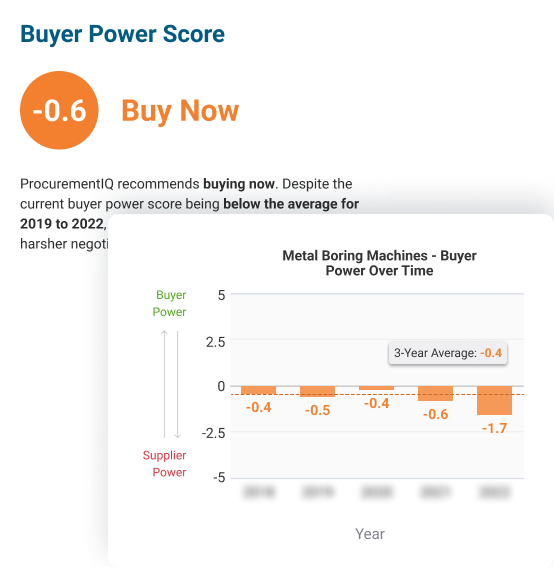
In 2026, buyer power amounts to 1.8 in the United States. Buyer power is most positively impacted by Recent Developments. It is most negatively impacted by Price Driver Volatility. Subscribers can access details on eight other factors that impact buyer power. Learn more
United States

Buyer power forecasts: your glimpse into the future
Develop strategies for the upcoming year and identify unforeseen opportunities for buying now
- Actionable "Buy Now" and "Buy Later" insights
- Near-real-time updates to current and forecast Buyer Power Scores
- Methodology and weightings for Buyer Power Score Components
Supply Chain Risk
The average level of supply chain risk is assessed as Low, which has a positive impact on buyer power. The level of supply chain risk is affected by industry volatility, barriers to entry, competition, import penetration, regulation and industry financial risk. Buyers in this market can mitigate procurement and supply chain management risks by monitoring risk levels for individual first and second tier suppliers:
1st
Tier Suppliers
- Computer & Packaged Software Wholesalers
- Computer Peripheral Manufacturers
- Intellectual Property Licensing Firms
- Data Processing & Hosting Firms
2nd
Tier Suppliers
- Computer Manufacturers
- Semiconductor & Circuit Manufacturers
- Law Firms
- Wired Telecommunications Carriers
Biggest Risk Management Software Suppliers in the US by Revenue
The largest Risk Management Software vendors by revenue in the US are IntelligenceBank Pty Ltd, ServiceNow Inc. and MetricStream Inc. Subscribers can sort and filter by market share concentration, profit level and other factors. Learn more
| Supplier | Operational Size | Headquarters | Number of Employees | Market Share (%) | Market Share Performance (3yr trend) | Total Revenue ($ million) | Profit Level (%) | Risk Level |
|---|---|---|---|---|---|---|---|---|
| International Business Machines Corporation | Global | ARMONK | >10,000 | 5-10 | ||||
| Sap Se | Global | WALLDORF | >10,000 | 5-10 | ||||
| MetricStream Inc. | Global | San Jose, CA | 1,001-10,000 | 5-10 | ||||
| SAS Institute | US | 5-10 | ||||||
| Oracle Corporation | Global | AUSTIN, CA | >10,000 | < 5 | ||||
| ServiceNow Inc. | Global | SANTA CLARA, CA | >10,000 | < 5 | ||||
| Infor, Inc. | Global | New York, NY | >10,000 | < 5 | ||||
| London Stock Exchange Group plc | Global | London, UK | 1,001-10,000 | < 5 | ||||
| Verisk Analytics, Inc. | Global | JERSEY CITY, NJ | 1,001-10,000 | < 5 | ||||
Looking for a list of suppliers by country?
Subscribers can access vendor information on Canadian and European suppliers, too. We also offer custom research services to help with vendor sourcing anywhere in the world.
Profit Analysis
The average profit margin across vendors in the Risk Management Software market is 17.4% and steady. Profit levels shift depending on suppliers' spend on wages, purchases and overhead. The highest cost component for vendors is Overhead. The cost trend for this component is rising, when considering movement between 2025 and 2026. To understand cost forecasts for 2027 and uncover the implications on profit, start your subscription. Learn more
Vendor & Supply Chain Analysis
Low market share concentration and intense competition enhance buyer power by providing buyers with a variety of vendors to choose from.
Like most software markets, there is a low level of supply chain risk for risk management software, which benefits buyers by reducing the likelihood of service disruptions.
Moderate vendor financial risk does not have a significant impact on buyer power. Nevertheless, buyers should check vendor financials because because vendor bankruptcy could result in financial losses or unexpected service disruptions.
The United States is a net importer of computers, importing more computers than it exports. However, this does not affect this market as computers are inputs purchased by vendors.
Supplier Information
International Business Machines Corporation
International Business Machines Corporation (IBM) is a global integrated computer technology, hardware, software, and services provider. It organizes its business into four segments: Software segment, which provides software solutions for a hybrid cloud platform, data and artificial intelligence, automation,... Subscribe to learn more
MetricStream Inc.
MetricStream Inc. is a private company operating globally in the information sector. The company's offerings include risk management software and environmental health & safety software. Founded in 1999, the company is currently headquartered in San Jose, California, United States of America with an estimated... Subscribe to learn more
Sap Se
Sap Se is a public company operating globally in the information, professional, scientific & technical services and educational services sectors. The company's offerings include warehouse management systems, travel management software, recruitment software, order tracking software, contract management software.... Subscribe to learn more
SAS Institute
SAS Institute is a private company operating in the information and professional, scientific & technical services sectors. The company's offerings include sales & marketing software, claims management software, data visualization software, risk management software, incentive management software. Founded Subscribe to learn more
Diligent Corporation
Diligent Corporation is a private company operating globally in the information sector. The company's offerings include risk management software. Founded in 1994, the company is currently headquartered in New York, New York, United States of America with an estimated 5500 employees. Subscribe to learn more
Infor, Inc.
Infor, Inc. is a private company operating globally in the information sector. The company's offerings include erp software, accounting software, expense management software, spend analytics software, maintenance management software. Founded in 2002, the company is currently headquartered in New York, New... Subscribe to learn more
IntelligenceBank Pty Ltd
IntelligenceBank Pty Ltd is a private company operating globally in the information sector. The company's offerings include risk management software. Founded in 2009, the company is currently headquartered in Southbank, Victoria, Australia with an estimated 75 employees. Subscribe to learn more
London Stock Exchange Group plc
London Stock Exchange Group plc is a public company operating globally in the information and professional, scientific & technical services sectors. The company's offerings include risk management software and investor relations services. Founded in 2005, the company is currently headquartered in London, Subscribe to learn more
NAVEX Global, Inc.
NAVEX Global, Inc. is a private company operating globally in the information sector. The company's offerings include online compliance training and risk management software. Founded in 1997, the company is currently headquartered in Lake Oswego, Oregon, United States of America with an estimated 5500 employees.... Subscribe to learn more
Accelerate the vendor selection process
Get a clear picture of the competition in a market and discover which vendors are best-suited for your sourcing needs. Our supplier profiles include hard-to-find financial ranges for private companies, cover public company data and feature an interactive competitor matrix.
Procurement Management KPIs for the Risk Management Software Market
Managing vendor performance throughout the contract period is easier when tracking specific key performance indicators (KPIs). For example, buyers should monitor Average Resolution Time and Average Response Time. Buyers may experience better performance throughout their contracts if they establish service level agreements (SLAs) based on Availability and other factors.
| KPI | Level of Importance (1-5) | Measurements | Key Considerations |
|---|---|---|---|
| Average Resolution Time |
|
Average resolution time Percentage of problems resolved within 1 week |
Competent support staff will resolve technical problems in a timely manner, limiting disruption to workflows. Buyers should monitor the amount of time that it takes for support staff to resolve issues during a given period. Vendors should be able to resolve minor issues within four hours and major issues within two business days. |
| Average Response Time |
|
Average response time Percentage of queries responded to in 24 hours |
The average response time measures how quickly the vendor’s support staff respond to complaints and questions from customers. Buyers should track the supplier’s average response time and ensure that the supplier is meeting these goals. |

Questions to Ask During Procurement Negotiations
How can I gain leverage during negotiations?
Competition
What is your reputation like among competitors and customers? How have you developed it?
What sets your software apart from your competitors'?
Supply Chain Risk
Amid the widespread health concerns, what contingency plans are in place to mitigate the risk to your clients and employees? Do you offer clients any flexible exceptions, such as contract suspensions?
Has the pandemic affected your team’s ability to provide technical support or software updates?
Customer Service
Do clients have a dedicated account manager, or do they call a general support line?
How many clients does each account manager look after?
The ultimate prep for procurement negotations
View all 34 negotiation questions for this category when you subscribe.
Risk Management Software RFP Guidelines
What should my RFP include?
Organizational Overview
Buyers should describe their organization and explain why they are seeking risk management software.
Buyers should specify the size of their organization and the number of expected software users.
Statement Of Need
Buyers need to detail the number of active software licenses needed and the type of users.
Buyers should state the features they require and whether the system must meet any compatibility requirements with existing networks.
Project Budget
Buyers should specify the contract term for the software license and any contract renewal terms if applicable.
Buyers should detail the contract term for annual ongoing costs (e.g. system support, upgrade and maintenance charges and license fees).
The RFP process made easy
Find out how you can access RFP templates for 800+ procurement categories to start writing better, more consistent RFPs.
We display average pricing information, trends and market data.
Our Reports include:
- Opportunity assessment
- Market dynamics
- Recent developments
- Positive and warning trends
- Buyer power levers
- Price environment and market pricing
- Geographic wage rates
- Global market updates
- Total cost of ownership
- Cost structure benchmarks and analysis
- Supply chain and vendors
- Global supplier breakdown
- Market share concentration
- Regulation and business requirements
- Vendor management and KPIs
- Sourcing strategy guidance