Procurement Market Intelligence Report
Televisions
Sourcing Guide & Market Intelligence
Smarter cost management starts with comprehensive market intelligence
 United States
 Global
Quick Navigation
Televisions Global Overview
Definition
Summary
This report is intended to assist buyers of televisions, which are electronic devices that display visual media. Televisions allow users to access and view media content delivered from computers, stored to discs or distributed via subscription services.
This Report Includes:
- Televisions
- Television Accessories
Not in this Report:
- Projectors
- Mobile Devices
- Computer Display Panels
Classification:
Global Televisions Procurement Trends
Discover the top international trends affecting procurement in the global Televisions market.
Warning Trends
Tariffs to escalate prices for electronics and computing equipment
- The Trump administration’s reciprocating tariffs, which will increase the tariff on all products imported from nearly all US trade partners, are set to take effect on August 7 and are likely to drive price increases across a wide range of sectors.
- The United States is highly reliant on imported electronics, communication equipment, and computing devices, having imported more than $472 billion worth of electronics in 2024, or about half of the total domestic supply. Starting August 7, imports from key computer and electronics producers such as China (54,0%), Japan (15.0%), South Korea (15.0%), Thailand (19.0%), Vietnam (20.0%), and Taiwan (20.0%) will be subject to new tariff rates. Trade deals for many countries are still being negotiated, and these rates are subject to change.
- For this reason, the US electronics industry is highly exposed to price increases and supply chain disruptions when the tariffs take effect. For example, the cost of iPhones, which are predominantly manufactured in China, could rise by as much as 43.0% in response to tariffs, according to projections by Rosenblatt Securities.
- Overall, the Yale Budget Lab anticipates tariffs will increase the average cost of computers and electronics by 18.7% in the short term.
- The tariffs exempt semiconductors, limiting the cost increases for domestic electronics manufacturers, but the lack of domestic electronics assembly capacity means that this exemption will have a limited effect.
Aluminum and steel tariffs are extended to the metals content of imported appliances
- On June 3rd, the Trump Administration announced an increase of aluminum and steel tariffs to 50.0%, up from the 25.0% rate imposed a few months prior.
- The administration has since introduced plans to apply these tariffs to the aluminum and steel content of imported appliances starting June 23rd.
- Under the new rule, imported appliances and appliance components will face 50.0% tariffs on the value of their aluminum and steel content. Aluminum and Steel account for more than a third of the total value of the average appliance, meaning this rule change will significantly increase the average import fees on appliances.
- In response to this rule change, appliance retailers, such as Home Depot, have indicated they will rely more heavily on domestic manufacturers to avoid the tariffs, creating a risk of shortages and long order backlogs. Alternatively, Walmart’s CEO has indicated the company will raise prices to compensate for the higher appliance costs.
- While differing tariff response strategies will result in varying supply chain and price impacts, the Yale Budget Lab projects machinery and equipment prices to rise by 9.4% on average due to this policy.
The FBI has warned that Chinese government hackers could disrupt critical infrastructure in the United States in the event of a conflict with China.
- The FBI announced on January 31 that it had thwarted an attempt by the Chinese government hacking group “Volt Typhoon” to plant malware onto electric power, water treatment and transportation systems in the United States using compromised end-of-life small office/home office (SOHO) routers from Cisco and Netgear. End-of-life devices have been discontinued by manufacturers and no longer receive software patches to eliminate vulnerabilities, which makes these devices attractive targets for hackers.
- US officials assess that China might disrupt critical US infrastructure to prevent the United States from responding to a Chinese attack on Taiwan. Volt Typhoon has been particularly active in Hawaii and Guam, which house some of the largest US military and naval installations in the Pacific.
- The FBI announced on September 18 that it had disrupted a botnet from another Chinese government hacking group known as “Flax Typhoon”. Flax Typhoon had infected 260,000 networking devices around the world, including SOHO routers, internet protocol (IP) cameras, digital video recorders (DVRs), and network-attached storage (NAS) devices.n
- The Cybersecurity and Infrastructure Security Agency (CISA) recommends that organizations use its Known Exploited Vulnerabilities (KEV) Catalog to identify any vulnerabilities in their systems. Furthermore, organizations can subscribe to receive KEV Catalog updates from the agency and may contact the agency for advice.
Global Televisions Market - Suppliers by Region
| Country/Region | Number of Suppliers |
|---|---|
| #1 Oceania & Southeast Asia | 2,455 |
| #2 China | 1,800 |
| #3 Europe | 1,615 |
Explore supplier concentration across the globe
We've uncovered the 11 top regions for global procurement, based on feedback from our most strategic clients. Access vendor counts for each unique region when you subscribe.
2
Geography Drilldown - US
Average Cost of Televisions
United States
2026 Market Pricing$250.00 to $XX,XXX.XX
per televisionAverage Price
Prices in the Televisions market range from $250.00 to $XX,XXX.XX, depending on Size, Resolution, Type of Screen and Ancillary Features. For example, lower prices are associated with Less than 42 inches ($115 to $500 per television), whereas higher prices are associated with More than 42 inches ($500 to $10,000 per television).
Need the scoop on international price trends?
Between our Europe and Canada collections, we provide price data for 350 markets so you can instantly compare prices across borders. Or, use our custom research services for intel on prices in any region across the globe.
Televisions Category Price Trends
Pricing trends are indicated by the compound annual growth rate (CAGR) during a set period of time. For the Televisions market, prices in the US have grown 3.6% from 2022 to 2025. Subscribers can access price trend forecasts, price driver projections and forward-looking cost structure data. Learn more
United States (2022-2025)


Wondering where prices are heading?
Price trend forecasts are available to subscribers, along with price driver projections and forward-looking cost structure data.
Cost Analysis - Total Cost of Ownership for Televisions
Total cost of ownership is Low in the Televisions market. The average cost of ownership differs depending on the contract but generally includes costs negotiated before the contract begins, costs billed during the contract period and unforeseen costs.
Negotiated Before
Transportation
Buyer Power in Procurement Negotiations
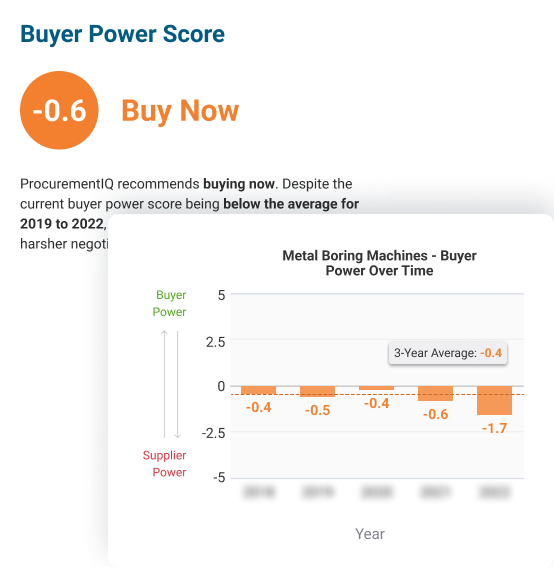
In 2026, buyer power amounts to -2.9 in the United States. Buyer power is most positively impacted by Forecast Price Trend. It is most negatively impacted by Availability of Substitutes. Subscribers can access details on eight other factors that impact buyer power. Learn more
United States
Buyer power forecasts: your glimpse into the future
Develop strategies for the upcoming year and identify unforeseen opportunities for buying now
- Actionable "Buy Now" and "Buy Later" insights
- Near-real-time updates to current and forecast Buyer Power Scores
- Methodology and weightings for Buyer Power Score Components
Supply Chain Risk
The average level of supply chain risk is assessed as Medium, which has a negative impact on buyer power. The level of supply chain risk is affected by industry volatility, barriers to entry, competition, import penetration, regulation and industry financial risk. Buyers in this market can mitigate procurement and supply chain management risks by monitoring risk levels for individual first and second tier suppliers:
1st
Tier Suppliers
- Computer & Packaged Software Wholesalers
- Semiconductor & Circuit Manufacturers
2nd
Tier Suppliers
- Software Publishers
- Computer Manufacturers
- Semiconductor Machinery Manufacturers
Biggest Televisions Suppliers in the US by Revenue
The largest Televisions vendors by revenue in the US are Sony Corporation, Sharp Corporation and Vizio, Inc. Subscribers can sort and filter by market share concentration, profit level and other factors. Learn more
| Supplier | Operational Size | Headquarters | Number of Employees | Market Share (%) | Market Share Performance (3yr trend) | Total Revenue ($ million) | Profit Level (%) | Risk Level |
|---|---|---|---|---|---|---|---|---|
| LG Electronics Inc. | Global | Seoul, KOR | >10,001 | 10-15 | ||||
| Best Buy Co., inc. | International | RICHFIELD, MN | >10,000 | 10-15 | ||||
| Vizio, Inc. | National | Irvine, CA | 251-500 | 10-15 | ||||
| Samsung Electronics Co Ltd | Global | Suwon-si, KR | >10,001 | 25+ | ||||
| Walmart Inc. | International | BENTONVILLE, AR | >10,000 | 25+ | ||||
| Amazon.Com, Inc. | Global | Seattle | >10,000 | 25+ | ||||
| Sony Corporation | Global | Tokyo, USA | >10,001 | 5-10 | ||||
| Panasonic Corp | Global | Kadoma, JP | >10,001 | 5-10 | ||||
| Sharp Corporation | Global | Sakai , JP | >10,001 | 5-10 | ||||
Looking for a list of suppliers by country?
Subscribers can access vendor information on Canadian and European suppliers, too. We also offer custom research services to help with vendor sourcing anywhere in the world.
Profit Analysis
The average profit margin across vendors in the Televisions market is 6.4% and steady. Profit levels shift depending on suppliers' spend on wages, purchases and overhead. The highest cost component for vendors is Purchases. The cost trend for this component is stagnating, when considering movement between 2025 and 2026. To understand cost forecasts for 2027 and uncover the implications on profit, start your subscription. Learn more
Vendor & Supply Chain Analysis
A medium level of vendor financial risk somewhat hurts buyer power by increasing the risk of a discontinuity of service.
High market share concentration harms buyer power by reducing competition between vendors.
Due to a global chip shortage, moderate supply chain risk somewhat detracts from buyer power by increasing the risk of supply disruptions, price fluctuations and the loss of a preferred supplier.
The United States is a net importer of television receivers, meaning it imports more television receivers than it exports. While lower manufacturing costs abroad drive down prices for imported television receivers, relying on imports can lead to potential shortages or price increases if there are supply chain disruptions due to geopolitical tensions, trade disputes, or global crises.
Supplier Information
Best Buy Co., inc.
Best Buy Co., inc. is a public company operating internationally in the manufacturing, information and real estate and rental and leasing sectors. The company's offerings include gps navigation devices, phone headsets, hard disk drives, usb flash drives, laptop computers. Founded in 1966, the company is currently... Subscribe to learn more
LG Electronics Inc.
LG Electronics Inc. is a public company operating globally in the manufacturing sector. The company's offerings include lithium-ion batteries, battery energy storage systems, photovoltaic panels, smartphones, lcd panels & monitors. Founded in 2002, the company is currently headquartered in Seoul, Korea, South... Subscribe to learn more
Vizio, Inc.
Vizio, Inc. is a private company operating nationally in the manufacturing sector. The company's offerings include lcd panels & monitors and televisions. Founded in 2003, the company is currently headquartered in Irvine, California, United States of America with an estimated 375 employees. Subscribe to learn more
Amazon.Com, Inc.
Amazon.com, Inc. is a global e-commerce company that offers a range of consumer products and services through online and physical stores. It resells merchandise and content and offers products from third-party sellers. It also manufactures and sells electronic devices and develops and distributes media content.... Subscribe to learn more
Samsung Electronics Co Ltd
Samsung Electronics Co Ltd is a public company operating globally in the manufacturing sector. The company's offerings include battery energy storage systems, central processing units, smartphones, solid state drives, flash memory devices. Founded in 1969, the company is currently headquartered in Suwon-si,... Subscribe to learn more
Walmart Inc.
Walmart Inc. is a public company operating internationally in the manufacturing, manufacturing and professional, scientific and technical services sectors. The company's offerings include personal paper products, paper towels, receipt tape, gps navigation devices, portable generators. Founded in 1962, the... Subscribe to learn more
Panasonic Corp
Panasonic Corp is a public company operating globally in the manufacturing and information sectors. The company's offerings include warehouse management systems, commercial refrigerators & freezers, industrial freezers, alkaline batteries, lithium-ion batteries. Founded in 1918, the company is currently headquartered... Subscribe to learn more
Sharp Corporation
Sharp Corporation is a public company operating globally in the manufacturing and manufacturing sectors. The company's offerings include photovoltaic panels, televisions and managed print services. Founded in 1962, the company is currently headquartered in Sakai, Japan with an estimated employee count of Subscribe to learn more
Sony Corporation
Sony Corporation is a public company operating globally in the manufacturing sector. The company's offerings include smartphones, office phones, flash memory devices, e-reader devices, computer displays. Founded in 2002, the company is currently headquartered in Tokyo, United States of America, Japan with... Subscribe to learn more
Accelerate the vendor selection process
Get a clear picture of the competition in a market and discover which vendors are best-suited for your sourcing needs. Our supplier profiles include hard-to-find financial ranges for private companies, cover public company data and feature an interactive competitor matrix.
Procurement Management KPIs for the Televisions Market
Managing vendor performance throughout the contract period is easier when tracking specific key performance indicators (KPIs). For example, buyers should monitor Average Response Time and Customer Effort Score. Buyers may experience better performance throughout their contracts if they establish service level agreements (SLAs) based on Pricing and other factors.
| KPI | Level of Importance (1-5) | Measurements | Key Considerations |
|---|---|---|---|
| Average Response Time |
|
Cumulative Number of Queries Cumulative Response Time |
The average response time is an important indicator of the responsiveness of a supplier’s customer support staff. A low average response time means that queries are being responded to quickly, which can help to minimized downtime. |
| Customer Effort Score |
|
Number of People Surveyed Cumulative Customer Effort Score |
The customer effort score assesses how much effort customers must put into getting their problems resolved. A low customer effort score signifies that it is relatively easy for customers to interact with support staff and get their problems resolved. |

Questions to Ask During Procurement Negotiations
How can I gain leverage during negotiations?
Quality Control
How many reports of television malfunctions has your company received in the past three years? How do you handle the discovery of faulty televisions?
How many of your products have been recalled in the past three years? What were the primary reasons for these recalls?
Product Lines
Are there any accessories and related products offered at no additional cost with the purchase of televisions?
Do you offer any discounts for purchasing related goods or accessories at the time of the television purchase? Do you offer any discounts on future purchases of related goods?
Accessibility
How large is your current inventory of televisions? How low do you allow your inventory to get before it is replenished?
How do you forecast future demand for your products and how do you adjust your inventory to prepare for anticipated demand fluctuations?
The ultimate prep for procurement negotations
View all 27 negotiation questions for this category when you subscribe.
Televisions RFP Guidelines
What should my RFP include?
Organizational Overview
Buyers should provide an overview of their company, including number of employees and geographic regions where they operate.
Buyers should state the type(s) of television(s) they desire.
Statement Of Need
Buyers should specify exact counts of the types of televisions they need.
Buyers should specify the size of the televisions they wish to purchase.
Project Budget
Vendors should provide a full list of the makes and models of televisions they sell.
Vendors should indicate the degree to which the televisions they are offering meet the buyer’s requirements.
The RFP process made easy
Find out how you can access RFP templates for 800+ procurement categories to start writing better, more consistent RFPs.
We display average pricing information, trends and market data.
Our Reports include:
- Opportunity assessment
- Market dynamics
- Recent developments
- Positive and warning trends
- Buyer power levers
- Price environment and market pricing
- Geographic wage rates
- Global market updates
- Total cost of ownership
- Cost structure benchmarks and analysis
- Supply chain and vendors
- Global supplier breakdown
- Market share concentration
- Regulation and business requirements
- Vendor management and KPIs
- Sourcing strategy guidance