Procurement Market Intelligence Report
Temperature Measurement Instrumentation
Sourcing Guide & Market Intelligence
Smarter cost management starts with comprehensive market intelligence
 United States
 Global
Quick Navigation
Temperature Measurement Instrumentation Global Overview
Definition
Summary
Temperature measurement instrumentation products monitor and analyze temperature levels in a wide range of industrial processes. A large pool of wholesalers and distributors operate in the market. Large manufacturers, such as Emerson Electric and Honeywell International, also offer these products in addition to other solutions (e.g. aerospace, automation, and home and building solutions). Key buyers include food and beverage manufacturers, metal product manufacturers, research laboratories, and HVAC service providers.
This Report Includes:
- Contact Temperature Instruments
- Noncontact Temperature Instruments
Not in this Report:
- Temperature Transmitters
- Thermostats
- Humidity Measuring Instruments
- Pressure Measuring Instruments
- Combustion Analyzers
Global Temperature Measurement Instrumentation Procurement Trends
Discover the top international trends affecting procurement in the global Temperature Measurement Instrumentation market.
Warning Trends
Elevated Tariffs are increasing prices for law enforcement, security, and safety equipment
- The Trump administration’s reciprocal tariffs, which place broad tariffs on all imports from most US trade partners, are set to take effect on August 7 after the tariff rates were finalized on August 1.
- As a result, all foreign suppliers in law enforcement, security, and safety equipment will face significantly increased costs when selling products to US buyers, and domestic manufacturers of these goods will face higher costs when sourcing key inputs for these products.
- Countries such as China, Germany, Mexico, Thailand, and Vietnam are leading sources of imports in this sector, providing high quantities of goods such as safes, locks, security cameras, security systems, and personal protective equipment. Starting August 7, imports from China, Germany, Mexico, Thailand, and Vietnam will be subject to tariff rates of 54.0%, 15.0%, 25.0%, 20.0%, and 19.0% respectively.
- Elevated tariffs are likely to impact pricing and supply chains in this industry due to the United States’ reliance on imported manufactured goods, which gives foreign suppliers the leverage to pass through the costs of tariffs to buyers and domestic suppliers the leverage to raise prices.
- Consequently, the Yale Budget Lab projects a 39.2% average increase in metal product prices, impacting products such as security gates and safes. Electronic security devices, such as cameras or metal detectors, are projected to rise by 18.7% in price. In the personal protective equipment market, prices are forecast to rise by between 11.0% and 37.5%, depending on the type of equipment and materials used to make it.
Increased tariffs on copper imports take effect
- On August 1, the Trump administration implemented 50.0% tariffs on imported copper. Chile and Canada will be most impacted by these tariffs, as they account for a combined 87.0% of all copper imports in the United States.
- However, these tariffs are less sweeping than initially expected, only applying to semi-finished copper products, while excluding high-purity refined copper and copper input materials, such as ore and concentrate. As leading importers, such as Chile and Canada, have both high copper mining and refining capacities, they will likely avoid most of these tariffs by either exporting the copper in its unrefined form or refining the copper before exporting it to the United States
- These copper tariff exemptions limit the impact on the electronics and electrical equipment sectors because these applications require refined copper due to its optimal conductive properties.
- Thus, the prices of metal alloys that include copper, consumer products made from copper, tools, plumbing, corrosion-resistant alloys, and construction materials made from copper are forecast to rise by an average of 39.2%, according to the Yale Budget Lab.
Russian invasion of Ukraine is putting additional strain on US chip supply
- Until recently, the United States sourced nearly all of its neon gas (an essential material in the laser imprinting process to produce semiconductors) from Ukrainian and Russian producers. Previous conflicts between the two nations, specifically related to the Crimea conflict in 2014, resulted in a nearly 600.0% increase in the price of neon.
- The Russian Ministry of Industry and Trade announced in early June that it would be limiting neon gas exports as part of its sanctions against countries it views as unfriendly. This move will add to lead times and prices for neon.
- Downstream semiconductor manufacturers keep stockpiles of neon gas that have allowed them to continue manufacturing chips, though it is unknown how long these stockpiles will last. Semiconductor manufacturers will likely pay higher prices for neon gas outside Ukraine as global supplies dwindle.
Global Temperature Measurement Instrumentation Market - Suppliers by Region
| Country/Region | Number of Suppliers |
|---|---|
| #1 Europe | 1,090 |
| #2 China | 580 |
| #3 United States | 410 |
Explore supplier concentration across the globe
We've uncovered the 11 top regions for global procurement, based on feedback from our most strategic clients. Access vendor counts for each unique region when you subscribe.
2
Geography Drilldown - US
Average Cost of Temperature Measurement Instrumentation
United States
2026 Market Pricing$10.00 to $X,XXX.XX
per unitAverage Price
Prices in the Temperature Measurement Instrumentation market range from $10.00 to $X,XXX.XX, depending on Type of Temperature Instrument, End Use, Accuracy, Range of Measurement and Level of Customization. For example, lower prices are associated with Thermocouple probe ($10.00 to $510 per unit) and Thermistors, whereas higher prices are associated with Thermal sensors ($10.00 to $2,000 per unit) and Digital and infrared thermometers ($50.00 to $4,390 per unit).
Need the scoop on international price trends?
Between our Europe and Canada collections, we provide price data for 350 markets so you can instantly compare prices across borders. Or, use our custom research services for intel on prices in any region across the globe.
Temperature Measurement Instrumentation Category Price Trends
Pricing trends are indicated by the compound annual growth rate (CAGR) during a set period of time. For the Temperature Measurement Instrumentation market, prices in the US have grown 1.4% from 2022 to 2025. Subscribers can access price trend forecasts, price driver projections and forward-looking cost structure data. Learn more
United States (2022-2025)


Wondering where prices are heading?
Price trend forecasts are available to subscribers, along with price driver projections and forward-looking cost structure data.
Cost Analysis - Total Cost of Ownership for Temperature Measurement Instrumentation
Total cost of ownership is Medium in the Temperature Measurement Instrumentation market. The average cost of ownership differs depending on the contract but generally includes costs negotiated before the contract begins, costs billed during the contract period and unforeseen costs. For example, unforeseen costs in the form of Obsolescence may raise the total cost of ownership unexpectedly.
Negotiated Before
Installation
Implementation
Billed During
Warranties
Repairs
Training
Unforeseen
Obsolescence
Buyer Power in Procurement Negotiations
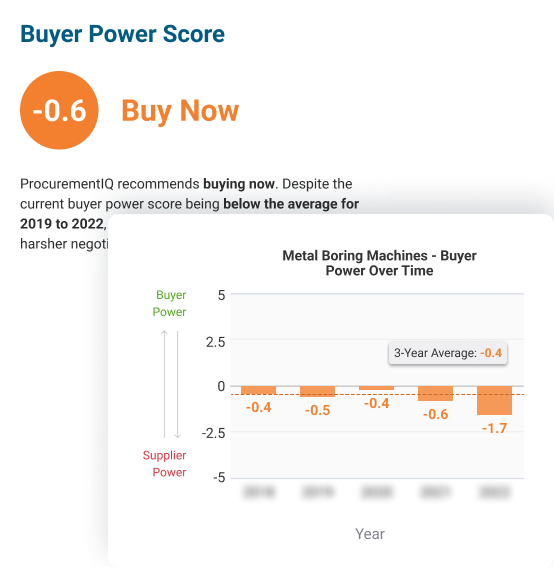
In 2026, buyer power amounts to -1.8 in the United States. Buyer power is most positively impacted by Recent Developments. It is most negatively impacted by Market Share Concentration. Subscribers can access details on eight other factors that impact buyer power. Learn more
United States
Buyer power forecasts: your glimpse into the future
Develop strategies for the upcoming year and identify unforeseen opportunities for buying now
- Actionable "Buy Now" and "Buy Later" insights
- Near-real-time updates to current and forecast Buyer Power Scores
- Methodology and weightings for Buyer Power Score Components
Supply Chain Risk
The average level of supply chain risk is assessed as Medium, which has a negative impact on buyer power. The level of supply chain risk is affected by industry volatility, barriers to entry, competition, import penetration, regulation and industry financial risk. Buyers in this market can mitigate procurement and supply chain management risks by monitoring risk levels for individual first and second tier suppliers:
1st
Tier Suppliers
- Metalworking Machinery Manufacturers
- Electrical Equipment Wholesalers
- Nonferrous Metal Foundry Products Manufacturers
- Iron & Steel Manufacturers
2nd
Tier Suppliers
- Metal Platers & Treators
- Semiconductor & Circuit Manufacturers
- Molybdenum & Metal Ore Miners
- Iron Ore Miners
Biggest Temperature Measurement Instrumentation Suppliers in the US by Revenue
The largest Temperature Measurement Instrumentation vendors by revenue in the US are Texas Instruments Incorporated, W.W. Grainger, Inc. and Emerson Electric Co. Subscribers can sort and filter by market share concentration, profit level and other factors. Learn more
| Supplier | Operational Size | Headquarters | Number of Employees | Market Share (%) | Market Share Performance (3yr trend) | Total Revenue ($ million) | Profit Level (%) | Risk Level |
|---|---|---|---|---|---|---|---|---|
| Thermo Fisher Scientific Inc. | Global | WALTHAM, MA | >10,000 | 5-10 | ||||
| Fortive Corporation | Global | Everett, WA | >10,000 | 5-10 | ||||
| Yokogawa Electric Corporation | Global | Tokyo, JP | >10,001 | < 5 | ||||
| Siemens Ag | Global | Munich , DE | >10,001 | < 5 | ||||
| Basf Se | Global | Ludwigshafen, DE | >10,001 | < 5 | ||||
| General Electric Company | Global | EVENDALE | >10,000 | < 5 | ||||
| Honeywell International Inc. | Global | CHARLOTTE | >10,000 | < 5 | ||||
| Schneider Electric Se | Global | Paris, FR | >10,001 | < 5 | ||||
| Abb Ltd | Global | Zurich | >10,000 | < 5 | ||||
Looking for a list of suppliers by country?
Subscribers can access vendor information on Canadian and European suppliers, too. We also offer custom research services to help with vendor sourcing anywhere in the world.
Profit Analysis
The average profit margin across vendors in the Temperature Measurement Instrumentation market is 7.5% and steady. Profit levels shift depending on suppliers' spend on wages, purchases and overhead. The highest cost component for vendors is Overhead. The cost trend for this component is rising, when considering movement between 2025 and 2026. To understand cost forecasts for 2027 and uncover the implications on profit, start your subscription. Learn more
Vendor & Supply Chain Analysis
Bankruptcy risk is low for vendors in the market. Most are large, multinational conglomerates, diversified across industries, which limits the risk of service disruptions for buyers.
Market share concentration is low in the market as the top four suppliers occupy less than 10.0% of the market each. Buyers can shop around and gather multiple bids to leverage during price negotiations as a result.
There is moderate supply chain risk in the market for temperature measurement instruments due to the reliance on volatile inputs, such as nonferrous metals. However, suppliers are capable of sourcing what they need to provide their products to buyers, even with higher risk elsewhere in the supply chain.
The United States is a net importer of temperature measurement instrumentation, benefitting buyers because manufacturers producing instruments in certain foreign countries can do so at a lower cost, contributing to lower market prices. However, importing products may lead to higher shipping costs, higher tariff costs, and longer lead times.
Supplier Information
Fortive Corporation
Fortive Corporation is a public company operating globally in the manufacturing and information sectors. The company's offerings include laboratory sterilizers, leak detection equipment, temperature measurement instrumentation, air quality testing equipment, supply chain management software. Founded in 2016,... Subscribe to learn more
Thermo Fisher Scientific Inc.
Thermo Fisher Scientific Inc. is a public company operating globally in the manufacturing, manufacturing and professional, scientific and technical services sectors. The company's offerings include membrane filters, laboratory fume hoods, microscopes, leak detection equipment, temperature measurement instrumentation.... Subscribe to learn more
Abb Ltd
ABB Ltd. is a global technology company that offers comprehensive electrification, robotics, automation, and motion solutions, primarily serving the distribution utilities, renewables, and transport & infrastructure markets. It organizes its business into four segments: the Electrification segment, which Subscribe to learn more
Ametek, inc.
Ametek, inc. is a public company operating globally in the manufacturing and professional, scientific and technical services sectors. The company's offerings include hydraulic motors, industrial battery chargers, uninterruptible power supply systems, torque measuring equipment, temperature measurement instrumentation.... Subscribe to learn more
Basf Se
Basf Se is a public company operating globally in the manufacturing, manufacturing and professional, scientific & technical services sectors. The company's offerings include pesticides, refining catalysts, plasticizers, preservatives, waterproofing coatings. Founded in 1865, the company is currently headquartered... Subscribe to learn more
Emerson Electric Co.
Emerson Electric Co. is a public company operating globally in the manufacturing, professional, scientific and technical services and other services (except public administration) sectors. The company's offerings include downhole instrumentation, welding machines, industrial refrigerators, auxiliary generators,... Subscribe to learn more
Endress + Hauser
Endress + Hauser is a private company operating globally in the manufacturing and professional, scientific & technical services sectors. The company's offerings include temperature measurement instrumentation, pressure measurement instrumentation, flow measurement instrumentation and process control systems... Subscribe to learn more
General Electric Company
General Electric Company (dba GE Aerospace) is a global aerospace company that provides engines, systems, and services to commercial, government, and military markets. It organizes its business into two segments: the Commercial Engines & Services segment, which designs and manufactures jet engines for commercial... Subscribe to learn more
Honeywell International Inc.
Honeywell International Inc. is a global technology and manufacturing company that designs, develops, produces, and markets consumer and industrial products. It organizes its business into four reportable business segments: the Aerospace segment, which supplies products, software, and services for aircraft;... Subscribe to learn more
Accelerate the vendor selection process
Get a clear picture of the competition in a market and discover which vendors are best-suited for your sourcing needs. Our supplier profiles include hard-to-find financial ranges for private companies, cover public company data and feature an interactive competitor matrix.
Procurement Management KPIs for the Temperature Measurement Instrumentation Market
Managing vendor performance throughout the contract period is easier when tracking specific key performance indicators (KPIs). For example, buyers should monitor Average Resolution Time and Cost of Goods Sold. Buyers may experience better performance throughout their contracts if they establish service level agreements (SLAs) based on Accuracy and other factors.
| KPI | Level of Importance (1-5) | Measurements | Key Considerations |
|---|---|---|---|
| Average Resolution Time |
|
Total resolution time Number of resolved tickets |
The average resolution time represents the average amount of time it takes to resolve a support ticket. The average resolution time can be used to determine a company’s support responsiveness. Since defective or broken temperature measurement instruments can shut down operations or create regulatory issues, buyers will want suppliers to have a responsive support staff. |
| Cost of Goods Sold |
|
Total material cost Total labor cost |
The cost of goods sold takes into account the costs of labor, material, service, and delivery. The cost of goods sold can be used to determine profitability for suppliers and pricing strategies for buyers, since most vendors use cost-plus pricing. |

Questions to Ask During Procurement Negotiations
How can I gain leverage during negotiations?
Quality Control
How often do your products need to be calibrated?
What are the most common technical issues that you have experienced with these products?
Competition
How do you win and retain business?
What sets your product apart from your competitors'?
Warranty
Do you offer a warranty on your temperature measurement instruments? What do your warranties cover?
How long does the warranty last?
The ultimate prep for procurement negotations
View all 31 negotiation questions for this category when you subscribe.
Temperature Measurement Instrumentation RFP Guidelines
What should my RFP include?
Organizational Overview
Buyers should describe their organization and its core business functions.
Buyers should explain the nature of the work environments and the substances that the instruments will be measuring.
Statement Of Need
Buyers should specify the type of temperature measurement instrument required, including any customization requirements.
Buyers should state the temperature range that the instrument will be exposed to.
Project Budget
Buyers should state the amount of the contract.
Buyers should request information about shipping costs and terms.
The RFP process made easy
Find out how you can access RFP templates for 800+ procurement categories to start writing better, more consistent RFPs.
We display average pricing information, trends and market data.
Our Reports include:
- Opportunity assessment
- Market dynamics
- Recent developments
- Positive and warning trends
- Buyer power levers
- Price environment and market pricing
- Geographic wage rates
- Global market updates
- Total cost of ownership
- Cost structure benchmarks and analysis
- Supply chain and vendors
- Global supplier breakdown
- Market share concentration
- Regulation and business requirements
- Vendor management and KPIs
- Sourcing strategy guidance