Procurement Market Intelligence Report
Medical Gloves
Sourcing Guide & Market Intelligence
Smarter cost management starts with comprehensive market intelligence
 United States
 Europe
 Global
Quick Navigation
Medical Gloves Global Overview
Definition
Summary
Medical gloves are used during medical examinations and procedures to help prevent the transmission of various diseases to patients and healthcare personnel. They are made from different types of polymers, such as latex, nitrile rubber, vinyl, and neoprene, and come nonpowdered or powdered with cornstarch to make them easier to put on the hands.
This Report Includes:
- Examination Gloves
- Surgical Gloves
Not in this Report:
- Food Processing Gloves
- Industrial Gloves
Global Medical Gloves Procurement Trends
Discover the top international trends affecting procurement in the global Medical Gloves market.
Warning Trends
Public sector demand slumps as the government enters shutdown
- On October 1, the US federal government entered a shutdown after negotiations for a new appropriations bill failed.
- During a government shutdown, essential federal government operations, such as law enforcement, air-traffic control, and social security, persist, while nonessential operations are paused and workers involved in these operations are furloughed. Thus, the current shutdown is expected to result in 750,000 federal workers being furloughed, representing a $400 million reduction in daily expenditure by the federal government.
- This significant reduction in federal spending and operations will affect the entire US economy, weakening aggregate demand and slowing economic growth. For example, the 35-day government shutdown in Q1, 2019, reduced aggregate demand in both the public and private sectors, resulting in a 0.2% reduction in GDP growth that quarter.
- The effects of the shutdown are likely to be most acute in markets where the public sector is a major buyer segment, weakening demand and increasing average vendor risk by destabilizing important revenue streams.
- As negotiations for a new appropriations bill to reopen the government remain ongoing, ProcurementIQ will continue to monitor the situation and update this story with the latest information.
Reciprocal tariffs to increase prices and supply chain risk in the medical equipment industry
- The Trump administration’s reciprocal tariffs, which impose increased general tariffs on all products imported from most nations, are set to take effect on August 7 after rates were finalized on August 1.
- The US medical equipment industry is highly reliant on imported products, with medical equipment imports totaling $122 billion in 2024, or about 19.2% of the total market supply.
- The European Union, Mexico, and China are key importers of medical equipment, accounting for 28.1%, 11.0%, and 9.6% of total medical equipment imports, respectively.
- Thus, the 15.0%, 25.0%, and 54.0% tariffs on imports from the European Union, Mexico, and China will significantly increase the prices of medical equipment. Steel and aluminum imports, common materials in medical equipment manufacturing, also currently face 50.0% tariffs when imported from any nation other than the United Kingdom.
- The Yale Budget Lab projects that key inputs for medical equipment, such as electronic components, metals, plastic, and rubber, will increase in price by 10.4% to 37.6% due to tariffs, indicating domestic producers will face sharp cost increases as well.
Global Medical Gloves Market - Suppliers by Region
| Country/Region | Number of Suppliers |
|---|---|
| #1 Europe | 8,500 |
| #2 Oceania & Southeast Asia | 6,815 |
| #3 China | 5,695 |
Explore supplier concentration across the globe
We've uncovered the 11 top regions for global procurement, based on feedback from our most strategic clients. Access vendor counts for each unique region when you subscribe.
2
Geography Drilldown - US & Europe
Average Cost of Medical Gloves
United States
2026 Market Pricing$2.00 to $XX.XX
per box of 100 gloves
Average Price
Prices in the Medical Gloves market range from $2.00 to $XX.XX, depending on Type of Material, Brand and Intended Use. For example, lower prices are associated with Latex ($5.00 to $22.00 per pack of 100 gloves), whereas higher prices are associated with Nonlatex (e.g., nitrile, polyisoprene) ($12.00 to $100 per pack of 100 gloves).
Need the scoop on international price trends?
Between our Europe and Canada collections, we provide price data for 350 markets so you can instantly compare prices across borders. Or, use our custom research services for intel on prices in any region across the globe.
Medical Gloves Category Price Trends
Pricing trends are indicated by the compound annual growth rate (CAGR) during a set period of time. For the Medical Gloves market, prices in the US have grown 1.8% from 2022 to 2025. Meanwhile, the recent three-year CAGR for Europe is +0.6%.
United States (2022-2025)

Europe (2022-2025)
Compound Annual Growth Rate
Wondering where prices are heading?
Price trend forecasts are available to subscribers, along with price driver projections and forward-looking cost structure data.
Cost Analysis - Total Cost of Ownership for Medical Gloves
Total cost of ownership is Low in the Medical Gloves market. The average cost of ownership differs depending on the contract but generally includes costs negotiated before the contract begins, costs billed during the contract period and unforeseen costs. For example, unforeseen costs in the form of Restocking may raise the total cost of ownership unexpectedly.
Negotiated Before
Transportation
Billed During
Disposal
Unforeseen
Restocking
Buyer Power in Procurement Negotiations
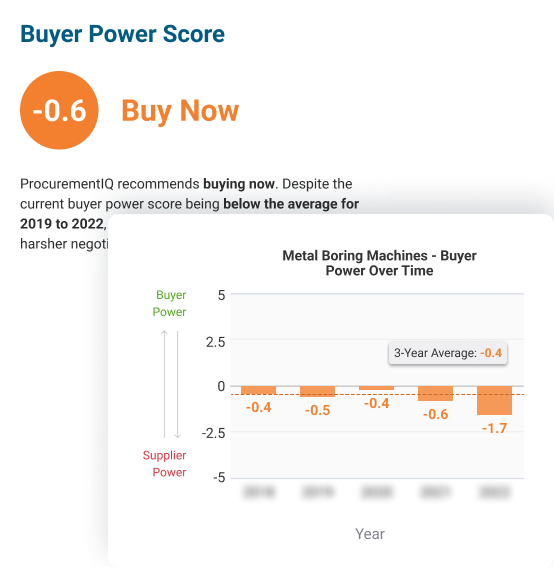
In 2026, buyer power amounts to -2.4 in the United States. Buyer power is most positively impacted by Recent Developments. It is most negatively impacted by Product Specialization. Subscribers can access details on eight other factors that impact buyer power. Learn more
United States

Buyer power forecasts: your glimpse into the future
Develop strategies for the upcoming year and identify unforeseen opportunities for buying now
- Actionable "Buy Now" and "Buy Later" insights
- Near-real-time updates to current and forecast Buyer Power Scores
- Methodology and weightings for Buyer Power Score Components
Supply Chain Risk
The average level of supply chain risk is assessed as High, which has a negative impact on buyer power. The level of supply chain risk is affected by industry volatility, barriers to entry, competition, import penetration, regulation and industry financial risk. Buyers in this market can mitigate procurement and supply chain management risks by monitoring risk levels for individual first and second tier suppliers:
1st
Tier Suppliers
- Rubber Product Manufacturers
- Chemical Product Manufacturers
- Cardboard Box & Container Manufacturers
- Freight Trucking Suppliers
2nd
Tier Suppliers
- Petroleum Refiners
- Inorganic Chemical Manufacturers
- Organic Chemical Manufacturers
- Paperboard Mills
- Gasoline & Petroleum Wholesalers
Biggest Medical Gloves Suppliers in the US by Revenue
The largest Medical Gloves vendors by revenue in the US are Owens & Minor Inc., Henry Schein Inc. and Ansell Limited. Subscribers can sort and filter by market share concentration, profit level and other factors. Learn more
| Supplier | Operational Size | Headquarters | Number of Employees | Market Share (%) | Market Share Performance (3yr trend) | Total Revenue ($ million) | Profit Level (%) | Risk Level |
|---|---|---|---|---|---|---|---|---|
| Hartalega Holdings Berhad | Global | Kuala Lumpur, MY | 101-250 | 10-15 | ||||
| Cardinal Health, Inc. | Global | DUBLIN, OH | >10,000 | 5-10 | ||||
| Top Glove | Global | Shah Alam, MY | >10,001 | 5-10 | ||||
| Ansell Limited | Global | Richmond, AU | >10,001 | 5-10 | ||||
| Mckesson Corporation | Global | IRVING | >10,000 | < 5 | ||||
| Kimberly-Clark Corporation | Global | IRVING | >10,000 | < 5 | ||||
| Henry Schein Inc. | Global | MELVILLE | >10,000 | < 5 | ||||
| Owens & Minor Inc. | Global | GLEN ALLEN, VA | >10,000 | < 5 | ||||
| B. Braun Melsungen AG | Global | Melsungen, DE | >10,001 | < 5 | ||||
Looking for a list of suppliers by country?
Subscribers can access vendor information on Canadian and European suppliers, too. We also offer custom research services to help with vendor sourcing anywhere in the world.
Profit Analysis
The average profit margin across vendors in the Medical Gloves market is 3.5% and steady. Profit levels shift depending on suppliers' spend on wages, purchases and overhead. The highest cost component for vendors is Overhead. The cost trend for this component is rising, when considering movement between 2025 and 2026. To understand cost forecasts for 2027 and uncover the implications on profit, start your subscription. Learn more
Vendor & Supply Chain Analysis
The medical gloves market exhibits a moderate level of market share concentration, with the top four players capturing about 35.0% of total market revenue. These notable players, such as Cardinal Health and Ansell Limited, have greater financial resources, large-volume sales, and more established distribution channels than their smaller counterparts.
The average supplier operates with low financial risk, which provides buyers with a greater degree of certainty and flexibility when locking in contracts over the long term.
Supply chain risk for medical gloves is high due to fluctuations in the prices of key raw materials such as natural and synthetic rubbers. Although supply chain risks may impact suppliers’ production costs and the price of medical gloves, it is unlikely that these risks will undermine the overall availability of the raw materials used in glove production.
The United States is a net importer of medical gloves, as it imports more gloves than it exports. This adds risk to buyers, as trade policies and currency exchange rates can add price volatility to the market.
Supplier Information
Hartalega Holdings Berhad
Hartalega Holdings Berhad is a public company operating globally in the manufacturing sector. The company's offerings include medical gloves. Founded in 1988, the company is currently headquartered in Kuala Lumpur, Malaysia with an estimated 175 employees. Subscribe to learn more
Ansell Limited
Ansell Limited is a public company operating globally in the manufacturing sector. The company's offerings include medical gloves, safety apparel and protective gloves. Founded in 1929, the company is currently headquartered in Richmond, Victoria, Australia with an estimated employee count of over 10,000.... Subscribe to learn more
Cardinal Health, Inc.
Cardinal Health, Inc. is a public company operating globally in the manufacturing and other services (except public administration) sectors. The company's offerings include bandages & dressings, medical & surgical adherent tapes, medical tissue closures, surgical textiles, medical gloves. Founded in 1971,... Subscribe to learn more
Top Glove
Top Glove is a public company operating globally in the manufacturing sector. The company's offerings include medical gloves and protective gloves. Founded in 1998, the company is currently headquartered in Shah Alam, Malaysia with an estimated employee count of over 10,000. Subscribe to learn more
B. Braun Melsungen AG
B. Braun Melsungen AG is a private company operating globally in the manufacturing sector. The company's offerings include catheters, bandages & dressings, medical gloves and medical syringes. Founded in 1839, the company is currently headquartered in Melsungen, Hesse, Germany with an estimated 66821 employees.... Subscribe to learn more
Henry Schein Inc.
Henry Schein, Inc. is a solutions company for healthcare professionals in the dental and medical markets. It organizes its business into two segments: the HealthCare Distribution segment, which offers consumable products, small equipment, laboratory products, large equipment, equipment repair services, branded... Subscribe to learn more
Kimberly-Clark Corporation
Kimberly-Clark Corp. is a global consumer goods company that primarily manufactures and markets a wide range of products made from natural or synthetic fibers and materials using advanced technologies in fibers, nonwovens, and absorbency. It organizes its business into three reportable segments: the Personal... Subscribe to learn more
Mckesson Corporation
McKesson Corporation is a global, diversified healthcare services company. It distributes branded, generic, specialty, biosimilar, and over-the-counter pharmaceutical drugs and other healthcare-related products in the US, Canada, and Europe; provides prescription technology solutions that connect patients,... Subscribe to learn more
Medline Industries Inc.
Medline Industries Inc. is a private company operating globally in the manufacturing sector. The company's offerings include catheters, bandages & dressings, medical & surgical adherent tapes, medical tissue closures, surgical textiles. Founded in 1966, the company is currently headquartered in Northfield,... Subscribe to learn more
Accelerate the vendor selection process
Get a clear picture of the competition in a market and discover which vendors are best-suited for your sourcing needs. Our supplier profiles include hard-to-find financial ranges for private companies, cover public company data and feature an interactive competitor matrix.
Procurement Management KPIs for the Medical Gloves Market
Managing vendor performance throughout the contract period is easier when tracking specific key performance indicators (KPIs). For example, buyers should monitor Average Order Value and Defect Density. Buyers may experience better performance throughout their contracts if they establish service level agreements (SLAs) based on Support and other factors.
| KPI | Level of Importance (1-5) | Measurements | Key Considerations |
|---|---|---|---|
| Average Order Value |
|
Total revenue Number of orders |
The average order value represents the revenue generated from the average order. The average order value can be used to evaluate a company’s reputation. The average order value can be used to assess a company’s ability to provide large volumes of product. |
| Defect Density |
|
Number of units Number of defective units |
The defect density represents the share of defective medical gloves a company produces. The defect density can be used to determine whether manufacturing, assembly, or quality assurance processes require improvement. |

Questions to Ask During Procurement Negotiations
How can I gain leverage during negotiations?
Quality Control
What are your best-selling medical gloves (type and brand)?
What quality awards have you received, if any?
Supply Chain Risk
Do you source materials with a high exposure to market disruptions resulting from the pandemic? How are you coping with these disruptions?
How diversified is your supplier base for inputs? Do you source from multiple suppliers in different global regions?
Cost Containment
How do you address the changing cost of raw materials? How does volatility of raw material prices affect the prices that buyers pay?
Do you source raw materials from multiple sources? What measures do you undertake to ensure a continual supply of raw materials? Are there any sole-sourced raw materials?
The ultimate prep for procurement negotations
View all 32 negotiation questions for this category when you subscribe.
Medical Gloves RFP Guidelines
What should my RFP include?
Organizational Overview
Buyers should include information about their facility type (e.g., hospital or outpatient clinic) and size (e.g., number of beds).
Buyers should provide information about annual inpatient admissions, surgeries and outpatient visits to allow suppliers to determine whether they are capable of undertaking a given project.
Statement Of Need
Buyers should provide detailed information about the desired use of medical gloves (i.e., surgical or examination).
Buyers should provide design requirements based on the healthcare professional's needs and preferences.
Project Budget
If one exists, buyers should specify a budget for their desired medical gloves and any related products and services.
Buyers should inquire about the cost per unit.
The RFP process made easy
Find out how you can access RFP templates for 800+ procurement categories to start writing better, more consistent RFPs.
We display average pricing information, trends and market data.
Our Reports include:
- Opportunity assessment
- Market dynamics
- Recent developments
- Positive and warning trends
- Buyer power levers
- Price environment and market pricing
- Geographic wage rates
- Global market updates
- Total cost of ownership
- Cost structure benchmarks and analysis
- Supply chain and vendors
- Global supplier breakdown
- Market share concentration
- Regulation and business requirements
- Vendor management and KPIs
- Sourcing strategy guidance