Procurement Market Intelligence Report
Automated External Defibrillators
Sourcing Guide & Market Intelligence
Smarter cost management starts with comprehensive market intelligence
 United States
 Global
Quick Navigation
Automated External Defibrillators Global Overview
Definition
Summary
Automated external defibrillators (AEDs) are portable, electronic medical devices used to treat cardiac arrest, monitor the heart’s rhythm, and advise the rescuer when a shock is required. AEDs are widely used by paramedics and police and are becoming commonly available in public places, such as office buildings, shopping malls, schools and airports. Key buyers include hospitals, fire stations, airlines, household consumers, and nursing care facilities.
This Report Includes:
- Automated External Defibrillator Devices
- Automated External Defibrillator Device Accessories
Not in this Report:
- Manual External Cardioverter Defibrillator Devices
- Implantable Cardioverter Defibrillator Devices
Take the ProcurementIQ products and data tour
Explore live samples of price trend forecasts, price driver projections, forward-looking cost structure data and more.
Global Automated External Defibrillators Procurement Trends
Discover the top international trends affecting procurement in the global Automated External Defibrillators market.
Warning Trends
Public sector demand slumps as the government enters shutdown
- On October 1, the US federal government entered a shutdown after negotiations for a new appropriations bill failed.
- During a government shutdown, essential federal government operations, such as law enforcement, air-traffic control, and social security, persist, while nonessential operations are paused and workers involved in these operations are furloughed. Thus, the current shutdown is expected to result in 750,000 federal workers being furloughed, representing a $400 million reduction in daily expenditure by the federal government.
- This significant reduction in federal spending and operations will affect the entire US economy, weakening aggregate demand and slowing economic growth. For example, the 35-day government shutdown in Q1, 2019, reduced aggregate demand in both the public and private sectors, resulting in a 0.2% reduction in GDP growth that quarter.
- The effects of the shutdown are likely to be most acute in markets where the public sector is a major buyer segment, weakening demand and increasing average vendor risk by destabilizing important revenue streams.
- As negotiations for a new appropriations bill to reopen the government remain ongoing, ProcurementIQ will continue to monitor the situation and update this story with the latest information.
Reciprocal tariffs to increase prices and supply chain risk in the medical equipment industry
- The Trump administration’s reciprocal tariffs, which impose increased general tariffs on all products imported from most nations, are set to take effect on August 7 after rates were finalized on August 1.
- The US medical equipment industry is highly reliant on imported products, with medical equipment imports totaling $122 billion in 2024, or about 19.2% of the total market supply.
- The European Union, Mexico, and China are key importers of medical equipment, accounting for 28.1%, 11.0%, and 9.6% of total medical equipment imports, respectively.
- Thus, the 15.0%, 25.0%, and 54.0% tariffs on imports from the European Union, Mexico, and China will significantly increase the prices of medical equipment. Steel and aluminum imports, common materials in medical equipment manufacturing, also currently face 50.0% tariffs when imported from any nation other than the United Kingdom.
- The Yale Budget Lab projects that key inputs for medical equipment, such as electronic components, metals, plastic, and rubber, will increase in price by 10.4% to 37.6% due to tariffs, indicating domestic producers will face sharp cost increases as well.
Global Automated External Defibrillators Market - Suppliers by Region
| Country/Region | Number of Suppliers |
|---|---|
| #1 Oceania & Southeast Asia | 7,280 |
| #2 Europe | 4,790 |
| #3 United States | 1,930 |
Explore supplier concentration across the globe
We've uncovered the 11 top regions for global procurement, based on feedback from our most strategic clients. Access vendor counts for each unique region when you subscribe.
Geography Drilldown - US
Average Cost of Automated External Defibrillators
United States
2026 Market Pricing$400.00 to $X,XXX.XX
per defibrillatorAverage Price
Prices in the Automated External Defibrillators market range from $400.00 to $X,XXX.XX, depending on Brand Name, Usability, Battery Capacity and Portability and Durability. For example, lower prices are associated with Generic brand product ($400 to $1,300 per defibrillator), whereas higher prices are associated with Premium quality name brand product (e.g., Philips, Defibtech) ($1,300 to $3,500 per defibrillator).
Need the scoop on international price trends?
Between our Europe and Canada collections, we provide price data for 350 markets so you can instantly compare prices across borders. Or, use our custom research services for intel on prices in any region across the globe.
Automated External Defibrillators Category Price Trends
Pricing trends are indicated by the compound annual growth rate (CAGR) during a set period of time. For the Automated External Defibrillators market, prices in the US have declined 0.0% from 2022 to 2025. Subscribers can access price trend forecasts, price driver projections and forward-looking cost structure data. Learn more
United States (2022-2025)


Wondering where prices are heading?
Price trend forecasts are available to subscribers, along with price driver projections and forward-looking cost structure data.
Cost Analysis - Total Cost of Ownership for Automated External Defibrillators
Total cost of ownership is Medium in the Automated External Defibrillators market. The average cost of ownership differs depending on the contract but generally includes costs negotiated before the contract begins, costs billed during the contract period and unforeseen costs. For example, unforeseen costs in the form of Hidden Fees may raise the total cost of ownership unexpectedly.
Negotiated Before
Financing
Billed During
Repairs
Unforeseen
Hidden Fees
Buyer Power in Procurement Negotiations
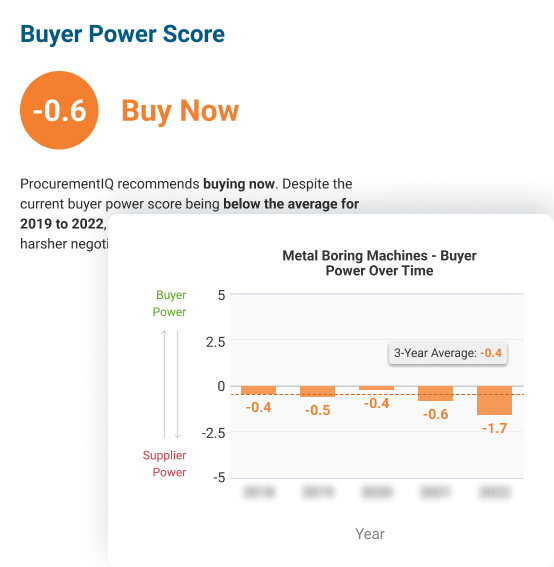
In 2026, buyer power amounts to -1.3 in the United States. Buyer power is most positively impacted by Recent Developments. It is most negatively impacted by Product Specialization. Subscribers can access details on eight other factors that impact buyer power. Learn more
United States
Buyer power forecasts: your glimpse into the future
Develop strategies for the upcoming year and identify unforeseen opportunities for buying now
- Actionable "Buy Now" and "Buy Later" insights
- Near-real-time updates to current and forecast Buyer Power Scores
- Methodology and weightings for Buyer Power Score Components
Supply Chain Risk
The average level of supply chain risk is assessed as High, which has a negative impact on buyer power. The level of supply chain risk is affected by industry volatility, barriers to entry, competition, import penetration, regulation and industry financial risk. Buyers in this market can mitigate procurement and supply chain management risks by monitoring risk levels for individual first and second tier suppliers:
1st
Tier Suppliers
- Semiconductor & Circuit Manufacturers
- Plastic and Resin Manufacturers
- Printing, Paper, Food, Textile & Other Machinery Manufacturers
- Wire & Cable Manufacturers
- Cardboard Box & Container Manufacturers
2nd
Tier Suppliers
- Aluminum Manufacturers
- Petrochemical Manufacturers
- Iron & Steel Manufacturers
- Copper Rolling, Drawing & Extruding Companies
- Paper Mills
Biggest Automated External Defibrillators Suppliers in the US by Revenue
The largest Automated External Defibrillators vendors by revenue in the US are Sarnova Inc., Stryker Corporation and Defibtech LLC. Subscribers can sort and filter by market share concentration, profit level and other factors. Learn more
| Supplier | Operational Size | Headquarters | Number of Employees | Market Share (%) | Market Share Performance (3yr trend) | Total Revenue ($ million) | Profit Level (%) | Risk Level |
|---|---|---|---|---|---|---|---|---|
| Asahi Kasei Corp | Global | Tokyo, JP | >10,001 | 10-15 | ||||
| Nihon Kohden Corporation | Global | Tokyo, JP | 1,001-10,000 | 10-15 | ||||
| Stryker Corporation | US | 15-20 | ||||||
| Koninklijke Philips Nv | Global | Amsterdam, NL | >10,001 | 5-10 | ||||
| Henry Schein Inc. | Global | MELVILLE | >10,000 | 5-10 | ||||
| Defibtech LLC | Global | Guilford, CT | 101-250 | 5-10 | ||||
| Cardiac Science Corporation | < 5 | |||||||
| Zoll Medical Corporation | < 5 | |||||||
| Sarnova Inc. | National | Dublin, OH | 1,001-10,000 | < 5 | ||||
Looking for a list of suppliers by country?
Subscribers can access vendor information on Canadian and European suppliers, too. We also offer custom research services to help with vendor sourcing anywhere in the world.
Profit Analysis
The average profit margin across vendors in the Automated External Defibrillators market is 14.1% and rising. Profit levels shift depending on suppliers' spend on wages, purchases and overhead. The highest cost component for vendors is Purchases. The cost trend for this component is falling, when considering movement between 2025 and 2026. To understand cost forecasts for 2027 and uncover the implications on profit, start your subscription. Learn more
Vendor & Supply Chain Analysis
Vendor risk is relatively low even as this market enters it late maturity stage. Entry into the market is not as strenuous as with other markets, however, larger vendors still hold a competitive advantage because of the different products and specializations they can offer clients.
Although market share concentration is moderate at the manufacturing level, the abundance of wholesalers and retailers provides buyers with a large selection of suppliers and keeps overall market share concentration at a stable level.
There is high risk within the supply chain for AEDs, and this stems primarily from the threat of price fluctuations from upstream vendors. The materials needed for AED production include plastic, aluminum, steel and copper, all of which exhibit notable price swings due to changes in the supply of and demand for these inputs.
As a net importer in the AED market, US buyers' procurement strategies may be influenced by factors such as cost considerations and international competition and will need to carefully evaluate pricing options and potentially seek out more cost-effective solutions. Being a net importer can restrict buyer power and reduce their ability to dictate terms and conditions in procurement transactions, and will have less control over pricing, quality, and availability of the goods or services they need.
Supplier Information
Asahi Kasei Corp
Asahi Kasei Corp is a public company operating globally in the manufacturing sector. The company's offerings include automated external defibrillators. Founded in 1931, the company is currently headquartered in Tokyo, Japan with an estimated 47895 employees. Subscribe to learn more
Nihon Kohden Corporation
Nihon Kohden Corporation is a public company operating globally in the manufacturing sector. The company's offerings include automated external defibrillators. Founded in 2013, the company is currently headquartered in Tokyo, Japan with an estimated 5500 employees. Subscribe to learn more
Stryker Corporation
Stryker Corporation is a private company operating in the manufacturing and real estate and rental and leasing sectors. The company's offerings include automated external defibrillators and medical equipment leasing. Founded in 2017, the company is currently headquartered in United States of America. Subscribe to learn more
Defibtech LLC
Defibtech LLC is a private company operating globally in the manufacturing sector. The company's offerings include automated external defibrillators. Founded in 1999, the company is currently headquartered in Guilford, Connecticut, United States of America with an estimated 175 employees. Subscribe to learn more
Henry Schein Inc.
Henry Schein, Inc. is a solutions company for healthcare professionals in the dental and medical markets. It organizes its business into two segments: the HealthCare Distribution segment, which offers consumable products, small equipment, laboratory products, large equipment, equipment repair services, branded... Subscribe to learn more
Koninklijke Philips Nv
Koninklijke Philips Nv is a public company operating globally in the manufacturing, real estate & rental & leasing and other services (except public administration) sectors. The company's offerings include capacitors, security lighting, ct scanners, mri scanners, automated external defibrillators. Founded... Subscribe to learn more
Cardiac Science Corporation
Cardiac Science Corporation is a private company operating in the manufacturing sector. The company's offerings include automated external defibrillators.. Subscribe to learn more
Sarnova Inc.
Sarnova Inc. is a private company operating nationally in the manufacturing sector. The company's offerings include automated external defibrillators. Founded in 2008, the company is currently headquartered in Dublin, Ohio, United States of America with an estimated 5500 employees. Subscribe to learn more
Zoll Medical Corporation
Zoll Medical Corporation is a private company operating in the manufacturing sector. The company's offerings include automated external defibrillators.. Subscribe to learn more
Accelerate the vendor selection process
Get a clear picture of the competition in a market and discover which vendors are best-suited for your sourcing needs. Our supplier profiles include hard-to-find financial ranges for private companies, cover public company data and feature an interactive competitor matrix.
Procurement Management KPIs for the Automated External Defibrillators Market
Managing vendor performance throughout the contract period is easier when tracking specific key performance indicators (KPIs). For example, buyers should monitor Cost of Goods Sold and Customer Satisfaction (CSAT). Buyers may experience better performance throughout their contracts if they establish service level agreements (SLAs) based on Accuracy and other factors.
| KPI | Level of Importance (1-5) | Measurements | Key Considerations |
|---|---|---|---|
| Cost of Goods Sold |
|
Total revenue Total labor cost Total material cost Total service cost Total delivery cost |
Knowing the cost of goods sold is used to determine market profitability, which is helpful to gauge the performance of a vendor's AEDs. Knowing the cost of goods sold is beneficial to the vendor for price determination of their AEDs, and helps buyers budget more cost-effectively. |
| Customer Satisfaction (CSAT) |
|
Number of positive customer responses Number of customer responses |
Overall customer satisfaction with a vendor is indicative of how cooperative and sympathetic they are to customer needs. Positive customer satisfaction shows that the vendor cares for the success of the buyers with their AEDs. |

Questions to Ask During Procurement Negotiations
How can I gain leverage during negotiations?
Quality Control
How many reports of AED malfunctions has your company received in the past three years? How do you handle the discovery of faulty AEDs?
How many of your products have been recalled in the past three years? What were the primary reasons for these recalls?
Product Lines
Are there any accessories and related products offered at no additional cost with the purchase of AEDs?
Do you offer any discounts for purchasing related goods or accessories at the time of the AED purchase? Do you offer any discounts on future purchases of related goods?
Accessibility
How large is your current inventory of AEDs? How low do you allow your inventory to get before it is replenished?
How do you forecast future demand for your products and how do you adjust your inventory to prepare for anticipated demand fluctuations?
The ultimate prep for procurement negotations
View all 26 negotiation questions for this category when you subscribe.
Automated External Defibrillators RFP Guidelines
What should my RFP include?
Organizational Overview
Buyers should describe their organization, including overview of core business operations, number of employees and how many locations they have.
Buyers should disclose how many licensed medical professionals they retain as employees.
Statement Of Need
Buyers should state the quantity and type of AED product needed.
Buyers should communicate delivery expectations, including preferred timeframe and locations.
Project Budget
Buyers should state the budget of the contract.
Buyers should dictate their preferred terms of payment.
The RFP process made easy
Find out how you can access RFP templates for 800+ procurement categories to start writing better, more consistent RFPs.
We display average pricing information, trends and market data.
Our Reports include:
- Opportunity assessment
- Market dynamics
- Recent developments
- Positive and warning trends
- Buyer power levers
- Price environment and market pricing
- Geographic wage rates
- Global market updates
- Total cost of ownership
- Cost structure benchmarks and analysis
- Supply chain and vendors
- Global supplier breakdown
- Market share concentration
- Regulation and business requirements
- Vendor management and KPIs
- Sourcing strategy guidance