Procurement Market Intelligence Report
Light-Emitting Diodes (LEDs)
Sourcing Guide & Market Intelligence
Smarter cost management starts with comprehensive market intelligence
 United States
 Global
Quick Navigation
Light-Emitting Diodes (LEDs) Global Overview
Definition
Summary
This report is intended to assist buyers of light-emitting diodes, also known as LEDs. This report includes LED chips and LED packages, which are LED chips inside of epoxy shells with wires. LEDs are often found in lamps, remote controls, lighting displays, digital clocks, vehicle lights, LED televisions, smartphones, flashlights and traffic signals. LEDs are used in a variety of downstream applications, including lighting, vehicle traffic management, automotive, electronic hardware and consumer electronics. Suppliers include manufacturers and distributors, while buyers are typically other manufacturers. LEDs offer many benefits, such as lower energy consumption, longer lifespans, greater durability and smaller size, that give them an edge over other light sources.
This Report Includes:
- LED Chips
- LED Packages
- White LED
- Miniature LED
Not in this Report:
- Incandescent Light
- Neon Light
- Halogen Light Bulb
- Compact Fluorescent Light (CFLs)
Take the ProcurementIQ products and data tour
Explore live samples of price trend forecasts, price driver projections, forward-looking cost structure data and more.
Global Light-Emitting Diodes (LEDs) Procurement Trends
Discover the top international trends affecting procurement in the global Light-Emitting Diodes (LEDs) market.
Warning Trends
Tariffs to negatively impact the electrical systems and lighting components sector
- The Trump Administration’s reciprocal tariffs, which apply general tariff rate increases to most leading US trade partners, are set to take effect on August 7, after the administration finalized the rates on August 1. These changes will significantly increase the tariff rate on leading electrical system and lighting component exporting countries, including China (54.0%), Mexico (25.0%), Vietnam (20.0%), and Taiwan (20.0%).
- The United States also raised tariffs on aluminum and steel, common inputs in electrical systems and components, to 50.0% in July, adding to rising costs in this sector.
- Lighting companies, such as Signify, commonly operate factories in Mexico and import components from China, indicating that higher tariffs will increase operating costs for suppliers with domestic manufacturing operations, in addition to increasing the cost of imported finished products.
- As many electrical systems and components, such as electrical transformers and switchgear systems, are already facing shortages and price increases, higher tariffs are likely to drive up prices further. For example, electrical transformer prices have already risen 70.0% to 100.0% since 2020, and higher tariffs are expected to push up prices further as Mexico, Canada, and China supply 80.0% of the transformers used in the United States.
- Likewise, the United States is reliant on imports for many major lighting components. For example, according to the Department of Energy, 94.0% of all LED imports to the United States were manufactured in China.
China bans exports of rare minerals to the United States
- On December 4, China announced a ban on all exports of gallium, germanium, graphite, and antimony to the United States, escalating existing trade restrictions on these materials.
- China is the leading global producer of each of these metals, producing 98.3%, 67.9%, 62.0%, and 48.2%, respectively, of the world’s gallium, germanium, graphite, and antimony supplies, respectively.
- The United States can still access these resources from other trade partners who make up most of the remaining global supply of the impacted commodities, such as Canada, Japan, and Brazil.
- However, the loss of supply from China, the leading producer of these materials, will increase prices and supply chain risk in a range of markets that rely on the affected metals, such as the semiconductor, batteries, and solar cell markets.
- China’s export ban on these materials is in retaliation to expanded US export bans on advanced semiconductor manufacturing equipment and technologies to China announced two days prior. This ongoing trade dispute adds further uncertainty to technology markets, which are often reliant on components and materials exported from China.
Russian invasion of Ukraine is putting additional strain on US chip supply
- Until recently, the United States sourced nearly all of its neon gas (an essential material in the laser imprinting process to produce semiconductors) from Ukrainian and Russian producers. Previous conflicts between the two nations, specifically related to the Crimea conflict in 2014, resulted in a nearly 600.0% increase in the price of neon.
- The Russian Ministry of Industry and Trade announced in early June that it would be limiting neon gas exports as part of its sanctions against countries it views as unfriendly. This move will add to lead times and prices for neon.
- Downstream semiconductor manufacturers keep stockpiles of neon gas that have allowed them to continue manufacturing chips, though it is unknown how long these stockpiles will last. Semiconductor manufacturers will likely pay higher prices for neon gas outside Ukraine as global supplies dwindle.
Global Light-Emitting Diodes (LEDs) Market - Suppliers by Region
| Country/Region | Number of Suppliers |
|---|---|
| #1 Oceania & Southeast Asia | 3,935 |
| #2 China | 2,880 |
| #3 Europe | 2,585 |
Explore supplier concentration across the globe
We've uncovered the 11 top regions for global procurement, based on feedback from our most strategic clients. Access vendor counts for each unique region when you subscribe.
Geography Drilldown - US
Average Cost of Light-Emitting Diodes (LEDs)
United States
2026 Market Pricing$0.01 to $XXX.XX
per unitAverage Price
Prices in the Light-Emitting Diodes (LEDs) market range from $0.01 to $XXX.XX, depending on Purchase volume, Use-case and Brightness. For example, lower prices are associated with More than 1,000 bulbs ($1.00 to $160 per bulb), whereas higher prices are associated with Less than 1,000 bulbs ($1.50 to $200 per bulb).
Need the scoop on international price trends?
Between our Europe and Canada collections, we provide price data for 350 markets so you can instantly compare prices across borders. Or, use our custom research services for intel on prices in any region across the globe.
Light-Emitting Diodes (LEDs) Category Price Trends
Pricing trends are indicated by the compound annual growth rate (CAGR) during a set period of time. For the Light-Emitting Diodes (LEDs) market, prices in the US have declined -0.2% from 2022 to 2025. Subscribers can access price trend forecasts, price driver projections and forward-looking cost structure data. Learn more
United States (2022-2025)


Wondering where prices are heading?
Price trend forecasts are available to subscribers, along with price driver projections and forward-looking cost structure data.
Cost Analysis - Total Cost of Ownership for Light-Emitting Diodes (LEDs)
Total cost of ownership is Low in the Light-Emitting Diodes (LEDs) market. The average cost of ownership differs depending on the contract but generally includes costs negotiated before the contract begins, costs billed during the contract period and unforeseen costs. For example, unforeseen costs in the form of Spoilage may raise the total cost of ownership unexpectedly.
Negotiated Before
Customization
Billed During
Maintenance
Unforeseen
Spoilage
Buyer Power in Procurement Negotiations
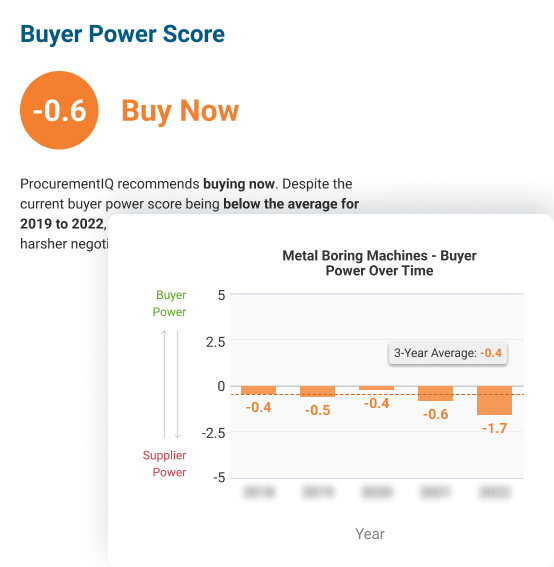
In 2026, buyer power amounts to -0.9 in the United States. Buyer power is most positively impacted by Recent Developments. It is most negatively impacted by Market Share Concentration. Subscribers can access details on eight other factors that impact buyer power. Learn more
United States
Buyer power forecasts: your glimpse into the future
Develop strategies for the upcoming year and identify unforeseen opportunities for buying now
- Actionable "Buy Now" and "Buy Later" insights
- Near-real-time updates to current and forecast Buyer Power Scores
- Methodology and weightings for Buyer Power Score Components
Supply Chain Risk
The average level of supply chain risk is assessed as Medium, which has a negative impact on buyer power. The level of supply chain risk is affected by industry volatility, barriers to entry, competition, import penetration, regulation and industry financial risk. Buyers in this market can mitigate procurement and supply chain management risks by monitoring risk levels for individual first and second tier suppliers:
1st
Tier Suppliers
- Plastic & Resin Manufacturers
- Inorganic Chemical Manufacturers
- Semiconductor & Circuit Manufacturers
- Wire & Spring Manufacturers
2nd
Tier Suppliers
- Petroleum Refiners
- Organic Chemical Manufacturers
- Semiconductor Machinery Manufacturers
- Iron & Steel Manufacturers
Biggest Light-Emitting Diodes (LEDs) Suppliers in the US by Revenue
The largest Light-Emitting Diodes (LEDs) vendors by revenue in the US are Nichia Corporation, Villa Lighting Supply Inc. and Home Depot, inc. Subscribers can sort and filter by market share concentration, profit level and other factors. Learn more
| Supplier | Operational Size | Headquarters | Number of Employees | Market Share (%) | Market Share Performance (3yr trend) | Total Revenue ($ million) | Profit Level (%) | Risk Level |
|---|---|---|---|---|---|---|---|---|
| Signify N.V. | Global | Eindhoven, NL | >10,001 | 5-10 | ||||
| Osram Licht Ag | Global | Munich, US | >10,001 | 5-10 | ||||
| Samsung Electronics Co Ltd | Global | Suwon-si, KR | >10,001 | < 5 | ||||
| LG Innotek Co. Ltd. | Global | Seoul, KR | >10,001 | < 5 | ||||
| Home Depot, inc. | International | ATLANTA | >10,000 | < 5 | ||||
| Lowes Companies Inc. | International | MOORESVILLE | >10,000 | < 5 | ||||
| W.W. Grainger, Inc. | Global | LAKE FOREST | >10,000 | < 5 | ||||
| Nichia Corporation | Global | Anan-Shi, JP | 1,001-10,000 | < 5 | ||||
| Ideal Industries, Inc. | Global | Sycamore, IL | 1,001-10,000 | < 5 | ||||
Looking for a list of suppliers by country?
Subscribers can access vendor information on Canadian and European suppliers, too. We also offer custom research services to help with vendor sourcing anywhere in the world.
Profit Analysis
The average profit margin across vendors in the Light-Emitting Diodes (LEDs) market is 7.0% and steady. Profit levels shift depending on suppliers' spend on wages, purchases and overhead. The highest cost component for vendors is Purchases. The cost trend for this component is stagnating, when considering movement between 2025 and 2026. To understand cost forecasts for 2027 and uncover the implications on profit, start your subscription. Learn more
Vendor & Supply Chain Analysis
Market share concentration for the LED market is low, with the top four suppliers accounting for less than 30.0% of total market revenue. The intensity of competition among market players is high, with suppliers competing on the basis of price and quality.
Vendor risk for LEDs remains moderate due to moderate regulatory change and moderate competition from substitutes.
Supply chain risk in the market is moderate with second tier suppliers sharing common threats including fluctuations in the availability and prices of major raw materials, such as metals and plastics.
The United States is a net importer of LEDs, meaning it imports more LEDs than it exports. This provides buyers in the United States with greater access to competitively priced products in the market.
Supplier Information
Osram Licht Ag
ams-OSRAM AG is a public company operating globally in the manufacturing sector. The company's offerings include light bulbs & tubes, street lighting fixtures, flood lights, security lighting, emergency lighting systems. Founded in 1906, the company is currently headquartered in Premstaetten, Austria with... Subscribe to learn more
Signify N.V.
Signify N.V. is a public company operating globally in the manufacturing sector. The company's offerings include light bulbs & tubes, commercial lighting fixtures, street lighting fixtures, flood lights, emergency lighting systems. Founded in 1997, the company is currently headquartered in Eindhoven, Netherlands... Subscribe to learn more
Home Depot, inc.
Home Depot, Inc. is a home improvement retailer offering building materials, home improvement products, lawn and garden products, décor products, and related services under national and proprietary brands. Its proprietary brands include, among others, HDX®, Husky®, Hampton Bay®, Home Decorators Collection®,... Subscribe to learn more
Ideal Industries, Inc.
Ideal Industries, Inc. is a private company operating globally in the manufacturing sector. The company's offerings include precision hand tools, light bulbs & tubes and commercial lighting fixtures. Founded in 1916, the company is currently headquartered in Sycamore, Illinois, United States of America with... Subscribe to learn more
LG Innotek Co. Ltd.
LG Innotek Co. Ltd. is a public company operating globally in the manufacturing sector. The company's offerings include leds. Founded in 2019, the company is currently headquartered in Seoul, South Korea with an estimated employee count of over 10,000. Subscribe to learn more
Lowes Companies Inc.
Lowe's Companies, Inc. is a home improvement retailer for maintenance, repair, remodeling, and decorating markets. Its product portfolio includes appliances, seasonal & outdoor living, lumber, lawn & garden, kitchen & bath, hardware, building materials, millwork, paint, rough plumbing, tools, electrical, Subscribe to learn more
Nichia Corporation
Nichia Corporation is a private company operating globally in the manufacturing sector. The company's offerings include leds. Founded in 1956, the company is currently headquartered in Anan-Shi, Tokushima, Japan with an estimated 9172 employees. Subscribe to learn more
Samsung Electronics Co Ltd
Samsung Electronics Co Ltd is a public company operating globally in the manufacturing sector. The company's offerings include battery energy storage systems, central processing units, smartphones, solid state drives, flash memory devices. Founded in 1969, the company is currently headquartered in Suwon-si,... Subscribe to learn more
Villa Lighting Supply Inc.
Villa Lighting Supply Inc. is a private company operating nationally in the manufacturing sector. The company's offerings include light bulbs & tubes. Founded in 1972, the company is currently headquartered in St. Louis, Missouri, United States of America with an estimated 175 employees. Subscribe to learn more
Accelerate the vendor selection process
Get a clear picture of the competition in a market and discover which vendors are best-suited for your sourcing needs. Our supplier profiles include hard-to-find financial ranges for private companies, cover public company data and feature an interactive competitor matrix.
Procurement Management KPIs for the Light-Emitting Diodes (LEDs) Market
Managing vendor performance throughout the contract period is easier when tracking specific key performance indicators (KPIs). For example, buyers should monitor Average Resolution Time and Delivery In Full On Time Rate. Buyers may experience better performance throughout their contracts if they establish service level agreements (SLAs) based on Warranty and other factors.
| KPI | Level of Importance (1-5) | Measurements | Key Considerations |
|---|---|---|---|
| Average Resolution Time |
|
Total resolution time Number of resolved tickets |
When ordering large purchases of LEDs, there is a possibility of failure of one or more LEDs. Average resolution time from the supplier should be used to determine a vendor's support responsiveness. Vendors should generally respond to issues quickly as the buying lead time for LEDs is generally less than a month. |
| Delivery In Full On Time Rate |
|
On time delivery rate Number of deliveries |
The on time delivery rate can be used to determine the likelihood of a delayed delivery in the future. Deliveries should always be on time unless in the case of an emergency on uncontrollable circumstance. |
Questions to Ask During Procurement Negotiations
How can I gain leverage during negotiations?
Competition
How do you win and retain business?
How long have you provided product to your longest tenured client?
Supply Chain Risk
How often do you evaluate your supply chain's prices to ensure they are still competitive?
Do you source materials with high exposure to market disruptions resulting from the coronavirus? How are you coping with these disruptions?
Globalization
Has import penetration adversely affected your operations? If so, how?
What incentive would I have in choosing your product over an imported product? What sets your product line apart from your foreign competitors?
The ultimate prep for procurement negotations
View all 28 negotiation questions for this category when you subscribe.
Light-Emitting Diodes (LEDs) RFP Guidelines
What should my RFP include?
Organizational Overview
Buyers should describe their manufacturing application for the LED (i.e. lamps, remote controls, TVs, smartphones, flashlights, etc.).
Buyers should provide a detailed description of their operational structure, including to whom vendors will report.
Statement Of Need
Buyers should describe the level of brightness they are seeking in their LEDs, measured in lumens.
Buyers should specify the features they are seeking in their LEDs, such as dimming capability, startup time and bulb color.
Project Budget
Buyers should explicitly state the amount for the award.
Given the volatility inherent with inputs like aluminum, buyers should list desired price ceilings or rate hikes that can arise from fluctuating input costs.
The RFP process made easy
Find out how you can access RFP templates for 800+ procurement categories to start writing better, more consistent RFPs.
We display average pricing information, trends and market data.
Our Reports include:
- Opportunity assessment
- Market dynamics
- Recent developments
- Positive and warning trends
- Buyer power levers
- Price environment and market pricing
- Geographic wage rates
- Global market updates
- Total cost of ownership
- Cost structure benchmarks and analysis
- Supply chain and vendors
- Global supplier breakdown
- Market share concentration
- Regulation and business requirements
- Vendor management and KPIs
- Sourcing strategy guidance