Procurement Market Intelligence Report
Computer Servers
Sourcing Guide & Market Intelligence
Smarter cost management starts with comprehensive market intelligence
 United States
 Europe
 Global
Quick Navigation
Computer Servers Global Overview
Definition
Summary
Computer servers are hardware systems designed to respond to and handle requests from other computers across a network or over the internet. Servers are designed to handle multiple tasks for multiple users and are essential for most midsize and large businesses. Key buyers include law firms, education institutions, and government agencies. Key suppliers include retailers and manufacturers.
This Report Includes:
- File Servers
- Print Servers
- Database Servers
- Application Servers
- Web Servers
Not in this Report:
- Desktop & Laptop Computer Software
- Cloud-Computing Services
Global Computer Servers Procurement Trends
Discover the top international trends affecting procurement in the global Computer Servers market.
Warning Trends
Tariffs to escalate prices for electronics and computing equipment
- The Trump administration’s reciprocating tariffs, which will increase the tariff on all products imported from nearly all US trade partners, are set to take effect on August 7 and are likely to drive price increases across a wide range of sectors.
- The United States is highly reliant on imported electronics, communication equipment, and computing devices, having imported more than $472 billion worth of electronics in 2024, or about half of the total domestic supply. Starting August 7, imports from key computer and electronics producers such as China (54,0%), Japan (15.0%), South Korea (15.0%), Thailand (19.0%), Vietnam (20.0%), and Taiwan (20.0%) will be subject to new tariff rates. Trade deals for many countries are still being negotiated, and these rates are subject to change.
- For this reason, the US electronics industry is highly exposed to price increases and supply chain disruptions when the tariffs take effect. For example, the cost of iPhones, which are predominantly manufactured in China, could rise by as much as 43.0% in response to tariffs, according to projections by Rosenblatt Securities.
- Overall, the Yale Budget Lab anticipates tariffs will increase the average cost of computers and electronics by 18.7% in the short term.
- The tariffs exempt semiconductors, limiting the cost increases for domestic electronics manufacturers, but the lack of domestic electronics assembly capacity means that this exemption will have a limited effect.
China bans exports of rare minerals to the United States
- On December 4, China announced a ban on all exports of gallium, germanium, graphite, and antimony to the United States, escalating existing trade restrictions on these materials.
- China is the leading global producer of each of these metals, producing 98.3%, 67.9%, 62.0%, and 48.2%, respectively, of the world’s gallium, germanium, graphite, and antimony supplies, respectively.
- The United States can still access these resources from other trade partners who make up most of the remaining global supply of the impacted commodities, such as Canada, Japan, and Brazil.
- However, the loss of supply from China, the leading producer of these materials, will increase prices and supply chain risk in a range of markets that rely on the affected metals, such as the semiconductor, batteries, and solar cell markets.
- China’s export ban on these materials is in retaliation to expanded US export bans on advanced semiconductor manufacturing equipment and technologies to China announced two days prior. This ongoing trade dispute adds further uncertainty to technology markets, which are often reliant on components and materials exported from China.
Neutral
GSA memo asks agencies to review consulting contracts
- The General Services Administration (GSA) recently issued a memorandum asking government agencies to review their consulting contracts with the ten highest-paid firms. The ten firms are Accenture PLC (Accenture Federal Services), Booz Allen Hamilton Inc., CGI Group Inc. (CGI Federal), Deloitte Touche Tohmatsu (Deloitte Consulting), General Dynamics Corporation (General Dynamics IT), Guidehouse Inc., Huntington Ingalls Industries Inc. (HII Mission Technologies), International Business Machines Corporation (IBM), Leidos Holdings, Inc., and Science Applications International Corporation, Inc. (SAIC).
- The memo states that agencies are strongly encouraged to cut non-essential consulting contracts, providing a list of those intended to be terminated by March 7, 2025. By April 19, 2025, agencies must submit their reviews of non-GSA consulting service contracts.
- According to the GSA, the ten consulting firms identified are set to receive $65.0 billion in fees in 2025. The Department of Defense (DoD) has stated its intention to terminate or descope contracts non-essential to the DoD’s purposes; some of the largest market players with high-value DoD contracts include Booz Allen Hamilton, Deloitte, and Accenture.
- According to the Government Accountability Office, in the fiscal year 2023, government agencies spent $478.0 billion on services, with the DoD accounting for $230.0 billion and non-defense agencies accounting for the rest. The DoD spent $21.3 billion on support, professional, and engineering and technical services, while non-defense agencies spent $21.4 billion on professional services, which includes consulting, training, and support services.
- The Department of Veterans Affairs (VA) initially cancelled 875 contracts (amounting to around $2.0 billion) but has currently paused efforts. However, contract terminations across most agencies are expected to continue.
Global Computer Servers Market - Suppliers by Region
| Country/Region | Number of Suppliers |
|---|---|
| #1 Oceania & Southeast Asia | 6,605 |
| #2 China | 4,840 |
| #3 Europe | 4,340 |
Explore supplier concentration across the globe
We've uncovered the 11 top regions for global procurement, based on feedback from our most strategic clients. Access vendor counts for each unique region when you subscribe.
2
Geography Drilldown - US & Europe
Average Cost of Computer Servers
United States
2026 Market Pricing$300.00 to $XXX,XXX.XX
per server
Average Price
Prices in the Computer Servers market range from $300.00 to $XXX,XXX.XX, depending on Type of Server, Business Size and Customizability. For example, lower prices are associated with Tower servers ($300 to $24,000 per server), whereas higher prices are associated with Rack servers ($700 to $110,000 per server).
Need the scoop on international price trends?
Between our Europe and Canada collections, we provide price data for 350 markets so you can instantly compare prices across borders. Or, use our custom research services for intel on prices in any region across the globe.
Computer Servers Category Price Trends
Pricing trends are indicated by the compound annual growth rate (CAGR) during a set period of time. For the Computer Servers market, prices in the US have grown 0.1% from 2022 to 2025. Meanwhile, the recent three-year CAGR for Europe is +0.8%.
United States (2022-2025)

Europe (2022-2025)
Compound Annual Growth Rate
Wondering where prices are heading?
Price trend forecasts are available to subscribers, along with price driver projections and forward-looking cost structure data.
Cost Analysis - Total Cost of Ownership for Computer Servers
Total cost of ownership is High in the Computer Servers market. The average cost of ownership differs depending on the contract but generally includes costs negotiated before the contract begins, costs billed during the contract period and unforeseen costs. For example, unforeseen costs in the form of Downtime may raise the total cost of ownership unexpectedly.
Negotiated Before
Installation
Billed During
Software
Storage
Maintenance
Unforeseen
Downtime
Buyer Power in Procurement Negotiations
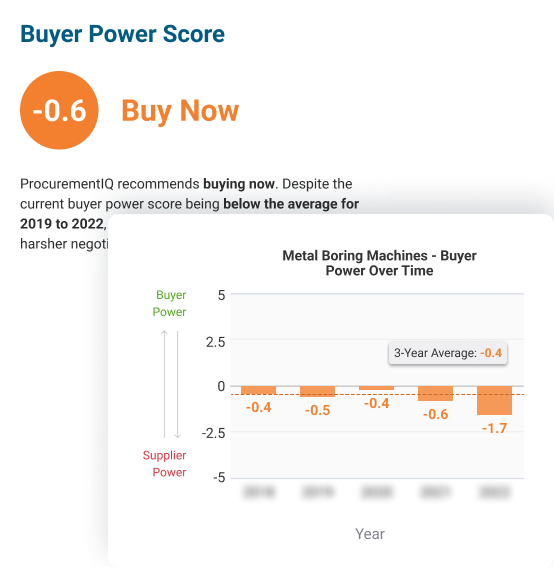
In 2026, buyer power amounts to -1.2 in the United States. Buyer power is most positively impacted by Recent Developments. It is most negatively impacted by Switching Costs. Subscribers can access details on eight other factors that impact buyer power. Learn more
United States

Buyer power forecasts: your glimpse into the future
Develop strategies for the upcoming year and identify unforeseen opportunities for buying now
- Actionable "Buy Now" and "Buy Later" insights
- Near-real-time updates to current and forecast Buyer Power Scores
- Methodology and weightings for Buyer Power Score Components
Supply Chain Risk
The average level of supply chain risk is assessed as High, which has a negative impact on buyer power. The level of supply chain risk is affected by industry volatility, barriers to entry, competition, import penetration, regulation and industry financial risk. Buyers in this market can mitigate procurement and supply chain management risks by monitoring risk levels for individual first and second tier suppliers:
1st
Tier Suppliers
- Software Publishers
- Semiconductor & Circuit Manufacturers
- Circuit Board & Electronic Component Manufacturers
2nd
Tier Suppliers
- Colleges & Universities
- Wire & Cable Manufacturers
- Copper, Nickel, Lead & Zinc Miners
Biggest Computer Servers Suppliers in the US by Revenue
The largest Computer Servers vendors by revenue in the US are Quanta Services, Inc., Fujitsu Limited and Hp inc. Subscribers can sort and filter by market share concentration, profit level and other factors. Learn more
| Supplier | Operational Size | Headquarters | Number of Employees | Market Share (%) | Market Share Performance (3yr trend) | Total Revenue ($ million) | Profit Level (%) | Risk Level |
|---|---|---|---|---|---|---|---|---|
| Lenovo Group Limited | Global | Hong Kong, CN | >10,001 | 10-15 | ||||
| Dell Technologies Inc. | Global | ROUND ROCK | >10,000 | 20-25 | ||||
| International Business Machines Corporation | Global | ARMONK | >10,000 | 25+ | ||||
| Hp inc. | Global | PALO ALTO | >10,000 | 25+ | ||||
| Fujitsu Limited | Global | Tokyo, JP | >10,001 | < 5 | ||||
| Toshiba Corporation | Global | Tokyo, JP | >10,001 | < 5 | ||||
| Oracle Corporation | Global | AUSTIN, CA | >10,000 | < 5 | ||||
| Cisco Systems, Inc. | Global | SAN JOSE, CA | >10,000 | < 5 | ||||
| Quanta Services, Inc. | Global | HOUSTON, TX | >10,000 | < 5 | ||||
Looking for a list of suppliers by country?
Subscribers can access vendor information on Canadian and European suppliers, too. We also offer custom research services to help with vendor sourcing anywhere in the world.
Profit Analysis
The average profit margin across vendors in the Computer Servers market is 9.8% and steady. Profit levels shift depending on suppliers' spend on wages, purchases and overhead. The highest cost component for vendors is Purchases. The cost trend for this component is stagnating, when considering movement between 2025 and 2026. To understand cost forecasts for 2027 and uncover the implications on profit, start your subscription. Learn more
Vendor & Supply Chain Analysis
Most companies are well-established, large corporations that sell a wide variety of products and services, thus ensuring stable revenue streams and low financial risk.
Supply chain risk in the computer server market is moderate, as computer servers are reliant on microprocessors, a market currently experiencing risks associated with high demand and disrupted supply chains.
Market share concentration is high as producing computer servers requires high capital investments and significant expertise in manufacturing and computer engineering; however, with new companies entering the market, market share concentration is trending down.
The United States is a net importer of computer servers, meaning it imports more computers than it exports. This provides buyers with greater access to competitively priced products; however, it increases the risk of supply disruptions.
Supplier Information
Lenovo Group Limited
Lenovo Group Limited is a public company operating globally in the manufacturing, real estate & rental & leasing and professional, scientific & technical services sectors. The company's offerings include smartphones, hard disk drives, laptop computers, desktop computers, computer servers. Founded in 1997,... Subscribe to learn more
Dell Technologies Inc.
Dell Technologies Inc. is a global provider of comprehensive information technology solutions, products, and services. It organizes its business into two segments: the Infrastructure Solutions Group, which offers multi-cloud and big data solutions to simplify, streamline, and automate cloud operations, and... Subscribe to learn more
Hp inc.
HP Inc. is a provider of diversified technology products. It offers personal computing, digital access devices, imaging and printing products, and related solutions. It sells and markets to individual consumers, small and medium-sized businesses, and large enterprises across healthcare, education, retail,... Subscribe to learn more
International Business Machines Corporation
International Business Machines Corporation (IBM) is a global integrated computer technology, hardware, software, and services provider. It organizes its business into four segments: Software segment, which provides software solutions for a hybrid cloud platform, data and artificial intelligence, automation,... Subscribe to learn more
Celestica Inc.
Celestica Inc. is a public company operating globally in the manufacturing sector. The company's offerings include bare printed circuit boards, flexible circuit boards and computer servers. Founded in 1994, the company is currently headquartered in Toronto, Canada with an estimated employee count of over Subscribe to learn more
Cisco Systems, Inc.
Cisco Systems, Inc. is a public company operating globally in the manufacturing, information and professional, scientific and technical services sectors. The company's offerings include rail signaling systems, office phones, print servers, computer servers, database management systems. Founded in 1984, the... Subscribe to learn more
Fujitsu Limited
Fujitsu Limited is a public company operating globally in the manufacturing sector. The company's offerings include computer servers, point-of-sale terminals, computer keyboards and biometric devices. Founded in 1935, the company is currently headquartered in Tokyo, Japan with an estimated employee count Subscribe to learn more
Oracle Corporation
Oracle Corporation is a global technology company that provides enterprise information technology (IT) products and services. It comprises three businesses: the Cloud and License business, which offers Oracle Applications, Oracle Database, and Oracle Middleware software offerings, among others, deployed using... Subscribe to learn more
Quanta Services, Inc.
Quanta Services, Inc. is a public company operating globally in the construction, manufacturing and other services (except public administration) sectors. The company's offerings include computer servers, generator maintenance & repair, transmission tower construction, electrical contracting services and Subscribe to learn more
Accelerate the vendor selection process
Get a clear picture of the competition in a market and discover which vendors are best-suited for your sourcing needs. Our supplier profiles include hard-to-find financial ranges for private companies, cover public company data and feature an interactive competitor matrix.
Procurement Management KPIs for the Computer Servers Market
Managing vendor performance throughout the contract period is easier when tracking specific key performance indicators (KPIs). For example, buyers should monitor Average Response Time and Customer Satisfaction (CSAT). Buyers may experience better performance throughout their contracts if they establish service level agreements (SLAs) based on Warranty and other factors.
| KPI | Level of Importance (1-5) | Measurements | Key Considerations |
|---|---|---|---|
| Average Response Time |
|
Average first response to query time Phone call pick-up rate |
The average response time measures how responsive a vendor's customer support team is. Buyers looking to bundle related services, such as maintenance, with their vendor should place higher importance on this metric. Buyers not seeking long-term contracts may still consider this metric should they have any difficulties with or questions about the product itself, even if the vendor will not be providing any additional services. |
| Customer Satisfaction (CSAT) |
|
Number of reviews Number of positive reviews |
Customer satisfaction represents the customer's overall satisfaction with the product, company, and service. Buyers should select suppliers that have strong reputations. If there are complaints or negative reviews, buyers should determine whether dissatisfaction is primarily driven by customer support or the product itself. |

Questions to Ask During Procurement Negotiations
How can I gain leverage during negotiations?
Product Lines
Can servers be traded in later for a more powerful server?
Can discounts be granted with the trade of an old server?
Supply Chain Risk
How diversified is your supplier base for equipment used in providing the service?
Do you source from multiple suppliers in different global regions?
Competition
How do you differentiate yourself in the market?
What acquisitions have you made, and how do they affect your product offerings?
The ultimate prep for procurement negotations
View all 30 negotiation questions for this category when you subscribe.
Computer Servers RFP Guidelines
What should my RFP include?
Organizational Overview
Buyers should outline the details of their organization, including their industry, number of employees, and business location(s).
Buyers should state the reasons for purchasing new computer servers or replacing their existing servers.
Statement Of Need
Buyers should provide a list of detailed product specifications, including the desired types of servers, processing speed, RAM, and storage capacity.
Buyers should detail the desired dimensions of the computer servers.
Project Budget
Buyers should specify their budget for the computer servers and related products and services, such as training, maintenance, and warranties.
Buyers should indicate when the payment will occur.
The RFP process made easy
Find out how you can access RFP templates for 800+ procurement categories to start writing better, more consistent RFPs.
We display average pricing information, trends and market data.
Our Reports include:
- Opportunity assessment
- Market dynamics
- Recent developments
- Positive and warning trends
- Buyer power levers
- Price environment and market pricing
- Geographic wage rates
- Global market updates
- Total cost of ownership
- Cost structure benchmarks and analysis
- Supply chain and vendors
- Global supplier breakdown
- Market share concentration
- Regulation and business requirements
- Vendor management and KPIs
- Sourcing strategy guidance