Procurement Market Intelligence Report
Transportation Management Systems
Sourcing Guide & Market Intelligence
Smarter cost management starts with comprehensive market intelligence
 United States
 Europe
 Global
Quick Navigation
Transportation Management Systems Global Overview
Definition
Summary
A transportation management system (TMS) has a broad range of functionality to assist with supply chain management, such as shipment tracking, carrier selection, route optimization, vehicle fleet management, regulatory compliance, documentation management, inbound freight management, and freight reconciliation. A TMS can be purchased as a traditional software solution that is installed on-premises or as a subscription with a software-as-a-service (SaaS) provider. Buyers include third-party logistics firms (3PLs), manufacturers, and retailers.
This Report Includes:
- Vehicle Fleet Management
- Freight Forwarding
- Supply Chain Management
Not in this Report:
- Labor-Based Scheduling Solutions
- Transporation Management Services
Global Transportation Management Systems Market - Suppliers by Region
| Country/Region | Number of Suppliers |
|---|---|
| #1 Europe | 340 |
| #2 United States | 260 |
| #3 China | 170 |
Explore supplier concentration across the globe
We've uncovered the 11 top regions for global procurement, based on feedback from our most strategic clients. Access vendor counts for each unique region when you subscribe.
2
Geography Drilldown - US & Europe
Average Cost of Transportation Management Systems
United States
2026 Market Pricing$425.00 to $X,XXX.XX
per month
Average Price
Prices in the Transportation Management Systems market range from $425.00 to $X,XXX.XX, depending on Functionality, Deployment Model and Buyer Freight Spend. For example, lower prices are associated with Basic shipment tracking ($0 to $325 per month), whereas higher prices are associated with Complete shipment cycle management ($325 to $4,300 per month), Route & load optimization ($135 to $4,300 per month), Centralized shipment planning and execution ($165 to $4,300 per month) and Business intelligence & analytics ($215 to $4,300 per month).
Need the scoop on international price trends?
Between our Europe and Canada collections, we provide price data for 350 markets so you can instantly compare prices across borders. Or, use our custom research services for intel on prices in any region across the globe.
Transportation Management Systems Category Price Trends
Pricing trends are indicated by the compound annual growth rate (CAGR) during a set period of time. For the Transportation Management Systems market, prices in the US have grown 3.7% from 2022 to 2025. Meanwhile, the recent three-year CAGR for Europe is +2.4%.
United States (2022-2025)

Europe (2022-2025)
Compound Annual Growth Rate
Wondering where prices are heading?
Price trend forecasts are available to subscribers, along with price driver projections and forward-looking cost structure data.
Cost Analysis - Total Cost of Ownership for Transportation Management Systems
Total cost of ownership is Medium in the Transportation Management Systems market. The average cost of ownership differs depending on the contract but generally includes costs negotiated before the contract begins, costs billed during the contract period and unforeseen costs.
Negotiated Before
Installation
Billed During
Training
Hardware
Support
Software
Buyer Power in Procurement Negotiations
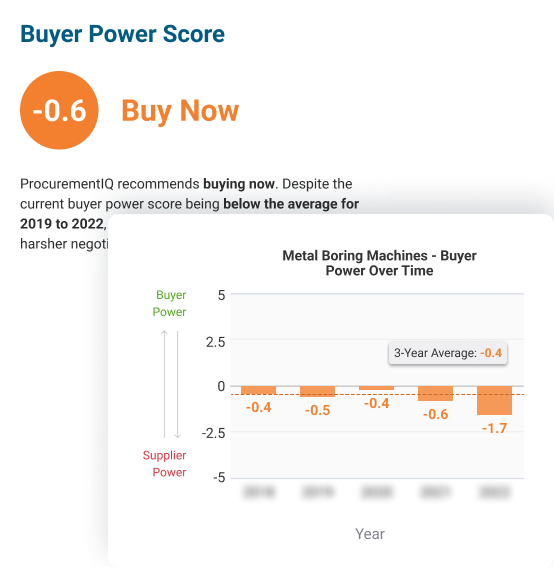
In 2026, buyer power amounts to -2.0 in the United States. Buyer power is most positively impacted by Recent Price Trend. It is most negatively impacted by Supply Chain Risk. Subscribers can access details on eight other factors that impact buyer power. Learn more
United States

Buyer power forecasts: your glimpse into the future
Develop strategies for the upcoming year and identify unforeseen opportunities for buying now
- Actionable "Buy Now" and "Buy Later" insights
- Near-real-time updates to current and forecast Buyer Power Scores
- Methodology and weightings for Buyer Power Score Components
Supply Chain Risk
The average level of supply chain risk is assessed as Low, which has a positive impact on buyer power. The level of supply chain risk is affected by industry volatility, barriers to entry, competition, import penetration, regulation and industry financial risk. Buyers in this market can mitigate procurement and supply chain management risks by monitoring risk levels for individual first and second tier suppliers:
1st
Tier Suppliers
- Computer Manufacturers
- Intellectual Property Licensing Firms
- Data Processing & Hosting Service Providers
2nd
Tier Suppliers
- Semiconductor & Circuit Manufacturers
- Law Firms
- IT Consulting Firms
Biggest Transportation Management Systems Suppliers in the US by Revenue
The largest Transportation Management Systems vendors by revenue in the US are Ramp Systems, Manhattan Associates Inc. and Microsoft Corporation. Subscribers can sort and filter by market share concentration, profit level and other factors. Learn more
| Supplier | Operational Size | Headquarters | Number of Employees | Market Share (%) | Market Share Performance (3yr trend) | Total Revenue ($ million) | Profit Level (%) | Risk Level |
|---|---|---|---|---|---|---|---|---|
| Microsoft Corporation | Global | Redmond | >10,000 | 10-15 | ||||
| Blue Yonder Group Inc. | US | 10-15 | ||||||
| Oracle Corporation | Global | AUSTIN, CA | >10,000 | 15-20 | ||||
| Sap Se | Global | WALLDORF | >10,000 | 15-20 | ||||
| Koch Industries Inc. | Global | Wichita, KS | >10,000 | 5-10 | ||||
| e2open, LLC | Global | Austin, TX | 1,001-10,000 | 5-10 | ||||
| 3m Company | Global | ST PAUL | >10,000 | < 5 | ||||
| Constellation Software Inc. | Global | Toronto, CA | >10,001 | < 5 | ||||
| Trimble Inc. | Global | WESTMINSTER, CA | >10,000 | < 5 | ||||
Looking for a list of suppliers by country?
Subscribers can access vendor information on Canadian and European suppliers, too. We also offer custom research services to help with vendor sourcing anywhere in the world.
Profit Analysis
The average profit margin across vendors in the Transportation Management Systems market is 17.2% and steady. Profit levels shift depending on suppliers' spend on wages, purchases and overhead. The highest cost component for vendors is Overhead. The cost trend for this component is rising, when considering movement between 2025 and 2026. To understand cost forecasts for 2027 and uncover the implications on profit, start your subscription. Learn more
Vendor & Supply Chain Analysis
Average vendor risk is low, meaning that there is little chance of a contracted vendor unexpectedly exiting the market.
Market share concentration in this market is high, reducing the selection of suppliers that buyers can choose from and resultantly curbing competition.
Vendors in this market face a low level of supply chain risk due to their limited reliance on physical goods to provide TMS solutions, minimizing the possibility of sudden price shifts.
The rate of regulatory change in this market is slow, and most regulations related to transportation management systems make mandatory record-keeping easier for organizations that choose to use these systems. As a result, buyers face few compliance costs when purchasing transportation management systems.
The United States is a net importer of computers, indicating that transportation management systems vendors have access to international supply chains for these inputs that can reduce risk and costs.
Supplier Information
Blue Yonder Group Inc.
Blue Yonder Group Inc. is a private company operating globally in the information sector. The company's offerings include order tracking software, inventory management software, retail planning software and transportation management systems. Founded in 1985, the company is currently headquartered in Scottsdale,... Subscribe to learn more
Microsoft Corporation
Microsoft Corporation is a technology company offering digital technology and artificial intelligence (AI) to businesses and individuals worldwide. It develops cloud-based solutions that deliver customers with software, services, platforms, and content and provides solution support and consulting services.... Subscribe to learn more
Oracle Corporation
Oracle Corporation is a global technology company that provides enterprise information technology (IT) products and services. It comprises three businesses: the Cloud and License business, which offers Oracle Applications, Oracle Database, and Oracle Middleware software offerings, among others, deployed using... Subscribe to learn more
Sap Se
Sap Se is a public company operating globally in the information, professional, scientific & technical services and educational services sectors. The company's offerings include warehouse management systems, travel management software, recruitment software, order tracking software, contract management software.... Subscribe to learn more
e2open, LLC
e2open, LLC is a private company operating globally in the information sector. The company's offerings include transportation management systems. Founded in 2000, the company is currently headquartered in Austin, Texas, United States of America with an estimated 5500 employees. Subscribe to learn more
Koch Industries Inc.
Koch Industries Inc. is a private company operating globally in the manufacturing, wholesale trade and information sectors. The company's offerings include warehouse management systems, corrugated boxes, drywall, resilient flooring, injection molding services. Founded in 1940, the company is currently headquartered... Subscribe to learn more
3m Company
3M Co. is a diversified technology company offering a range of products for safety and industrial, transportation, electronics, and consumer markets. It develops, manufactures, and markets, among others, industrial abrasives and finishing for metalworks, autobody repair solutions, industrial specialty products,... Subscribe to learn more
Constellation Software Inc.
Constellation Software Inc. is a public company operating globally in the information sector. The company's offerings include warehouse management systems and transportation management systems. Founded in 1995, the company is currently headquartered in Toronto, Canada with an estimated employee count of over... Subscribe to learn more
Epicor Software Corporation
Epicor Software Corporation is a private company operating globally in the information sector. The company's offerings include warehouse management systems, retail planning software, erp software, accounting software, digital transaction management software. Founded in 1972, the company is currently headquartered... Subscribe to learn more
Accelerate the vendor selection process
Get a clear picture of the competition in a market and discover which vendors are best-suited for your sourcing needs. Our supplier profiles include hard-to-find financial ranges for private companies, cover public company data and feature an interactive competitor matrix.
Procurement Management KPIs for the Transportation Management Systems Market
Managing vendor performance throughout the contract period is easier when tracking specific key performance indicators (KPIs). For example, buyers should monitor Customer Effort Score and IT Costs vs Revenue. Buyers may experience better performance throughout their contracts if they establish service level agreements (SLAs) based on Availibility and other factors.
| KPI | Level of Importance (1-5) | Measurements | Key Considerations |
|---|---|---|---|
| Customer Effort Score |
|
Customer effort score from surveyed employees Average training time per employee |
Due to the broad range of functionalities TMSs have, many employees within the buyer's organization will interact with the system, so buyers should track how easily employees are able to adapt to and make use of the TMS. A TMS with better effort scores will improve employee retention, lower training costs and improve efficiency. Buyers can determine customer effort score for internal use of the TMS by surveying employees that use the system. |
| IT Costs vs Revenue |
|
Change in IT costs relative to revenue after implementing a TMS Additional IT costs compared to the change in operating costs after implementing a TMS |
TMSs, especially ones deployed as an on-premises solution, will likely increase the buyer's IT costs as the systems will require maintenance, hardware upgrades and configuration. To ensure that these costs compare favorably to the efficiency benefits provided by the TMS, buyers should track how their IT costs change over time after implementing the system. |

Questions to Ask During Procurement Negotiations
How can I gain leverage during negotiations?
Service and Maintenance
What functionality does your software offer that is specific to my industry's shipping and receiving needs?
What functionality does the latest version of your software possess that previous versions and competitors' offerings do not have?
Legal Concerns
What are your licensing policies, rights granted and licensing metrics?
How will your licensing policies affect my future licensing purchases?
Reputation
How often, on average, do your systems malfunction within a single year?
What is the probability of needing outside assistance from you or a third party to fix a system within three years of operation?
The ultimate prep for procurement negotations
View all 28 negotiation questions for this category when you subscribe.
Transportation Management Systems RFP Guidelines
What should my RFP include?
Organizational Overview
Buyers should describe their organization and general operations and explain why they intend to purchase a TMS.
Buyers should provide the size of their organization and the number of expected TMS users; buyers should include the number of software licenses needed and the type of users.
Statement Of Need
Buyers should detail the features they require (e.g. GIS mapping, client registration, and management, trip booking and administration, fare management, scheduling and reporting capabilities) and whether the system must meet any compatibility requirements with existing networks.
Buyers should list any related goods and services they require, such as ERP software or warehouse management systems.
Project Budget
Buyers should specify the level of software access required for each user group.
Buyers should detail the contract term for annual ongoing costs (e.g. system support, upgrade, and maintenance charges and license fees).
The RFP process made easy
Find out how you can access RFP templates for 800+ procurement categories to start writing better, more consistent RFPs.
We display average pricing information, trends and market data.
Our Reports include:
- Opportunity assessment
- Market dynamics
- Recent developments
- Positive and warning trends
- Buyer power levers
- Price environment and market pricing
- Geographic wage rates
- Global market updates
- Total cost of ownership
- Cost structure benchmarks and analysis
- Supply chain and vendors
- Global supplier breakdown
- Market share concentration
- Regulation and business requirements
- Vendor management and KPIs
- Sourcing strategy guidance